Virginia
Virginia school ignored 'many behavioral problems,' violence of 6-year-old who shot teacher


A 6-year-old old student who shot his first grade teacher at Richneck Elementary School in Virginia last year exhibited signs of violence prior to the shooting and should not have been enrolled in school, according to a special grand jury report released Wednesday.
Behavioral Problems:
The child “exhibited many behavioral problems” prior to the Jan. 6, 2023 incident where he shot his teacher, Abby Zwerner, with a 9 mm semi-automatic pistol. The child was also reportedly disruptive during his kindergarten year to both fellow students and teacher Susan White, who was named in the grand jury report.
“Over the course of the kindergarten year the child exhibited many behavioral problems,” the special grand jury report stated. “He was disruptive in class and to his teacher, Susan White. The child would ‘get in other kids faces’ and when removed from class by a counselor would occasionally hit or punch the counselor.”
“In one incident, the child kicked and spit on the teacher assistant” the report said.
VIRGINIA SCHOOL ASSISTANT PRINCIPAL FACES CHARGES AFTER 6-YEAR-OLD SHOT TEACHER
Police look on as students return to Richneck Elementary on Jan. 30, 2023, in Newport News, Va. (Billy Schuerman/The Virginian-Pilot via AP, File)
The special grand jury detailed a disturbing incident when the student choked his kindergarten teacher in Sept. 2021.
“On September 27, 2021, Ms. White was concluding breakfast with the students when the child went to dump his breakfast in the hallway trash can and never returned. Ms. White went to search for him and found him with the security guard. When Ms. White tried to take his hand and bring him back to class the child hit Ms. White and yelled, “No! I don’t want to go back to class.” The child then aggressively twisted and pulled down on the security guard’s wrist. Due to his behavior, the security guard took the child to [assistant principal- Dr. Parker, while Ms. White returned to class,” the report said.
“At some point, Ms. White was sitting in a kids chair teaching the class. The child went up behind Ms. White placed his forearms in front of her neck and pulled down so hard she couldn’t breathe, choking her. The teacher’s assistant saw Ms. White being choked by the child and rescued her by pulling the child’s arms off and removing him from the class.”
Despite the child’s behavior, the student was returned to class and allowed to stay after school administration said there was “no administrator available to deal with the situation.”
Despite instances of physical aggression and profanity, the child was not given an Individualized Education Program (IEP) or considered for an alternative school placement, the report said.
Students and police gather outside of Richneck Elementary School after a shooting, Jan. 6, 2023 in Newport News, Va. (Billy Schuerman/The Virginian-Pilot via AP, File)
The grand jury also recommended further investigation into how the school handled two files on the student, both of which were missing when officials executed a search warrant.
LAWYERS FOR VIRGINIA TEACHER SHOT BY 6-YEAR-OLD FILE $40M SUIT DETAILING HOW SCHOOL ALLEGEDLY IGNORED WARNINGS
One file was returned by an administrator, but the file lacked the child’s disciplinary records, the report said. The other was never found.
The Virginia teacher who authorities say was shot by a 6-year-old student is known as a hard-working educator who’s devoted to her students and enthusiastic about the profession that runs in her family. (AP Photo/John C. Clark)
Security Issues:
The report details security issues that were allegedly “not addressed or were dismissed.”
Richneck Elementary School did not have a “consistent, full time” school resource officer (SRO) at the time of the shooting, the report said.
Along with not having a SRO, the school had a faulty front door system that was “broken for weeks” prior to the Jan. 6, 2023 shooting.
The school also did not practice school lockdown drills, despite it being federally mandated.
The report also said classrooms did not have a clear pathway for drills since the classrooms did not have “doors or permanent walls (the walls were made of partitions).”
Lack of Response:
The report provides further details about the events leading up to the shooting and during it.
Moments prior to the shooting, the boy “immediately started showing signs of aggression” at lunch and was escorted by Zwerner from the room.
Former Richneck Elementary School principal Briana Foster Newton in Aug. 2022, ahead of the new school year. (Twitter/@BriNewton_EDU)
Zwerner went to the school’s assistant principal, Ebony Parker, and shared that the student was in a violent mood.
“Dr. Parker did not respond. Dr. Parker did not look away from her computer screen. Dr. Parker did not acknowledge Ms. Zwerner’s presence,” the report said.
VIRGINIA TEACHER SHOT BY 6-YEAR-OLD STUDENT IN CLASSROOM SAYS SHE’LL ‘NEVER FORGET THE LOOK ON HIS FACE’
According to the report, Parker only took action after Zwerner had left her office. The assistant principal told her assistant to call the boy’s mother to pick him up early.
Abby Zwerner, a teacher who was shot at Richneck Elementary School in Newport News, Va., by her 6-year-old student last year, talks to reporter Peter Dujardin, on Wednesday in Virginia Beach, Va. (Stephen M. Katz /The Virginian-Pilot via AP)
According to the grand jury report, Parker was made aware on four occasions on the day of the shooting that the child might be a “potentially dangerous threat”:
At noon, a Richneck reading specialist told Parker that two students told her the child had a gun in his backpack, yet it was not checked.
VIRGINIA TEACHER EMAILS REVEAL ‘BEHAVIORAL DIFFICULTIES’ WITH 6-YEAR-OLD WHO SHOT HER: REPORT
At 12:30 p.m., the reading specialist told Parker that while she did search the backpack, she did not find a weapon,. Zwerner said that the child might have put something in his pockets.
A music teacher warned Parker that another first-grade teacher mentioned a gun.
And at 1:40 p.m., a guidance counselor told Parker the child might have a firearm or ammunition and, when he asked whether he could search him, Parker “refused and took no action.”
The report noted that the child was at recess – with 30 other children – with a firearm “tucked in his jacket.”
Residents of Newport News hold a candlelight vigil in honor of Richneck Elementary School first-grade teacher Abby Zwerner at the School Administration Building in Newport News, Va., Monday, Jan. 9, 2023. (AP Photo/John C. Clark)
At 1:58 p.m., Zwerner watched the child turn his body towards her and hold a firearm.
“He pointed directly at Ms. Zwerner, and, at less than six feet away, pulled the trigger and shot Ms. Zwerner,” the report said.
CLICK HERE TO GET THE FOX NEWS APP
The gun the boy fired at Zwerner jammed after he fired the first round, according to the report.
There were seven more bullets in the magazine — and 15 other 2nd grade students in the classroom.
“The firearm had jammed due to his lack of strength on the first shot, inhibiting him from shooting Ms. (Abigail) Zwerner or anyone else again,” the report said. “The firearm had a full magazine with seven additional bullets ready to fire if not for the jamming.”



RICHMOND, Va. — Jerrod Buford first picked up a paintbrush as a kid, never imagining that same creative outlet would carry him through his darkest days in prison.
Buford, who grew up in Williamsburg, was convicted and arrested as a young man and spent almost a decade behind bars. During that time, he struggled deeply.
“Turning to drugs and alcohol to kind of shadow over emotions,” Buford said. “Looking for acceptance, approval. Not just from my parents, but from friends, from, you name it. I mean, I tried to commit suicide, I don’t even know how many times,” Buford said.
WTVR
It was inside prison walls that art became more than a hobby.
“Throughout my prison time, I learned, the freedom that I desired, I’ve always had it. I got, I found it, in a box,” Buford said.
More than three years after his release, Buford continues to advocate for art as a tool for healing. He describes his work as a gift he feels called to share.
“I received a blessing from God that just allowed me to display what he’s given me,” Buford said.
For Buford, creating art is also a way of processing his past.
“That’s what art has done for me. It’s given me the ability to look at parts of my life, all parts of my life, and find the good and the negative, learn from the negative,” Buford said.
He shares his story and artwork with a wide audience through social media, including live sessions on TikTok, and holds art classes with new communities.
The Story Cafe
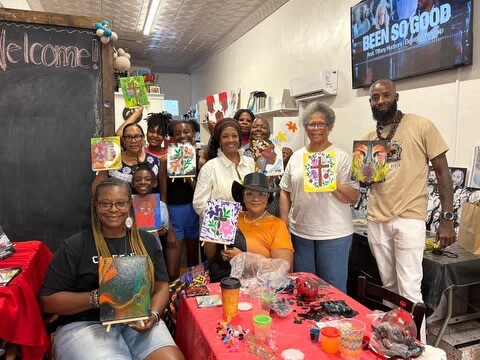
Buford said his mission is to help others find their own path toward healing — whatever form that takes.
“What I strive to do is guide this person to just create, man. Don’t care what people think about your creation, you just need to get it out,” Buford said. “Whether it’s with art, addressing your mental health, getting your life right — just do it.”
CBS 6 is committed to sharing community voices on this important topic. Email your thoughts to the CBS 6 Newsroom.
📲: CONNECT WITH US
Blue Sky | Facebook | Instagram | X | Threads | TikTok | YouTube

This story was initially reported by a journalist and has been converted to this platform with the assistance of AI. Our editorial team verifies all reporting on all platforms for fairness and accuracy. To learn more about how we use AI in our newsroom, click here.

Lovingston, VA (7News) — Good Morning Washington interviews Amanda Beckwith of Virginia Distillery Company- one of the contributing distilleries to the Virginia Spirits Board’s 250th Celebration Trio Pack, a special, exclusive release created to commemorate America’s upcoming 250th anniversary. This limited-edition package features a curated collection of a rum, a gin, and a whiskey, all crafted from scratch by distillers in Virginia to celebrate the rich history and current state of distilling within the Commonwealth.
Beckwith elaborates on VA Distillery Company’s role in the project, noting her focus on Virginia-grown grain to make the bottle of unique whiskey that is included in the Trio Pack. It is also worth noting that the Trio Packs themselves were bottled and produced right here at Virginia Distilling Company!
American single malts are the newest official category of American whiskey, distilled from one grain and from a single distillery. Virginia Distillery Co specializes in this new category of whiskey and crafted their contribution to the Trio Pack with this very specialty. Given the limited remaining availability of the Trio Pack, its historical value and collectible nature, the message it loud and clear encouraging viewers to grab a pack before they are all gone!
BE THE FIRST TO COMMENT
21+ Please drink responsibly, this content is sponsored by Virginia Distillery Company.


Powerball, Mega Millions jackpots: What to know in case you win
Here’s what to know in case you win the Powerball or Mega Millions jackpot.
Just the FAQs, USA TODAY
The Virginia Lottery offers multiple draw games for those aiming to win big.
Here’s a look at June 24, 2026, results for each game:
Powerball
Powerball drawings are held Monday, Wednesday and Saturday at 11 p.m.
13-14-16-21-38, Powerball: 14, Power Play: 2
Check Powerball payouts and previous drawings here.
Saturday, June 27, 2026
Pick 3
DAY drawing at 1:59 p.m. NIGHT drawing at 11 p.m. each day.
Night: 3-1-5, FB: 8
Day: 7-8-8, FB: 4
Check Pick 3 payouts and previous drawings here.
Pick 4
DAY drawing at 1:59 p.m. NIGHT drawing at 11 p.m. each day.
Night: 4-7-2-1, FB: 7
Day: 7-3-4-6, FB: 3
Check Pick 4 payouts and previous drawings here.
Pick 5
DAY drawing at 1:59 p.m. NIGHT drawing at 11 p.m. each day.
Night: 7-5-2-6-9, FB: 0
Day: 6-9-4-0-7, FB: 0
Check Pick 5 payouts and previous drawings here.
Cash Pop
Drawing times: Coffee Break 9 a.m.; Lunch Break 12 p.m.; Rush Hour 5 p.m.; Prime Time 9 p.m.; After Hours 11:59 p.m.
Coffee Break: 12
After Hours: 08
Prime Time: 13
Rush Hour: 01
Lunch Break: 14
Check Cash Pop payouts and previous drawings here.
Cash 5
Drawing every day at 11 p.m.
09-12-15-24-43
Check Cash 5 payouts and previous drawings here.
Bank a Million
Bank a Million draws are held every Wednesday and Saturday at 11 p.m.
18-21-25-33-36-39, Bonus: 13
Check Bank a Million payouts and previous drawings here.
Millionaire for Life
Drawing everyday at 11:15 p.m.
03-04-10-36-37, Bonus: 05
Check Millionaire for Life payouts and previous drawings here.
Feeling lucky? Explore the latest lottery news & results
This results page was generated automatically using information from TinBu and a template written and reviewed by a Center for Community Journalism (CCJ) editor. You can send feedback using this form.
-

 Los Angeles, Ca16 minutes ago
Woman ambushed, violently attacked by robber in downtown Long Beach
-

 Detroit, MI34 minutes ago
Where to watch Houston Astros vs Detroit Tigers: TV channel, start time, streaming for June 26
-
San Francisco, CA46 minutes ago
I own a Turkish Restaurant in San Francisco. Turkey’s World Cup match here has changed my business.
-

 Dallas, TX48 minutes ago
Australia advances at World Cup, how to buy Australia soccer tickets
-

 Miami, FL54 minutes ago
2 detained after police pursuit ends with bailout, neighborhood search in NW Miami-Dade – WSVN 7News | Miami News, Weather, Sports | Fort Lauderdale
-

 Boston, MA1 hour ago
Delta flight returns to Logan after smoke scare in cockpit – Boston News, Weather, Sports | WHDH 7News
-

 Denver, CO1 hour ago
Pat Surtain II Gets More Bad News Amid Broncos’ Uncertainty
-

 Seattle, WA1 hour ago
The World Cup 2026 Pride Match between Egypt and Iran that Seattle hopes can ‘unite football community’

