Politics
Israel's religious right has a clear plan for Gaza: 'We are occupying, deporting and settling'

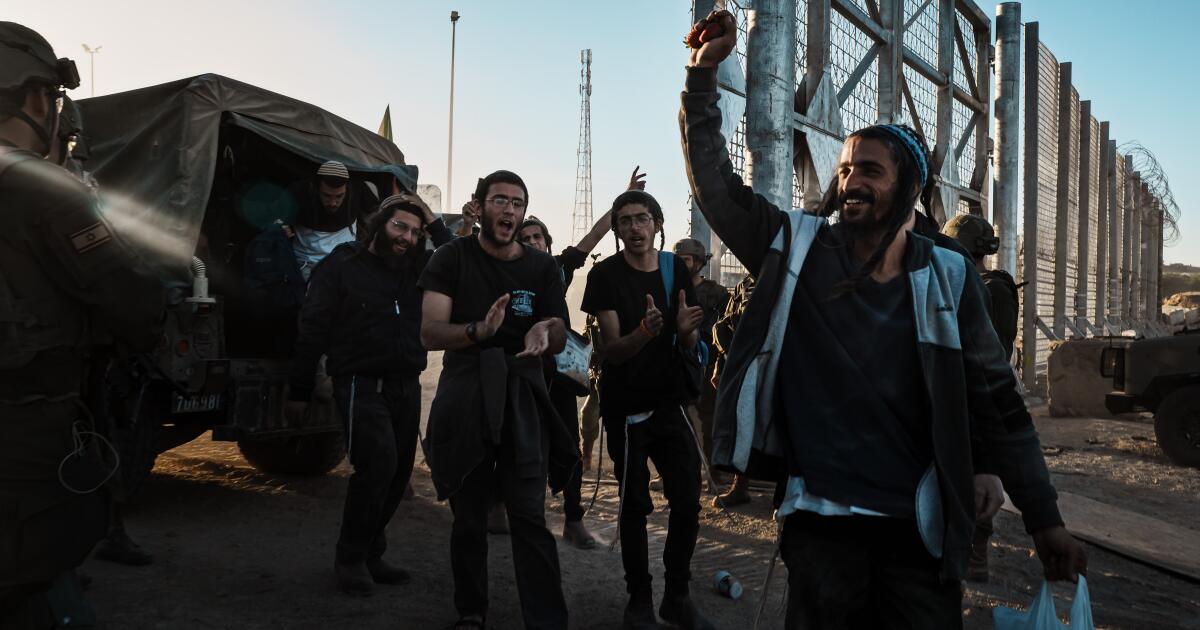
Carrying planks of plywood, a group of Israeli settlers pushed past soldiers guarding the barrier surrounding the Gaza Strip and quickly got to work. Within minutes, the young men had erected two small buildings — outposts, they said, of a future Jewish settlement in the war-torn Palestinian enclave.
Their movement had hungered for this moment for years, but now, after Oct. 7, they felt it was just a matter of time before Jews would be living in Gaza again. “It is ours,” said David Remer, 18. “[God] said it is ours.”
1
2
3
1. Protesters march to a border checkpoint in Kerem Shalom, Israel, hoping to block aid shipments into war-torn Gaza. 2. Israeli troops stand by at Erez Crossing as activists try to enter the military buffer zone into Gaza. 3. Israeli troops remove a protester from a sit-in intended to block shipments of aid into the Gaza Strip.
Religious Zionists, who believe the Jewish people have divine authority to rule from the Jordan River to the Mediterranean Sea, make up only around 14% of Israel’s population. But in recent years they have greatly expanded their influence in the military, the government and society at large, and their often extremist ideology is helping shape Israel’s war against Hamas.
Although they are not politically homogeneous, most religious Zionists embrace far-right views. They loudly oppose a cease-fire deal to bring home Israeli hostages, and have repeatedly blocked humanitarian assistance from entering Gaza by standing in front of aid trucks.
They see the deadly Oct. 7 Hamas-led attack on Israel as proof of their longtime assertion that peace cannot be made with the Palestinians, and view Gaza as a territory that they have a religious obligation to conquer. Increasingly, they have called for the expulsion of the 2.3 million Palestinians living there.
Jewish settler activists hastily erect outposts inside the Israeli military’s buffer zone for the Gaza Strip at the Erez crossing.
First, they dream of reestablishing Gush Katif, a bloc of Jewish settlements that existed in Gaza until Israel withdrew from the enclave in 2005.
It’s a goal embraced by some of the top leaders in Israel’s far-right government, many of whom appeared at a recent Jerusalem rally pushing for Gaza’s resettlement. While videos played showing Israel’s brutal military assault on the enclave and organizers shared brochures promising new houses with views of the Mediterranean Sea, National Security Minister Itamar Ben-Gvir sang religious songs alongside participants and told them: “Now is the time to return home.”
On the battlefield, some religious soldiers have recorded themselves dancing with Torah scrolls and waving the orange flags of Gush Katif. Other combatants travel with mezuzahs, small boxes containing biblical Scriptures meant to be hung outside Jewish residences, to affix to Palestinian homes.
Reuven Gal, former chief psychologist for the military and a researcher at the Israel Institute of Technology, says that for many soldiers, the Gaza conflict that has killed more than 30,000 Palestinians is “not just a military operation.”
“For them,” he said, “it’s a holy war.”
Top, Settler Avraham Sheinman, overlooking Nablus in the West Bank from Mt. Gerizim, points out passages in his Torah that he says show Jews have a religious obligation to conquer Palestinian territories. Bottom, Yishai Sheinman, left, and father Avraham Sheinman uncover the Torah in a synagogue in Yitzhar, West Bank. Yishai, 27, belongs to a violent extremist group devoted to expanding Israeli control of the region.
Yair Margolis, an army reservist who was called up from his yeshiva studies last year to fight in Gaza, said during a recent break from battle that the war had a clear spiritual dimension.
“Going back to that land is returning home,” he said. “This is where we are from, and this is what we are fighting for.”
It’s a vision starkly at odds with Israel’s mainstream, even as the country’s political center has shifted discernibly to the right in recent years. A January poll by Israel’s Channel 12 broadcaster found that 51% of Israelis oppose building Jewish settlements in Gaza, compared with 38% who support doing so.
1
2
1. Israel’s national security chief and leader of the far-right Jewish Power Party, Itamar Ben-Gvir, center, called at a recent convention for rebuilding Jewish settlements in Gaza and expanding those in the occupied West Bank. 2. The crowd celebrates at the Jerusalem convention, organized by far-right activists seeking expansion onto more Palestinian land.
Prime Minister Benjamin Netanyahu, a right-wing populist, has called settling Gaza “unrealistic.” But in 2022, as his ongoing corruption trials left him isolated, Netanyahu made a deal with several religious Zionist parties to form a coalition government, and his political future is now closely tied to theirs.
Beyond a pledge to maintain indefinite military control over Gaza and eventually turn over administrative duties to Palestinians, Netanyahu’s postwar strategy remains murky, leaving a vacuum, political analysts say, that the religious right is eager to fill.
Israeli forces arrive at the Erez border crossing next to the northern Gaza Strip.
In a recent video from Gaza circulated on social media, an Israeli soldier dressed in camouflage stands smiling with a machine gun in front of a bombed-out building. He directly addresses Netanyahu, who is widely known by his nickname “Bibi.”
“We are occupying, deporting and settling,” the soldier says. “Do you hear that, Bibi?”
::
During the war in 1967, Israel captured a wide swath of Palestinian land that included the West Bank, East Jerusalem and the Gaza Strip.
Almost immediately, Jewish settlers began establishing communities in each of them, displacing Palestinians who lived there.
Tuvia Levy, far right, and Marom Harel, center, look over Palestinian towns from a security outpost in Yitzhar, West Bank. Both men live in West Bank settlements and were called up for reserve duty after Oct. 7.
While the settler movement isn’t composed just of religious people, and over the years it has received backing from both right- and left-wing Israeli governments, it is ideologically driven by practitioners of Orthodox Judaism who believe God gave what they call the Land of Israel exclusively to the Jews.
Unlike the ultra-Orthodox, some of whom oppose the Zionist project and decline to serve in the military, religious Zionists embrace the teachings of rabbis who say believers have a spiritual imperative to expand Israel’s borders.
By 2005, around 8,000 mostly religious Zionists were living in Gaza, often in neighborhoods that resembled Southern California subdivisions, with their orderly rows of red-tile-roofed homes. The settlements were heavily guarded by the military, and residents frequently clashed with their Palestinian neighbors.
Amid growing concerns about high casualties among the troops tasked with protecting the settlements, Prime Minister Ariel Sharon ordered a complete Israeli withdrawal from the enclave. Sharon, who was a supporter of settlers in the West Bank, now instructed soldiers to forcibly remove them from Gaza.
The “disengagement” from Gaza, with its scenes of screaming settlers being pulled from their homes and synagogues, was transformative for religious Zionists. Many vowed to gain more influence in the traditionally secular institutions they felt had betrayed them.
“For them it was a traumatic event,” said Yagil Levy, a professor of political sociology at the Open University of Israel. “They want to erase this trauma by any means.”
Palestinians take in the rubble left by an Israeli airstrike on residential buildings and a mosque in Rafah, Gaza Strip.
(Fatima Shbair / Associated Press)
That meant building a political movement that has sought “to push the government as far right as it can go” and “completely demolish any talk of a Palestinian state,” said political scientist Dahlia Scheindlin. Over time, she said, ideas that once seemed extreme — like expanding settlements in the West Bank — became normalized.
Helping their cause were the country’s changing demographics: Religious Zionists, like the ultra-Orthodox, were having children at a much higher rate than their secular peers.
At the same time, they were making new inroads in the army.
The military academy that has become the West Point for the religious right is built atop a wind-swept hill in the West Bank settlement of Eli. Here, young men wearing yarmulkes spend their days studying both the Torah and military strategy.
For many years, religious Zionist families were hesitant for their sons to fulfill Israel’s mandatory three-year army service, worried that exposure to secular peers would erode their faith. This school, Bnei David, promised to minimize that risk, offering teenage boys a chance to fortify their religious beliefs before entering the military. Its website boasts of starting a “quiet revolution in the Israel Defense Forces.”
Students are taught that God “wants a people of Israel, and there is no state of Israel if there isn’t a strong army,” said Rabbi Eli Sadan, the school’s founder. They’re also taught by instructors who oppose the presence of women in the military and who have described gay people as “sick and perverted.”
Speaking from behind a large desk strewn with rabbinical texts, Sadan said he supports a scorched-earth military strategy in Gaza, “so Israel’s enemies will see the ruins and think: ‘I don’t want to mess with the Jews.’”
He is against the rebuilding of Palestinian society in Gaza, where at least half of all buildings have been damaged or destroyed during Israel’s fierce bombing campaign. “We must eliminate the possibility of Gazans returning,” he said, arguing that displaced civilians should be forced to live in tents for many years until they decide “to emigrate willingly.”
Top, Rabbi Eli Sadan, the founder of the Bnei David military academy, said he supports a scorched-earth strategy in Gaza. Bottom, Students attend a class in a room at Bnei David that honors alumni who died serving in the Israeli military. The school has lost 18 former students in the Gaza war.
Sadan said his school, which recently hosted events with both Netanyahu and Israel’s defense minister, has produced 3,000 soldiers, more than 50% of whom have risen to the rank of officer or higher. Since the conflict broke out, 18 alumni have died in Gaza.
The rise of religious military academies like this one has dramatically changed the makeup of the army, said Levy, the sociologist. Religious Zionists made up about 3% of officer school graduates in 1990, Levy’s research shows; in 2018, they accounted for over a third.
Levy, who has written about what he calls the “theocratization of the Israeli military,” said the trend has caused conflicts, with some religious soldiers refusing to serve alongside women.
A student does push-ups at the religious and military academy for religious Zionists.
A pressing question, he said, is whether religious soldiers would comply with orders to forcibly remove Jewish residents from a settlement — a scenario that could play out under the creation of a Palestinian state.
Sadan said he teaches his students to always heed commands from military superiors. But during the 2005 disengagement from Gaza, other rabbis called on soldiers to refuse orders, and some did.
“What we see is growing resistance in the ranks,” Levy said. “They’re trying to challenge the formal codes of the military.”
::
Those hoping to establish Jewish settlements in Gaza say they will model their strategy on the West Bank, where today 500,000 settlers live among 3 million Palestinians.
Since Oct. 7, tensions here have been simmering as the line between settlers and soldiers has become increasingly blurred.
Reservist Yosef Shalom Sheinman, 30, was called up after Oct. 7 to help protect Jewish settlements in the West Bank, where he lives.
After the Hamas attack in southern Israel killed around 1,200 people, hundreds of thousands of Israeli reservists were called up for duty. Many reservists in the West Bank were instructed to don uniforms and guard their own communities.
Among them were Yosef Shalom Sheinman, 30, who is from Har Bracha, a mountain settlement overlooking the Palestinian city of Nablus.
Sheinman’s parents helped found Har Bracha in 1987 amid protests from Jewish leftists and the Palestinians who once grazed sheep here. His younger brother, 27-year-old Yishai, belongs to a famously violent extremist group known as the Hilltop Youth, which is devoted to expanding Israeli control of the region. “These are kids who would eat Arabs for breakfast,” their father says proudly.
For decades, Israeli soldiers have been deployed throughout the West Bank to protect existing settlements, which most of the world considers illegal under international law. But the soldiers are also often instructed to stop the building of illegal settlement outposts. In the past, they sometimes clashed with Yishai Sheinman, tearing down new outposts he and his friends had erected.
Like many religious Zionists, Yishai Sheinman, his wife, Rashid, and their children live in a settlement on Palestinian territory despite the disapproval of Washington and international law.
Now many of the soldiers in the region are his friends — or, in the case of his older brother, his family.
The reservists are not curtailing settlement expansion, the older brother said. Instead, they’re focused on patrolling nearby Palestinian villages — and making sure they aren’t growing. His unit recently cut a new road through a stretch of hillside between a Palestinian hamlet and Har Bracha, in effect claiming the area for the settlement.
“This is our land,” he said. “And God is with us.”
On a recent afternoon, Sheinman stood with his father, Avraham, taking in views sweeping from the peaks of Jordan to the skyscrapers of Tel Aviv. Avraham Sheinman clutched a well-worn Torah, which he consulted frequently to highlight passages that he says show Jews have a religious obligation to be here. “We have a commandment to conquer it,” he said.
He spoke of a war with Palestinians, but also of “an inner war” within Israel.
“Who are we? What direction are we going?” he asked. “Are we going in the direction of our destiny as a chosen people in the Land of Israel — as a Jewish state according to Jewish law? Or are we a secular leftist copy of Europe or America?”
Israeli troops try to to stop one of many far-right activists from entering the Erez Crossing military buffer zone into Gaza.
Many on the other side of the political divide view that question with the same urgency.
In an interview with Sky News this month, writer and historian Yuval Noah Harari said the biggest threat to Israel is not Hamas, Hezbollah or Iran, but Jewish extremism: “There is really a battle for the soul of the Israeli nation between patriotism on the one side and ideals of Jewish supremacy on the other.”
It is too early to say exactly how the Hamas attack and the Gaza war will shape that debate. But early indications suggest they have awakened new support for the right.
Protests near the Egyptian border to halt aid delivery into Gaza were first organized by religious Zionists, but now draw secular participants. And while much of the international community holds out hope that the West Bank, East Jerusalem and Gaza will one day be recognized as a Palestinian country, faith among Israelis in a two-state solution has dimmed.
A Tel Aviv University poll found that support for peace negotiations among Israeli Jews had fallen from 48% just before the Hamas attacks to 25% a few weeks after.
Supporters of Jewish settlements talk with Israeli troops in an effort to enter war-ravaged Gaza.
Leaders of the religious right, meanwhile, are using the war as an opportunity to push through extreme policies.
Ben-Gvir, the national security chief, leads the Jewish Power party and has helped arm thousands of Israeli civilians by relaxing restrictions on gun ownership. Finance Minister Bezalel Smotrich, head of the Religious Zionist Party, recently announced plans to expand settlements in the West Bank by more than 3,000 homes. Both Smotrich and Ben-Gvir, who has been convicted of inciting racism and supporting terrorism, live in the West Bank.
Life for Palestinians there has gotten markedly worse since Oct. 7, with more than 600 settler attacks against Palestinians recorded since the war broke out, according to the United Nations, and more than 1,200 Palestinians displaced from their homes.
Palestinian activist Issa Amro lives in the historic center of Hebron, the largest city in the West Bank, in the midst of a heavily guarded Jewish settlement.
On the day of the Hamas attack, he was returning from work when several neighbors surprised him in an olive grove and began assaulting him. Some, he said, wore army uniforms probably left over from their military service.
Palestinian Issa Amro says he has lived in fear since he was assaulted by settlers, then detained and beaten at a military base. He’s surrounded in Hebron, West Bank, by a heavily guarded settlement.
Amro was then taken to a military base, where he says he was detained for 10 hours and beaten.
He said he lives in fear. Every day he passes former Palestinian businesses shuttered by settlers, as well as a sign that says: “We’re occupying Gaza now.”
“Every meter I walk, I think I may be shot,” he said.
Amro said he doesn’t blame the settlers so much as the political leaders who have allowed the settlements to flourish. He pointed to Netanyahu, who allied with Ben-Gvir and Smotrich, and to Donald Trump, who as president abandoned Washington’s long-held position that West Bank settlements violate international law. “Netanyahu made them mainstream,” Amro said. “The Trump administration made them mainstream.”
An Israeli soldier orders Palestinian children in the West Bank city of Hebron to go back inside, barring them from playing on the street.
President Biden has since reversed the U.S. stance on West Bank settlements — and recently imposed sanctions on four Israeli settlers for carrying out violence against Palestinians. And Secretary of State Antony J. Blinken says Washington opposes the reoccupation of the Gaza Strip by Israel and any reduction of the Palestinian territory’s size.
Joel Carmel, a former Israeli soldier who is now a peace activist, said the future of Jewish settlements in Gaza may depend on who wins the U.S. election in November.
“Probably the only thing holding back the resettlement of Gaza is the Biden administration,” he said. “And who knows how long that’s going to last.”
Many Palestinians in the West Bank think it’s only matter of time before Israeli settlers move permanently into Gaza.
Areej Al Jaabari, who lives in Hebron, West Bank, points toward the settlement where Israel’s national security minister lives.
Areej Al Jaabari, a mother in Hebron, has watched as settlements have crept ever closer to her family home. Ben-Gvir lives in a sprawling suburban community she can see from her living room window.
“They’re gradually accomplishing their goals,” she said of the settlers. “Eventually they will control everything in Gaza too.”
Linthicum reported from Jerusalem and from Yitzhar, Har Bracha and Hebron in the West Bank. Times staff photojournalist Marcus Yam contributed to this report from Erez Crossing, Israel.

Politics
Biden judge rejects Trump’s sanctuary cities lawsuit, says even a win wouldn’t solve DOJ’s problem

Authorities investigate ICE ramming incident in New Jersey
Criminal defense attorney Josh Ritter and former NYPD Lt. Darrin Porcher react to the New Jersey incident where an illegal alien allegedly rammed an ICE agent. They emphasize the staggering 3300% increase in vehicle attacks against law enforcement officers.
NEWYou can now listen to Fox News articles!
A federal judge has tossed the Trump administration’s lawsuit against four New Jersey sanctuary cities, ruling the Justice Department targeted local policies that largely mirror a statewide immigration directive — meaning a court victory wouldn’t eliminate restrictions on ICE cooperation.
U.S. District Judge Evelyn Padin of the District of New Jersey, who was appointed by President Joe Biden, on Wednesday dismissed the Department of Justice’s lawsuit against Newark, Hoboken, Jersey City and Paterson, ruling the federal government lacked standing because striking down the cities’ policies would not remedy its alleged injuries.
“The Federal Government’s case has a fundamental flaw — it treats the Challenged Policies as though they operate in isolation. They do not,” Padin wrote. “New Jersey’s Immigrant Trust Directive is a statewide directive that, like the Challenged Policies, limits voluntary cooperation with federal civil immigration enforcement beyond what the law requires.”
The lawsuit was part of President Donald Trump’s renewed immigration crackdown following his return to office. Since declaring a national emergency at the southern border on Jan. 20, 2025, the administration has aggressively targeted so-called sanctuary jurisdictions, arguing that local policies limiting cooperation with ICE obstruct federal immigration enforcement and violate the Constitution.
DHS TORCHES NEW JERSEY’S PROFANE ‘F—ICE ACT’ AS ASSAULTS ON AGENTS SKYROCKET 1,300%
Immigration and Customs Enforcement (ICE) agents stand outside Delaney Hall detention center in Newark, New Jersey. 5/28/26. (Rashid Umar Abbasi for Fox News Digital.)
The Justice Department filed the lawsuit in May 2025, arguing the four cities’ sanctuary policies violate the Constitution’s Supremacy Clause by interfering with federal immigration enforcement, including limiting voluntary cooperation with ICE, restricting information sharing, declining to honor certain immigration detainers and barring participation in civil immigration enforcement beyond what federal law requires.
Newark, Hoboken and Jersey City each adopted executive orders declaring themselves “fair and welcoming” or “sanctuary” cities, while Paterson implemented police procedures designed to comply with New Jersey’s immigrant protections. The cities have argued the policies preserve community trust and allow local police to focus on state and local crime rather than federal civil immigration enforcement.
But Padin did not address the question of whether the sanctuary policies are constitutional. Instead, she ruled the federal government lacked standing because New Jersey’s Immigrant Trust Directive independently imposes many of the same restrictions on law enforcement agencies across the state.
GOP CANDIDATE RIPS BLUE STATE DIRECTIVE MEDDLING IN POLICE FORCE’S COOPERATION WITH ICE: ‘HANDCUFFED’
New Jersey Gov. Mikie Sherrill said ICE is denying her access to Newark’s Delaney Hall detention center. (Rashid Umar Abbasi for Fox News Digital; Daniel Heuer/Bloomberg via Getty Images)
The directive, first issued under former Gov. Phil Murphy in 2018 and codified into state law by Gov. Mikie Sherrill earlier this year, limits when state and local police can cooperate with federal immigration authorities on civil immigration enforcement.
Because the statewide directive wasn’t challenged in this case, Padin concluded that even if she struck down the cities’ policies, many of the same restrictions would remain in place.
“Even if the Court enjoined the Challenged Policies,” she wrote, “its injuries would persist.”
NEW JERSEY’S BAN ON PRIVATELY OPERATED ICE DETENTION CENTERS STRUCK DOWN BY COURT
That directive has already survived multiple legal challenges. The Third Circuit upheld it after New Jersey counties argued it conflicted with federal immigration law, and the Justice Department later sued New Jersey directly over the policy, lost and did not appeal.
“No judgment here could invalidate the ITD or relieve municipal law enforcement officers of their independent obligation to follow it,” Padin wrote.
U.S. Immigration and Customs Enforcement agents are seen at Terminal 1 of JFK Airport in New York City. An ICE agent saved the life of a 1-year-old boy at JFK after performing the Heimlich maneuver, the Department of Homeland Security said. (Getty Images)
The opinion also faulted the government for failing to identify concrete injuries caused solely by the cities’ policies. While the Justice Department cited several instances in which ICE detainers allegedly were ignored, every example involved the Essex County Correctional Facility, a county-operated jail that is not a defendant in the lawsuit and is governed by the statewide directive.
“The Federal Government must plead facts that substantiate its feared harm,” Padin wrote.
CLICK HERE TO DOWNLOAD THE FOX NEWS APP
Padin dismissed the lawsuit without prejudice, meaning the administration isn’t barred from bringing the case again if it can overcome the standing issue.
The Justice Department declined to comment.

WASHINGTON — The Supreme Court ruled Thursday that the Trump administration may end the Temporary Protected Status granted to more than 350,000 Haitians and Syrians whose home countries remain unsafe.
In a 6-3 decision, the court’s conservative majority said Congress gave the administration, not judges, the power to cancel or renew this temporary protection for non-citizens who are living and working here.
In a second win Thursday for the Trump administration, the court also upheld the administration’s policy of blocking asylum seekers at the southern border.
By the same 6-3 vote, the court said migrants do not have a right to apply for asylum if they are not already in the United States.
The decision on Temporary Protected Status could affect up to 1.3 million non-citizens who are in the country.
In 1990, Congress authorized this emergency humanitarian relief for non-citizens whose home countries were wracked by armed conflict, natural disasters or other extraordinary disruptions.
Under the law, the Department of Homeland Security may grant this protection for 6, 12 or 18 months and either renew or extend it for a similar period.
But this legal authority has been under dispute since Trump returned to the White House last year and targeted the 1.3 million people with TPS from 17 countries who were living in the United States.
Trump’s lawyers said the law made clear there was “no judicial review” of the government’s decision to cancel the grant of temporary protection.
However, immigrant rights lawyers argued the government failed in its duty to consult the State Department and assess whether it was safe for migrants to return home.
Repeatedly, U.S. district judges agreed with the challengers and ruled the administration’s decisions were “arbitrary” and unreasonable. But in nearly every case, the Supreme Court granted emergency appeals from the administration and set aside those orders.
Since TPS was created, the government has ended the protected designation for citizens of 18 countries.
DHS under then-Secretary Kristi Noem ended TPS for Honduras, Nicaragua, Afghanistan and Venezuela. A spokesperson for the agency previously said the Haiti designation became “a de facto amnesty program” and that allowing Syrians to remain is contrary to national interest.
Advocates for the immigrants argue that the administration failed to conduct the required process to properly evaluate each country’s conditions and instead acted on political grounds driven by racial animus.
State Department travel advisories for both countries warn people against traveling to either because of the risk of terrorism, kidnapping and widespread violence. But Federal Register notices announcing the terminations said country conditions had improved enough.
Recently released internal documents show that DHS decided to terminate protections for Haitians without any input from the State Department.
Citing the documents, which were obtained by the National TPS Alliance in a separate lawsuit, lawyers for the Haitians asked the Supreme Court to dismiss the case and send it back to lower courts. They argued that the justices should first consider the communications before issuing a decision.
Internal emails show that homeland security officials sought a recommendation from the State Department in May 2025, ahead of Noem’s early June deadline on whether to extend protections for Haiti. But by the time Noem signed what appears to be a final decision memo, U.S. Citizenship and Immigration Services had not received input from the State Department, the emails show.
“State recommendation for Haiti TPS has not come in despite of many outreach,” a homeland security deputy assistant secretary wrote in a June 2, 2025, email. A recommendation “would be helpful to have,” the person added.
Eleven days later, a USCIS project manager wrote in an email that Noem “recently elected to terminate Haiti without country conditions from DOS.”
USCIS initially recommended automatically extending protections before Homeland Security decided to terminate them, earlier versions of the memo indicate.
The June decision was blocked by a federal judge. In November, DHS issued another notice terminating TPS protections for Haitians.
That time, according a previously publicized email, a homeland security senior counselor asked a State Department official for the agency’s views on the country conditions in Haiti. The official, Spencer Chretien, didn’t address the country conditions but responded that “there would be no foreign policy concerns.”
Lawyers for the Haitians argued that response didn’t meet the legal standard for a sufficient consultation, though the Trump administration disagreed.

NEWYou can now listen to Fox News articles!
An explosive meeting in the Senate turned into a win for President Donald Trump and his administration as key Republicans flipped on another bid to handcuff the administration’s authorities in Iran.
In its final act before leaving Washington, D.C., for an over two-week break, the Senate rejected Democrats’ attempt to rein in Trump’s war powers in Iran as talks continue between Iran and the U.S. to hammer out a long-term peace deal.
It was the same war powers resolution from Sen. Tim Kaine, D-Va., that passed over a month ago and stunned Republicans in the upper chamber.
‘HE NAMED NAMES’: TRUMP’S SENATE MEETING EXPLODES INTO SHOUTING MATCH OVER IRAN
Majority Leader John Thune, R-S.D., and Senate GOP leaders are pushing forward with budget reconciliation to fund the final piece of government that had been shut down by Senate Democrats’ opposition to President Donald Trump’s Immigration and Customs Enforcement actions. (Nathan Posner/Anadolu)
What seemed like a predetermined outcome just hours after Trump and Sen. Bill Cassidy, R-La., sparred over the Iran war, and the administration’s lack of forthcomingness with lawmakers, during a closed-door meeting to discuss the president’s marquee voter ID and citizenship verification legislation turned into a surprise late night win.
Trump argued to the GOP that the previous war powers resolution, which passed on Tuesday thanks in part to a pair of Republicans being absent, hurt the administration’s negotiating position with the Iranians.
Meetings with key holdouts at the White House helped change the minds of Cassidy and Sen. Rand Paul, R-Ky., who has routinely voted with Democrats on every war powers resolution brought forward, and provided the administration with a win as they work toward a deal beyond the 60-day memorandum of understanding with Iran.
IRATE REPUBLICANS ACCUSE TRUMP OF HANDING DEMOCRATS A WIN AFTER BLOWING UP HOUSING PACKAGE
“I want to thank Vice President [JD] Vance and Special Envoy [Steve] Witkoff for the thorough briefing this afternoon on Iran,” Cassidy said on X. “I appreciate the quick invitation to the White House to address many of my concerns.”
And Paul, who voted present, noted that his “opinion on the debate over war and executive power has not changed and I have voted that way several times.”
“But since hostilities seem to be over and the President asked me to give consideration to his negotiating position, I will do so,” Paul said on X. “My vote of present is a way to give the President more space and leverage to negotiate a lasting peace.”
Sen. Chris Murphy, D-Conn., who has been at the forefront among Democrats in pushing war powers resolutions in the upper chamber, acknowledged that “this is a different moment,” but cautioned that the ceasefire appeared to be “precarious right now.”
When asked if he believed Trump’s case to Republicans that the successful war powers vote just a day before was hurting the administration’s leverage, Murphy said, “The Iranians don’t — you know, all they have to do is read a poll and find out that people in this country don’t support the war. They didn’t support the war.”
TRUMP HEADS TO CAPITOL HILL FOR PIVOTAL MEETING AS SENATE GOP DIVISIONS DEEPEN
President Donald Trump boards Air Force One as he departs Reading Regional Airport in Reading, Pa., on Tuesday, June 23, 2026. (Evelyn Hockstein/Reuters)
Still, it marked a key win for Senate Majority Leader John Thune, R-S.D., and the Senate GOP’s whip operation, led by Senate Majority Whip John Barrasso, R-Wyo., to flip the skeptics into backers of the administration’s long game in Iran after several contentious weeks in the Senate spurred by Trump’s last-minute decisions that either derailed or torpedoed several of his key agenda items.
Thune and Barrasso, accompanied by Sens. Lindsey Graham, R-S.C., and Bernie Moreno, R-Ohio, huddled in the GOP leader’s office as the vote wound down late Wednesday to call Trump, and share the news of the vote.
“Wow! The Senate just changed its vote on Iran from 50-48 against, to 50-47 for,” Trump said on Truth Social. “Rand Paul and Bill Cassidy changed. Thank you to Leader John Thune, Lindsey Graham, Bernie Moreno, and all. This vote puts Iran on notice!”
It also comes at a time when speculation has swirled over the nature of Thune and Trump’s relationship as the president, accompanied by chatter online, have ramped up the pressure to pass the Safeguarding American Voter Eligibility (SAVE) America Act.
CLICK HERE TO DOWNLOAD THE FOX NEWS APP
Moreno made the case that the questions over their relationship, and Thune’s position as leader, was just noise, and that “there’s not a single solitary Senator running for office that says leader Thune should be replaced, not one, even non-incumbents.”
“What today showed is that President Trump has a kind of relationship with John Thune where he says, ‘Hey, let me talk to the guys,’ understand the situation,” Moreno said. “As much as Cassidy and Trump got into it, it was because they’re both passionate, they’re both smart people.”
“And now, we’ve most importantly sent the Iranians a message that President Trump has the full backing of the Congress, and that was an incredibly important day,” he continued. “That’s a huge victory for us.”
-

 Connecticut3 minutes ago
Workers say violent disturbances followed staffing shortages at CT youth psychiatric facility
-

 Delaware6 minutes ago
Thousands moving to Delaware County fuels need for more housing
-

 Florida11 minutes ago
Aerial photos show sprawling algal blooms. What causes them in Florida?
-

 Georgia18 minutes ago
Georgia election bill deadlines: New law delays ballot QR code removal
-

 Hawaii21 minutes ago
Hawaii overpays SNAP benefits by nearly 10% in 2025
-

 Idaho26 minutes ago
Idaho woman finds love on reality TV’s ‘Farmer Wants a Wife’
-

 Illinois33 minutes ago
Illinois man charged after Rochester sting catches phone scammer with $50K in cash
-

 Indiana36 minutes ago
New law allows alcohol at participating county fairs in Indiana

