Politics
Special prosecutor quits after judge allows Fani Willis to stay on Trump's Georgia case

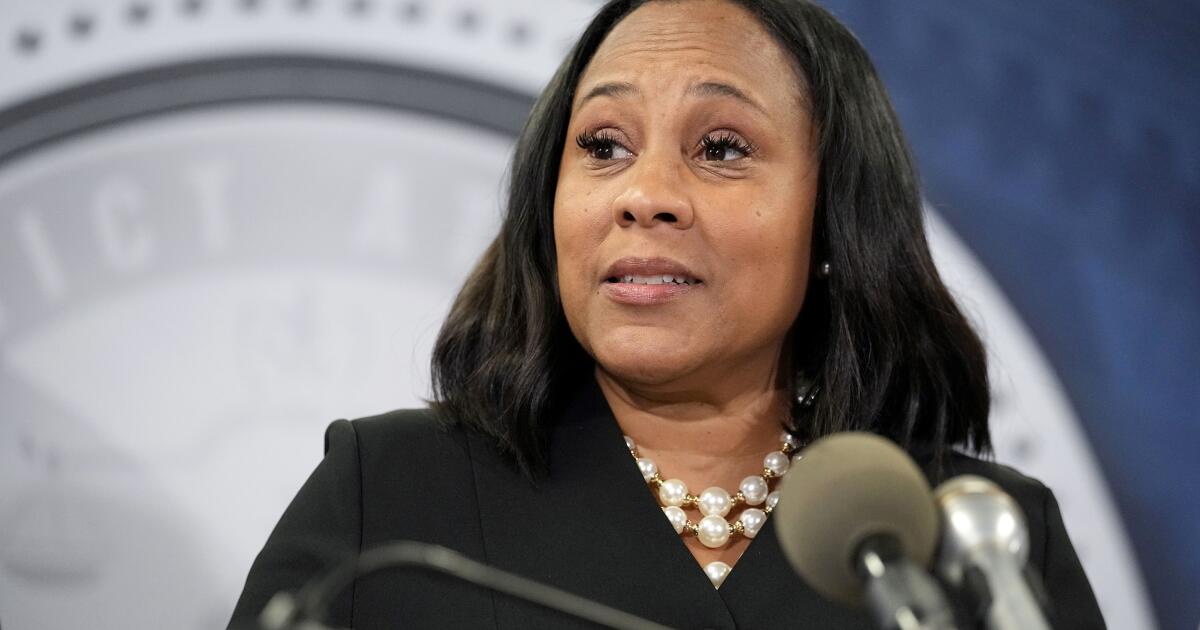
A judge delivered a significant victory Friday to Fulton County Dist. Atty. Fani Willis, ruling that she would not be disqualified from leading the Georgia election interference case against former President Trump — as long as her lead prosecutor and former romantic partner, Nathan Wade, stepped down from the case.
Hours later, Wade offered his resignation, “in the interest of democracy” and to “move this case forward as quickly as possible.”
In a 23-page ruling, Fulton County Superior Court Judge Scott McAfee said the defense had “failed to meet their burden of proving” that Willis’ relationship with the special prosecutor amounted to a conflict of interest.
But the relationship, McAfee said, had created the appearance of such a conflict in the sweeping racketeering trial, one of four criminal cases against the former president.
Wade’s withdrawal, the judge suggested, would allow “the District Attorney, the Defendants, and the public to move forward without his presence or remuneration distracting from and potentially compromising the merits of this case.”
The judge stopped short of disqualifying Willis, but rebuked her for what he called a “tremendous lack of judgment,” and said that “reasonable questions remained” about whether she and Wade had been honest on the witness stand about the timing of their relationship and their financial exchanges.
“An odor of mendacity remains,” McAfee wrote.
But he concluded that “ultimately, dismissal of the indictment is not the appropriate remedy to adequately dissipate the financial cloud of impropriety and potential untruthfulness found here.”
Willis accepted Wade’s resignation, calling him an “outstanding advocate” who was “brave enough to step forward and take on the investigation.”
Steve Sadow, Trump’s lead defense counsel in the case, said that the judge’s ruling did not go far enough and that the former president’s legal team would use “all legal options available” to end the prosecution.
“While respecting the Court’s decision, we believe that it did not afford appropriate significance to the prosecutorial misconduct of Willis and Wade, including the financial benefits, testifying untruthfully about when their personal relationship began, as well as Willis’ extrajudicial MLK ‘church speech,’” Sadow said in a statement.
Trump and his co-defendants had pushed for Willis to be disqualified — a move that would have derailed the case, likely holding up the start date of a trial that could have a significant influence on the Nov. 5 presidential election. Trump has won enough delegates to become the Republican Party’s nominee.
Willis has sought an August trial. But the timeline is still uncertain. McAfee’s ruling is expected to be appealed — although some legal experts say it’s unlikely to be overturned.
Anthony Michael Kreis, a professor of constitutional law at Georgia State University, said McAfee gave Willis the best ruling possible.
“It is a total legal victory — and a huge political slap on the wrist,” Kreis said. “She definitely comes out scraped, battered and bruised — but that was true a month ago. And so the bigger question is: Is the case preserved? Yes. Have things been derailed? No.”
Crucially, McAfee found no evidence to suggest that Willis had profited from the investigation, Kreis said.
“That is a finding of fact that will be held up on appeal,” Kreis said. “That means that long term, it’s really unlikely that this ruling is going to be overturned on appeal; it makes it also exceedingly less likely that the Court of Appeals would even take this up.”
Willis, a Democrat, was a newly elected Fulton County district attorney when she opened a “high priority” criminal probe in February 2021 into efforts to overturn Republican Trump’s 2020 election loss in Georgia to Joe Biden.
After losing Georgia by nearly 12,000 votes, Trump raised baseless claims of election fraud and pressured GOP leaders in the state to help him reverse the result.
In August 2023, a Fulton County grand jury charged Trump and 18 of his allies in a sprawling 98-page indictment with racketeering and a dozen other felonies. Four of the defendants have since pleaded guilty to some of the charges.
The relationship between Willis and Wade first drew public scrutiny in January, when an attorney for Mike Roman, a co-defendant and former Trump campaign aide, filed a motion accusing the pair of engaging in an “improper, clandestine personal relationship.”
Defense lawyers sought to block Willis and her office from prosecuting the case, alleging Willis was already dating Wade when she hired him in November 2021 and then improperly benefited when she accompanied him on vacations he paid for.
Willis and Wade have acknowledged they had a relationship. But they testified that it did not begin until early 2022 — months after his hiring — and that it ended last summer. They also testified that they split travel expenses.
The prosecutors have argued there was no conflict of interest — and no evidence the district attorney gained direct or indirect financial benefit from the relationship.
Last month, the two sides sparred in hearings that played out like a daytime soap opera, as defense attorneys quizzed Wade on whether Willis had repaid him with cash for her share of their vacations, and asked Willis who paid when they went out for dinner.
On the witness stand, Wade described a birthday trip to Belize as a gift from Willis. Willis detailed a Napa Valley wine tour, saying that she’d paid in cash for Champagne paired with chocolate and caviar, and that she didn’t really like wine and would have preferred Grey Goose vodka.
Visibly upset as defense lawyers accused her of lying about the timeline of their relationship, Willis dismissed their allegations as “lies” and railed against what she characterized as intrusions into her personal life.
“You’re confused. You think I’m on trial,” she said at one point, confronting Roman’s defense attorney, Ashleigh Merchant. “These people are on trial for trying to steal an election in 2020. I’m not on trial, no matter how hard you try to put me on trial.”
Defense attorneys argue that allowing Willis to preside over the case threatens to undermine public confidence in an already charged and sensitive investigation. Even the appearance of a conflict of interest, they argue, is enough to remove her from the case.
That is disputed by Willis’ attorneys. They argued in a court filing that disqualification of a district attorney requires a “high standard of proof,” and that the defense had the burden of showing an actual conflict of interest.
Trump’s attorneys have continued to claim that Willis and Wade are lying about the timeline of the relationship.
The week after the two prosecutors testified, defense attorneys filed an affidavit detailing cellphone records that they said indicated Willis and Wade had exchanged just under 12,000 calls and text messages before Wade joined the investigation.
They also presented cellphone location data that they said showed Wade visited the South Atlanta neighborhood where Willis was living at least 35 times in the 11 months before she hired him. Wade had testified that he had been there fewer than 10 times during that period.
But Kreis said the evidence unrebutted in court showed that the relationship ended well in advance of any grand jury indictments being considered and ultimately handed down.
“That really undermines the argument that this prosecution is either selective or was somehow kind of strategically manipulated in order to enrich Fani Willis,” Kreis said.
Still, he said, the allegations of a conflict of interest — a narrative that Trump has seized on as he campaigns to reclaim the White House — threatened to taint the public’s perception of the prosecution.
McAfee’s ruling came two days after he delivered a partial win to Trump and his co-defendants, dismissing six counts on Wednesday — including three against the former president — related to accusations of solicitation of violation of oath by a public officer. The judge said the counts “fail to allege sufficient detail” about what part of the oath the defendants had allegedly tried to get public officials to violate.
The timeline of Trump’s three other criminal cases is uncertain.
His federal trial on charges of plotting to overturn the 2020 election, originally set to begin March 4, stalled last month as the Supreme Court agreed to consider his claim of “total immunity” from prosecution for actions alleged to have taken place while he was in office.
And on Friday, a judge delayed New York’s hush money trial over Trump’s 2016 payment to adult film actor Stormy Daniels after his lawyers said they needed more time to sift through a profusion of evidence they only recently obtained from a previous federal investigation into the matter.
Judge Juan Manuel Merchan agreed to a 30-day postponement and scheduled a hearing to address questions about the evidence dump for March 25, when the trial had previously been set to begin.
Meanwhile, the judge in the federal classified document case in Florida, involving government files Trump stored at his Mar-a-Lago residence and club, has delayed that trial, which had been scheduled for May.
Prosecutors are seeking a new start date in July, and Trump’s legal team is pressing to delay the trial until after November’s election.


Habitual marijuana users cannot be barred from owning guns, Supreme Court rules
Fox News host Sean Hannity reports the Supreme Court unanimously limits a federal gun law, ruling habitual marijuana users cannot be banned from owning guns. Legal Analyst Gregg Jarrett explains the 9-0 decision, distinguishing between recreational use and serious addiction, contrasting it with Hunter Biden’s crack cocaine and gun charges.
NEWYou can now listen to Fox News articles!
FIRST ON FOX: A powerful House committee is escalating its probe into the Biden administration for alleged collusion with gun control activists.
House Oversight Chairman James Comer, R-Ky., is demanding that the Bureau of Alcohol, Tobacco, Firearms and Explosives (ATF), the federal agency responsible for enforcing gun laws, hand over documents detailing Biden aides’ communications with Everytown for Gun Safety, an influential gun control group founded by billionaire Michael Bloomberg.
Comer’s panel has argued that a now-defunct Biden office may have collaborated with Everytown to help facilitate its lawsuit with the city of Chicago against the gunmaker Glock Inc.
“These records will inform the Committee as to whether the Biden Administration and Everytown colluded to attack private gun manufacturing companies through lawfare to circumvent Second Amendment rights,” Comer wrote in a letter Wednesday to the ATF that was reviewed by Fox News Digital.
Rep. James Comer arrives at the U.S. Capitol in Washington, D.C., on June 10, 2026. (Tom Brenner/Getty Images)
CITY OF CHICAGO SUES GLOCK INC. OVER ‘FACILITATING’ ILLEGAL GUN CONVERSIONS
Chicago’s lawsuit, listing Everytown’s legal arm as the plaintiff’s counsel, was filed in March 2024 and alleges Glock sold pistols that the firearms manufacturer knew could be easily modified to fire like machine guns.
“Glock knows that it takes little effort to convert its pistols into illegal machine guns and that criminals frequently do so,” the lawsuit alleged. “Glock also knows it could fix the problem, but has chosen not to, putting profits over public safety and violating the law.”
In the letter, Comer cited a 2023 meeting between the White House Office of Gun Violence Prevention (WHOGVP) and representatives from Glock, during which Biden officials pressed the gun manufacturer to modify its pistol designs.
When Chicago sued Glock three months later, John Feinblatt, president of Everytown, wrote on X, “Federal officials recently contacted Glock to discuss implementing new ways to modify Glock pistols to make it harder for Glock switches to be installed. Rather than help, Glock has falsely insisted there is nothing they can do.”
Comer argues Feinblatt “appears to have had insider information regarding the WHOGVP’s private meeting with Glock, which raises questions about whether the Biden Administration colluded with Everytown to initiate their lawsuit against Glock,” according to the letter.
The lawsuit is still moving through the court system, with a Cook County judge denying Glock’s motion to dismiss the case in September 2025.
Members of Everytown for Gun Safety rally outside the U.S. Capitol in Washington, D.C., on May 26, 2022. (Chip Somodevilla/Getty Images)
STATES’ TOP COPS GANG UP ON LETITIA JAMES IN CRUSADE WITH POTENTIAL NATIONWIDE CONSEQUENCES
The Kentucky lawmaker has also highlighted close ties between the Biden White House and Everytown. The letter notes that Biden aide Rob Wilcox worked at Everytown for eight years prior to his employment with the WHOGVP.
Biden also headlined Everytown action fund’s annual training conference, known as Gun Sense University, in June 2024, during which he reiterated his support for a nationwide ban on so-called assault weapons.
Wednesday’s letter comes after the GOP-led panel asked the National Archives and Records Administration (NARA) in April for communications between the Biden White House and Everytown.
House Oversight Republicans previously subpoenaed the Biden ATF and Everytown for all communications related to their “potential collaboration efforts,” but neither party complied with the request.
President Joe Biden speaks about gun safety at Everytown’s Gun Sense University at the Washington Hilton in Washington, D.C., on June 11, 2024. (Saul Loeb/AFP)
CLICK HERE TO DOWNLOAD THE FOX NEWS APP
Comer has also argued that the committee’s probe will help lawmakers evaluate whether new legislation is needed to combat officials violating recordkeeping requirements or using their roles to leak private information to politically aligned third parties.
A spokesperson for the ATF did not immediately respond to a request for comment.

The June 16 appearance by Vance gave the program its most-watched episode since November 2024.
The first appearance by Vice President JD Vance on ABC’s “The View” delivered the most-watched edition of the talk show since November 2024.
The June 16 program averaged 3.3 million viewers, according to Nielsen data. The figure was well above the average of 2.6 million viewers for “The View” in the 2025-26 season.
Vance appeared on the liberal-leaning program to promote his new book on his decision to become a Catholic. While the co-hosts mostly questioned him on the Trump administration’s policies on immigration and race, the discussion was cordial.
The panel of co-hosts — Whoopi Goldberg, Joy Behar, Ana Navarro, Sunny Hostin and Alyssa Farah Griffin — did not ask Vance to address the program’s ongoing tension with the Federal Communications Commission.
FCC Chairman Brendan Carr has questioned whether “The View” should have the status of news programs, which are exempt from giving equal time to the opponents of political candidates who appear as guests.
ABC has asked the FCC to rule on the status of “The View,” which received an exemption from the rarely enforced equal time provision in 2002. ABC has maintained that “The View” books politicians based on newsworthiness and not partisanship.
The FCC is currently taking comments from the public on the matter. ABC is running on-air spots urging viewers to support the program.
“‘The View’ has welcomed your favorite guests and covered the issues you care about for nearly 30 years,” the spot says. “Now the FCC wants to control who is allowed to appear on the show.”
The National Republican Senatorial Committee and the National Republican Congressional Committee submitted comments Monday, asserting that “The View” takes advantage of its exemption and favors Democratic candidates and permits “only rare appearances by Republican-aligned figures.”
ABC has told the FCC that “The View” has invited politicians from both sides of the aisle to appear on “The View,” including Health Secretary Robert F. Kennedy Jr., Secretary of State Marco Rubio and entrepreneur Elon Musk. They have declined the invitation as did Vance before his appearance last week.
The letter from the GOP committees also cited the ideological leanings of the co-hosts, saying they are “not selected for their journalistic talent or excellence in commentary, but for their partisan tilt.”
Over the last two decades, “The View” has used five liberal hosts and filled one seat designated for a conservative voice. The right-leaning co-host role has had the most turnover.
“The View” has been the most-watched daytime program for the last nine years. As a live, topical program, it has remained an important media platform while the rest of the talk show genre has largely faded due to diminishing audiences.
Carr’s targeting of “The View” is part of his ongoing criticism of broadcast platforms that annoy President Trump, who has urged that TV station licenses be pulled when he’s been unhappy with coverage.
Politics
Trump to kick off Great American State Fair as 250th anniversary celebrations take over National Mall

Washington DC to host Great American State Fair for America250
Ambassador Monica Crowley discusses the Great American State Fair, set to transform the National Mall in Washington D.C. from June 25 to July 10. Celebrating America’s 250th anniversary, the 16-day event will feature pavilions from all 50 states and six territories, a 110-foot Ferris wheel, traditional games, and rodeo competitions, aiming to unite the country.
NEWYou can now listen to Fox News articles!
President Donald Trump will kick off the Great American State Fair Wednesday evening as part of celebrations surrounding the nation’s 250th anniversary.
“President Trump promised the greatest 250th birthday celebration in American history, and Freedom 250 is proud to help deliver it for the American people,” Freedom 250 CEO Keith Kranch told Fox News Digital.
“This celebration is about what makes America exceptional—our freedom, our faith, our optimism, and our people. We are honored to welcome President Trump as he helps kick off these historic festivities tomorrow and begin a nationwide celebration of our Nation’s 250th birthday,” Krach added.
The fair brings together all 50 states and six U.S. territories for a national celebration stretching from the Capitol to the Washington Monument featuring military flyovers, musical performances and civic programming. Trump announced he will deliver remarks after a handful of musical artists pulled out of their musical performances, turning the bash into a “Make America Great Again Rally.”
TRUMP FLOATS REPLACING 250TH ANNIVERSARY CONCERT WITH MASSIVE MAGA RALLY AFTER ARTISTS PULL OUT
Organizers describe the Great American State Fair as a modern-day World’s Fair celebrating America’s 250th anniversary. (Aaron Schwartz/Bloomberg via Getty Images)
The event is scheduled to run from June 25 through July 10, 2026, celebrating patriotism to bring together the nation for a celebration of unity.
TRUMP’S DC BEAUTIFICATION PUSH WINS RARE DEM PRAISE AS PRESIDENT SNAPS LANDMARKS BACK TO LIFE
U.S. President Donald J. Trump watches the UFC lightweight championship fight during the UFC Freedom 250 event on the South Lawn at the White House on June 14, 2026 in Washington, DC (Jeff Bottari/Zuffa LLC)
Trump’s anticipated remarks follow his signature last week on a Memorandum of Understanding with Iran, launching a 60-day negotiating period aimed at preventing Tehran from ever obtaining nuclear weapons capability.
The world’s fair-scale event will have pavilions touching on five national themes: Made in America, American Heartland, American Innovates, The American Canvas, and Faith & Family.
There will also be a 110-foot Ferris wheel and the refurbished Smithsonian carousel for families to enjoy.
Rending of 110-foot ferris wheel coming to National Mall for “Great American State Fair.” (Freedom250)
The U.S. has hosted over two dozen variations of the world’s fair since first hosted in Philadelphia in 1876, according to the State Department.
CLICK HERE TO DOWNLOAD THE FOX NEWS APP
Freedom250, the nonpartisan group helping coordinate the broader America250 effort, said the fair will feature food, games, exhibits and themed attractions designed to showcase the country’s culture, history and innovation.
-

 Iowa1 minute ago
Iowa one of nine states that won’t have to match portion of federal SNAP benefits
-

 Kansas4 minutes ago
Body believed to be Kansas City highway shooting suspect found in burned home’s basement by family: police
-

 Kentucky9 minutes ago
Kentucky’s Otega Oweh headed to Thunder in 2026 NBA Draft trade
-

 Louisiana16 minutes ago
GOP candidates trade attacks, differ on carbon capture in Louisiana Senate race
-

 Maine19 minutes ago
Hearts of Pine halt 4-game skid with emphatic win
-

 Maryland24 minutes ago
Republican candidates ask judge to block Maryland primary certification
-

 Michigan31 minutes ago
Michigan heatwave on way. See day likely to set a record high
-

 Massachusetts34 minutes ago
Massachusetts man accused of wanting sex with girl busted in World Cup trafficking operation

