Connecticut lawmakers are considering banning the use of legacy and donor preferences in admissions to all colleges and universities across the state, including private ones like Yale University.
A bill was advanced to the Senate floor on Thursday, days after Virginia Gov. Glenn Youngkin signed legislation barring consideration of a student’s familial ties to a public college or university when being considered for admission. The first such law was signed in Colorado in 2021.
There has been pushback to Connecticut’s bill from some private institutions in the state, including Yale, which have argued the state should not be dictating how they make admissions decisions, just like it shouldn’t dictate decisions on curriculum and faculty hiring. But proponents note how these schools, which receive substantial tax benefits for their non-profit status, have the power to provide all kinds of students with a ticket to an elite world.
CONNECTICUT UNIVERSITY DORM FIRE FORCES DOZENS OF STUDENTS INTO TEMPORARY HOUSING
“If you look at leaders of Fortune 500 companies, you look at members of Congress, United States Supreme Court justices, this really matters to how our society operates,” said Democratic state Sen. Derek Slap, co-chair of the Higher Education and Employment Advancement Committee.
Advertisement
An Associated Press survey of the nation’s most selective colleges in 2022 found that legacy students in the freshman class ranged from 4% to 23%, though many schools declined to provide basic data in response to AP’s request. The AP found that at four schools — Notre Dame, USC, Cornell and Dartmouth — legacy students outnumbered Black students.
Slap noted how the U.S. Supreme Court last summer struck down affirmative action in college admissions, proving they don’t have institutional freedom to make preferences based on race.
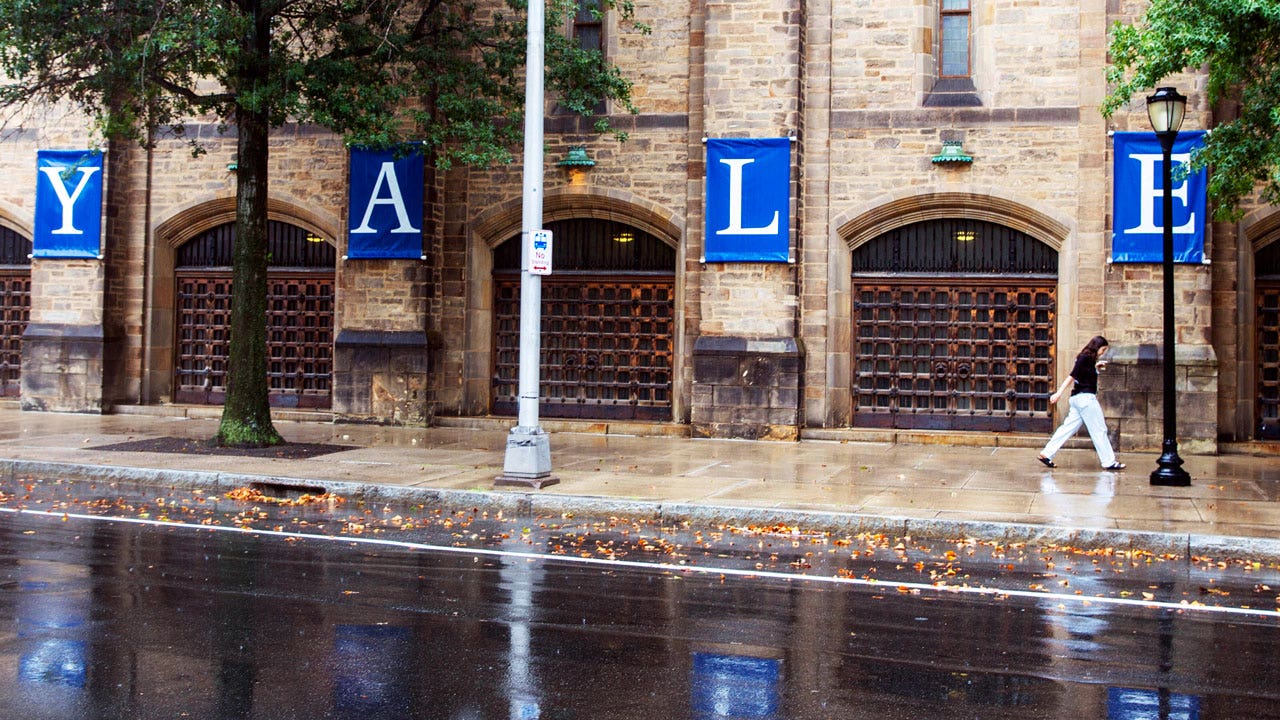
A woman walks by a Yale sign reflected in the rainwater on the Yale University campus on Aug. 22, 2021, in New Haven, Connecticut. Connecticut lawmakers are considering banning the use of legacy and donor preferences in admissions to all colleges and universities across the state.(AP Photo/Ted Shaffrey, File)
“I think it’s egregious, though, that this preference, the one for wealthy folks, remains,” he said.
Republican Sen. Kevin Kelly said he has heard from private schools in his district, especially faith-based colleges, that are concerned about how they would be impacted by the legislation. He said the ability of institutions of higher education to “exercise their freedom to teach how they are and what they are” has helped to create “American exceptionalism.”
Advertisement
“I think when the state government starts to interfere in that process, we’re not only interfering in private relations of institutions, but we’re also interfering in that American excellence,” he said.
Jeremiah Quinlan, dean of Undergraduate Admissions and Financial Aid at Yale University, recently told state lawmakers that the school agrees with the “central aim” of the bill, which is to enroll more low-income and first-generation students. But in addition to the state overstepping its bounds, he said the bill doesn’t address the key challenge of providing less advantaged students with the resources needed to prepare for college and graduate on time.
He also said Yale’s undergraduate admissions office strives to “assemble a group of the most promising students from the most diverse collection of backgrounds.” He said undergraduates from families that can’t afford the full cost of attending Yale receive a need-based scholarship that covers tuition, housing, meals, travel, books and personal expenses.
Last year, Wesleyan University, another private school in Connecticut, announced it was ending its policy of giving preferential treatment in admissions to those whose families have historical ties to the school.
Advertisement
The bill, which cleared the committee on a vote of 18-4, moves to the Senate for further action.
A federal judge on Wednesday permanently barred President Donald Trump’s administration from implementing most of his first executive order on elections, part of which sought to require people to show documentary proof of citizenship when they register to vote.
The ruling by U.S. District Court Judge Denise Casper in Boston effectively converts a preliminary injunction she issued a year ago, in which she temporarily blocked many of Trump’s efforts to overhaul elections, into a permanent ban.
Casper rejected the administration’s argument that the lawsuit to block the changes brought by Democratic state attorneys general was premature because the rules had yet to be implemented. Instead, she agreed that the Constitution gives states and Congress the authority to regulate elections, and that Trump’s requirements violated the separation of powers.
The Constitution “does not grant the President any specific powers over elections,” she wrote.
Advertisement
Among other proposed changes, Trump’s order would have required people to provide documentary proof of citizenship when registering to vote, prevented mail ballots from being counted if they arrive after Election Day, even if they were postmarked by then, and punished states that failed to comply by withholding certain federal money.
It was the latest in a string of rulings against the elections executive order Trump signed just months after taking office for his second term. He has since signed another executive order on elections, seeking to create a national voter list and limit mail balloting. That directive also faces multiple legal challenges.
Last fall, a federal judge in Washington, D.C., overseeing a separate challenge to the first election executive order by civil rights and Democratic Party-aligned groups blocked the government from taking steps to include the proof-of-citizenship requirement on the federal voter registration form. That judge later barred the Secretary of Defense from requiring documentary proof of citizenship when military personnel register to vote or request ballots.
In an apparent nod to the difficulty of implementing a proof-of-citizen requirement by executive order, Trump is pushing legislation in the Republican-controlled Congress to create such a mandate. The SAVE America Act has passed the House but has stalled in the Senate, leading Trump to advocate for eliminating the filibuster that is blocking the legislation.
On Wednesday, he abruptly cancelled the expected signing of a bipartisan housing bill, saying he won’t sign legislation until Congress passes his proof of citizenship requirement for voting.
What’s going on in Pittsburgh this weekend, June 25-28? Find out here. Know of a cool event? Email us.
Thursday, June 25, Friday, June 26, & Saturday, June 27 Pittsburgh Dance Workshop and Choreography Festival at the Charity Randall Theatre Various times Bringing together emerging and established choreographers from across the region and elsewhere to present original works, the Pittsburgh Choreography Festival provides a platform for artistic innovation, collaboration and the creation of new dance experiences for local audiences. Featured artists and companies performing this year include Anthony Alterio, Bodiography, Confluence Ballet Co., D.A.N.A Movement Ensemble, Ebony Cunningham, Get Down Gang, Jothika Gorur, PearlArts Movement & Sound, Shana Simmons Dance, Texture Contemporary Ballet and others. Festival performances take place on Friday and Saturday at the University of Pittsburgh’s Charity Randall Theatre at 7 p.m.
Looking for something more intensive and hands-on? In conjunction with the festival, the Pittsburgh Dance Workshop offers classes, workshops and performance opportunities. Drop-in public classes run through Thursday and are $20. Tickets.
Advertisement
Thursday, June 25 “The Birdcage” at The Plaza at North Shore 6 p.m. Pittsburghers have a new open-air movie theater to add to their summer fun list. Watch flicks under the stars at one of the city’s newest outdoor venues when The Plaza at North Shore launches its summer movies series on the big screen. To celebrate Pride Month, the free series kicks off with a 30th anniversary screening of “The Birdcage,” starring Robin Williams and Nathan Lane. Produced and directed by Mike Nichols, the 1996 comedy follows a gay couple who own a legendary drag club in South Beach, Miami.
A special pop-up performance with photo opps featuring local drag artists will get the revelry started at 6pm. The film begins at 7:30 p.m. Hosted by local personality Joe King, the drag show will pay homage to The Birdcage’s iconic characters and songs. The Plaza’s on-site eatery, SugarBird, will get in on the fun with tropical cocktails, soft serve ice cream, fried chicken, popcorn and cotton candy for moviegoers. The Plaza will host free movies on select Thursday nights through September. Attendees are encouraged to BYOS (bring your own seat). Information.
Kyra Kennedy in “BEAUTIFUL: The Carole King Musical.” Photo by Archie Carpenter.
Thursday, June 25-Sunday, June 28 “BEAUTIFUL: The Carole King Musical” at the Benedum Center 7:30 p.m., 1 p.m., 6 p.m., 2 p.m. What do you get when you cross a musical, a biopic and a jukebox filled with hits? Find out when the Pittsburgh CLO presents this all-new production of “BEAUTIFUL: The Carole King Musical.” Sing your your heart out to iconic songs like “(You Make Me Feel Like) A Natural Woman,” “It’s Too Late,” “So Far Away” and more when this production rocks the Benedum. Be inspired by the remarkable true story of “a girl from Brooklyn who became one of the most successful singer-songwriters in music history.”
The must-see musical stars Kyra Kennedy (Carole King), Dylan S. Wallach (Gerry Goffin), Lee Harrington (Cynthia Weil) and Barrett Riggins (Barry Mann). The creative team features Director/Choreographer Dan Knechtges and Music Director Catie Brown. Don’t miss the Talkback with Cast on Thursday, June 25, following the performance, and the Female Singer-Songwriter Brunch on Sunday, June 28, at 11:30 a.m. Tickets.
Friday, June 26 Turn It Upstream Music Festival in Frick Park Hollow 5 p.m. There’s a new music festival in town with an important mission. To celebrate the organization’s silver anniversary, UpstreamPgh is hosting a music festival in Frick Park Hollow near Regent Square. Turning upstream and turning up the music, the 25th anniversary party is hosted by WQED television producer, writer and narrator Rick Sebak. Welcoming all ages, the vibrant summer evening features music by Beauty Slap, Colatura, NASH.V.ILL, the anonymous chronicles, and DJ BusCrates. Located along Tranquil Trail, the festival midway will be lined with local artists and vendors, interactive demonstrations and activities for all ages, including eco-friendly screenprinting.
Advertisement
East End Brewing Co. and Goodlander Cocktail Brewery will offer a mix of alcoholic and NA options. Food will be provided by local food trucks Mr. Bulgogi and La Palapa. The event’s silent auction showcases unique items like lunch with Rick Sebak and a private hike with renowned mushroom hunter, Barbora Batokova. Proceeds from the sustainable, zero-waste event will support UpstreamPgh’s community engagement, clean water advocacy, and green stormwater infrastructure programming. Tickets. Read more about summer music festivals in NEXT.
Friday, June 26: Gallery Crawl in the Cultural District 5:30-9 p.m. Now that summer is officially here, that means you have even more ways — and more daylight hours — to explore the city’s creative offerings. With its expanded year-round schedule, the Gallery Crawl in the Cultural District makes contemporary art even more accessible. Head Downtown to find the sidewalk stop signs identifying the participating venues in this multi-venue “open house” presented by Pittsburgh Cultural Trust. Free to all, each crawl showcases what’s new in Pittsburgh’s dynamic art and entertainment scene Downtown. From visual arts, live music, dance, spoken word and more — it’s a chance to experience one of the liveliest nights in the city within a walkable footprint. Information.
Friday, June 26 Pride and Joy at The August Wilson African American Cultural Center 6 p.m.-12 a.m. Keep your Pittsburgh Pride Month jubilation going right into summer, when the August Wilson African American Cultural Center hosts its fourth annual celebration “uplifting and honoring Black queer joy, creativity, music and community.” The festivities kick off with a special live podcast experience hosted by Rian-Louis. Dubbed RIANOUTLOUD!, the engaging conversation will feature “Black queer community and arts leaders and changemakers discussing creativity, identity, community impact and the importance of visibility and representation within the arts and beyond.” The program includes light refreshments and a cash bar.
Next, the party heats up with performances by Maya Universe and Manny Dibiachi, followed by an electrifying DJ battle between HUNY XO and Queen Father. Pride-goers are invited to “dance, celebrate, connect and experience a night centered on love, liberation and community.” Free STI testing and health resources will be available on-site through event partner, Central Outreach. Partygoers can also fuel up at Quick-E Food Truck. Register for free. Find more to do in the 2026 NEXT Pride Guide.
Crown Series installation view, (from left) Crown Series: Iris, 2024, Crown Series: Sadie, 2024, Crown Series: Opal, 2024; Photo by Kohler Co., courtesy of John Michael Kohler Arts Center.
Friday, June 26 Sharif Bey: “Homecoming” Opening Reception at the Andy Warhol Museum 7-9 p.m. For its next special exhibition, the Warhol Museum is showcasing the work and creative practice of Pittsburgh-born ceramic artist, sculptor and educator Sharif Bey. Celebrating Bey’s return to his hometown, the exhibit features “monumental ceramic sculptures” inspired by modernism, functional pottery and Oceanic and African art. Don’t miss tonight’s free opening reception featuring live music by the artist’s cousin, Ublai Bey and his band, Timeless.
Highlighting Bey’s “artistic development and emergence as a significant voice in contemporary art,” the works on view explore a range of themes, including childhood memories, Pittsburgh’s urban landscape, identity, home, personal history, memory, artistic roots and more. Bey’s work will be shown alongside artwork from the museum’s permanent collection by Andy Warhol and Jean-Michel Basquiat, underscoring how the three artists “engage deeply with themes of identity, culture and societal commentary.” “Homecoming” also aims to honor community arts education and Pittsburgh’s role in supporting artistic innovation. The exhibit will be on view through Oct. 12. Free with registration.
Advertisement
Charmed at The Store at Contemporary Craft. Photo courtesy of Julie Celidonia.
Charmed at The Store at Contemporary Craft. Photo courtesy of Julie Celidonia.
Saturday, June 27 Community Day and Charmed at Contemporary Craft 10 a.m.-4 p.m. In conjunction with its next Community Day, the event will showcase handmade charms by 40 artists from around the country, including makers of contemporary jewelry along with Pittsburgh-based artists and regional craftspeople. All of the original charms are for sale to the public. Peruse a curated selection of pendants, keychains, charms and chains created by artists working in a wide range of craft media, such as metal, wood, beadwork and more.
Representing a vast array of materials, sizes, and styles, many of the featured pieces were fabricated exclusively for “Charmed,” and will be only available at The Store at Contemporary Craft. Featured artists include Lauren Kalman, Terry Lavin, Dongyi Wu, Jason Stein, Maria Camera-Smith, Sarah Sindler, Amanda Stumpf, Andrew Thornton and many more. Get a first look at the “Charmed” preview on Thursday, June 25, from 5 to 8 p.m., where attendees can shop the collection early and participate in an artist-led activity with Andrew Thornton. Registration is encouraged, but not required.
Saturday, June 27 Andy Warhol Bridge 100th Birthday Bash 11 a.m.-3 p.m. As America celebrates its 250th birthday, one of Pittsburgh’s oldest and longest Sister Bridges will mark its milestone centennial. Join Allegheny County to celebrate the only bridge in the country named for a visual artist. A free festival with games, music, food and summer fun, the unique bridge bash will also feature community art projects led by the Andy Warhol Museum and the Children’s Museum of Pittsburgh. To celebrate the heritage of the bridge, local artist strawberryluna has created a special edition commemorative poster.
In 1925, Allegheny County awarded a contract to the American Bridge Co. to build the only three identically designed self-anchored suspension bridges in the world – now dubbed the Sister Bridges. Opened on June 17, 1926, the Seventh Street Bridge cost $1.4 million to build and is the oldest of the three Sister Bridges — and the longest, at 1,061 feet. In 2005, the Seventh Street Bridge was renamed to honor the King of Pop Art in celebration of the 10th anniversary of The Andy Warhol Museum just blocks away. The bridge will be closed to vehicular traffic for the free event. Information.
Saturday, June 27 Bellevue Pride at Andrew Bayne Park 12-4 p.m. Head up the Ohio to Bellevue for the borough’s signature Pride celebration. For its fifth annual event, the festivities are revolving around the theme of “Fire and Dragons” to reflect concepts of transformation and renewal. The free community festival will fill Andrew Bayne Park with live stage entertainment, dozens of activities, scores of food trucks and more. Emceed by Gay Fieri, the festivities will feature accordionist Pat Septak, Pittsburgh-based cover band, Candy Ring, the Cool Kids Collaborative, DJs and more. Pop into the artisan fair featuring 40 booths showcasing local makers and area nonprofits. Organized by a consortium of local LGBTQIA+ volunteers and board members, Bellevue Pride aims to create an inclusive, welcoming and safe environment for the LGBTQ+ community all year long. Information. Find more to do in the 2026 NEXT Pride Guide.
All photos courtesy of Alternate Histories.
Saturday, June 27 Yinzilla Day Block Party at the Alternate Histories Studio 3-7 p.m. The monsters are due on Greenfield Avenue, and you’re invited to their friendly party. The studio’s second annual Yinzilla Day promises to be a “big celebration of Pittsburgh’s favorite monster.” Be there when Alternate Histories debuts this year’s new Yinzilla T-shirts and glassware, and shop in the mini maker market for everything from leather goods, artwork and zines, to illustrations, stickers and accessories. Check out screen-printing demos with Fio Avocado and make your very own Monongahela Monster T-shirt. Sample the new Yinzilla beer produced in collaboration with East End Brewing, enjoy summer tunes by local surf rock band The Yeggs and grab dinner from the La Palapa Taco Truck. Information.
Ratboys. Photo by Miles Kalchik.
Saturday, June 27 WYEP Summer Music Festival at Schenley Plaza 4 p.m. Spread out a blanket and plop down a lawn chair to enjoy music with family and friends under the stars. Celebrating both national and homegrown music, this year’s festival will fill Oakland’s green space with live sets from Michigander, Ratboys, Jobi Riccio, Cam Chambers and Kahone Concept. The free rain-or-shine event is open to all ages. Looking for a bite to eat? The Porch at Schenley offers seated dining, and takeout is available through kiosks featuring cuisine from Asia Tea House, K Station and Omar’s Halal Grill. Information. Read more about summer music festivals in NEXT.
On Sunday, June 28, OpenStreetsPGH comes to Downtown Pittsburgh and the South Side from 10 a.m. to 2 p.m. Photo by Murphy Moschetta.
Sunday, June 28 OpenStreetsPGH through Downtown Pittsburgh and the South Side 10 a.m.-2 p.m. If you’ve ever wanted to stroll, bike, skate or dance through the middle of the city’s streets with nary a car in sight, mark your calendar now for the kickoff of OpenStreetsPGH. Transforming Pittsburgh roadways into vibrant car-free spaces, this season’s inaugural event takes urban adventurers on a route through Downtown Pittsburgh and the historic South Side — including the rare chance to traverse an iconic tunnel and bridge without cars.
Advertisement
Hosted by BikePGH, the free event celebrates active transportation and community connection while highlighting the city’s neighborhoods, landmark architecture and dramatic topography. Join the 2-mile journey from Downtown Pittsburgh through Market Square, up Forbes Avenue and through the Armstrong Tunnel. Continue your journey across the scenic 10th Street Bridge to the South Side’s eclectic East Carson Street commercial corridor. Pop into Activity Hubs along the route to join fitness classes for all ages and abilities, participate in art activities and relax at cooling stations. Visit the Duquesne Light Co. Community Wellness Hub in Market Square to participate in BikePGH’s “off the course banana-themed Side Quest” and fitness classes hosted by the YMCA. At the Edgar Snyder Kids Hub, BikePGH will lead a “Learn to Ride” course for youth on East Carson between 19th and 21st streets. View a map. Read more about the event in NEXT.
Sunday, June 28 Queer Craft Market: Pride Edition at City Theatre 2-6 p.m. Get crafty during Pride Month. This year, Pittsburgh’s premier queer DIY market takes the wares over to the South Side to set up shop in two spaces within City Theatre’s campus for the first time. Showcasing Pittsburgh’s talented LGBTQ+ maker community, the eclectic marketplace will feature more than 40 local vendors selling a wide variety of handmade Pride goods, from pins to prints to pens and more. Follow the market on Instagram to get a sneak peek of the wares on sale this weekend. Information.
6 more things to do this weekend in Pittsburgh
Thursday, June 25-Sunday, June 28: In Your Write Mind Writers Workshop at Seton Hill University in Greensburg
Friday, June 26: Jamie Baum Septet at MCG Jazz, 7:30 p.m.
Friday, June 26, & Saturday, June 27: Pittsburgh Noise Fest at Little Giant Studios
Advertisement
Saturday, June 27: PGH Social Club at the Schenley Park Overlook, 3-6 p.m.
Saturday, June 27: Reel Q presents “She’s the He” at The Glitterbox Theater, 7 p.m.
Sunday, June 28: Days Gone By Vintage Market at Velum Fermentation, 12-5 p.m.
If a bear is encountered, officials urge people to remain calm and avoid running.
Instead, speak in a calm voice, slowly back away while keeping the animal in sight, and make yourself appear larger by raising your arms or moving to higher ground.
If a bear continues to approach, DEEP recommends becoming more assertive by shouting, making loud noises, and throwing objects such as rocks or sticks.
While black bear attacks are rare, officials stress that people should never play dead during an attack.
Advertisement
“If attacked by a black bear, fight back vigorously,” DEEP advises. People should use any available object and focus defensive actions on the bear’s face and muzzle.