Entertainment
Anthony Hopkins on Holocaust drama 'One Life': 'This can happen again at any moment'

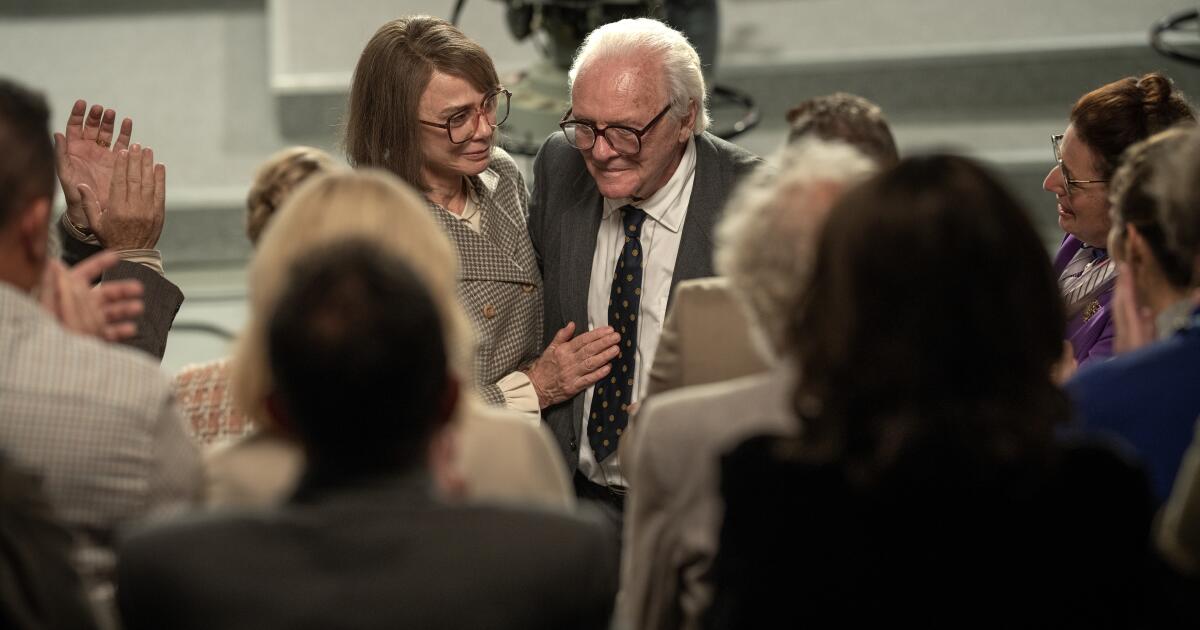
In 1988, the BBC television series “That’s Life!” aired a program on Nicholas Winton, a former stockbroker who helped to save 669 children from the Nazis in the months leading up to World War II and the Holocaust. As seen in the episode, the producers of the show surprised Winton by seating him in the audience next to several now-adult survivors of the Kindertransport. Years later, Iain Canning, the Oscar-winning producer of “The King’s Speech,” rediscovered the popular clip and wondered about the story behind it.
“It was such a stoic, emotional moment,” Canning tells The Times. “I just felt it was a life and a story worth exploring in film.”
He and Emile Sherman, who, together, had recently established their See-Saw Films company, went to visit Winton, then 101 years old, in 2010. Canning describes him as “humble, generous and also incredibly kind,” but says Winton was reluctant to be painted as a hero onscreen. “He believed that we all have the capacity to do the right thing at the right time,” Canning recalls.
A few years later, the producers enlisted screenwriters Lucinda Coxon and Nick Drake to adapt “If It’s Not Impossible…: The Life of Sir Nicholas Winton,” a 2014 biography of Winton written by his daughter Barbara Winton. She gave her blessing to the film, titled “One Life” — as long as her father was played by Anthony Hopkins.
Although the actor initially had to turn the role down, the opportunity came back in 2021 and he gladly accepted.
“It sounds weird to say that this story was personal to me because obviously I wasn’t involved in the Holocaust, but I do remember the war,” says Hopkins, 86, currently writing his memoirs and pleased to hold court in a suite at London’s Dorchester Hotel. (He wants us to take pastries and we oblige.) “I remember the bomb damage. That period of history encompasses my own life. It’s part of my consciousness.”
“One Life” shifts between two timelines. Hopkins plays Winton in the late 1980s reflecting on his life. Actor Johnny Flynn plays Winton in 1938 when he accompanies a friend to pre-war Prague and discovers that thousands of people are living in refugee camps in Czechoslovakia after fleeing Nazi persecution. Although Winton was at the time working as a stockbroker, he joined forces with the British Committee for Refugees, based in Prague, and devised a plan to move children across Europe by train to England.
“It’s hard for us on this side of the Holocaust to imagine that, in 1938, people didn’t know what these events were pushing toward,” Flynn says. “It was an existential threat, certainly for people back home in Britain. But Nicholas, who had Jewish heritage, connected to the plight of these people. Because of the type of person he was, he went there and saw it and he came back to England going, ‘No, these people are starving and dying.’”
Romola Garai and Johnny Flynn in the movie “One Life.”
(Julie Vrabelova / Bleecker Street)
Winton worked with a team of like-minded people, including Doreen Warriner (Romola Garai), Trevor Chadwick (Alex Sharp) and his mother Babette (Helena Bonham Carter). Traveling back and forth between London and Prague, he raised money, fought with the Home Office to grant visas for the children, many of whom were Jewish, and found foster families willing to take them in. Winton kept detailed records of his efforts in a scrapbook, now displayed in Jerusalem’s Yad Vashem memorial, that includes photographs of the children he shot and developed himself. The filmmakers also had access to Warriner’s 1984 book “A Winter in Prague” and Chadwick’s personal records, as well as other historical accounts to ensure accuracy.
“You always want to stay as close to history as possible — or at least I do,” director James Hawes says. “It gives it an authority. The nature of a drama is you always have to squeeze things for time, but we went out of our way to adhere to the truth. There are moments, like in the BBC studio, where we had an extremely good record of how things were, although we changed that slightly. But a huge amount of it is very true and anchored.”
Although author Barbara Winton died halfway through the filming, which took place first in England and then in Prague, Hawes remained in close contact with Winton’s grandson and son-in-law. “We could literally ring them up for photos and details,” Hawes says. “Because once you get into production beyond the script, props want to know, ‘What sort of car did they drive? What sort of meals would be right for each of them to eat in front of the TV?’ We went down to that kind of detail.”
Flynn shot his scenes after Hopkins wrapped so he was able to observe the elder actor’s portrayal of Winton. He also had footage of Winton in 1938, including a clip of him holding a rescued child, which was re-created in the film. Although it’s told from Winton’s perspective, the movie makes it clear that he didn’t work alone.
James Hawes, director of the movie “One Life.”
(Jack English)
“Nicholas knew that he wasn’t the most important aspect of the operation,” Flynn says. “He was just the person who was there as a face for the children to see and meet. He was working back in England to get the bureaucratic side done with his mother, which was all done from their front room in their house. They had to be pretty ruthless with the Home Office and that’s all there in the film. Nothing needed to be exaggerated.”
To re-create the episode of “That’s Life!” the team built a replica of the 1980s BBC studio at Pinewood outside London. Instead of casting actors to play the adult survivors, the filmmakers invited the family members of the original Kindertransport children to be in the studio audience. Hawes approximates nearly 50 of them participated.
“We had organizations working with us to make sure that we reached as many children as possible to let them know it was happening and to invite them to be in the audience,” producer Joanna Laurie says. “The response was astonishing. On the day, everyone was weeping.”
Although the scene was emotional to shoot, it was important to the filmmakers to ensure it played authentically. Hawes shot it from Winton’s perspective, reframing the well-known clip.
“It was quite an experience,” Hopkins says. “But James didn’t want to make a spectacle of it. He didn’t want to make it sentimental.”
Hawes adds that much of the feeling in the scene came from the crowd itself. “If you look at the line [of people] just behind Tony in the second audience scene, there’s a family of three sisters and a brother and you can see the emotion they’re giving,” he says. “It breaks me just to remember it. They felt it utterly and honestly.”
Anthony Hopkins in the movie “One Life.”
(Peter Mountain / Bleecker Street)
Despite Winton’s reluctance to be recognized, “One Life” spotlights the importance of doing good — especially when no one is looking.
“He wasn’t trying to save the world,” Flynn says. “He was just doing what he could do in that moment. There’s so much cynicism around doing good things now because of the potential to virtue-signal. No good deed goes unnoticed by Instagram. But I think what’s nice is to remember a time when that wasn’t a part of it.”
Hopkins agrees that today “everyone wants to show how clever they are.” He sees a film like “One Life” as an opportunity for audiences to be reminded of what’s at stake if we don’t learn to compromise or help. He remembers meeting a survivor of Auschwitz more than 20 years ago, who told him she goes into schools to teach them that the Holocaust could be repeated.
“It’s easy to forget,” Hopkins adds. “And nobody wants to be lectured and have it jammed down their throats. But I hope for at least an awareness. This can happen again at any moment and if we are not aware of that, we are doomed. But the human being has, I think, the capacity also to survive and pull ourselves back from the brink.”


Sail we must, on Homer’s “wine dark sea” from Ithaca to Asia Minor and many points in between for the greatest story of them all, the tale of “a face, a fleet…of a war with Troy, of a man and a ‘trick’” and “Zeus’s Law, defied at mankind’s peril.
For his latest feat, Christopher Nolan takes us on the epic quest that is the cornerstone of Western literature and Western civilization, Homer’s saga of Odysseus, “hero of the Trojan War,” a trickster ready to wield his brain and his brawn in a titanic struggle not just to win that war, but the many tests that stand between himself and “home.”
And in Nolan’s telling, what makes “The Odyssey” timeless is the remorse of civilization’s unraveling, of the violence and pitiless greed that brings great epochs and empires to an end. Odysseus, played with equal parts cunning and gravitas by Matt Damon, spends his years “coming home” from The Trojan War filled with regret at what he’s seen, what he’s done and what’ he’s caused to come to pass.
His men and even he see himself as “punished” by the gods for his acts, playing god himself as he is forced to choose who lives and who dies. He pay for his hubris with more tests, more violence and more second guessing than we’ve ever seen in in a film or mini-series about him, the original “classic” hero of Western literature.
Nolan’s ancient epic is more historical and slightly grander than Wolfgang Peterson’s mythic star vehicle “Troy,” more touching than the riveting and brutally heroic “300,” and more tactile than either. We’re seeing real seas, realistic reconstructions of ancient armor, cities, galleys of war and a real dog — Argus — waiting for his master to return from decades of fighting and traveling.
Note to “Supergirl” and “Superboy” filmmakers and anybody else thinking “Let’s just digitally animate the damned dog.” Nobody cries when a digital dog dies.
If I’m honest, Nolan’s version of an oft-told tale had me from the moment I saw “the horse,” the “trick” of the tale-teller’s account of “clever” Odysseus. Troy really existed, and if there really was a “Trojan Horse,” I’ll bet it looked a lot like this — half-buried in the surf, a “Planet of the Apes” post-apocalyptic monument and tribute to the gods that had to be hauled, sans wheels, from the sand to the city whose blasphemous undoing it held hidden in its belly.
Nolan’s narrative opens with that “trick,” and tells the tale from three temporal perspectives — the war, as remembered, events back home in the Ithaca with the queen (Anne Hathaway) and son (Tom Holland) that King Odysseus left behind to fight, and the epic quest to return from that war as recalled by Odysseus in the company of his most alluring captor, Calypso (Charlize Theron).
The central conflict isn’t the war, or the murderously ruthless “suitors” for Queen Penelope, foremost among them the handsome and venomous Antinous (Robert Pattinson). It is between Odysseus and his superstitious men as he struggles with hardened warriors (Himesh Patel plays his stoic but questioning second in command) convinced their commanding officer has offended and re-offended the gods, especially Troy’s patron, Poseidon.
“You can’t live by omens and sacrifices,” Odysseus scoffs. But in this “time of apparent magic,” even our Ur-hero is given pause by Cyclops, the Sirens, the enchantress Circe (Samantha Morton) and the gigantic armored man-eaters that confront them, the Laestrygonians.
And even Odysseus has his Mount Olympus spirit guide. Zendaya plays the goddess Athena, who warns him “Your cleverness will get you into trouble.”
As indeed it does.
Damon’s “brand” as an actor has long been the intelligence he conveys in all but the silliest roles. That’s put to great use here as we see him plotting and planning this escape or that ambush. “The gods help those who help themselves,” he preaches. But his Odysseus also lets us see him second-guessing himself, a wearying and ageing man weighed down by the heartbreaking burdens of leadership.
Hathaway, in the role of the dutiful wife weaving and unraveling her tapestry while bullying suitors impose themselves on her household, shows us her own burdens. She said “Promise me you’ll come back.” And all she’s left with, decades later, is rising anger at the plight her long-absent and presumed-dead husband has placed her in. She is queen, but their overmatched son (Tom Holland) is too unsophisticated and physically weak to take the throne in the presence of entitled, murderous brutes.
Jon Bernthal brings a rough bluntness to the gruff Menelaus of Sparta, a hardnosed ruler dragged into war when Helen (Lupita Nyong’o) ran away from his brother Agamemnon (Benny Safdie) to Troy.
And John Leguizamo nimbly plays the loyal blind swineherd who tries to help Penelope and son Telemachus (Holland) cling to power as long as possible against long odds that his master, Odysseus, might return. Horror icon Mia Goth plays Penelope’s treacherous handmaiden.
Nolan’s “all-star cast” makes something of a statement in terms or the film’s intentions and modern messaging. The first character we see is played by the transgender actor Page, with a Black Helen of Troy and Black and Asian characters giving this ancient world the cosmopolitan flavor it most certainly had.
A running theme through all this is the breakdown of an old order, “Zeus’s Law” about piety, square dealing and how to treat strangers and guests and the rest of the human race, Trojans included. Nolan is talking about the “Dark Ages” to come, and the “Dark Ages” which have revisited us whenever the people lose their way and the violent and rapacious are empowered over us, often at our own doing.
Take a gander at insensate monster Cyclops and who he seems to resemble. Imagine him in a diaper if you have trouble making the connection.
This “Odyssey” is almost exactly what we’d expect from Nolan, a very good film not on a par with the unnerving novelty of “Inception,” lacking the poetry and stunning suspense of “Dunkirk” — just an epic yarn given epic treatment/
This is a filmmaker who has something to say to modern audiences, and a pretty good idea of how to say it within the context of a 3000 year old tale of “a face” that “launched” a “fleet” of “a thousand ships,” of “clever” Odysseus” and the gods and all-too-human men who bedeviled him every step of his guilt-ridden and bloody journey “home.”
Rating: R, graphic violence, nudity, profanity
Cast: Matt Damon, Anne Hathaway, Tom Holland, Lupita Nyong’o, Himesh Patel, Zendaya, Robert Pattinson, Elliot Page, John Leguizamo, Samantha Morton, James Remar, Ryan Hurst, Mia Goth, Jon Bernthal and Charlize Theron
Credits: Scripted and directed by Christopher Nolan, based on “The Odyssey” by Homer. A Universal release.
Running time: 2:52

Kris Jenner’s mom, Mary Jo “MJ” Shannon, has died.
Jenner announced the news of Shannon’s death Thursday in an Instagram tribute. She was 91.
“Today, we said goodbye to my beautiful Mommy MJ. … There are no words that could ever capture what she has meant to me or the heartbreak of having to say goodbye. My mom was the heart of our family.”
Jenner wrote that her mother, the matriarch of the Jenner-Kardashian clan, taught her everything that “truly matters.”
“To love your family fiercely, to be kind, to show up for the people you love, and to never take a single moment together for granted,” she wrote alongside a glamour shot of Shannon. “She taught us that family is everything. She showed us how to love unconditionally and how to find joy in the little moments. She showed me how to face life’s challenges with resilience and faith.”
Jenner concluded the post with an open letter to MJ:
“Mom, thank you for every sacrifice you made, every piece of wisdom you shared, and every moment you loved us so completely. I will miss our daily talks, your smile, your laughter… Our hearts are broken, but we find comfort knowing that love like yours never truly leaves us. Your love will live on in our family, in our traditions, in every moment we are together, and in every life you touched. When I look at my kids and my grandkids, I will forever see pieces of you in all of us. There is not a part of me that isn’t shaped by you. And if I have done anything right in this world, it’s because I spent my life trying to live in a way that would make you proud. Every memory, every moment, every blessing, it was all because of you, and I will forever thank God every single day for making you my mommy. My heart is broken into a million pieces… thank you for giving me the greatest childhood and oh what a beautiful blessed life… I love you forever Mommy. Thank you for giving us everything.”
Born Mary Jo Campbell on July 26, 1934, MJ married her high school sweetheart, whom she divorced two months later. Then in 1954, she wed Jenner’s dad, Robert “Bob” True Houghton. She gave birth to Jenner the following year and Jenner’s late sister, Karen Houghton, in 1958. After seven years of marriage, MJ and Bob called it quits and she married Harry Shannon, a businessman who helped raise Jenner and her sister in San Diego, where MJ ran a children’s clothing store.
Harry Shannon died in 2003.
MJ was featured on the famous clan’s E! reality series “Keeping Up With the Kardashians” and the follow-up Hulu series “The Kardashians” numerous times over the years. In a clip from the show, granddaughter Kim Kardashian detailed that her grandmother had survived colon cancer and breast cancer and, in her sunset years, struggled with sickness resulting from the cancer treatments.
In one clip from the show, MJ said she didn’t have an appetite without taking her “medication” first. Then she persuaded her daughter, Jenner, to have marijuana gummies with her. Together they lit some incense and munched on muffins and chips and guacamole.
In another clip, Jenner interviews MJ about her life, and during the sit-down, Jenner asks MJ, “What’s your biggest fear?”
MJ replies, “I try not to fear,” and then follows up asking Jenner what her biggest fear is.
Jenner starts to cry and says, “I don’t want to say it. I can’t believe I’m crying. … Just, losing someone.”
On Thursday, Kim Kardashian caught flak online when a post featuring the Skims mogul and her sister Khloe Kardashian swigging tequila from a boat on a lake published shortly after Jenner announced the news of MJ’s death.
“This post was scheduled a few days ago before we lost MJ, so its timing came right alongside her passing,” Kim wrote in the comment section of the post. “I’ve been by my mom and grandma’s side this past week, and my heart is completely with my family right now. We love and miss her so deeply, and in the days ahead, we’ll be focusing on celebrating her beautiful life.”
Kim followed up with a post celebrating her grandmother, writing, “My sweet Grandma MJ, my best friend, my gossip buddy, my forever twin … You taught all of us the importance of family, and those values are something we’ll carry with us forever!!!!! You were the woman who showed me what it meant to be a hardworking businesswoman. You gave me my very first job at your store in San Diego and taught me lessons about work ethic, strength, and confidence that I’ve carried with me ever since.
“You always believed in me, championed me, and were my safe place. You truly were the matriarch of our family, and your love is woven into all of us. I know you’re at peace now. Give Papa Harry, Aunt Karen, and my dad a hug for me. You will always be a part of me, I love you soooooo much and I will miss you forever and ever. … YOU ARE THE BEST OF US!!!”
Two weeks ago, Jenner’s bodyguard, Mason Haynes, who also worked as a close protection guard for other members of the Kardashian-Jenner family, died in a traffic accident. He was 52.

Heat Advisory
from THU 12:00 PM EDT until THU 8:00 PM EDT, Eastern Montgomery County, Lower Bucks County, Philadelphia County, Delaware County, Eastern Chester County, Gloucester County, Northwestern Burlington County, Camden County, Mercer County, New Castle County
-

 Pennsylvania35 seconds ago
Continued Legacy: Central Pennsylvania Auto Auction gears up for 25th anniversary of Classic Car Auction
-

 Rhode Island7 minutes ago
Would You Dare Step Inside the Scariest Porta Potty in Rhode Island?
-

 South-Carolina13 minutes ago
South Carolina Lottery Pick 3, Pick 4 results for July 16, 2026
-
 South Dakota19 minutes ago
South Dakota opera ‘Giants in the Earth’ finds new audience
-

 Tennessee24 minutes ago
State encouraging Paramount to come to Tennessee
-

 Texas31 minutes ago
Texas floods ravage through southwestern areas of state
-
 Utah37 minutes ago
Beaver County residents set up thousands of sandbags ahead of flashfloods
-
Vermont43 minutes ago
VT Lottery Gimme 5, Pick 3 results for July 16, 2026

