Virginia
Dark Sky Week resolution highlights ‘wonder and awe’ of star gazing • Virginia Mercury


By Sam Bradley / Capital News Service
Lawmakers unanimously supported a resolution that encouraged Virginians to “ponder the cosmic eons beyond” and consider the impact of increased light pollution.
Del. David Reid, D-Loudoun, introduced House Joint Resolution 74 to designate the week of the new moon in April as International Dark Sky Week. Gov. Glenn Youngkin issued a proclamation the past two years in observance of the week, but it will now have official designation and be placed on the General Assembly website.
The resolution sheds light on a dark sky movement that values darkness to appreciate “the beauty of the night sky above” and explores solutions to minimize light pollution.
“This first part is about awareness,” Reid said, with hopes people will think about the kinds of lighting used in their homes or businesses.
Reid was inspired by an avid photographer friend to present the resolution to the General Assembly, in addition to his own self-described amateur forays into astronomy.
“It’s again, awe inspiring when you can look through the telescope and see these things with your own eyes,” Reid said.
He hopes that clearer night skies may encourage children to engage with science, technology and engineering programs at a young age.
The DarkSky International organization defines light pollution as the human-made alteration of natural levels of light. This can occur from the harsh exterior lighting of buildings, parking lots and street lamps.
Light pollution harms migratory birds and other local wildlife in addition to blocking out the night sky, according to the organization.
The annual cost of wasted energy in the U.S. is estimated to be roughly $3 billion, according to the resolution and previous proclamations from the governor’s office.
The first lighting ordinance was passed in Arizona in 1958. The DarkSky organization began advocacy in 1988 to educate and preserve starry views throughout the world, according to its website.
The history of Dark Sky Week is rooted in a Virginia suburb and North Carolina beach. Midlothian native Jennifer Barlow realized as a teen that her view of the stars was not the same in her backyard as it was at the beach, according to a University of Virginia profile.
Barlow’s mission to “spread the wonders of the skies in their full beauty” reached a worldwide audience and became the inspiration for International Dark Sky Week, she told Sky and Telescope in 2006.
The celebratory week was first observed in April 2003. International Dark Sky Week will occur from April 2-8 this year, according to DarkSky.
Virginia describes itself as the home of “some of the best stargazing on the East Coast.” And there are several renowned observatories and parks, according to the resolution.
James River, Natural Bridge, Sky Meadows and Staunton River state parks are officially designated as Dark Sky parks. This means that these parks follow strict lighting ordinances to prevent light pollution and obscuration of the night sky.
George Spagna is the former director of Randolph-Macon College’s Keeble Observatory and former mayor of Ashland, a town about 20 miles north of Richmond.
“We have grown into a nation of people who are afraid of the dark,” Spagna said. “The problem with being afraid of the dark is you can’t see the wonders of the universe around you.”
Randolph-Macon College has offered astronomy courses since their relocation to Ashland in 1868. Star-gazing classes were on the catalog as early as 1872, according to Spagna.
Spagna worked with Ashland to meet light pollution standards established by the International Dark Sky Association. He explained that lighting can often be an afterthought for developers, and an official Dark Sky week could help make the public more cognizant of light pollution.
Staunton River State Park was the first Virginia park in 2015 to be designated by the international organization, and the 25th in the world.
Chapel Hill Astronomical and Observational Society hosts the biannual Staunton River Star Party at the park, with the spring event held this year March 4-10. Astronomers camp for the week and aim equipment toward the dark sky.
Public day for the star party will be held March 8, from 8 p.m. to 10 p.m, for those who wish to observe the “transitive nightfall of diamonds.”


RICHMOND, Va. — Jerrod Buford first picked up a paintbrush as a kid, never imagining that same creative outlet would carry him through his darkest days in prison.
Buford, who grew up in Williamsburg, was convicted and arrested as a young man and spent almost a decade behind bars. During that time, he struggled deeply.
“Turning to drugs and alcohol to kind of shadow over emotions,” Buford said. “Looking for acceptance, approval. Not just from my parents, but from friends, from, you name it. I mean, I tried to commit suicide, I don’t even know how many times,” Buford said.
WTVR
It was inside prison walls that art became more than a hobby.
“Throughout my prison time, I learned, the freedom that I desired, I’ve always had it. I got, I found it, in a box,” Buford said.
More than three years after his release, Buford continues to advocate for art as a tool for healing. He describes his work as a gift he feels called to share.
“I received a blessing from God that just allowed me to display what he’s given me,” Buford said.
For Buford, creating art is also a way of processing his past.
“That’s what art has done for me. It’s given me the ability to look at parts of my life, all parts of my life, and find the good and the negative, learn from the negative,” Buford said.
He shares his story and artwork with a wide audience through social media, including live sessions on TikTok, and holds art classes with new communities.
The Story Cafe
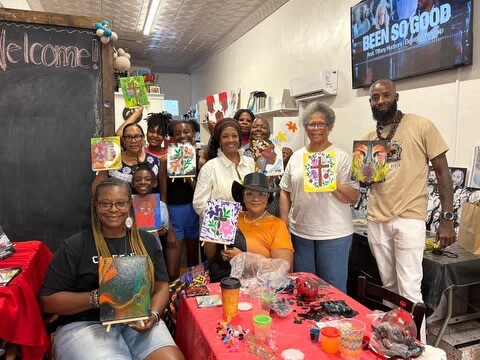
Buford said his mission is to help others find their own path toward healing — whatever form that takes.
“What I strive to do is guide this person to just create, man. Don’t care what people think about your creation, you just need to get it out,” Buford said. “Whether it’s with art, addressing your mental health, getting your life right — just do it.”
CBS 6 is committed to sharing community voices on this important topic. Email your thoughts to the CBS 6 Newsroom.
📲: CONNECT WITH US
Blue Sky | Facebook | Instagram | X | Threads | TikTok | YouTube

This story was initially reported by a journalist and has been converted to this platform with the assistance of AI. Our editorial team verifies all reporting on all platforms for fairness and accuracy. To learn more about how we use AI in our newsroom, click here.

Lovingston, VA (7News) — Good Morning Washington interviews Amanda Beckwith of Virginia Distillery Company- one of the contributing distilleries to the Virginia Spirits Board’s 250th Celebration Trio Pack, a special, exclusive release created to commemorate America’s upcoming 250th anniversary. This limited-edition package features a curated collection of a rum, a gin, and a whiskey, all crafted from scratch by distillers in Virginia to celebrate the rich history and current state of distilling within the Commonwealth.
Beckwith elaborates on VA Distillery Company’s role in the project, noting her focus on Virginia-grown grain to make the bottle of unique whiskey that is included in the Trio Pack. It is also worth noting that the Trio Packs themselves were bottled and produced right here at Virginia Distilling Company!
American single malts are the newest official category of American whiskey, distilled from one grain and from a single distillery. Virginia Distillery Co specializes in this new category of whiskey and crafted their contribution to the Trio Pack with this very specialty. Given the limited remaining availability of the Trio Pack, its historical value and collectible nature, the message it loud and clear encouraging viewers to grab a pack before they are all gone!
BE THE FIRST TO COMMENT
21+ Please drink responsibly, this content is sponsored by Virginia Distillery Company.


Powerball, Mega Millions jackpots: What to know in case you win
Here’s what to know in case you win the Powerball or Mega Millions jackpot.
Just the FAQs, USA TODAY
The Virginia Lottery offers multiple draw games for those aiming to win big.
Here’s a look at June 24, 2026, results for each game:
Powerball
Powerball drawings are held Monday, Wednesday and Saturday at 11 p.m.
13-14-16-21-38, Powerball: 14, Power Play: 2
Check Powerball payouts and previous drawings here.
Saturday, June 27, 2026
Pick 3
DAY drawing at 1:59 p.m. NIGHT drawing at 11 p.m. each day.
Night: 3-1-5, FB: 8
Day: 7-8-8, FB: 4
Check Pick 3 payouts and previous drawings here.
Pick 4
DAY drawing at 1:59 p.m. NIGHT drawing at 11 p.m. each day.
Night: 4-7-2-1, FB: 7
Day: 7-3-4-6, FB: 3
Check Pick 4 payouts and previous drawings here.
Pick 5
DAY drawing at 1:59 p.m. NIGHT drawing at 11 p.m. each day.
Night: 7-5-2-6-9, FB: 0
Day: 6-9-4-0-7, FB: 0
Check Pick 5 payouts and previous drawings here.
Cash Pop
Drawing times: Coffee Break 9 a.m.; Lunch Break 12 p.m.; Rush Hour 5 p.m.; Prime Time 9 p.m.; After Hours 11:59 p.m.
Coffee Break: 12
After Hours: 08
Prime Time: 13
Rush Hour: 01
Lunch Break: 14
Check Cash Pop payouts and previous drawings here.
Cash 5
Drawing every day at 11 p.m.
09-12-15-24-43
Check Cash 5 payouts and previous drawings here.
Bank a Million
Bank a Million draws are held every Wednesday and Saturday at 11 p.m.
18-21-25-33-36-39, Bonus: 13
Check Bank a Million payouts and previous drawings here.
Millionaire for Life
Drawing everyday at 11:15 p.m.
03-04-10-36-37, Bonus: 05
Check Millionaire for Life payouts and previous drawings here.
Feeling lucky? Explore the latest lottery news & results
This results page was generated automatically using information from TinBu and a template written and reviewed by a Center for Community Journalism (CCJ) editor. You can send feedback using this form.
-

 Boston, MA7 minutes ago
Delta flight returns to Logan after smoke scare in cockpit – Boston News, Weather, Sports | WHDH 7News
-

 Denver, CO10 minutes ago
Pat Surtain II Gets More Bad News Amid Broncos’ Uncertainty
-

 Seattle, WA15 minutes ago
The World Cup 2026 Pride Match between Egypt and Iran that Seattle hopes can ‘unite football community’
-

 San Diego, CA22 minutes ago
County Leaders Still Eyeing County-Backed Tax Hike
-

 Milwaukee, WI25 minutes ago
We must have answers before awarding new wastewater contract | Opinion
-

 Atlanta, GA30 minutes ago
Semi-truck, train collide in fiery crash in SW Atlanta
-

 Minneapolis, MN36 minutes ago
Reform, money and trust: Council members’ key criteria for Minneapolis’ next police chief
-

 Indianapolis, IN40 minutes ago
Ciara Myst is Indianapolis’ shapeshifting superstar on social media, too

