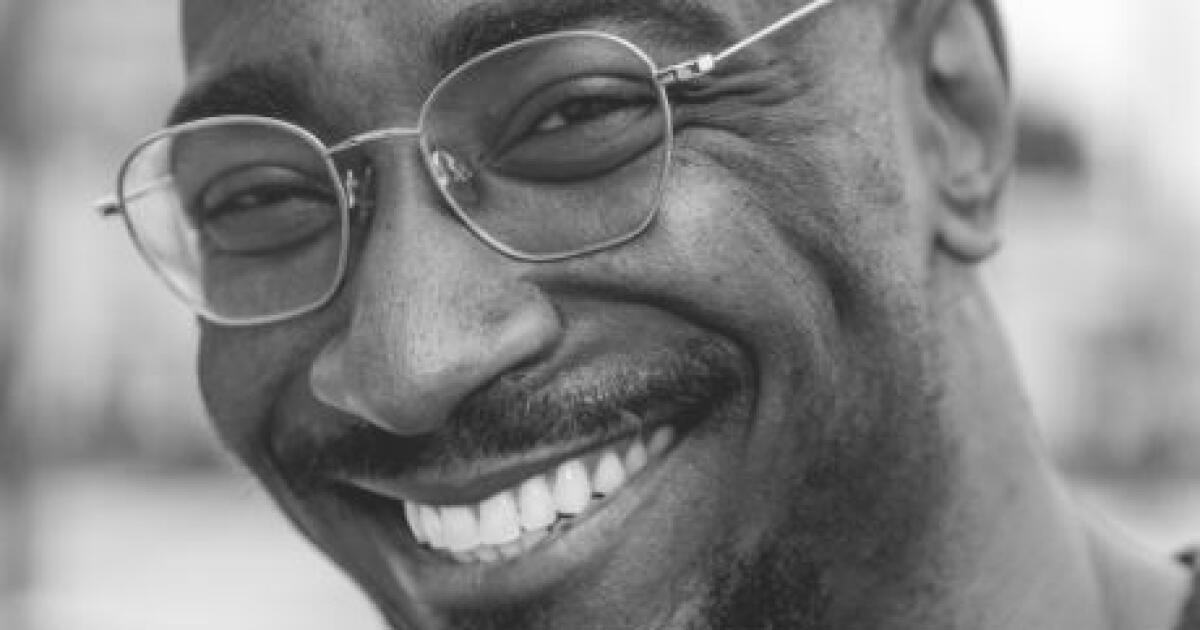
By Phillip B. Williams Viking: 592 pages, $32 If you buy books linked on our site, The Times may earn a commission from Bookshop.org, whose fees support independent bookstores.
Advertisement
Award-winning poet Phillip B. Williams’ debut novel, “Ours,” begins with a death — and a resurrection. A 17-year-old Black boy stands up shortly after a policeman fatally shoots him, as surprised as anyone else that he’s alive. He’s surrounded by the residents of the neighborhood: “Yes, they had left something behind to stand in that street together, blocked off from touching him and told to ‘Back up,’ had it yelled at them as though they were to have as little care and consideration for the boy as the ones who had shot him.”
From this contemporary opening, Williams takes readers back in time to the 1830s, when a woman known as Saint travels around Arkansas, freeing the enslaved and indirectly killing their so-called masters. She takes them to an area near St. Louis and founds a town called Ours, which she intends to keep safe and hidden from the outside world using her conjuring powers. She’s unsure where those powers came from. There’s a lot that Saint doesn’t know, doesn’t quite remember, but what she’s convinced of is that in order to keep the townspeople, called the Ouhmey, safe, she must keep them physically nearby and emotionally at a distance, for “if there’s anything more shockingly unpredictable than freedom, it’s love.”
Saint is only one of many characters whose stories unfold over the course of this deeply absorbing novel. Others include Luther-Philip and Justice, two boys born free in Ours, whose intimacy ebbs and flows through changing times and needs; Frances, whose pronouns and gender identity vary according to the eye of the beholder; and Joy, a young woman with a taste for vengeful violence, who accompanies Frances when the boardinghouse matrons they were staying with in New Orleans are murdered. Some get less page time than others but remain important. Luther-Philip’s mother, for instance, Miss Love, leaves the stage much earlier than her husband, Miss Wife, but her absence, and the way it came about, reverberates throughout the novel. Many of the characters’ conflicts and questions are never fully resolved, but that is because “Ours” is a book that embraces mystery and the unknown, whether found in conjuring and rituals or in the vagaries of lifelong relationships.
“Ours” has a fickle relationship with linearity. (I suspect it’s no coincidence that the novel’s title and town name is a homophone of “hours.”) The town’s denizens variously pass, reject, deviate from, travel through, ignore or lose time. It’s been interesting to see, then, how shorthand attempts to describe the book have leaned into the idea of Ours being an attempt at utopia, a word that doesn’t appear in the book.
* * *
Advertisement
A truism of our times is that the dystopia is already here — potentially a riff on a line attributed to author William Gibson, which goes something like “The future is already here. It’s just not very evenly distributed.” Dystopian fiction, John Scalzi wrote for The Times a few years ago, “lets us simulate our worst imaginings from the private security of our own homes, the better to avoid them in the real world.” The problem, of course, is that we haven’t managed to avoid many trappings of dystopian fiction: a rapidly changing climate and its attendant human displacement; the rise of fascist ideas and rhetoric; a seemingly ever-widening income gap; severalongoinggenocides; billionaires building bunkers in case of some worldwide cataclysmic event. By many metrics, the dystopias we’ve been envisioning for decades no longer feel quite so escapist, nor fictional.
It’s against this background that I’ve come to notice a rise in recent fiction that explores possible utopias. Allegra Hyde’s 2022 “Eleutheria,” for example, follows its white protagonist to the titular Bahamian island and to Camp Hope, a commune attempting to address the ravages of climate change by living differently. Last year, in Gabriel Bump’s “The New Naturals,” a deeply disillusioned and grief-stricken Black couple tries to create a utopian society in a bunker in western Massachusetts, where they hope to abandon the plagues of capitalism, politics, racism and global warming. Gabrielle Korn’s “Yours for the Taking,” published in December and set in a dystopian near-future, features the troubling consequences that arise when a white girlboss billionaire decides to create a feminist utopia by cultivating a society without men, to prove that in their absence, peace and harmony will prevail.
None of these novels end up fully endorsing their various utopias, nor is that their intent. Instead, they ask tricky questions about what attempting to create an ideal society entails: What compromises of exclusion are made in the name of future equality? What fundamental human realities do we ignore in our fantasies of perfect harmony? What happens when a foundational ideology works for some but not others? Perhaps most tellingly, these books seem to conclude that it’s largely impossible to manufacture a utopia — which isn’t to say that the project is entirely unworthy, only that curation won’t be how we arrive at equality, safety and peace.
I’m wary of codifying literary trends. In part, the recognition of a trend so often depends on what subset of literature you’re looking at. Science fiction writers, for example, have long been interested in both utopias and dystopias, but those novels from Hyde, Bump and Korn were not presented strictly as science fiction. Another reason for my caution is that many “trend” labels arise from what is essentially marketing language, from book editors and publicists — such as the one who pitched “Ours” to me as being about the creation of a utopian town. For better or worse, this framing remained with me as I read the novel.
Williams writes in his author’s note at the end of the book that “Ours” is his attempt “at creating a contemporary mythology for Blackness in the United States of America.” He says he “aimed to write an epic taking place during the antebellum period where slavery is not the main antagonist without disregarding or disappearing the enslaved.” In other words, the author’s own framework doesn’t include the idea of utopia. Even so, his novel still ends up demonstrating what a utopia can look like.
Advertisement
Ours is a manufactured town, yes, created by Saint for the purposes of providing both safety and freedom to its people, but she refuses to be its leader, and when her meddling causes harm, she suffers consequences, losing the Ouhmey’s trust. In many ways, the 1800s Ours runs itself, without need for a mayor or a police force; it’s a communal effort whose people help one another when and as needed, even when they don’t particularly like each other. They come together to protect the town when it’s under assault, not because it’s perfect, but because it is their home, where they find joy and sorrow and love and heartbreak, where they relive the traumas of their past enslavement while also comforting one another. It is a messy utopia, unpredictable and full of conflict, which is to say it is human.
The novel’s opening indicates that the town has changed drastically in the nearly 200 years of its existence, becoming what Williams calls a hood rather than a town, suffering from the same police violence enacted against Black people all over the country, including infamously in Ferguson, Mo., a real town that like Ours sits just outside St. Louis. And yet its sense of community remains intact.
In a 2022 interview, Williams expressed his interest in navigating “the terrain of harsh realities without falling into the trap of valorizing them,” acknowledging that “rarely are moments simply pure in either direction of beautiful or ugly, peaceful or challenging.” Fictional utopias often fail because they refuse to dwell in complexity, insisting on a moral or ideological purity that ignores the lived realities of human beings and all their hurts. In this sense, “Ours,” for all its elements of magic, fantasy and mythology, is a realistic depiction of how we might arrive at utopia: through people who are always trying to become, always finding ways to navigate and survive harsh realities, always reaching for moments of joy and intimacy.
Ilana Masad is a books and culture critic and author of “All My Mother’s Lovers.”
Starring: Kansas Bowling, Jessa Jupiter Flux and Julie Kashmanian Directed by: Jason Zink Rated: NR Running Time: 80 minutes
Our Score: 3.5 out of 5 Stars
The found footage serial killer subgenre is surprisingly crowded with films like “Man Bites Dog,” “Maniac,” and the “Creep” franchise. So while it can be difficult to stand out, 2025’s “Looky-loo” and now “looky-loo: PART II” carve out their own identity by trapping us with very little dialogue and a killer who sees the camera as a creative tool rather than a simple recording device.
Advertisement
For the uninitiated (like I was a month ago), “Looky-loo” follows an aspiring filmmaker whose obsession with cameras evolves into voyeurism, stalking, and eventually murder. Not just one murder, either. He begins staging his victims like actors preparing for a scene, finding as much satisfaction in the production as the killing itself. That’s important because “PART II” picks up almost immediately afterward, with the killer seemingly releasing “Looky-loo” to the public like a drive-in snuff film. He even scrawls “PART II” in blood across a refrigerator, as if he’s proudly unveiling the title card for his next masterpiece.
My perspective may be slightly skewed because I watched both films within a 36-hour span. I never really had time to sit with the first film before diving into the sequel. While I think the original is a solid exercise in restraint, “PART II” noticeably improves on many of its quieter shortcomings. The first film feels a bit like “In a Violent Nature.” Instead of marinating in dense forests and ambient sound, “Looky-loo” lingers in sweaty breathing, uncomfortable silence, and victims blissfully unaware that a killer is standing in the closet. I think it works, but I can also understand why some viewers find it painfully slow.
Advertisement
“PART II” replaces much of that restraint with confidence. The killer stomps upstairs without hesitation, casually raids victims’ refrigerators, drinks their beverages, and only occasionally bothers wearing gloves, as if DNA evidence simply stopped existing. None of these moments feel like plot holes. They’re deliberate choices that suggest someone who either no longer fears getting caught or genuinely believes he’s untouchable. It’s difficult to know which because the film still reveals remarkably little about who he actually is.
What we do learn is perhaps the most interesting development of the sequel. I think our killer is creating incel art. The first film hints at it, but “PART II” pushes the idea much further. While he expands his victims to include men, the murders aren’t treated equally. The men often become victims of blunt rage. The women become productions. They’re staged, framed, and lingered upon with a disturbing artistic obsession. Even more revealing is his growing fixation on female artists. It’s almost as if he can’t tolerate the idea that women might be more creative, more fulfilled, or more talented than he is. The murders begin feeling less like random acts of violence and more like warped attempts to prove he’s the only true artist in the room.
That’s ultimately what elevates the “Looky-loo” series. Like “The Poughkeepsie Tapes,” it invites you to revisit it because so much of the story exists between the scenes rather than inside them. Every repeated viewing uncovers another clue about the psychology hiding behind the camera. Unlike charismatic fictional killers like Hannibal Lecter or Dexter Morgan, this murderer isn’t interested in charming us. He wants us to appreciate the process: the stalking, the waiting, the intrusion, and finally the kill. In his mind, we’re his audience. He believes we should admire his work just as much as he does. And if we don’t, we might as well become part of his next production.
Advertisement
“looky loo: PART II” will have its Midwest premiere at Hysteria Fest in St. Louis on Thursday July 9th.
In an era hallmarked by what experts call a “sexrecession,” Six Sex is a symbol of liberation.
The Argentine baddie fashions herself as a baby-voiced, bikini-clad fembot, beamed in from the clubs of Buenos Aires — and has become known for cheeky, instructive celebrations of desire. Her songs are designed to galvanize like-minded club rats into Dionysian revelry, or, in the case of the song “How to Make Your Ass Bigger,” squats.
To a certain subset of the Latine underground, she represents a pure-hearted hypersexuality. Yet, for the artist behind the persona, Francisca Agustina Cuello, this wasn’t always the intention.
“I don’t know if it was because I still had to keep my innocence or what, but I didn’t envision the project that way,” she said, calling from a hotel room in Barcelona. “That response sort of came about from the people, towards me. So, I said OK, I’m making it my own.”
In doing so, Cuello has churned out six thumping EPs as Six Sex, a campy character that she describes as a “fable” — a mix of “fantasía y hedonismo.”
Advertisement
That dynamic is taken to extremes on her debut album, “Ultra”, released June 6. It’s a dark and propulsive journey through decades of electronic dance music, best described by its own opening words portending “ultra terrorific fantasy.” (The phrase conjures up images of grandeur, but really, it evokes that “Blades of Glory” quote: “no one knows what it means, but it’s provocative.”)
“I feel like nothing I say is all that serious,” she said about her lyrics. “It’s a thing about my personality to be silly and goof around.”
“Ultra” centers Cuello’s winking, suggestive sense of humor. “Not Your Mom” features a conversation with a garbled, omnipotent voice akin to the parents in Charlie Brown; “FUchi!” features schoolyard taunts about “low dickie energy;” the album ends with “No More Porn,” a playful yet powerful subversion of sexual expectations.
Advertisement
“At the same time, for me, that acts as a filter,” she added with a laugh. “Weeding out the people who get scandalized by it, and identifying the people who get it and say: ‘Yas, yo también quiero tener cuatro novios.’”
Earlier this year, Cuello took the stage at Don Quixote, performing in front of a sold-out crowd for her Los Angeles debut. The smell of sweat permeated the air as she ripped through several of her hits — including collaborations with Reysha Rami and German producer MCR-T. Every single one of her signature ponytail flips sent the room into hysterics. The audience screamed every word at the top of their lungs; it was the loudest, most raucous show I’d been to in years.
Cuello took a breather in the middle of her world tour to chat with De Los over Zoom about all things Six Sex: her new record, her writing style and how it feels to connect with fans spun into febrile intensity.
This interview has been condensed for clarity and was translated from Spanish to English.
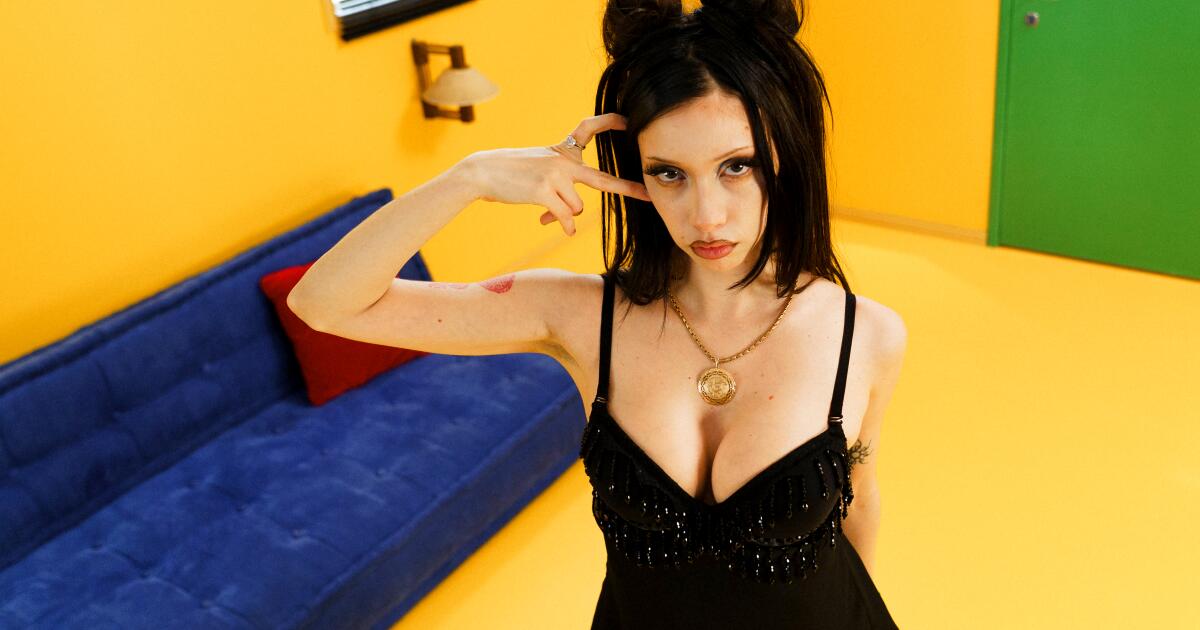
“[I’m] weeding out the people who get scandalized,” says Six Sex of her provocative music.
(Catalina Jacobo)
Advertisement
I was really taken by the “Ultra” album cover. You’re wearing a white bikini and in this “come to Jesus” pose. What was the goal? [laughs] It was hard, because I wanted the cover to represent what the entire journey of the album meant to me. I was looking for something strong and heavy in visual terms, because with “Ultra”, this is the first time I’ve finished a long, heavy project and I see the start of something. It’s like something new was unlocked. I found a new way to convey feelings, and a new way to create as well. It’s not like I just finished, and it is what it is. Rather, it is the beginning of something bigger.
Is there an element of separation at all between the artistry and you as a person? I think they’re pretty close. It’s as if Six Sex was sort of a fable, or like a hentai or comic [version of] my life. It’s also happened that things I wrote as a joke later became reality. But generally, I draw inspiration from things that actually happened to me.
Is it weird to put those intimate experiences on an album? No, not for me. Because I’m not speaking so seriously, I don’t feel exposed. Even though my persona and my character are very close to one another, I don’t have to prove anything to anyone. I’m not trying to make you believe in something. The songs stop being about me as soon as someone else listens to them. There are certain things we can all see ourselves represented in, and I think my music aims for that, too.
I want to ask about your performance style. I saw you live in Los Angeles and was really taken by the energy exchange between yourself and the crowd. How do you approach live performance? Nowadays, I’m in a balance between performance and being a human being that connects with people and can pause to look in the eyes of the audience to register how they feel. I like being in a showgirl role, and at the same time, knowing when to step out of it.
Advertisement
Sometimes I go up there after having a crappy day, thinking that I’m gonna screw it up. And when I get up there and connect with the people, everything flows in a perfect way.
Does the music transform when it’s performed live, versus on a record? A lot of your music seems designed to be played in the club. I think it’s very personal. For me, I’m a bit autistic; sometimes when I’m at a show, I get different sensations. It really depends on the person. I like seeing people’s reactions live when I start playing these songs for the first time. People were super hyped. They were enjoying them and jumping around a lot. It feels really fresh.
You reference ‘90s club classics all over “Ultra,” including by U.K. band the Prodigy on “Bitch Up.” How did these sounds come into your life? These sounds evoke a special kind of nostalgia for me. Even though I hadn’t been listening to them lately, they sounded like something I wanted to bring back to the table — songs my uncle used to listen to when I was really young. Like a CD [of] pirated songs that somehow ended up at my house, and at the time I was like, “Wow, what is this music?”
There’s an element of Six Sex that gives “fembot,” like a female, sexy robot. I’m curious if you feel that playing out in your work. [laughs] I didn’t know about the fembot thing. I don’t use Twitter. I [keep] a bubble… against some things that I don’t know. But I’ve always liked the idea that people have that perception of me, to some extent.
Advertisement
How do you feel about the rise of AI as a musician, especially considering your persona adopts that perception? I mean… I don’t have a formed opinion on the matter. I do think that, I don’t know, it’s all very relative. For one thing, I obviously feel like it strips away the human value, but at the same time, it’s also a tool for humans. So it’s kind of contradictory. I feel weird about it…. I don’t know.
Zooming out, I’ve noticed Argentina has been having a musical moment over the last few years between yourself, Ca7riel y Paco Amoroso, Juana Rozas… How do you feel Argentina being represented or even challenged in your music? I feel that culturally, Argentina is a very rich country. However, I do feel like, over generations, a paradigm was broken, and new sounds have been created that don’t necessarily abandon the roots of our music, but were created out of counterculture.
That same kind of counterculture is what makes Argentina be in such turmoil. It’s also the context of our country. Economic, political, social. The key Argentinian figures we refer to nowadays are constantly changing. And that allows you to listen to a variety of genres from Argentina, from people doing different things, and at the same time raising the flag and saying: “Yo soy argentino.” And we love that.
A still from ‘Enola Holmes 3’
| Photo Credit: Netflix
Enola Holmes 3sees Philip Barantini (Adolescence) take over direction from Fleabag’s Harry Bradbeer while Jack Thorne (another Adolescence alum) continues as writer from the first two films. The supposed darker take is not very apparent in this tale featuring the consultant detective’s sister.
Based on Nancy Springer’s charming The Enola Holmes Mysteries, Enola Holmes 3 opens with a wedding in Malta. Enola (Millie Bobby Brown), the younger sister of Sherlock (Henry Cavill), and a detective in her own right, as we have seen from the earlier films, is getting married to sweet, idealistic Lord Tewkesbury (Louis Partridge).
Sherlock is in Malta for the wedding which he strongly disapproves, believing Enola will not be able to pursue her career as a detective once she marries and becomes Lady Tewkesbury. Enola has her own doubts about the marriage — not about Tewkesbury but about his world, the people in it and their expectations.
Enola Holmes 3 (English)
Director: Philip Barantini
Cast: Millie Bobby Brown, Louis Partridge, Himesh Patel, Sharon Duncan-Brewster, Henry Cavill, Helena Bonham Carter, Susan Wokoma
Advertisement
Runtime: 105 minutes
Storyline: As Enola prepares to marry Lord Tewkesbury in Malta, her brother goes missing and the game is afoot
When she finally gets into the carriage for her wedding, she realises she is being followed by a masked rider. After a thrilling chase involving the dropping of many bridal veils, the pursuer is revealed to be Dr Watson (Himesh Patel), Sherlock’s flatmate, friend and chronicler (not yet, though). The mask, the good doctor explains, is for allergies.
He was thundering after Enola because Sherlock has vanished, probably kidnapped, as he was working on another case. When Enola’s future mother-in-law, Lady Tewkesbury (Hattie Morahan) also goes missing, the wedding is forgotten as Enola races against time to solve the mystery.
A still from ‘Enola Holmes 3’
| Photo Credit:
Netflix
The pieces of the puzzle include the Battle of Khost in Afghanistan, looted gold, the Maltese fight for independence in the person of Mikiel Mizzi (Joe Azzopardi) from the Partito Anti-Riformista, and the criminal mastermind Moriarty (Sharon Duncan-Brewster).
Advertisement
Enola’s mother, Eudoria (Helena Bonham Carter) and her friend Edith (Susan Wokoma) are skulking around giving Enola invisible support as Eudoria is in trouble with the law for her dynamite-forward ways.
Enola Holmes 3 zips by in a series of frantic action sequences, quips and callbacks. The storybook look is propped up by those amazing pop-ups. Darker themes arrive in lines such as Moriarty saying “There are few British names that are not tarnished with the pain of its empire.”
Brown has created an endearing heroine in her Enola, even if her habit of breaking the fourth wall, while definitely reduced, has gone way beyond twee to be outright annoying. Cavill’s Sherlock is brave and beautiful and just that little bit cross, while Carter’s Eudoria walks the line between gently eccentric and decidedly odd as she dispenses gems of wisdom including “the puzzle is always as devious as the setter.”
Fast, fun and eminently forgettable, this is popcorn entertainment at its most efficient.