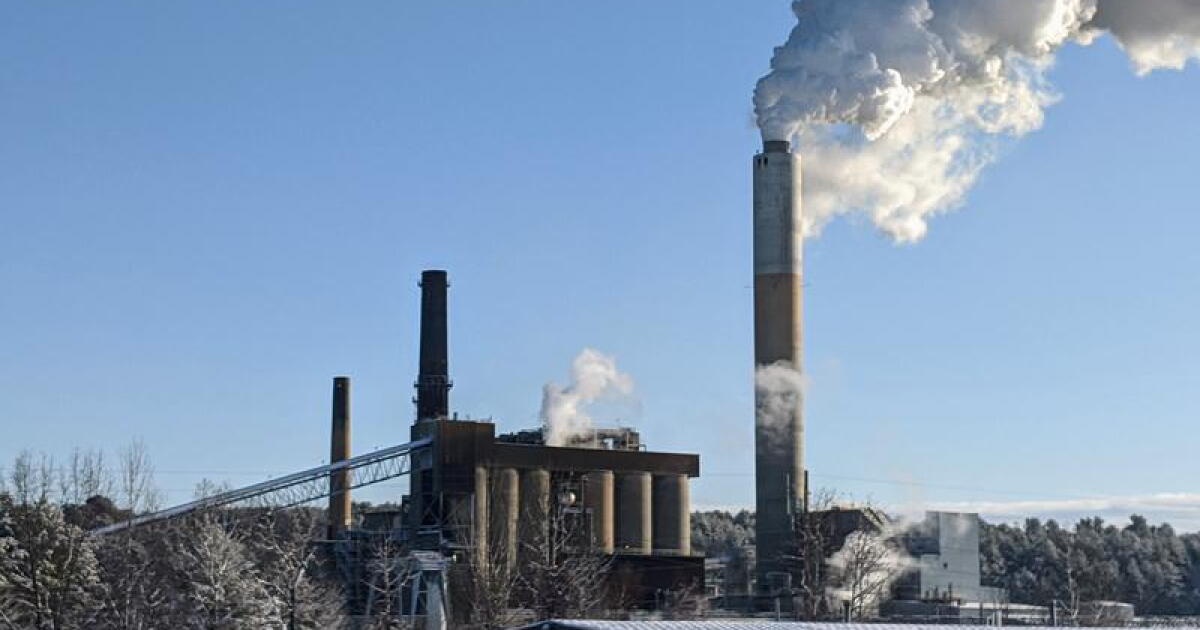
New Hampshire environmental regulators are ordering the Merrimack Station in Bow – the last operating coal plant in New England – to demonstrate that they can comply with their emissions regulations by the end of March.
The last time the plant tested its emissions in February 2023, it exceeded one emissions limit by about 70%, according to state regulators. Since then, the state’s Department of Environmental Services says the plant has not yet been able to retake their emissions test, and it has operated for more than 500 hours in violation of its permit.
Merrimack Station has tried on four separate occasions to retake the emissions test, but has canceled each attempt due to issues including boiler leaks and an electrical breaker issue.
Local advocates say it’s been frustrating to see how long it’s been since the plant showed compliance with emissions regulations. Without a passed emissions test, they say it’s difficult to know if the air quality is safe for surrounding towns when the plant operates.
“It’s really hard to look at this and not get angry,” said Catherine Corkery, an organizer with the Sierra Club’s New Hampshire chapter who has been following the coal plant’s testing reports. “It’s shocking to know that this plant has run over 500 hours without guaranteeing to the public that it’s safe.”
Granite Shore Power, which owns Merrimack Station, responded to the first part of the state’s order on Wednesday, saying the company “disputes the findings and conclusions in the Order and takes issue with the unreasonable relief and deadlines.”
The company said it was aware of operational issues leading up to the emissions test Merrimack Station failed late last February, and undertook a “comprehensive investigation” to figure out the cause of the problems.
In a November statement to NHPR, Granite Shore Power asserted that their failed test had not resulted in “any excessive emissions.” State regulators in their Feb. 7 order maintained that the plant exceeded its emissions limit during its last stack test, and any operations are considered a violation of part of their permit until they pass the test.
Granite Shore Power says they’ve replaced some equipment that had a “pluggage,” which was causing particulate “presence” on testing filters. The replacement of that equipment, the company said, was expected to resolve the operational issues the plant was experiencing.
But still, the coal plant has not been able to retake their emissions test to show it can comply with the limits in its permit. Granite Shore Power says that’s due to “circumstances unrelated” to the emissions control equipment or other measures they’ve taken to fix the original issues.
Failed emissions test
Merrimack Station tested its emissions every three years because of its status as a “low emitting electric generating unit,” a status that it no longer meets the criteria for, according to regulators.
To complete the test, the plant has to run between 90 and 100% of its maximum capacity for power generation. Regulators test the emissions from a combined “stack,” which is part of the facility’s two generating units.
The February 2023 test showed Merrimack Station emitted particulate matter at a rate of 0.052 pounds per million British thermal units. The plant’s permitted limit is 0.030 lb/MMBtu.
Particulate matter is the term the Environmental Protection Agency uses for a mix of tiny solids and liquids like dust, soot, or smoke. The particles are so small that humans and animals can breathe them in – and they can cause major health problems, including lung and heart issues and premature death. They can also cause environmental issues, like acidifying lakes and streams, depleting soil nutrients, and damaging farm crops.
“It is troubling for people who have to breathe this air,” Corkery said, “to not know if it is running as it should.”
State regulators sent a letter to Granite Shore Power about the excess emissions. The company then ran the coal plant between July 4 and July 8, saying it was completing an audit for New England’s grid operator, which has been paying Merrimack Station to be available as needed when the grid requires extra power.
During that window of time, when the grid was experiencing a scarcity of power, one of the generating units experienced issues due to wet coal. That unit only ran on July 7.
In August, the Department of Environmental Services issued Granite Shore Power another notice telling the company they were out of compliance with their limit for particulate matter and requesting more information.
Granite Shore Power wrote back a month later, saying the failed stack test from February was not valid, and the data regulators had requested was not available. Regulators maintained that they considered the stack test valid.
Attempts to retake the emissions test
Merrimack Station has scheduled retests four times, and each time it has run the power plant for between 73 and 139 hours in preparation for it. But each retest was canceled.
An October test was canceled due to a boiler tube leak, according to a permit deviation report filed by Granite Shore Power. In November, a test was canceled for the same reason. In early December, one of the plant’s units experienced an electrical breaker issue that meant it could not safely connect to the electrical grid.
In January, another tube leak caused the plant to go offline before it completed the test.
Rebecca Beaulieu, a representative of the climate advocacy group 350 New Hampshire, said the issues Merrimack Station has been experiencing call into question the ability of the plant to continue providing power to the grid.
“I think this just proves that coal is not the reliable source anymore,” she said.
Granite Shore Power declined to respond to questions from NHPR about how the issues that have kept it from retesting its emissions have affected the plant’s ability to provide power to the electrical grid or meet its requirements from New England’s grid operator, which has been paying it to be able to commit to supplying power through the region’s forward capacity market. The plant generally provides electricity on very hot or very cold days.
Mary Cate Colapietro is a representative from ISO-New England, the region’s grid operator. She said the owners of power plants are responsible for keeping them informed of their operating status, but any permit violations are under the jurisdiction of state or federal regulators.
Power plants can face penalties if they cannot operate during times when the electric system is stressed, she said, but said her comments were not related to any particular facility.
What happens next?
Granite Shore Power has until the end of March to complete an emissions compliance test.
Regulators say the company must treat each day it operates as a day that results in excess emissions until the plant demonstrates it can comply with its permit, or stops operating altogether.
Craig Wright, the head of the Air Resources Division at the Department of Environmental Services, said the company could file an appeal of the order.
Beaulieu, with 350 New Hampshire, said she was surprised that state regulators had taken so long to issue an order, and was hoping for more serious action from regulators in the future.
“If I went and dumped a bunch of trash myself in the Merrimack River, I’d get a ticket at minimum, and would have actual serious consequences,” Beaulieu said. “They’ve gotten a whole bunch of warnings. So I think it’s time for Merrimack Station to face some real consequences for their permit violations.”
Wright, with the Department of Environmental Services, said regulators’ first priority is to get facilities to come into compliance, and they’ve followed the steps in their compliance assurance response policy.
“One of the things we obviously need to do is follow our due process,” he said. “We will deal with the noncompliance issue as we move forward in a manner the Department sees as appropriate.”
Wright said he wouldn’t speculate on the future for the state’s case regarding Merrimack Station. But, he said, his agency can pursue administrative fines or civil penalties in any enforcement case.