Lifestyle
Oscars, take note: 'Poor Things' built its weird, unforgettable world from scratch


Oddsmakers say Barbie will win this year’s Oscar for production design. But here’s the case for Poor Things.
Searchlight Pictures
hide caption
toggle caption
Searchlight Pictures

Oddsmakers say Barbie will win this year’s Oscar for production design. But here’s the case for Poor Things.
Searchlight Pictures
Stepping out of Yorgos Lanthimos’ grotesquely gorgeous Poor Things, I found myself frowning at the world around me, struggling to take in the sheer, thudding, somehow plaintive dullness of it all. At the way the buildings just sort of … sat there sullenly, like a series of well-ordered lumps, risking nothing. The way the inert, featureless sky seemed perfectly content to simply hang in the air, instead of swirling furiously with drama and menace. At the drab, leached out colors of the cars and sidewalks.
I’d spent the previous two hours deep inside a film that was thrilling to look at – that offered a visual tasting menu, serving up its rich and detailed story with inventiveness and style, scene by intoxicating scene. For its sheer craft and invention, I felt certain Poor Things would get nominated for the production design Oscar this year – and win.
But then I remembered that the Academy of Motion Picture Arts and Sciences – which hands out the Oscars each year – has developed a few pernicious habits over the decades. You can count on ’em:
- If a movie’s considered too weird to win best picture, it’ll take home a screenplay award.
- The best costume award goes to period films; if your movie’s got bustles and bonnets, corsets and corsages, you’re gonna have a good night.
- You know how folks say the acting awards never recognize the year’s best acting, but the year’s most acting? Same thing for production design.
When it comes to production design, the Academy likes a big swing. It wants to see the work (read: the budget) onscreen. This is why, year in and year out, the best production design Oscar goes to films that spend millions to painstakingly recreate historical eras (All Quiet on the Western Front, Mank, Lincoln), films that sink the GNP of small countries into bringing the fantastic to life (Dune, Black Panther, Avatar), or films that do a bit of both at once (The Shape of Water, Hugo, Pan’s Labyrinth).
Jerrod Carmichael on the set of Poor Things.
Yorgos Lanthimos/Searchlight Pictures
hide caption
toggle caption
Yorgos Lanthimos/Searchlight Pictures
Jerrod Carmichael on the set of Poor Things.
Yorgos Lanthimos/Searchlight Pictures
This year’s contenders fit the mold. There’s your historical epics like Oppenheimer, Killers of the Flower Moon and Napoleon, which flood the screen with thousands of tiny, period details to situate us in a specific time and place. There’s Barbie’s fantasy world of shiny, retina-sizzling pink plastic. And there’s the visionary, pseudo-historical alt-reality of Poor Things.
Barbie‘s the odds-on favorite to take home the production design award this year, and it’s easy to see why. The filmmakers had a very specific, and thus very difficult, job to do: Distill the mutable design aesthetic of a toy that’s weathered six decades of change into a single clear vision that’s specific and instantly, universally recognizable as Barbie. It’s a lot, no question; I doff my wide-brimmed pink gingham beach hat to them.
But I’d argue that what Poor Things accomplishes is something more, something that strikes me as the essence of truly great production design – it supplies us with a bespoke visual language that reveals what the film’s truly about.
And what Poor Thing‘s about is Bella, played by Emma Stone, who is brought into the world by a brilliant surgeon (Willem Defoe) who reanimates the corpse of a pregnant woman after replacing her brain with that of her unborn child. But director Yorgos Lanthimos and screenwriter Tony McNamara are less interested in Bella as one man’s scientific creation and more concerned with Bella as a woman who creates herself. As Bella grows into herself sexually, intellectually and politically, her curiosity and confidence allow her to embrace her individuality, on her own terms.
Emma Stone in Poor Things.
Atsushi Nishijima/Searchlight Pictures
hide caption
toggle caption
Atsushi Nishijima/Searchlight Pictures
Emma Stone in Poor Things.
Atsushi Nishijima/Searchlight Pictures
Throughout, Lanthimos and production designers James Price and Shona Heath help us chart Bella’s development by creating a sealed-off world, a kind of cinematic terrarium, for us to watch her grow inside – a world that resembles our own only in passing.
Poor Things takes that world building seriously – and literally. The streets of its sort-of Victorian London, Lisbon, Alexandria and Paris were built on vast soundstages. The fantastical architecture of these pseudo-cities combine familiar references – Belle Epoque, Gaudi’s Modernisme, Art Deco, Neo-Gothic – to create a singular aesthetic that reflects who Bella is: She, like the world around her, is a thing that has been obviously, painstakingly wrought. She and it are constructs, made with deliberate purpose, from scratch. They belong to themselves.
Part one: London
The film’s opening scenes take place in a fanciful, quasi-Victorian London, in and around Bella’s birthplace — the home of Dafoe’s Godwin Baxter. Airships hang in the gray skies above its roof, and Baxter’s motorized carriage sports a superfluous horse-head to more easily blend in with the other horse-drawn vehicles on the narrow, curvilinear cobblestone streets.
Ramy Youssef and Willem Dafoe.
Yorgos Lanthimos/Searchlight Pictures
hide caption
toggle caption
Yorgos Lanthimos/Searchlight Pictures
Ramy Youssef and Willem Dafoe.
Yorgos Lanthimos/Searchlight Pictures
The interiors of the surgeon’s home echo the man’s profession – its rooms and hallways seem as if they have been carved out of the walls with a scalpel and hastily rearranged. These early scenes are shot in black and white to underscore the fact that Bella is still in her developmental infancy, and her status as Godric’s sheltered plaything is established by the house’s low ceilings, which loom into every shot and lend a claustrophobic sense of oppressiveness.
Part two: Lisbon
Bella absconds to Portugal with the smarmy lawyer Duncan Wedderburn (Mark Ruffalo) and experiences her sexual awakening. This is the point at which color surges into the film, splayed across the sun-dazzled, Marshmallow-Peeps-yellow streets of Lisbon. Everything about the look of these scenes seems deliberately artificial, even fantastical; we’re reminded that this is Bella’s first step into the wider world, and these oversaturated, canary-colored walls and rich vermillion terra-cotta rooftops help us see things as she does, with wonder edging into disbelief.
Alt-Lisbon in Poor Things.
Searchlight Pictures
hide caption
toggle caption
Searchlight Pictures
Alt-Lisbon in Poor Things.
Searchlight Pictures
Part three: Ocean liner
As Bella’s worldliness increases, she begins to see Wedderburn as the weak, simpering fool he is. He responds by kidnapping her and forcing her to accompany him on a cruise to Alexandria. The cruise ship itself is a sleek, richly appointed teak-and-glass marvel; their stateroom is a dark space of rich browns and lurid reds – a kind of tufted Jules Verne sex capsule.
Yorgos Lanthimos/Searchlight Pictures
Yorgos Lanthimos/Searchlight Pictures
But Bella and Wedderburn never take advantage of it. They’ve stopped having sex and instead quarrel often; Wedderburn even goes so far as to threaten violence. As if in response to these heightening stakes, and to signal Bella’s growing wariness, the skies around the ship begin to roil with low clouds of purples and yellows – the colors of an aging bruise.
Part five: Alexandria
When the ship reaches Egypt, Bella goes ashore with Jerrod Carmichael’s Harry, a cynic determined to prove to her that the world is a miserable place. To do this, he need only get her to gaze from the balcony of the swank hotel bar they’re visiting. There, far below, the poor and downtrodden suffer and die.
The production designers pull out all the visual stops here, by showing us what Bella sees as she sees it: an ancient, ruined structure covered in sand, where wailing men and women bury their infant children. The gulf separating her from them is made garishly physical: A staircase leads down from the balcony she’s standing on; once, it descended all the way to the plaza where the poor now lay moaning and dying. Long ago, however, the bottom of the staircase crumbled away. She cannot reach them; they are stranded, lost, alone.
This scene takes place under the kind of bright sunlight that, back at the start of her journey in Lisbon, seemed like a cheery, warm and inviting confection. Now that same quality of light has become blistering, ruthless – and deadly.
Part six: Paris
Bella leaves Wedderburn for good and takes a job as a sex worker in a wintry Paris. The narrow streets she navigates recall the winding alleys and squares of London, as does the snow, which evokes the film’s monochromatic early scenes. But Bella is a fundamentally different person than she was in London, and her work allows her to complete her sexual education and embark upon a political one.
Atsushi Nishijima/ Searchlight Pictures
The baroque lobby of the brothel in which she works features sections of floor lit from below, which put the women who work there on display, under their cold white glare. It’s a stark and deliberate contrast to the plush velvet sofas and settees on which the women lounge as they await their next client. It’s as if the filmmakers are visually referencing Bella’s current state of mind – she’s a sex worker (the velvet) who is ruthlessly pragmatic, even scientific, in her duties (that harsh, clinical lighting).
As for Bella’s bedroom, it, too, seems remarkably practical. The visual language of the film’s production design grows more muted, here – downright realistic. That’s because Bella no longer sees the world through the eyes of a naive, delighted child; her perspective has coalesced into something logical, hard-earned, mature.
Part seven: Back to London
Yorgos Lanthimos/Searchlight Pictures
Yorgos Lanthimos/Searchlight Pictures
The film concludes with Bella’s return to London to tie up loose ends: Baxter’s final fate, her relationship with the sad-eyed, long-suffering Max (Ramy Youssef) and her unresolved business with a man from her past (Christopher Abbot).
Baxter’s house is the same as ever, but Lanthimos now doesn’t include its low ceilings in scenes taking place there – the 0ppressiveness is gone, and Bella’s asserting her independent personhood, moving on. In fact, the film’s final scene takes place in the house’s back garden, under a wide open sky – in full color. But now those colors are milder, closer to the more moderate hues seen in “our” world. Bella is planning her future, and it’s one that she could only arrive at after taking the journey she has. She sees the world as it is. (There will still be plenty of room for the weird and grotesque in her life, we are assured – Baxter’s duck-pig and other unholy animal hybrids aren’t going anywhere.)
Poor Things does what all the other nominated films this year do, but it goes even further. It’s not content to recreate one single, specific historical moment, or to concoct a bright bubble-gum fantasy world that contrasts with ours. Instead it lays out a discrete series of visual cues and design choices that bring us along with its main character; they underscore, and comment on, the hard choices she makes throughout the story.
The design team behind Poor Things blends familiar styles and points of historical reference to produce a new aesthetic, one that’s unique to the film and its characters. It plays with layers of artifice and textures to instill in us a deliberate sense of the uncanny, of strangeness and untapped possibility. And it does all this for a very good and necessary narrative reason – we get to crawl inside Bella’s head and be there with her as her dawning self-awareness proceeds to change how she sees the world.
And in the process, because it’s just that great of a film, it changes how we see the world, too.


Once rivals on the tennis court, Martina Navratilova, left, and Chris Evert have become close friends in retirement. They are pictured above at the French Open in 1986.
Trevor Jones/Getty Images Europe
hide caption
toggle caption
Trevor Jones/Getty Images Europe
Chris Evert and Martina Navratilova were the most successful women’s tennis champions of their generation. Both were 18-time Grand Slam tournament winners — and each other’s greatest rivals.
Evert, a Florida native, became a tennis star in her teens. Navratilova was born in communist Czechoslovakia, and emerged as a player after Evert was established. They first faced off during a match in Akron, Ohio, in 1973, when Evert was 18, and Navratilova was 16. Evert won, but Navratilova left an impression.
“I remember thinking to myself, holy cow, when this young girl gets into better shape, she is going to be a force to be reckoned with,” Evert says. “She had so much talent. Her hands were quick, she had a big first serve, she had a big forehand, and she just was so powerful.”

Two years later, on the day she lost a semifinals match to Evert at the U.S. Open, Navratilova defected to the U.S. In the years that followed, her tennis game improved. Though she and Evert had initially been friendly, the friendship cooled as their rivalry heated up.
“Playing Chris was difficult because how can you not like Chris? What’s not to admire?” Navratilova says. “She was like the epitome of cool.”
The new Netflix documentary Chris & Martina: The Final Set tells the story of how Evert and Navratilova re-established their friendship and how they both faced cancer in retirement. Evert was diagnosed with ovarian cancer in 2021; Navratilova was diagnosed with throat and breast cancer in 2022.
“I can’t get away from her,” Evert jokes. “We had a 15-year career, and then we got cancer at the same time. It really is freaky, but I always say: If I want someone to be in the trenches with me, it’s Martina because she has been so supportive and so understanding.”

Navratilova agrees: “We have such a level of trust that we know whatever we say to each other, it stays there. We give each other the best advice we know how to. And there is no ulterior motive, no playing games.”
At the time that this interview was taped, Evert and Navratilova were both in remission from cancer. But late last week, Evert disclosed she’d recently been diagnosed with a recurrence of ovarian cancer.

“We know whatever we say to each other, it stays there,” Martina Navratilova says of her friendship with Chris Evert.
Netflix
hide caption
toggle caption
Netflix
Interview highlights
On supporting each other through cancer
Evert: There are a lot of phone calls between us. … I don’t cook, but Martina would bake bread for me, and her wife Julia would cook, make some chicken soup. … I got a lot of food from Martina. She got a necklace from me.
Navratilova: I get jewelry from Chris, she gets food from me.
Evert: Martina’s and my relationship — because we’ve had one for 50 years — is not the type where we have to talk to each other every day to maintain the closeness. I always knew she was there. She always knew I was there if we needed to talk, and that was that.
On the weakness they experienced with cancer
Navratilova: Chris’ diagnosis and treatment was much more life-threatening than mine, percentage wise, but my treatment was more difficult physically. … I was in New York for seven weeks and I literally sat on a yoga mat, maybe half an hour of the seven weeks, and did some stretching. I couldn’t even do the down dog pose because I would have fallen down. I had absolutely zero strength left.
Evert: The chemo kicked my butt, let’s put it that way. … It left me very weak, very, very weak. After chemo I would have three or four days of intense nausea and I just would feel tingling in my body and it just wasn’t nice. I didn’t have the energy. To walk six blocks was a big deal for me. And it was foreign. You know, it felt like it wasn’t my body, for sure.
On watching the old footage of their matches together for the documentary
Navratilova: For me, it was fun watching with Chris, because we had different reactions to what happened on the court. But what impressed me is how well we played with those wooden rackets. Because you know what? Those rackets are not easy to play with. But you try to put yourself in there physically, what it was like, mentally, what it is like. And it’s like, “Oh, I should have gone down the line,” or, “I can’t believe I missed that shot.” Or “Chris, you had such a great pass.” It was amazing. So it was impressive. … I wish I could still have that six-pack, but anyhow.

Evert: I remember feeling genuinely happy for her. I remember it was her first Wimbledon. That’s always been her dream since she defected. Her family couldn’t be there to watch her. She was all alone. And I just was happy for it. And I knew that this was gonna be one of many for her to win.
On defecting to the U.S. in 1975 when she was 18 years old
Navratilova: I was thrilled to be in the States. I always loved American cars. And when you ordered a ham sandwich, you got, like, two inches of ham and two slices of bread. Whereas growing up, you had thick bread and one slice of ham. So I thought I was in heaven. And it was $2.30 for that sandwich. I still remember it. I couldn’t believe how much ham I was getting.
Lauren Krenzel and Nico Gonzalez Wisler produced and edited this interview for broadcast. Bridget Bentz, Molly Seavy-Nesper and Beth Novey adapted it for the web.


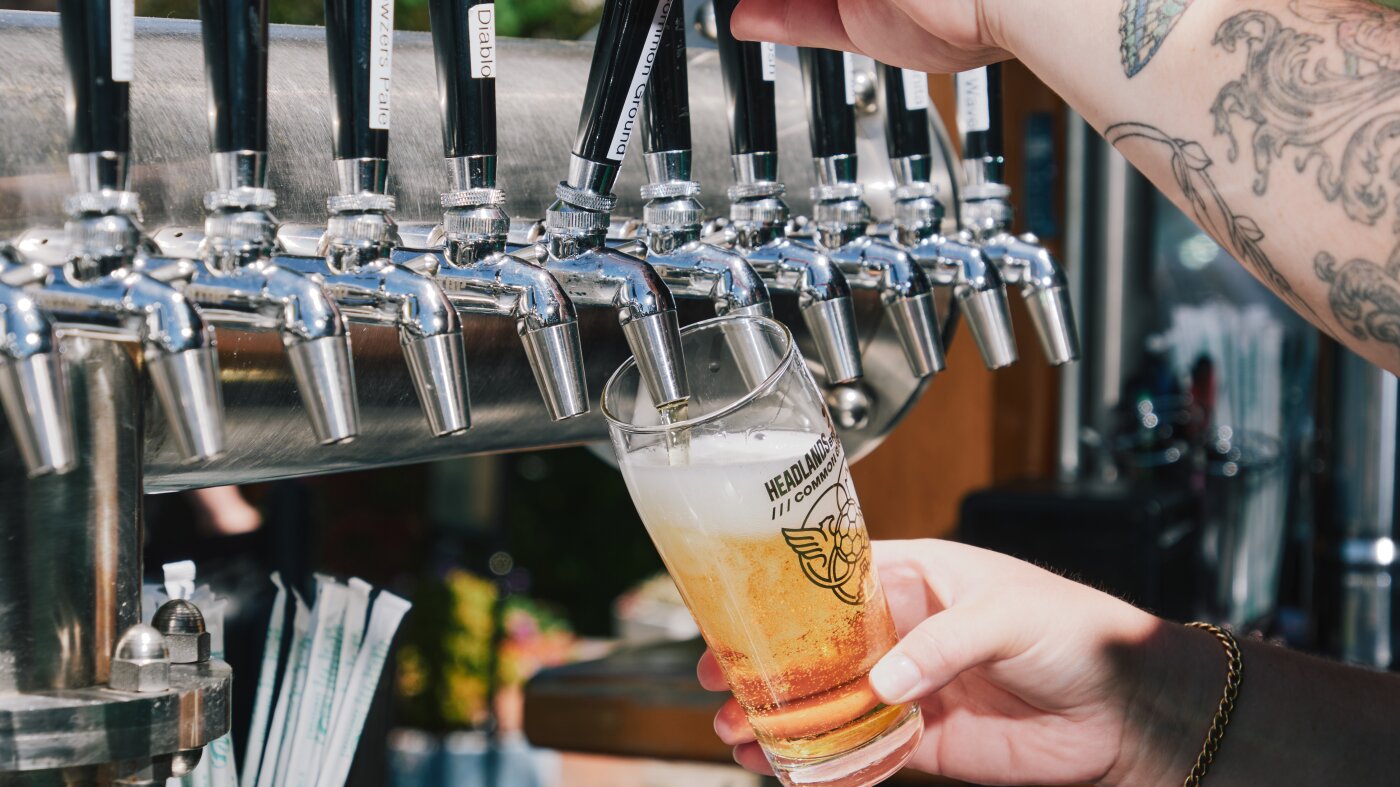
Headlands Brewing launched its World Cup-themed beer Common Ground ahead of the first World Cup game in June.
Justin Gellerson for NPR
hide caption
toggle caption
Justin Gellerson for NPR
The British betting company William Hill predicts that soccer fans will throw back more than 5 million pints of beer in stadiums and fan zones during this year’s World Cup. And that number doesn’t even account for the millions of pints being poured in bars as fans tune in to the global soccer event.
But while international soccer crowds are focusing on goals and penalties, a trio of craft breweries from the tournament’s three host nations are using the tournament to brew something increasingly rare: cross-border solidarity.

A shared recipe with local spin
The collaboration began months ago over a flurry of video chats and emails. The beermakers at Rey Árbol Brewing Co. in Mexico, Headlands Brewing in the United States, and Cabin Brewing Co. in Canada set out to design a single, unified recipe representing the brewing traditions of all three nations.
“It’s a Mexican lager,” said Alejandro Gomez, founder of Rey Árbol.
“That’s like a West Coast IPA,” said Ryan Frank, chief operating officer and brewmaster for Headlands.
“And up in Canada, most of our beers are hop driven,” said Haydon Dewes, co-founder of Cabin. “So we thought, let’s go for a dry-hopped Mexican lager.”
While all three breweries share the exact same recipe, each is giving the final product a distinct local spin, including unique, regionally designed labels. A four-pack of the U.S version costs $15.99. Frank said Headlands has produced about 130 cases of the limited-run brew.
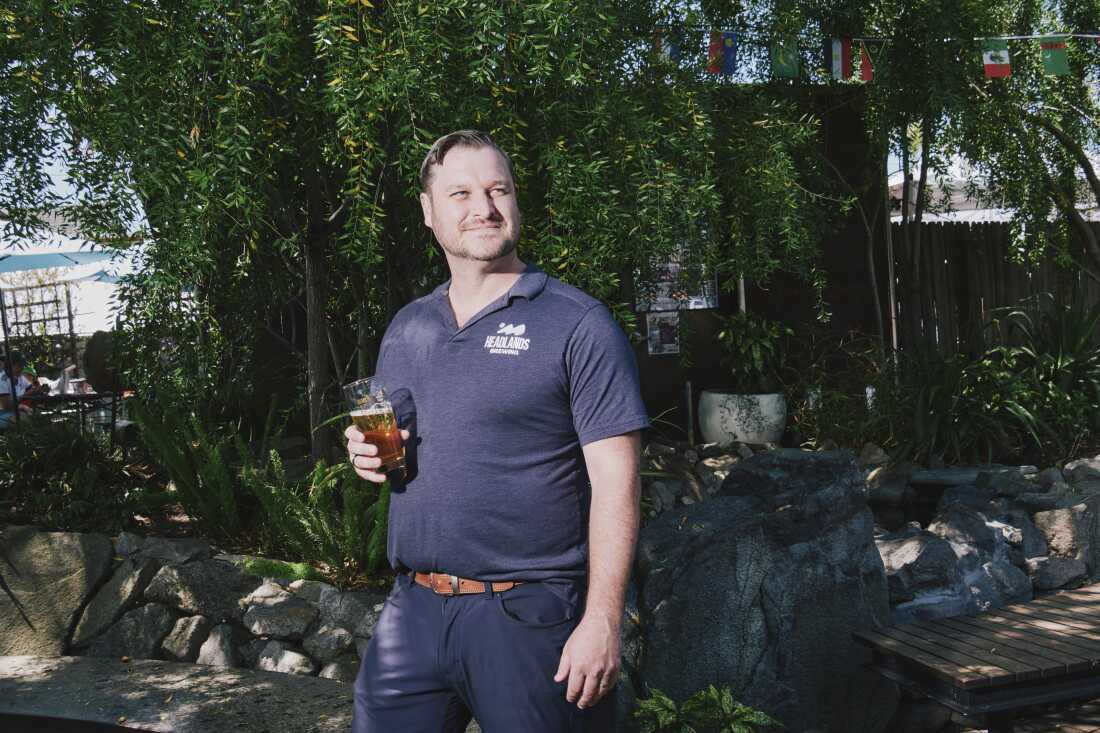
Headlands Brewing COO and brewmaster Ryan Frank drinks a Common Ground beer in Berkeley, Calif., on June 11.
Justin Gellerson for NPR
hide caption
toggle caption
Justin Gellerson for NPR
For the brewers, however, the project is less about marketing and more about connection: They named the multinational beer “Common Ground.”
“When I go to California or Canada, they will treat me like family,” Gomez said.
“It makes the world feel so much smaller,” said Dewes.
“It’s about building bridges and knowing what’s important in life,” said Frank. “And for us, that’s soccer and beer.”
Geopolitical friction in the taproom
The official rhetoric surrounding World Cup 2026 mirrors the brewers’ optimism, with promotional materials promising a tournament where billions are “united as individuals, united as billions.”
Yet this idealistic messaging stands in sharp contrast to a prickly geopolitical reality. Tensions between the U.S., Mexico and Canada have mounted over trade tariffs and auto manufacturing standards as the three nations renegotiate long-standing trade agreements.
The independent brewers behind Common Ground are feeling that friction firsthand through the rising costs of aluminum cans and raw ingredients.
“There are 15% tariffs slapped on any European-grown hops, which are really critical to some of our core brands,” Frank said.

Headlands Brewing brewmaster Ryan Frank and CEO Austin Sharp share a Common Ground beer in Berkeley, Calif., ahead of the first World Cup game on June 11.
Justin Gellerson for NPR
hide caption
toggle caption
Justin Gellerson for NPR
The political discord hasn’t just been confined to trade boards.
When signing an executive order to establish a White House Task Force for the World Cup in March 2025, President Trump suggested that cross-border hostilities might actually benefit the tournament. “Oh, I think it’s gonna make it more exciting,” the president said.
A bittersweet reminder
Tension on the soccer field is one thing; between nations, it’s another.
“It’s true that when it comes to the actual soccer, we’ve developed a very healthy, vibrant rivalry between the three countries,” said Andrés Martinez, the author of The Great Game: A Tale of Two Footballs and America’s Quest to Conquer Global Sport and co-director of Arizona State University’s Great Game Lab, which studies the intersection of sports, media and geopolitics. “But we’re also linked together in this very symbiotic relationship.”
Martinez said that when the U.S., Canada and Mexico initially launched their collaborative bid to host the World Cup back in 2017, the political climate was warmer.
“It was meant to showcase these tight bonds that had developed between the three countries,” Martinez said.

The makers of Common Ground used a shared recipe, but all created their own distinct packaging for the beer: Canada’s Cabin Brewing Co.; Mexico’s Rey Árbol Brewing Co.; the United States’ Headlands Brewing.
Cabin Brewing Company, Rey Árbol Brewing Company, Headlands Brewing
hide caption
toggle caption
Cabin Brewing Company, Rey Árbol Brewing Company, Headlands Brewing
But relations have soured since then, making cross-border business collaborations like Common Ground an anomaly rather than the norm for this tournament.
“To see craft beers across the three countries coming together like this, it’s a bittersweet reminder of what we were hoping to see a lot more of,” Martinez said.
Finding the real common ground
If trade wars and political posturing are looming large in Washington, D.C., Ottawa and Mexico City, they feel a world away at Headlands Brewing’s busy North Berkeley location.
As fans gathered to watch a crucial match between Mexico and South Africa at the start of the tournament, the sunny patio erupted into cheers and shrieks of “Goal!” when Mexico found the back of the net.

Headlands Brewing hosts a screening of the first World Cup game on June 11 in Berkeley, Calif.
Justin Gellerson for NPR
hide caption
toggle caption
Justin Gellerson for NPR
Hovering over a pint of the collaborative brew, soccer fan Roberto Mandujano reflected on the cross-border experiment.
“Three different ways, three different taste buds come together to make something cool,” he said.
When asked about the underlying political tensions between the host nations, Mandujano shrugged off the discord.
“We live in a world where everyone wants to make everything political,” Mandujano said. “But I think we’re all here for soccer. So I guess that’s the common ground.”
-

 Maryland4 minutes ago
Maryland man sentenced for making online threats toward Black and Muslim communities
-

 Michigan11 minutes ago
Michigan Lottery Daily 3, Daily 4 results for June 29, 2026
-

 Massachusetts14 minutes ago
Millions of gallons of wastewater discharged into Merrimack River due to broken pipe
-

 Minnesota19 minutes ago
Driver in fatal crash near Belview, Minnesota, was fleeing law enforcement
-

 Mississippi26 minutes ago
Mississippi gas prices drop ahead of Fourth of July weekend
-

 Missouri29 minutes ago
Gas prices falling in Missouri despite U.S. conflict with Iran
-

 Montana34 minutes ago
June 29 recap: Missoula and Western Montana news you may have missed today
-

 Nebraska41 minutes ago
Nebraska running back arrested in Florida on aggravated battery charge

