Business
Column: The climate scientist who just won a $1-million judgment against climate change deniers

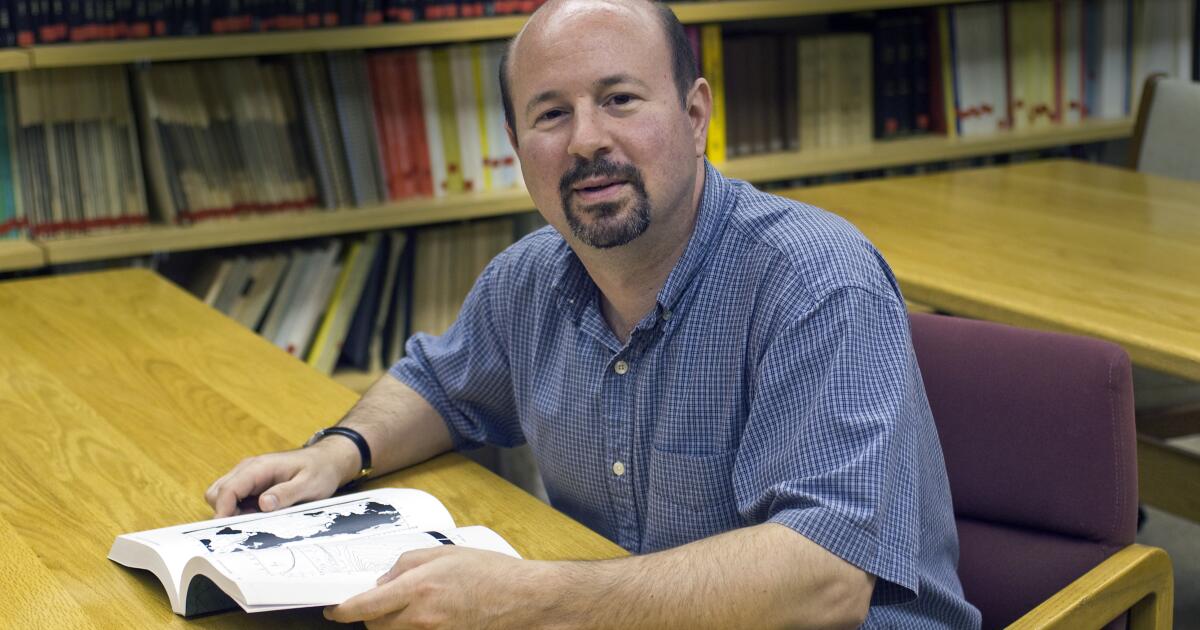
One of the major issues confronting scientists today — especially those working in the heavily politicized fields of global warming, vaccines and the origin of COVID-19 — is how to deal with the torrents of misinformation and disinformation, some of it personal, pushing back against their work.
Climate scientist Michael E. Mann just found an answer. Sue the critics — and win.
Last week, a Washington, D.C., jury awarded Mann more than $1 million in punitive damages against two right-wing writers who had accused him of research fraud.
I hope this verdict sends a message that falsely attacking climate scientists is not protected speech.
— Climate scientist Michael Mann
The jurors didn’t appear to find this a close question. They ruled that the online posts written by Rand Simberg and Mark Steyn breached the legal standards applied to defamation lawsuits involving a public figure such as Mann — that their writings asserted facts that were “provably false” and that they knew or should have known that their assertions were false.
The jury awarded Mann $1 in compensatory damages from each defendant, plus $1,000 in punitive damages from Simberg and $1 million in punitive damages from Steyn. The verdicts capped a painful 12-year battle that Mann waged to protect his reputation from trolls questioning his integrity.
“I hope this verdict sends a message that falsely attacking climate scientists is not protected speech,” Mann said after the verdict.
There’s more to the case than the exoneration of a single scientist. The verdict scored a direct hit on personal attacks on scientists using innuendo and outright lies, all aimed at advancing partisan and economic ideologies by undermining scientific research.
“The attacks denigrating science and trying to undercut science, both for climate science and biomedicine, [are] not just about the science,” Peter Hotez, a leading authority on medicines and vaccines and a prominent foe of anti-science politics, told PBS.
“It’s now gone the next step to attack the scientists and portray us as public enemies,” said Hotez, who is collaborating with Mann on a book about the anti-science movement. “Both Michael and I are stalked regularly. We receive threats online, phone calls to the office, sometimes physical confrontations. So it’s gone out to that new level.”
Scientists working in all fields subjected to partisan critiques have lamented that the flow of lies about their work and about established science can be unrelenting.
The critics are financed by right-wing foundations and their claims repeated at congressional hearings — typically, these days, chaired by House Republicans aiming to pump conspiracy theories into the mainstream. Sometimes, as many targets have experienced, the criticism degenerates into personal threats and physical confrontations.
Much is at stake in these battles. Global warming is an elemental threat to life on Earth, and ignoring it as its deniers advocate is a recipe for extinction. Campaigns by anti-vaccine activists can cause sickness and death for untold millions in the U.S. and worldwide.
To understand Mann’s case, it helps to start at the beginning.
In 1998 and 1999, Mann and colleagues published two papers reporting that global temperatures, which had been stable for at least a millennium, began rising sharply during the 20th century and especially in the last 50 years. They used evidence from tree rings, sediment cores from oceans, caves and lakes and ice cores from glaciers to reconstruct climate patterns of the distant past.
The famous “hockey stick” graph developed by Michael Mann and colleagues showed average climate temperatures soaring sharply over the last century as burning of fossil fuels increased.
(Intergovernmental Panel on Climate Change)
The 1999 paper illustrated their findings with what became known as the “hockey stick” graph because it resembled that implement with a long horizontal shaft (the distant past) ending with a nearly upright blade (recent times).
Mann’s research and the graph drew immediate pushback from global warming deniers, who questioned his data and methodology. After 2009, when emails among climate scientists including Mann were hacked from the files of the University of East Anglia in Britain and cherry-picked to suggest that the scientists were manipulating their data, they also questioned his integrity.
The attacks on Mann should have been ended by a series of official investigations through 2021 that cleared him of research wrongdoing, including two by Pennsylvania State University, where Mann taught from 2005 to 2022, and another by the National Science Foundation.
In all, eight separate investigations by official bodies found Mann innocent of wrongdoing or validated his research findings; the results all were made public. But the attacks continued, even up to this day. (Mann is now at the University of Pennsylvania.)
That brings us to the noxious posts by Simberg and Steyn.
Simberg’s post, titled “The Other Scandal in Unhappy Valley,” was published by the Competitive Enterprise Institute on July 12, 2012 — after Mann had been cleared. It’s worth noting that the CEI is a free-enterprise think tank that has been funded by the Koch network, other far-right moneybags and the tobacco industry, and that global warming denial has been one of its favorite themes.
Simberg drew a connection between the scandal in the Penn State football program involving a cover-up of sexual molestations by Jerry Sandusky, an assistant coach, and the university’s purported “whitewash” of Mann’s hockey stick deceptions. (The headline referred to the nickname of Penn State’s scenic location, “Happy Valley.”)
“Mann could be said to be the Jerry Sandusky of climate science,” Simberg wrote, “except for instead of molesting children, he has molested and tortured data in the service of politicized science.”
CEI has left Simberg’s post up on its website but has excised his references to Sandusky as “inappropriate.” However, the full post, including its original references to Sandusky, was reprinted in a 2016 decision by a Washington, D.C., court of appeals that allowed Mann’s case against the writers to proceed to trial.
Steyn followed Simberg’s post with his own, published in the conservative organ National Review on July 15.
While writing, apropos of Simberg’s Sandusky reference, that he was “not sure I’d have extended that metaphor all the way into the locker-room showers,” Steyn asserted that Simberg “has a point.” He called Mann’s hockey-stick graph “fraudulent.”
Steyn and Simberg both questioned the investigations that cleared Mann. Simberg noted that Penn State’s investigators were all tenured professors on its faculty. Steyn wrote, “If an institution is prepared to cover up systemic statutory rape of minors, what won’t it cover up?”
Simberg also referred disdainfully to a 2011 investigation by the National Science Foundation’s inspector general, which exonerated Mann, writing that it relied on information from Penn State and therefore was “not truly independent.”
A couple of points about that. First, Simberg wrote that the investigation was by the National Academy of Sciences, which is different from the NSF. (The NAS conducted its own investigation upholding Mann’s work, in 2006, but that’s not the one Simberg quoted.)
Second, the NSF’s office of inspector general specifically stated that in its investigation it did not rely on Penn State.
Rather, it examined “a substantial amount of publicly available documentation concerning both [Mann’s] research and parallel research conducted by his collaborators and other scientists” in the field of global warming, and also interviewed Mann, “critics, and disciplinary experts” before finding that there was no evidence that Mann “falsified or fabricated any data.”
National Review defended itself and Steyn’s column with the sort of vacuous braggadocio that is its stock in trade.
In a 2012 editorial headlined “Get Lost,” its editor, Rich Lowry, laughed off Mann’s threat to file a lawsuit by pledging that if Mann did so it would be pleased to engage in “extremely wide-ranging” discovery — “we will be doing more than fighting a nuisance lawsuit; we will be embarking on a journalistic project of great interest to us and our readers.”
In any event, National Review turned tail and ran. It persuaded the D.C. court to drop it from Mann’s lawsuit in 2021 by pleading that Steyn wasn’t its employee but merely an “independent contractor” and that none of its employees had reviewed his posting until it was published on its website, which it portrayed as sort of a neutral landing place for posts to appear. That “journalistic project of great interest”? Fugeddaboutit.
The Competitive Enterprise Institute also got itself dismissed from Mann’s lawsuit in 2021 via a similar argument that a judge described as “an assertion of ignorance”: It said Simberg wasn’t its employee and that the low-level employee who did review his article before it posted checked it only for “formatting error and typos,” not for content.
National Review continued to ridicule Mann. In January, as the trial against the writers began in a D.C. courtroom, it labeled Mann “a darling of fashionable opinion,” placed his case in the category of “runaway snowflakery” and called it “laughably weak.” (Whoops.) Given the publication’s court-ordered immunization against liability, it appeared to be taking on the role of a bully who goads others into waging battle with the words, “Let’s you and him fight.”
Now that the verdict is in, National Review is wrapping itself in the U.S. Constitution. It editorialized that a few blocks from the courthouse, “at the National Archives Museum, the 1st Amendment faded a little on its parchment.”
It asserted that Mann won the $1-million verdict merely for a blog post that did no more than “ruffle [his] feathers.” It charged that Mann’s “mendacity and egomania” motivated his lawsuit.
“Ultimately, this lawsuit is not about Mark Steyn or about conservative magazines or about climate change,” National Review wrote, “but about the integrity of free speech in these United States.”
The truth is, however, that Steyn and Simberg lost only after the jury applied the most stringent standards for defamation lawsuits — standards that have been developed precisely to protect “the integrity of free speech” and that protect serious journalism. Mann had to show that the authors knew or should have known that their factual assertions about his work were false, and that’s exactly what he did.
The lesson embodied in the jury award is not that you can’t smear or defame your targets. The jury didn’t rule that you can’t express an opinion about them or their work in the course of robust debate.
What it did rule, and it isn’t alone in honoring this principle, is that you can’t smear them by parading lies and misrepresentations as though they’re facts — not without paying a price.
That may be a frightful lesson for National Review and other publications like it, but it should be comforting for the rest of us.


Tech stocks took another big hit Tuesday as investors sold off shares of companies that have powered the artificial intelligence boom.
Technology companies have been spending billions of dollars investing in data centers and infrastructure needed to support the race to advance AI. But sky-high valuations and geopolitical tensions have some investors questioning whether massive AI spending will pay off, analysts said.
Reflecting the unease, the tech-heavy Nasdaq composite dropped roughly 2%. The Standard & Poor’s 500, a stock market index that tracks the performance of the largest U.S. publicly traded companies, fell by more than 1%.
Share prices for major California tech companies including Nvidia, Qualcomm, Intel and Marvell Technology all dropped. Meta Platforms, Apple, and Google’s parent company, Alphabet, also saw their stock prices slide, though the decline wasn’t as large as the drop in chip stocks.
Shares of Micron Technology, a U.S. memory chip manufacturer, plunged by more than 13% a day before the company was scheduled to report its third-quarter financial results. Anxiety in the U.S. spilled over from Asia, where South Korean tech companies SK Hynix and Samsung Electronics, both major computer memory chip manufacturers, saw their stocks plunge Tuesday by more than 12%.
“Investors are just a bit skittish after very strong moves in tech stocks where any hint of caution causes some investors to hit the sell button,” said Dan Ives, an analyst who heads technology research at Wedbush Securities, adding that it’s a “gut-check moment.”
On Monday, SpaceX saw its shares plunge 16% after a record-breaking initial public offering this month. Its share price then rebounded Tuesday, closing up less than 1% to roughly $156.
Tech companies have been making big bets on the role AI will play in people’s work and personal lives. They’ve been improving chatbots that can generate code, words, photos and videos. The companies also are betting that “AI agents” will be able to proactively tackle more in the future, automating repetitive tasks in customer service, online shopping and other industries. They’re releasing more AI-powered hardware such as smartglasses.
Major tech companies are going head-to-head in the race to dominate AI, competing to sway talent and consumers into using their products. Alphabet saw its stock slip after two of the company’s prominent AI researchers left for rival companies OpenAI and Anthropic.
Despite profitability questions, AI use has been growing. Roughly half of U.S. adults use an AI chatbot, according to a Pew Research Center report released this month. They’re using these tools for search, work tasks, entertainment and even companionship. More U.S. adults reported using OpenAI’s ChatGPT, followed by Google’s Gemini, Microsoft Copilot and Meta AI.
Amid all the hype and spending, there also have been growing fears about whether AI will take over people’s jobs and whether the boom will lead to a bubble that will eventually burst. California AI startups OpenAI, valued at $852 billion, and Anthropic, valued at nearly $1 trillion, are preparing to potentially become publicly traded companies.
“I don’t view this as a bubble,” Ives said. “I view it as we’re going to go through these white-knuckle moments as tech stocks continue to move higher, but the bears will continue to yell fire in a crowded theater when we have these pullbacks.”
Economic factors also could affect how much people are willing to invest in tech company stocks. There’s anxiety over whether the new Federal Reserve Chair Kevin Warsh will raise interest rates, making it more expensive to borrow money. That could cut into a company’s profit margin or decrease consumer spending. United States’ war with Iran is driving up gas prices while the U.S. inflation rate rose to 4.2% in May.
The AI boom is fueling the demand for memory and storage chips, but prices for them are on the rise, prompting some companies such as Apple to look at raising prices for consumer electronics.
Globally, AI spending is projected to increase to $2.59 trillion in 2026, up 47% year over year, according to a forecast by research firm Gartner.
Driven by AI demand, memory and storage vendors have significantly outperformed the S&P 500 and the SOX index, a global semiconductor and microchip index, since the start of 2025, according to a note to clients from BNP Paribas.
Still, investors are on edge ahead of Idaho-based Micron Technology’s earnings report Wednesday, said Gil Luria, head of technology research at financial services company D.A. Davidson. Since January, Micron Technology’s stock has climbed more than 233% to more than $1,000 per share.
“Any indication of a slowdown in demand for AI is seen as a potential turn in the cycle,” Luria said. “While the overwhelming sense is that demand is still far exceeding supply, investors are waiting for Micron to indicate that is still the case.”
Times staff writer Nilesh Christopher contributed to this report.

Tired of the same old dating apps like Bumble and Hinge, Marie Lansley tried talking to an artificial intelligence matchmaker.
For roughly 15 minutes, she chatted with an AI voice on the dating app Known, answering questions about her upbringing, personality, education, lessons from past relationships and whether she’s looking for a serious relationship or something more casual.
“Divorced at 36. Yea, you’re not here to waste time. The way you build your days matter,” the AI voice told her after Lansley replied she was looking for a serious relationship.
Weeks later, the San Francisco resident got a match along with a written summary of why the pair could be compatible. But the stranger wasn’t her type and she wasn’t keen on paying $15 to meet up.
Startups like Known are roping in new users by hosting in-person dating events in San Francisco.
“I want to be able to use AI to improve efficiency in dating and to help navigate a pretty frustrating dating landscape. But there are just some things that are so deeply human that AI technology cannot capture,” said Lansley, who has posted about her dating experience on social media.
Singles like Lansley are dipping their toes into the wacky world of AI dating but they’re also skeptical if it will make it easier to find love. Online dating is ripe for disruption, and tech companies big and small are turning to AI as a potential solution to find people better matches more quickly and help them improve their chances of landing a date.
For years, people have been frustrated and exhausted by the seemingly endless amount of swiping and small talk that go nowhere on dating apps. They’re turning to in-person options such as running clubs, pickleball and speed dating but finding the right partner is still tough.
Online dating remains a popular way people search for a partner but some are dumping the platforms. Tinder’s monthly active users in March dropped 7% year-over-year, though its parent company Match Group noted that the rate of decline has been slowing as it revamps the app.
West Hollywood-based Tinder, which has roughly 50 million monthly users, has been experimenting with using AI to analyze a user’s camera roll and recommend better matches.

Known, an AI dating app, has its branding plastered on a storefront in the Marina District in San Francisco.
Its rival Bumble — an app that initially stood out for having women message their matches first — saw its paying users drop 21% to 3.2 million in the first quarter this year compared to 2025. The company has been working on AI matchmaking and plans to ditch swiping in the last three months of the year in select markets.
Even dating services that have grown users such as West Hollywood-based Grindr, an app for the LGBTQ+ community, and Facebook Dating, which is included in the main social network, are also leveraging AI more.
And new AI dating startups are popping up in California, New York and other states that could change the way people find a partner online. Former Hinge co-founder and Chief Executive Justin McLeod is working on an AI dating app called Overtone, stating on its website that “AI, if used correctly, can help us invent an entirely new way for people to find their partners that is far more personal, far more efficient, and far more effective.”
Some of those startups started in the San Francisco Bay area, where AI dating apps are hosting parties, speed dating, coffee meet-ups and other in-person events to rope people into using their new service.

Singles who downloaded the Known dating app mingle over drinks at Left Door, a cocktail lounge in San Francisco, on Thursday.
On one recent Thursday night, dating app startup Known hosted a dating event at a swanky San Francisco cocktail lounge for people who completed their matchmaking call on the app. The event’s description said attendees would be greeted with “champagne, caviar bumps, and a mysterious envelope” that reveals who the AI matchmaker paired them up with.
Known Chief Executive and co-founder Celeste Amadon, who dropped out of Stanford University to create the AI dating app, said Americans are spending more time alone at home as online services have made it more convenient to do everything from getting food delivered, online shop and date. Young people complain about traditional dating apps yet they’re also still on them.
“The more I understood today’s dating apps, the more clear it became that they have been for the better part of two decades now, designed, tweaked, redesigned, rebuilt, to not work,” she said.
1

2

3

1. A sign that reads, “I love my AI boyfriend” hangs in a San Francisco window. 2. Known, an AI-driven dating app, has their branding plastered on a store front in the Marina District in San Francisco. 3. Celeste Amadon, CEO of Known, poses for a portrait.
The company charges per date to ensure people show up but the startup also has a business incentive to find people a match they actually want to meet, she said. Known plans to expand to San Diego in July, she said. Amadon said she expects the AI matching technology to become more accurate over time.
Known hasn’t shared its user numbers or revenue figures. Founded in 2025, the startup launched the dating app in February and has raised roughly $10 million from investors such as Coelius Capital, Forerunner Ventures and NFX, according to PitchBook.
Grindr is learning more about how much users are willing to use and pay for AI features.
The company has been testing a subscription tier called “Edge” in Australia, New Zealand, the United States and Canada that includes AI tools that recap meaningful chats, display personalized profile recommendations and show users who they’re likely to match with.
Unlike other dating apps, Grindr users don’t swipe through profiles. The app displays a grid of people who are nearby that they’re able to chat with. Grindr has expanded beyond casual dating, allowing people to find friends, travel companions and others in the LGBTQ+ community.
Grindr’s Chief Product Officer AJ Balance said the company is still testing subscription pricing for Edge but some users are willing to pay $350 per month because they’re “seeing a lot of value” and saving time.
“We view AI and new paradigm shifts like it as opportunities to build great, new product experiences that haven’t been developed before,” he said. “Our approach is really to leverage AI, like we did with mobile, to facilitate better conversations, deeper connections, ultimately more success in dating in the real world.”
Other popular dating services aren’t charging for AI matchmaking features. On Facebook Dating, which has more than 21.5 million daily users worldwide, users can use AI to write their profile intro and chat with an dating assistant for free.

AI dating startups are popping up in California, New York and other states that could change the way people find a partner online.
The AI assistant can recommend people looking for a serious relationship, someone with common hobbies or even above a certain height or age. Roughly 1 million people use Facebook Dating’s AI assistant daily in the United States and Canada, Meta said.
Facebook Dating product manager Neha Kumar said AI can help combat “swipe fatigue” facing online dating users.
“You’re sifting through a bunch of profiles. It’s really hard to understand and find somebody that’s compatible for you based on your specific types of preferences,” she said. “We really wanted to think about leveraging AI to solve this growing pain point.”
Technology is also a double-edged sword. The rise of AI tools means people can use technology to easily manipulate photos and craft messages on dating apps that might make them seem much more attractive or charismatic than they are in person. Some people are even turning to AI chatbots for companionship.
“How do we maintain human authenticity and human connection through an AI world? I don’t have a perfect answer to that. I think we’re still figuring it out,” Kumar said.
Lansley, the online dating user, said apps do make dating more convenient but it’s much more interesting to meet people face-to-face. She worries people will rely too much on AI as a “crutch” to replace human intimacy or emotional judgment.
“Chemistry,” she said, “is always going to be analog.”

Los Angeles County saw job gains in May, likely driven in part by rebuilding after the January 2025 wildfires, which destroyed or damaged more than 18,000 structures.
Construction added 2,300 jobs since April, while postings for new jobs in the industry jumped 45% over a year ago —indicating rebuilding in Pacific Palisades, Altadena and nearby is helping boost the local economy, according to a report by the Los Angeles County Economic Development Corp.
“This is consistent with the possibility that wildfire rebuilding activity is increasing construction labor demand in the area,” Max Chomas, an economist at the LAEDC Institute for Applied Economics, said at a presentation this week based on California Employment Development Department and other data.
Motion picture and sound recordings also added 2,800 jobs during the month, despite a deep downturn in Hollywood caused by a reduction in streaming filming, runaway production and other factors. The industry lost 6,700 jobs compared with a year ago.
Still, the job growth since April in construction and Hollywood were among the highlights of a month that saw total county payroll jobs — excluding agriculture and certain other sectors — grow by 9,000 jobs, to 4,618,400. Employment was virtually flat from the same time a year ago.
“May was a relatively good month for employment growth,” Chomas said.
The biggest monthly job gainers were the hotel and restaurant industries, which added 3,700 jobs.
Manufacturing, which has been hit by job losses over recent years, added 400 jobs since April. It also saw a 15% increase in job postings compared with a year ago.
That could reflect the resurgence in Southern California’s aerospace and defense industries, which have seen a sharp rise in startups.
Postings for all new jobs were up 1,134, or 2.4%, since a year ago. Chomas noted that May was only one of five months over the last three years that saw year-over-year growth in job postings.
The gains helped stabilize the county’s unemployment rate at 5.2%, matching April’s rate and down from 5.4% in May 2025.
Still, that is higher than May’s 4.3% national unemployment rate, and it masked some weakness in the local economy.
The rate is calculated by a household survey to determine which members are working, looking for work or no longer seeking employment.
It found 18,000 workers had dropped out of the county labor force in May, artificially driving down the unemployment rate, according the California EDD.
Similarly, California recorded a 5.3% unemployment rate in May, on par with April, despite a drop in the labor force.
That rate is higher than every state other than Delaware. In May, California only added 3,100 non-farm jobs month-over-month — a job growth rate that lags behind the nation, according to an analysis by the Inland Empire Economic Partnership and the Lowe Institute of Political Economy at Claremont McKenna College.
The LAEDC’s report also examined the potential effects the growth in artificial intelligence has been having on L.A. County jobs “exposed” to AI, meaning they are vulnerable to AI replacement.
California has been hit hard by thousands of AI-related layoffs in Silicon Valley as the software has been integrated into the tech workplace — even though there is fierce competition for software engineers with skills and expertise in the field.
The report found that since July 2023, job listings in Los Angeles County for AI-exposed positions — such as clerical and translation positions — have lagged behind other jobs. However, it is unclear whether businesses have replaced or are waiting to replace those workers with AI.
It may be that employers overhired for those positions during the COVID-19 pandemic and are now shedding them, since there is a correlation between AI-exposed positions and those jobs that can be completed from home, Chomas said.
The report also examined macroeconomic trends and policy decisions affecting the national, state and Los Angeles County economies — which have been hit by tariffs, the crackdown on immigrant labor and high energy costs, among other factors.
Nevertheless, consumers continue to spend despite affordability strains, and employers continue to hire selectively amid higher interest rates to battle inflation, said institute economist Shannon Sedgwick.
“During the previous decade, we experienced extraordinarily low inflation, near zero interest rates, relatively stable globalization, and abundant capital. So those conditions may have conditioned us to think that environment was normal,” she said.
“But historically speaking, today’s world of higher rates, greater geopolitical uncertainty and tighter labor markets, they may actually be closer to that long-run average,” Sedgwick noted.
-

 Maryland4 minutes ago
Maryland Lottery Pick 3, Pick 4 results for June 28, 2026
-

 Michigan11 minutes ago
Three U.S. House hopefuls in Michigan own million-dollar D.C. homes
-

 Massachusetts12 minutes ago
Man cited for alleged wrong-way deadly crash
-

 Minnesota19 minutes ago
Minnesota leads all states with 12 draftees – Lets Play Hockey
-

 Mississippi26 minutes ago
Mississippi’s Top High School Quarterbacks: 10 Passers to Watch in 2026
-
Missouri29 minutes ago
Missouri Lottery Pick 3, Pick 4 winning numbers for June 28, 2026
-
Montana34 minutes ago
French Montana, Rick Ross & Max B Turn the BET Awards Into “ – BET Awards 2026 | BET
-

 Nebraska41 minutes ago
"They've Built This": Nebraska commit Barrett Kitrell carries on family football legacy


