Midwest
Rail safety reform efforts stalled in Congress a year after Ohio train derailment

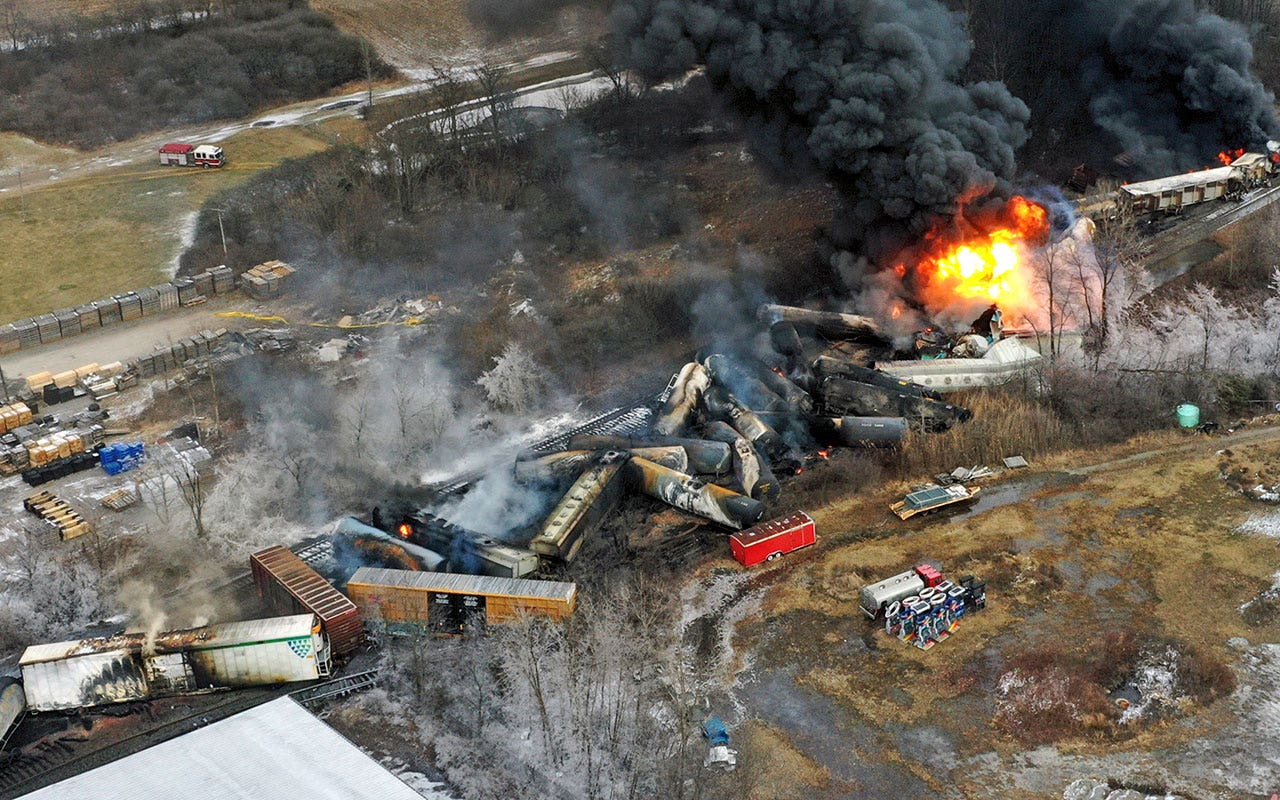
- Congress has yet to take significant action on railroad safety reforms despite ongoing concerns following last year’s train derailment in Ohio.
- The railroad safety act, which proposes federal standards for two-person crews on freight trains, has not advanced to a full Senate vote.
- Despite bipartisan support for the bill, opposition from the railroad industry, which is lobbying against certain provisions.
The changes railroads announced after last year’s fiery crash in East Palestine, Ohio, haven’t yet made a major difference, statistics show, and reforms have stalled in Congress.
A few key measures in the latest Federal Railroad Administration statistics, including the total number of train accidents, worsened over the first 11 months of last year compared to the same period in previous years. Meanwhile there were some improvements with other numbers, like total derailments.
The overall picture is that rail safety hasn’t significantly improved in recent years — and as the Norfolk Southern derailment in East Palestine last Feb. 3 and others demonstrate, just one derailment can be disastrous when hazardous chemicals are involved. The small town near the Ohio-Pennsylvania border is still struggling to recover a year later.
BIDEN TO TRAVEL TO EAST PALESTINE NEARLY ONE YEAR AFTER TRAIN DERAILMENT DISASTER
U.S. Transportation Secretary Pete Buttigieg said there was a meaningful 15% decrease in derailments along mainline tracks after Congress responded to a number of high-profile train crashes involving crude oil in the early 2010s. “Progress has plateaued as derailments and preventable incidents are happening at an unacceptable rate,” Buttigieg said, urging Congress to pass the reforms now.
Portions of a Norfolk Southern freight train that derailed on Feb. 3, 2023, in East Palestine, Ohio, are seen here. The major freight railroads all promised safety improvements after the fiery derailment, but they have yet to make a meaningful improvement in the safety statistics and efforts to reform the industry have stalled in Congress. (AP Photo/Gene J. Puskar, File)
The railroad industry defends its record as the safest way to transport hazardous materials over land — something the head of the National Transportation Safety Board agreed with in recent testimony in the House — though officials acknowledge the railroads need to continue improving safety. And the Association of American Railroads trade group says most of the measures railroads promised to take last spring weren’t completed until late last year, so they aren’t yet reflected in the numbers.
What’s the industry’s safety record?
Safety statistics are mixed for the six biggest freight railroads that dominate the industry — Norfolk Southern, CSX, Union Pacific, CPKC, Canadian National and BNSF.
For the majority of 2023 the total number of train accidents increased slightly to 4,845, including more than 600 deaths.
When comparing 2022 and 2023, the total number of derailments declined about 2.6% — but there were still nearly three derailments a day nationwide. Railroads point out that roughly two-thirds of those crashes happen at slow speeds in railyards and don’t cause significant damage.
How many costly derailments are there?
There were 53 major derailments last year causing damage over $1 million, a surge of nearly 33%. Norfolk Southern has said the cost of the East Palestine derailment has already topped $1.1 billion, and that total will continue to grow with cleanup costs and lawsuit settlements.
The number of total crashes caused by the same issue as the eastern Ohio derailment more than doubled nationwide last year to 19. Overheating bearing failures remain a small fraction representing less than 2% of all accidents.
Are railroads getting riskier?
All 13 railroad unions have sounded the alarm about the dangers of the lean operating model that has cut roughly one-third of the industry’s rail jobs. The unions say that as a result of these cuts, inspections are rushed — or done by less qualified workers — and everyone remaining is overworked. They also say companies may be neglecting to do preventative maintenance.
“East Palestine was no surprise,” said Jared Cassity, the safety chief at the SMART-TD union, which represents conductors. “The next East Palestine, at least at this pace that we’re going, is imminent to some degree.”
The railroads defend their operating model — which relies on fewer trains that have grown much longer — as simply helping them make the best use of their locomotives, tracks and crews without jeopardizing safety, and the Federal Railroad Administration says safety statistics haven’t gotten significantly worse since they started using it.
But Tony Cardwell who leads the Brotherhood of Maintenance of Way Employes Division union, which represents track maintenance workers, said the railroads are under pressure to cut costs from “vulture capitalist” investors.
Over the past year, the railroads have agreed to provide paid sick leave to most of their workers for the first time and improve the way engineers and conductors are scheduled in order to help reduce fatigue.
What have railroads done to improve safety?
Last year, the major freight railroads installed hundreds of new trackside detectors to spot overheating bearings, as part of their goal of adding roughly 1,000 of those nationwide to make the average spacing between them 15 miles (24 kilometers) in most places.
All railroads will now stop trains when bearings detect a gap of more than 170 degrees from the outside air, and there are new standards to help them better track when bearings start to heat up to catch issues sooner.
Railroads have also been installing complex portals filled with cameras, other sensors and advanced detectors to spot problems as they’re moving.
Norfolk Southern also took additional steps like hiring a consultant from the nuclear power industry to review its safety practices, establishing a pilot program so employees can anonymously report safety concerns and changing rules for train assembly to better balance the weight of heavy cars and hazardous materials.
“We’re always going to strive to get better at safety,” Norfolk Southern CEO Alan Shaw told The Associated Press. “There’s no one thing that you do. It’s a bunch of different things.”
Why hasn’t Congress acted?
The railroad safety act has yet to get a vote in the full Senate — or even a hearing in the House. The measure would call for the creation of federal standards for those trackside detectors, increased inspections by qualified employees and two-person crews on every freight train.
Ian Jefferies with the AAR trade group says railroads haven’t opposed the bill outright — but they are fighting several provisions like the two-man crew requirement and locomotive inspection rules. They say such changes aren’t related to what caused the East Palestine wreck. After all, that train had three crew members, and the railcar — not a locomotive — had the flaw. The railroads also want a cost-benefit analysis to be done on the rules.
OHIO RESIDENTS GRAPPLE WITH LONG-TERM IMPACTS OF EAST PALESTINE TRAIN DERAILMENT
House Republicans say they want to wait for the final NTSB report before they act, so they can be sure that any new regulations are directly related to the cause of the East Palestine derailment. The report won’t be out until sometime this summer.
Democratic Ohio Sen. Sherrod Brown, who was part of the bipartisan group that proposed the bill, blames railroad industry lobbying from keeping the act from advancing.
“It goes down to the power of the rail industry. I mean the fact that Norfolk Southern and other railroads have continued to oppose this bill,” Brown said. “They’ve always put profits over people.”
Read the full article from Here


Madison Heights, Michigan, city employees are working to repair six water main breaks that happened on Friday night, officials said.
City workers responded to the ruptures around 8:30 p.m. According to officials, crews with the Department of Public Services have since been working to make repairs.
Officials said Saturday morning that a break at 29633 Shackett Ave. was in the process of being repaired and incidents at the following locations are anticipated to be repaired by Sunday:
- 29604 Howard Ave.
- 26639 Groveland St.
- 26145 Delton St.
- 133 E. Barrett Ave.
- The intersection of 11 Mile Road and Vance Street
A break at 29090 Campbell Rd. was repaired by Saturday at 8:30 a.m.
As of Saturday morning, there is no boil water advisory in effect for residents, though officials said they may experience temporary outages or discolored water.
“If discoloration occurs, please run the cold water tap until the water clears,” officials said in a social media post. “We understand these issues are frustrating and appreciate your patience as our crews continue working to restore the system.”
Officials have yet to disclose what caused the breaks.

Minnesota is dotted with towns with fascinating, oddball attributes. Think of a bank whose third-floor mezzanine is filled with interesting taxidermy exhibits, including an ostrich head. You will find it in Winona, a town also known for its stained glass masterpieces. Visit a Bavarian village that you’d think someone mistakenly threw in the Midwest and forgot and that is New Ulm for you. In Blue Earth, a gigantic Jolly Green Giant statue waits to greet you with a 4 ft smile. Get ready to dive into the unusual. We reveal 9 offbeat Minnesota towns to visit in 2026.
Northfield
On September 7, 1876, Jesse James and his gang rode into Northfield to rob the First National Bank. In a memorable show of courage, the townspeople fought back, killing two bandits and capturing the Younger brothers, marking the beginning of the end of the James-Younger Gang’s outlaw career. That single seven-minute skirmish became the town’s entire identity, and they have been reminding everyone who cares to listen. The story has subsequently been the subject of countless novels and movies. The Northfield Historical Society, the site of the 1876 Jesse James shootout, opened on May 30, 2026, after weeks spent installing new sprinklers.
The museum occupies the fully restored original building where the raid occurred, bringing the event to life with exhibits. Every September, on the weekend after Labor Day, thousands descend for Defeat of Jesse James Days, where volunteers in period costume re-enact the robbery on Division Street. Beyond the outlaws, Ames Park offers a nice trail by the lake, while The Ole Store Restaurant, located at 1011 St. Olaf Ave, is famous for its rich history dating back to 1889 and its signature “Ole Roll,” a massive, warm caramel and pecan roll that has been a staple for over six decades. It is a beloved, Nordic-inspired neighborhood institution near the St. Olaf College campus.
Blue Earth

What do you do when you realize a new Interstate 90 construction is about to divert traffic away from your town, pushing it far from the limelight? When the same fate faced Blue Earth about 50 years ago, Radio station owner Paul Hedberg dreamed up a plan. He was going to put up a 60-foot fiberglass Jolly Green Giant that greets drivers off I-90 with a four-foot smile and a size-78 shoe. It may not have prevented the diversion, but it kept interest in the town alive. Today, one of America’s most notable roadside attractions offers fantastic photo-ops, reminding people not to let a crisis go to waste.
There is a free museum called the Giant Museum and statues of the notorious Green Giant foods icon, but remember to drop a few bucks in the basket to help them maintain this wonderfully unique attraction. To finish the Little Sprout selfie challenge, snap photos with the uniquely painted Sprout statues scattered around town. Grab a checklist map at the Giant Welcome Center. Once your card is complete, return it to the center to claim your exclusive Sprout Hunt Prize. If you want to know why Minnesotans are frequently ranked among the friendliest folks in the country, pass by Farmer’s Daughters Kitchen, a family-run establishment, whose pancakes are plate-sized, homestyle, and astoundingly delicious.
New Ulm
A European enclave plunked down on the Minnesota prairie, New Ulm was proclaimed by the 2000 Census as “the most German town in America,” with many residents tracing German ancestry through generations. From the Glockenspiel to bratwurst to a monument honoring a Germanic warrior, it feels less like a Midwestern city and more like a Bavarian village that someone mistakenly threw in the Midwest and forgot about. The Glockenspiel is one of the world’s few free-standing carillon clock towers, standing 45 feet high with thirty-seven bells chiming each quarter hour. On the flip side, the Hermann Heights Monument, depicting the ancient Cheruscan warrior Arminius (“Hermann the German”), is the third-largest copper statue in the United States after the Statue of Liberty and Portlandia. The best part is that visitors can climb a spiral staircase to a panoramic observation platform.
If that’s not enough, New Ulm’s August Schell Brewing Company is the second-oldest family-owned brewery in the United States. Founded in 1860 by a German immigrant, the brewery has been producing traditional German-style beers for over 160 years. The Minnesota Music Hall of Fame is a bit of a quirky museum that displays donated memorabilia such as CDs, vinyl, and posters, as well as some instruments and a large display about Prince. As expected, Polka is a large portion of the inductees, but you have John Denver (who does have a Minnesota connection), the Whitesidewalls, Lori Line, Dr Frank Bencriscudo, and Daisy Dillman.
Bemidji
If you’ve ever wondered why so many small American towns have absurdly large statues of things, Bemidji honestly bears a huge part of the blame. Originally conceived as a gimmick to promote tourism during the city’s 1937 Winter Carnival, the Paul Bunyan and Babe the Blue Ox statues became the second-most-photographed sculptures in America. Soon after, the “prototypical roadside colossus” inspired dozens of copycat giant statues across Minnesota and the Midwest. Before paddling Lake Bemidji or Lake Irwing, stand between the 18-foot Paul Bunyan and the massive blue ox, both of which are listed on the National Register of Historic Places.
Boat rentals are available at Lake Bemidji and Itasca State Parks, as well as several resorts and lodges throughout Bemidji, including the Ruttger’s Birchmont Lodge, which first opened as the Birchmont Beach Hotel on July 3, 1921. The trick is to start at the Tourist Information Center, where you will marvel at the nationally known historic Fireplace of States.
Ely
Ely began as a hard-edged Iron Range mining town in the 1880s, and downtown still carries the memory of its Pioneer Mine, which, for several decades, stood as one of the most significant underground mining operations in the Midwest. Yet today, the town feels almost wild enough to belong to the wolves. Here, locals occasionally spot them near the school, while visitors can stand just feet away from live wolf packs at the International Wolf Center. The North American Bear Center offers a similar encounter with giant black bears, making Ely feel less like a town than a front-row seat to the North Woods. Beyond the last street, the wilderness takes over: Ely opens into the Boundary Waters Canoe Area Wilderness, where paddlers slip onto silent, motor-free lakes that mirror forests stretching unbroken to Canada. Insula Restaurant serves unique dishes like wild rice chicken pot pie, giving classic comfort food a distinctly North Woods twist.
Two Harbors
Two Harbors occupies, as anyone would guess, two harbors on Lake Superior: the enclaves of Agate Bay and Burlington Bay. It is not easy to find a place where you can sleep inside a vintage freight boxcar in the woods, themed as a Victorian parlor, or an African safari lodge, half a mile from the world’s largest freshwater lake. Quirky gets a fresh perspective at the Northern Rail Traincar Inn, which travel experts like Peter Greenberg recognize as one of the “World’s 10 Most Unusual Hotels.” Charming boxcar accommodations, not standard brick-and-mortar rooms, are connected by an enclosed hallway that evokes the nostalgic feel of an old-fashioned train station platform, enhancing your stay with a touch of whimsy.
You’re essentially sleeping inside a piece of rail history rather than a conventional hotel building. Visit the Split Rock Lighthouse, one of the most-photographed lighthouses in North America, and where guides in period garb display 1920s daily life. You will enjoy the exhibits inside the building, the view of Lake Superior, and the detailed architecture. Rustic Inn Café, as the name suggests, is a rustic American cafe in a circa-1925 cabin serving homestyle meals and pies made from scratch.
Winona
Known as the Stained Glass Capital of the United States, Winona glows through the colored windows of its historic churches, especially the 131-year-old Basilica of Saint Stanislaus Kostka and the awe-inspiring Cathedral of the Sacred Heart, where 19th-century artistry still filters the Midwestern sun. Above the river, Garvin Heights offers sweeping views of the Mississippi valley, while below, kayakers trace the slow bends of the water.
Nearby, the Minnesota Marine Art Museum surprises visitors with works by Monet and Van Gogh sitting improbably on the river’s edge. Winona’s stories run deeper still. Sugar Loaf Bluff rises from a Dakota legend of a split mountain, though its sharp form was shaped by 19th-century quarrying. The unexpected African Safari Exhibit inside a bank adds to the town’s quirky character. WNB, originally named Winona Savings Bank, has dedicated its third floor to more than 20 pieces of taxidermy, including a lion, a leopard, an ostrich, and a number of antelope heads.
Pipestone
Modern highways across North America began as the original trade and migration routes of Indigenous peoples, and they intersect at Pipestone, Minnesota, known as “the crossroads of the Indian world.” A sacred pipestone quarry has drawn Native nations from across North America for thousands of years. The buttery-soft red stone, also called Catlinite, is found almost nowhere else on earth. Today, Pipestone National Monument offers a short and easy walking trail along Pipestone Creek and goes past the beautiful Winnewissa Falls, amid tallgrass prairie and live pipe-carving demonstrations by American Indian craftspeople, especially from May through October.
After witnessing the quarrying tradition that Henry Wadsworth Longfellow immortalized in The Song of Hiawatha, you will want to have a look at the World’s Largest Peace Pipe, created after three spiritual people from different Native tribes (one Lakota and two Anishinaabe) shared the same vision within two years in the 1990s. Pipestone County Museum has interesting exhibits showing the town’s history, while Pipestone Performing Arts Center, right next, is a great, cozy theatre with nice seating and wonderful performances.
Lindström
At the west entrance, bronze figures of Karl Oskar and Kristina stand facing opposite directions, he toward the promise of the new world, she glancing back at the old, capturing the emotional weight of Swedish migration stories made famous by Vilhelm Moberg. The statues echo a replica in Sweden itself, linking this small Minnesota town to a transatlantic memory. Lindström is known as “America’s Little Sweden, and around midsummer, Karl Oskar Days, which honors the fictional pioneer characters Karl Oskar and Kristina Nilsson from Vilhelm Moberg’s classic novel series The Emigrants, fills the streets with parades and music.
Meanwhile, five surrounding lakes nearly blur land and water and almost transform Lindström into an island-like town. As for breakfast, Northwoods Roasterie is loved for its moose decor, natural wood, and, of course, fresh roasted coffee. Don’t forget to pass by Glädje, a cute gallery and gift shop featuring some unique pieces and plenty of Scandinavian-inspired items. Whether you’re looking for books, artwork, tomten, or candles, they have a wide variety of things to choose from.
So, in a way, Minnesota reveals itself best when you stop following the obvious map. Whether it is a bluff shaped as much by legend as by quarrying, a lakeside “Little Sweden” preserving its immigrant memory, or a museum tucked into an unlikely building, each town rewards curiosity over convention. And the truth is, the unusual and the extraordinary hold an appeal in the human psyche that familiarity rarely satisfies. This quality pulls us toward places that surprise, unsettle, and linger in memory long after the journey ends.

Missouri Attorney General Catherine Hanaway has announced a partnership she hopes will lessen human trafficking during the FIFA World Cup in Kansas City. Large events such as the World Cup are known to have an increased rate of human trafficking, and Missouri is working to get ahead of this trend.
Safe House Project is a nonprofit organization that aims to end human trafficking. The group has developed an app called Simply Report that gives people the ability to report to law enforcement any activity they feel is concerning.
Safe House Project CEO Kristi Wells said the Simply Report app uses artificial intelligence to parse the information people report.
“Everybody has a gut instinct, and there are times where we see something where we just aren’t confident, but we are concerned. And so the beautiful thing about using Simply Report is that they can share the suspicions and the things they’re seeing and they don’t have to know everything to report,” Wells said.
The app has been available for a year and there has already been considerable success in supporting victims of human trafficking.
“Within three months we saw a 371% increase in the number of victims identified and served by our organization and after 10 months we had a 1,200%,” Wells said.
A 2023 report from the Missouri Statewide Council on Sex Trafficking and Sexual Exploitation of Children, citing an analysis of 2021 data from the National Human Trafficking Hotline, said “As recent as 2020, Missouri had the fourth highest incidence rate of human trafficking at 4.32 per 100,000 people.”
Missouri was the fifth state to partner with Safe House Project. The state’s Director of Anti-Trafficking Operations, Diana Haines, said this issue is important to the Attorney General.
“Catherine Hanaway is committed to protecting victims and preventing exploitation,” Haines said. “The attorney general will always work to get every tool available into the hands of law enforcement to catch traffickers and hold them accountable.”
There is no intention to get rid of Simply Safe after the World Cup.
“We will continue to use and promote Simply Report following the games,” Haines said, “continuing to put the victims first.”
This story was produced by KBIA and shared through the Missouri News Network.
-

 Louisiana2 minutes ago
Louisiana drivers warned not to leave these 10 everyday items in parked cars as June heat builds
-
 Maine7 minutes ago
Man shot by police after Calais sword incident hospitalized
-

 Maryland14 minutes ago
Maryland Sen. Dalya Attar barred from using criminal case evidence in campaign
-

 Michigan17 minutes ago
Crews work to repair several water main breaks in Madison Heights
-

 Massachusetts22 minutes ago
Opioid deaths fall below 1,000 a year in Massachusetts
-

 Minnesota29 minutes ago
9 Offbeat Minnesota Towns To Visit In 2026
-

 Mississippi32 minutes ago
How Mississippi State baseball star Ace Reese got his name
-

 Missouri37 minutes ago
Missouri launches anti-trafficking app ahead of World Cup events

