Midwest
Rail safety reform efforts stalled in Congress a year after Ohio train derailment

- Congress has yet to take significant action on railroad safety reforms despite ongoing concerns following last year’s train derailment in Ohio.
- The railroad safety act, which proposes federal standards for two-person crews on freight trains, has not advanced to a full Senate vote.
- Despite bipartisan support for the bill, opposition from the railroad industry, which is lobbying against certain provisions.
The changes railroads announced after last year’s fiery crash in East Palestine, Ohio, haven’t yet made a major difference, statistics show, and reforms have stalled in Congress.
A few key measures in the latest Federal Railroad Administration statistics, including the total number of train accidents, worsened over the first 11 months of last year compared to the same period in previous years. Meanwhile there were some improvements with other numbers, like total derailments.
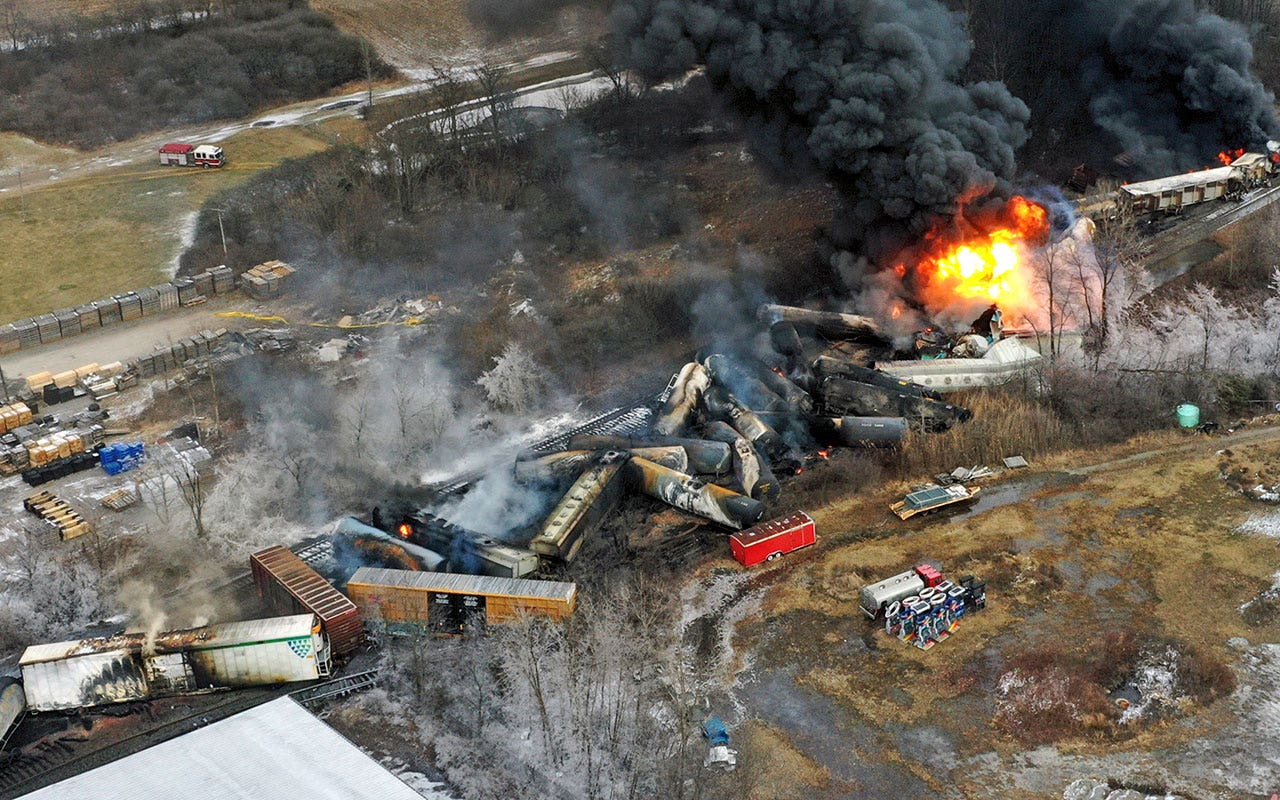
The overall picture is that rail safety hasn’t significantly improved in recent years — and as the Norfolk Southern derailment in East Palestine last Feb. 3 and others demonstrate, just one derailment can be disastrous when hazardous chemicals are involved. The small town near the Ohio-Pennsylvania border is still struggling to recover a year later.
BIDEN TO TRAVEL TO EAST PALESTINE NEARLY ONE YEAR AFTER TRAIN DERAILMENT DISASTER
U.S. Transportation Secretary Pete Buttigieg said there was a meaningful 15% decrease in derailments along mainline tracks after Congress responded to a number of high-profile train crashes involving crude oil in the early 2010s. “Progress has plateaued as derailments and preventable incidents are happening at an unacceptable rate,” Buttigieg said, urging Congress to pass the reforms now.
Portions of a Norfolk Southern freight train that derailed on Feb. 3, 2023, in East Palestine, Ohio, are seen here. The major freight railroads all promised safety improvements after the fiery derailment, but they have yet to make a meaningful improvement in the safety statistics and efforts to reform the industry have stalled in Congress. (AP Photo/Gene J. Puskar, File)
The railroad industry defends its record as the safest way to transport hazardous materials over land — something the head of the National Transportation Safety Board agreed with in recent testimony in the House — though officials acknowledge the railroads need to continue improving safety. And the Association of American Railroads trade group says most of the measures railroads promised to take last spring weren’t completed until late last year, so they aren’t yet reflected in the numbers.
What’s the industry’s safety record?
Safety statistics are mixed for the six biggest freight railroads that dominate the industry — Norfolk Southern, CSX, Union Pacific, CPKC, Canadian National and BNSF.
For the majority of 2023 the total number of train accidents increased slightly to 4,845, including more than 600 deaths.
When comparing 2022 and 2023, the total number of derailments declined about 2.6% — but there were still nearly three derailments a day nationwide. Railroads point out that roughly two-thirds of those crashes happen at slow speeds in railyards and don’t cause significant damage.
How many costly derailments are there?
There were 53 major derailments last year causing damage over $1 million, a surge of nearly 33%. Norfolk Southern has said the cost of the East Palestine derailment has already topped $1.1 billion, and that total will continue to grow with cleanup costs and lawsuit settlements.
The number of total crashes caused by the same issue as the eastern Ohio derailment more than doubled nationwide last year to 19. Overheating bearing failures remain a small fraction representing less than 2% of all accidents.
Are railroads getting riskier?
All 13 railroad unions have sounded the alarm about the dangers of the lean operating model that has cut roughly one-third of the industry’s rail jobs. The unions say that as a result of these cuts, inspections are rushed — or done by less qualified workers — and everyone remaining is overworked. They also say companies may be neglecting to do preventative maintenance.
“East Palestine was no surprise,” said Jared Cassity, the safety chief at the SMART-TD union, which represents conductors. “The next East Palestine, at least at this pace that we’re going, is imminent to some degree.”
The railroads defend their operating model — which relies on fewer trains that have grown much longer — as simply helping them make the best use of their locomotives, tracks and crews without jeopardizing safety, and the Federal Railroad Administration says safety statistics haven’t gotten significantly worse since they started using it.
But Tony Cardwell who leads the Brotherhood of Maintenance of Way Employes Division union, which represents track maintenance workers, said the railroads are under pressure to cut costs from “vulture capitalist” investors.
Over the past year, the railroads have agreed to provide paid sick leave to most of their workers for the first time and improve the way engineers and conductors are scheduled in order to help reduce fatigue.
What have railroads done to improve safety?
Last year, the major freight railroads installed hundreds of new trackside detectors to spot overheating bearings, as part of their goal of adding roughly 1,000 of those nationwide to make the average spacing between them 15 miles (24 kilometers) in most places.
All railroads will now stop trains when bearings detect a gap of more than 170 degrees from the outside air, and there are new standards to help them better track when bearings start to heat up to catch issues sooner.
Railroads have also been installing complex portals filled with cameras, other sensors and advanced detectors to spot problems as they’re moving.
Norfolk Southern also took additional steps like hiring a consultant from the nuclear power industry to review its safety practices, establishing a pilot program so employees can anonymously report safety concerns and changing rules for train assembly to better balance the weight of heavy cars and hazardous materials.
“We’re always going to strive to get better at safety,” Norfolk Southern CEO Alan Shaw told The Associated Press. “There’s no one thing that you do. It’s a bunch of different things.”
Why hasn’t Congress acted?
The railroad safety act has yet to get a vote in the full Senate — or even a hearing in the House. The measure would call for the creation of federal standards for those trackside detectors, increased inspections by qualified employees and two-person crews on every freight train.
Ian Jefferies with the AAR trade group says railroads haven’t opposed the bill outright — but they are fighting several provisions like the two-man crew requirement and locomotive inspection rules. They say such changes aren’t related to what caused the East Palestine wreck. After all, that train had three crew members, and the railcar — not a locomotive — had the flaw. The railroads also want a cost-benefit analysis to be done on the rules.
OHIO RESIDENTS GRAPPLE WITH LONG-TERM IMPACTS OF EAST PALESTINE TRAIN DERAILMENT
House Republicans say they want to wait for the final NTSB report before they act, so they can be sure that any new regulations are directly related to the cause of the East Palestine derailment. The report won’t be out until sometime this summer.
Democratic Ohio Sen. Sherrod Brown, who was part of the bipartisan group that proposed the bill, blames railroad industry lobbying from keeping the act from advancing.
“It goes down to the power of the rail industry. I mean the fact that Norfolk Southern and other railroads have continued to oppose this bill,” Brown said. “They’ve always put profits over people.”
Read the full article from Here


Detroit — The Tigers will get pitcher Jack Flaherty back in the starting rotation for a start in the series finale against the Houston Astros on Sunday, manager AJ Hinch confirmed on Saturday.
Flaherty, who has been on the 15-day injured list since June 13 with a strain of the peroneal tendons in his left foot/ankle, will get back on the active roster with a yet-to-be-announced move on Sunday morning, as it’s the first day he’s eligible to come back from the IL.
“He’s good to go for tomorrow,” Hinch said. “We can’t make it official until the morning. But yeah, we’re fully expecting him to be good to go.”
Flaherty completed a rehab assignment with Double-A Erie on Tuesday, throwing 5⅔ innings of two-run ball with seven strikeouts.
That outing and the lack of any hang-ups in the days since have Flaherty on the precipice of his return. Hinch was hopeful that Flaherty could make his return on Sunday, and a few days earlier he recalled some words of motivation he gave the pitcher in a postgame handshake line.
“I told him, I was standing in the high-five line yesterday, that we’re getting closer, closer to him being back,” Hinch said. “So, he’s definitely the right amount of being agitated and wanting to pitch.”
With Flaherty back in the mix, Hinch is unsure if Detroit will stick with a six-man pitching rotation of Tarik Skubal, Framber Valdez, Casey Mize, Troy Melton, Keider Montero and Flaherty or take it back down to five. The latter option likely requires Montero to move into a bullpen role.
As of Saturday, the inflection point on any decision will be the series opener against the Texas Rangers on Thursday.
The plan is for Flaherty to pitch the finale against Houston. Detroit then travels to New York for a three-game series against the Yankees where it’s set up for Mize, Skubal and Melton to pitch Monday through Wednesday.
That Thursday opener against the Rangers, where Hinch will make a call between Valdez and Montero, sits in an odd pocket of the schedule, too, as the two teams are off on Friday before completing a three-game series over the weekend. That’s because there’s a Round of 32 game in the FIFA World Cup taking place in Arlington, Texas, that afternoon.
And with a day off the following Monday, Detroit has two days of rest in a four-day span after coming off a 14-game stretch without an off day.
“We’ll have a decision to make on Thursday, going to Texas,” Hinch said. “We can bring Framber back on regular rest. We could put Keider in there, do the six man. We’re kind of considering all of our options. Going with Jack coming in tomorrow kind of creates that decision for the back end of that. Then we have two off days surrounding the weekend. It’s really weird with the World Cup. We have that weird mid-series off day. So we’ll see.”
Hinch shares updates on Perez, Báez
The timeline for Wenceel Perez and Javier Báez to rejoin the active roster remains murky, though both are progressing in recovering from their respective injuries, Hinch said.
Perez, who suffered a fractured orbital bone on his left side after a resistance band under tension released and hit him the face last week, is on the 60-day injured list. Hinch shared that things are going slow in Perez’s recovery as all parties are basically waiting for the fracture to heal and Perez’s vision to be fully restored.
Perez is back in Detroit, but is otherwise laying low on any sort of rehab until the injury itself subsides enough.
“There’s a little bit of unknown on how long this can take but given — I mean, it’s like two-sided,” Hinch said. “You want everybody to know he’s safe and out of harm’s way. He’s just mending slowly in that. And the swelling, the vision, not disrupting the healing of the orbital bone, it’s a lot more sensitive than just getting hit in the face.”
Báez is getting back to some physical activity after taking some prolonged rest, which came as a result of his sprained right ankle not responding well to earlier rehab.
Báez has been on the IL since late April and got moved to the 60-day IL on June 11.
And despite the need for serious ramping up, Báez’s return to some light physical activity is a welcome sign for Hinch and Co. for an injury they worried could be much more serious.
“He’s doing well and going to continue on with his rehab and getting back into baseball stuff. There’s jump tests, there’s running, there’s the hitting, again,” Hinch said. “So the good news is he’s not shut down. That’s what our fear was. The continual delay is it has just been a complicated injury.”
Andrew Graham is a freelance writer.

Penelope the corpse flower is in bloom at Milwaukee’s Mitchell Park Domes.
Penelope, which last bloomed in 2024, will be open and stinking for the next 24-48 hours. This rare and very large flower only booms every couple of years; when it does, it emits a powerful – and disgusting – odor.
“Typically they only bloom once every six to eight years, ” said Amanda Garchow, horticulturist at the Domes. “Penelope’s a little different in our case; this is her second bloom in two years, so it’s extra exciting for us because it’s a rare event that’s she’s blooming so soon.”
The ephemeral nature of this plant and its experience has gathered somewhat of a cult following, according to Bryan Connolly, botanist and associate professor of biology at Eastern Connecticut State University, who once had someone visit his greenhouse with a corpse flower tattoo on his leg.
Below, with some help from Connolly and Garchow, we answer questions about this fascinating plant.
What exactly is a corpse flower?
The corpse flower, also known as a Amorphophallus titanum to scientists and “titan arum” to fans of David Attenborough’s “The Private Life of Plants,” is a flowering plant native to rainforests on the Indonesian island of Sumatra. It is known for its putrid smell, often compared to the scent of rotting flesh, and for only blooming for 24-48 hours every couple years.
Why does it take so long to bloom?
It needs to accumulate enough nutrients. The corpse plant starts as a seed or, if it’s already bloomed, an underground tuber-like corm (think potato). Both produce a really large leaf, which can be up to 15 feet tall.
“There’s no stem when it’s not flowering, and so it has a petiole, which is part of the leaf that looks kind of like a stem, but it’s not a stem,” Connolly explained. “They can get very large, like bigger than your thigh around.”
The leaf generates sugar – food for the plant – and stores it in the underground corm.
After a year, the leaf dies, and the tuber rests for four months. Then it produces a new leaf and repeats the cycle until the tuber becomes large enough. This takes about seven to 10 years for a new seed and three to four years for a corm that’s bloomed before.
The corm of a corpse flower is the largest of any flowering plant. According to Connolly, the biggest one has been up to 200 pounds, but they’re typically more like 60 pounds.
Why the rotting meat smell?
To attract pollinators. After years of tuber growing, the tuber eventually produces a spike, formally known as a spadix, of flowers wrapped in a specialized leaf called a spathe. Female and male flowers grow in a ring at the bottom of the spadix. This stage is called an inflorescence, which is a group of flowers.
The corpse flower is the world’s largest unbranched inflorescence or group of flowers.
Eventually, as the spathe opens, the spadix heats up to about 99 degrees F and the flowers begin to emit pulses of powerful odor to attract insects, like carrion beetles or fruit flies, that typically eat or lay their eggs on rotten meat. These insects pollinate the flowers at the base of the plant.
Are there benefits to being pollinated by insects like fruit flies and carrion beetles instead of more common pollinators like bees?
Not really.
According Connolly, it may be related to the plant’s native environment. Corpse plants can be miles apart in a rainforest, and since they bloom infrequently they can only be pollinated and reproduce every few years. Because of that, it could be advantageous to seek pollinators that are willing to travel long distances between plants.
What makes it smell so bad?
Chemists have isolated identified over 40 compounds that make up the odor released by the plant. Some of the chemicals include two that smell like garlic (dimethyl trisulfide and disulfide), one that smells like sulfur (methanethiol), one that smells like citrus (limonene), one that smells like feces (idole), and one that smells like urine (phenylalanin).
Why should I care?
There is inherent intrigue to a smelly plant named Penelope. But also, corpse flowers are an endangered species due to loss of habitat, climate change and encroachment from invasive species. Garchow said that it’s estimated there are only 800 left in the wild.
Additionally, these plants are difficult to conserve via seed preservation because their seeds aren’t viable after drying.
Therefore, they must be conserved in living collections in gardens, research labs or greenhouses and conservatories like the Domes.
Since they can’t self-pollinate, despite having both male and female flowers, they must be pollinated by another plant. Different research labs and greenhouses often rely on sending stored pollen to each other to keep these plant lines going.
“I’m really thankful that we have this giant, smelly, weird plant that, you know, kind of brings botany to the public,” said Connolly with a smile. “And just the conservation of plants and of the species in general.”
The Domes will have extended hours on Saturday and Sunday to accommodate visitors who want to see the corpse flower in bloom, though the smell will mostly fade by Sunday. Stop by to see Penelope, support important conservation work and acquire a unique, albeit smelly, experience.
The Dome, 524 S. Layton Blvd., will host extending hours for this event, from 8 a.m. to 4 p.m. both days. Admission is $10 for adults ($9 for residents), $6.50 for ages 3-12 and free for children younger than 2. Due to road construction and the closure of the 27th Street bridge, the Milwaukee Domes Alliance suggests using GPS to plot a route. Directions and more information, including specific discounts, are available at www.MilwaukeeDomes.org.
Reach Donnisa Edmonds at DEdmonds@usatodayco.com.

A shooting in north Minneapolis injured two men on Friday night.
Minneapolis police said officers responded around 9:30 p.m. Friday after multiple reports of gunfire near Lowry Avenue North and North Logan Avenue.Police said they found two men with gunshot wounds outside a home.
Officers said both men were outside when the gunfire started and a nearby hospital treated both men for non-life-threatening injuries.
Police are still investigating. Officers said no arrests have been made.
This is a developing story; check back for updates.
-

 Los Angeles, Ca43 minutes ago
About 20 detained after armed suspect call sparks LAPD response in Koreatown
-

 Detroit, MI1 hour ago
With Jack Flaherty returning, AJ Hinch ponders Tigers’ starting rotation
-
 San Francisco, CA1 hour ago
Serving up a slice of Palestine at Old Jerusalem in the Mission District
-

 Dallas, TX1 hour ago
All-day restaurant and patio coming to Dallas’ Knox and more top stories
-

 Miami, FL1 hour ago
Bugtopia takes center stage at Zoo Miami
-

 Boston, MA1 hour ago
What JJ Peterka Will Add to the Bruins’ Roster, ‘He’s Got an Elite Shot’ | Boston Bruins
-

 Denver, CO2 hours ago
This Boulder farm dinner serves up midsummer Slavic vibes with James Beard-worthy fare
-

 Videos2 hours ago
Destruction in Venezuela after deadly earthquakes | BBC News

