Lifestyle
Cool cats and tiki treats: Inside the outrageous Midcentury Modern Shag House in Palm Springs

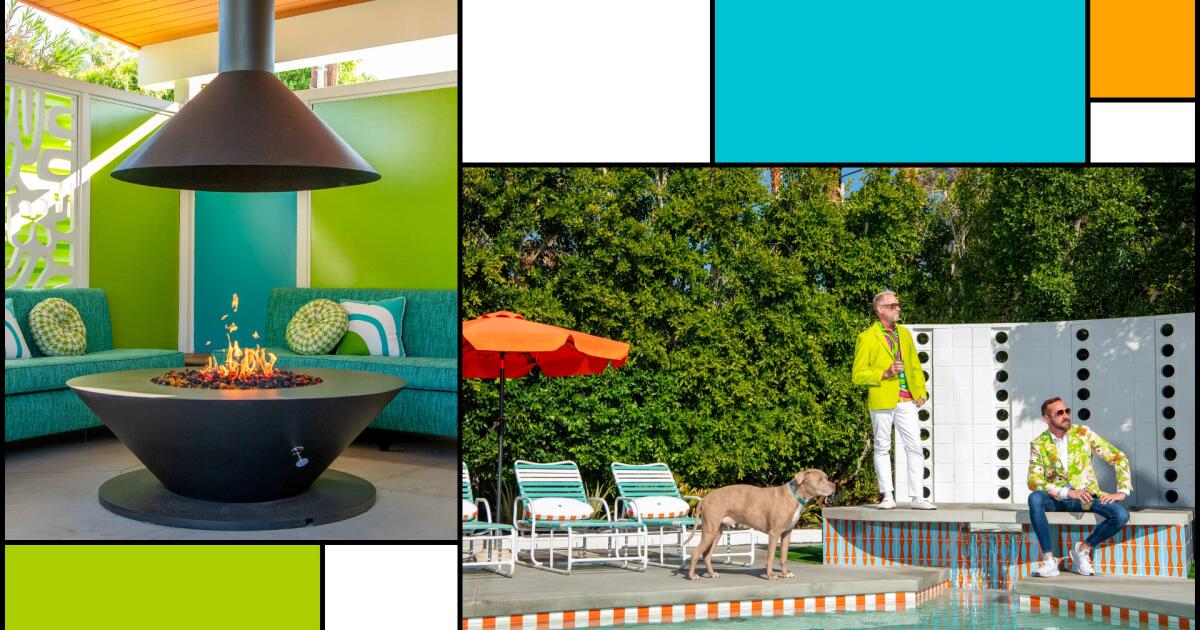
In a neighborhood filled with homogeneous Midcentury Modern residences, Brandon McBurney’s Palm Springs home stands out thanks to its 10-foot-tall lime green doors that face the street.
“I wanted something that would stand up to the history of the Palm Springs front door,” says Josh Agle, the artist popularly known as Shag, who designed the house and chose the lively hue. “There’s no such thing as too cheesy.”
Agle was referring to the Shag House, McBurney’s four-bedroom home designed by architects Dan Palmer and William Krisel for the Alexander Construction Co. in 1958. The house started as a whimsical idea by branding guru John-Patrick Flynn in 2021: Purchase a run-down Midcentury Modern tract home in Palm Springs and invite Shag to reimagine it as one of his artworks.
The front patio and the outdoor lounge at the Shag House. (Mariah Tauger / Los Angeles Times)
A sunny cat-themed bedroom features custom wallpaper by Shag, a.k.a. artist Josh Agle.
(Mariah Tauger / Los Angeles Times)
On a recent sunny afternoon, Agle, whose colorful artworks depict cool cats, Hawaiian tiki gods and martini-sipping swingers, had just put the finishing touches on the house, which will be open to the public during Modernism Week, which runs Feb. 15-25.
“We built it exactly to his specifications,” says Flynn, who found the house along with McBurney and Agle after looking at 22 others. “Josh created a piece of art, handed it to us, and said, ‘Build this.’ And we did.”
The process was sometimes challenging. For instance, when Agle designed an outdoor bar topped with a round roof, the contractors told them it was impossible to build. However, the 61-year-old artist insisted. “He stayed true to his design,” Flynn says of the bar, now ready for cocktail service.
As the principal designer, Agle had the final say on the home’s design, with some input from McBurney, 46, who purchased the house in the Little Beverly Hills neighborhood of Palm Springs for $935,750 in 2021.
Intentionally askew liquor-themed artwork hangs on a wall in the game room.
(Mariah Tauger / Los Angeles Times)
Homeowner Brandon McBurney gives some love to his dog, Thor, in the Shag House’s living room.
(Mariah Tauger / Los Angeles Times)
“I would do renderings, and they would often tell me it would be hard to do,” Agle says of the design and build process. “I changed some things. But I was unbending on the bar, especially since it was in the renderings, and they had shown it on social media.”
Although McBurney was OK with Agle’s tongue-in-cheek designs, including cat-, tiki- and Asian-themed bedrooms with velvet paintings and Googie-style lava lamps, he wasn’t initially sold on the home’s orange ceilings. But now he’s a fan. His only request? A hanging daybed and a Buddha statue overlooking the pool in the backyard.
Agle’s artworks tread between lighthearted joy and sincere nostalgia: Rat Packers spinning records and sipping martinis inside the John Lautner Compound in Desert Hot Springs; cocktail parties at Richard Neutra’s Kaufmann Desert House; and a family picnic outside the Eames House in Pacific Palisades. His latest piece, “The Mammoth Martini,” was inspired by his father, who was in a fraternity at UCLA. The painting hangs over the bar in the game room and is fully realized in the Shag House’s backyard.
“I’ve always been a fan of Shag’s art,” says McBurney, an e-commerce executive for supermarket chain Kroger who has been coming to Palm Springs for more than 20 years. Originally from the Pacific Northwest, he lives in the desert full-time and hopes to open his home for fundraising and charity events.
“How can I not share this house?” says McBurney, decked out in a Palm Springs-appropriate pink and green floral blazer by Mr. Turk. (McBurney describes the renovation as a “million-dollar” project, including what he spent and donations from sponsors Ferguson Bath, Kitchen & Lighting Gallery, JennAir and California Closets, among others.)
The backyard, with a pair of towering palm trees, is ready for Modernism Week parties.
(Mariah Tauger / Los Angeles Times)
He adds, sounding a bit wistful: “I’m so blessed to be able to live here. This house is iconic. It’s a beautiful representation of Josh’s art.”
Agle admits he wasn’t a fan of Palm Springs when he first came to the desert enclave in the 1980s. “It was pretty boring,” he says. “But the architecture was amazing — even the commercial buildings. You could see what it once was. I started painting not what it used to be but what I hoped it would become. I was painting the lifestyle I wanted to live, the parties I wanted to be at and the houses I wanted to live in.”
Today, past and present collide at the Shag House, which is a testament to sunny midcentury Palm Springs and the postwar optimism of that time. In fact, it’s hard to feel sad while experiencing the Shag House, which is a little like viewing a holiday light display: You can’t help but smile when you see it and wish it would stay open all year.
Like Palm Springs itself, the house has a casual vacation vibe. “I didn’t want to take the house too seriously,” Agle says as he walks by an Operation game-inspired artwork depicting a Hennessy Heart, Bacardi Brain and Ketel One Kidney.
Clad in a chartreuse sport coat, white pants and a vintage-inspired shirt made from a fluorescent print fabric, Agle says, “There is a strong alcohol theme throughout the house, which plays into my art as well.”
Tiki-themed artworks hang on the wall.
(Mariah Tauger / Los Angeles Times)
Thor the dog, left, Seal Beach artist Josh Agle (a.k.a. Shag) and homeowner Brandon McBurney strike a poolside pose at the Shag House.
(Mariah Tauger / Los Angeles Times)
Agle doesn’t drink anymore — he drolly describes it as “career research” — but he still loves to paint alcohol-fueled party scenes. “It points to a mythical lifestyle that Palm Springs encapsulates,” Agle says. “People from L.A. and movie stars would come to Palm Springs and start drinking at noon, have drinks at the clubhouse, go out to Melvyn’s and have a couple more drinks. Because they weren’t working, they could live that lifestyle, if only for a weekend.”
Regarding the home’s colorful interiors, which feature a glossy orange and green kitchen, blue Case Study-style daybeds and an Eames lounge chair in a custom orange fabric, Agle wanted to fight neutral trends like cream-colored boucle. “Ten to 15 years ago, you’d walk into a Midcentury Modern shop in Palm Springs, and everything was turquoise and green,” he says. “The colors I chose for the house — mostly orange, green, and blue — are appropriate for Palm Springs.”
The result is an upbeat and happy home that feels like you have somehow touched down in a surreal version of one of Agle’s paintings.
“It is no surprise that Shag is an icon in Palm Springs,” says Elizabeth Armstrong, an independent curator and former director of the Palm Springs Art Museum, in an email. While Modernism Week takes historic preservation seriously, Armstrong adds, “Shag has created a new kind of concept house. A Retro-Futurist known for his nostalgic take on all things Midcentury Modern, visitors can immerse in a totally seductive and surreal 3-D version of Shag’s take on Camp Modernism. It’s Shagalicious.”
Shag’s mural “The Mammoth Martini” hangs above the bar in the house, whose backyard was designed to look like the artwork’s pool scene.
(Mariah Tauger / Los Angeles Times)
Colorful lights and a classic Shag mural set the scene in the dining room. The side yard hosts a ping-pong table. (Mariah Tauger / Los Angeles Times)
After two years of supply chain issues, labor disruptions and weather delays, the Shag House is finally ready to open its doors on Feb. 15. Representatives for Modernism Week estimate that more than 4,000 people will come through the house, in addition to it hosting special events and parties for more than 300 people. As Agle prepares for the unveiling, he hopes visitors will “have fun and don’t take it too seriously.”
True to their initial concept, the home is a timeless treasure from a forward-thinking team that worked to preserve its past.
“We added square footage, but you can still recognize that it’s an Alexander house,” says project manager Flynn. “I found a woman whose grandparents owned the house from 1968 to 1992, and I invited her and her stepbrother to come see the house. She stood there with tears and said, ‘I recognize my grandparents’ house. I see the magic that you have created.’”
Homeowner Brandon McBurney, left, says he didn’t veto any of Josh Agle’s ideas when it came to transforming the dated Midcentury Modern home into a Shag artwork.
(Mariah Tauger / Los Angeles Times)
Shag House events during Modernism Week
The Shag House Signature Home Tour, Modernism Week 2024: Feb. 15-25. Ticket: $40.
Poolside Fashion at the Shag House: The Style of Trina Turk: 11 a.m. Feb. 20. Ticket: $95.
Poolside Fashion at the Shag House: The History of the Caftan: 11 a.m. Feb. 21. Ticket: $125.
Swinging Mid Mod Cocktail Party: At the Shag House: 7 p.m. Feb. 21. Ticket: $250.
Poolside Fashion at the Shag House: The Style of Candice Held: 11 a.m. Feb. 22. Ticket: $95.
The Mammoth Martini Party at the Shag House: 8 p.m. Feb. 23. Ticket: $125.
For tickets to these events and more information, visit modernismweek.com.
Consider subscribing to the Los Angeles Times
Your support helps us deliver the news that matters most.
Become a subscriber.



Since leaving office, former Vice President Mike Pence founded the policy and advocacy organization Advancing American Freedom.
Drew Angerer/Getty Images
hide caption
toggle caption
Drew Angerer/Getty Images

Since leaving office, former Vice President Mike Pence founded the policy and advocacy organization Advancing American Freedom.
Drew Angerer/Getty Images
Former Vice President Mike Pence played a key role in bringing President Trump to power in 2016. By putting his name on the Republican ticket, he helped reassure the Republican establishment and evangelical voters who were wary of Trump’s brash brand of populism.
Pence’s departure from Trump’s leadership of the Republican party began when Trump called on Pence to refuse to certify the results of the 2020 election — pressure Pence rejected.
“For four years, we had a close working relationship. It did not end well,” Pence wrote in his memoir So Help Me God, which was released in 2022.
In the years since leaving office, Pence has been advocating for an ideological restructure of the Republican party, and founded the policy and advocacy organization Advancing American Freedom. Pence builds on the theme of reimagining the Republican party in his new book What Conservatives Want, which provides a critique of the second Trump administration and what he terms the “populist right.”
In an interview with Morning Edition, Pence detailed to NPR’s Steve Inskeep his critique of the second Trump administration, shared his perspective on civil rights legislation and challenged Trump’s tariffs and other interventions in the economy.
Listen to the full interview by clicking on the blue play button above; and read highlights from the conversation below.
‘The populist right’ does not represent conservative beliefs
Pence believes that Trump has embraced “the populist right” over traditional conservatives in the Republican party.
The sale of economic American company U.S. Steel to Nippon Steel in Japan exemplifies this shift, Pence said.
In his first term, President Trump opposed the sale. But in his second term, he approved the sale and took a golden share — a class of shares in which a government can own a very small percentage of the company but has outsized voting rights.
Pence said that he was taken aback by Trump’s decision to take a golden share.
Free trade is essential to American conservatism
Pence takes umbrage with his former boss’ tariff-laden economic policy.
Pence said it violates conservatism’s bedrock belief in the power of free trade, and Trump has gone about granting exceptions to tariffs in an unfair way.
Granting waivers to large corporations from certain tariffs is “one of the lesser reported aspects of the tariff regime that’s been imposed by the administration,” Pence added.
Trump and Pence ran in 2020 on a mission to “drain the swamp,” rooting out government corruption and wasteful spending. However, Pence said Trump appears to have shifted from those goals.
“There’s maybe nothing more swampy than the battle over getting tariff waivers for big business,” Pence said.
Women’s rights on the right
There is a debate among the ultraconservative right about the role of women in civic life.
The concept of “household voting,” has become a familiar talking point for ultra-right-wing communities online. Supporters of “household voting” advocate that every American household should get one vote, the vote being that of the husband’s. This concept has been promoted by figures such as Abby Johnson, a prominent anti-abortion activist who spoke at the 2020 Republican National Convention. When asked about whether he supported household voting, Pence said he is not aligned
“It’s one person, one vote in this country. And people have bled and died for that principle throughout the years of our history,” Pence said.
He added that American families don’t need to be propped up by government programs to boost childbirth. “What American families need is an application of the kind of principles that will create higher wages, more opportunities, more jobs,” Pence said.
Should conservatives stand for civil rights?
Pence said he was an admirer of senator and one-time presidential candidate Barry Goldwater.
Notably, Goldwater voted against the Civil Rights Act of 1964.
“Should conservatives stand for civil rights?” asked Inskeep.
Pence responded that civil rights are important to conservatives, but that equality of opportunity is what legislation ought to enshrine, not equality of outcome.
Pence added that he stood by the Supreme Court’s decision to ban partisan gerrymandering on the basis of race, rendering ineffective a key provision of the Voting Rights Act of 1965.


Milly Alcock in Supergirl.
Warner Bros. Pictures
hide caption
toggle caption
Warner Bros. Pictures
Hollywood’s newest Supergirl is kind of a dirtbag — in the good way. Fearless and grumpy, Supergirl (Milly Alcock) sets out on a quest to support a new pal’s revenge journey and to make a point that should be clear by now: Never mess with a lady’s dog. Also featuring David Corenswet and Jason Momoa, is Supergirl a worthy follow up to Superman?
If you want more DC superhero action, check out these episodes:
‘Superman’ takes off and nails the landing
‘The Batman’ puts the emo in emote
Connect with Pop Culture Happy Hour:
Letterboxd / Facebook
Our weekly newsletter
Support Pop Culture Happy Hour+
-

 West Virginia4 minutes ago
West Virginia First Foundation advances key initiatives at second quarterly board meeting
-

 Wyoming11 minutes ago
At 6,000-year-old crossing, Gov. Gordon OKs Wyoming’s first-ever designated pronghorn migration route – WyoFile
-

 Crypto14 minutes ago
SpaceX Lands Nasdaq-100 Spot Weeks After Record IPO
-

 Finance19 minutes ago
Hong Kong vows stronger exchange with reforms, bond futures and gold push
-

 Fitness26 minutes ago
Health Watch: Fitness Friday – exercise and dementia
-
Movie Reviews34 minutes ago
Film review: ‘Tuner’ mixes classical music, crime, and Dustin Hoffman | The Jerusalem Post
-

 World43 minutes ago
Rescuers comb Venezuelan quake rubble, thousands reported missing
-

 Lifestyle1 hour ago
Former Vice President Mike Pence believes Washington is more ‘swampy’ under Trump

