Midwest
Video shows Kansas City Chiefs watch party host handcuffed after friends’ bodies found

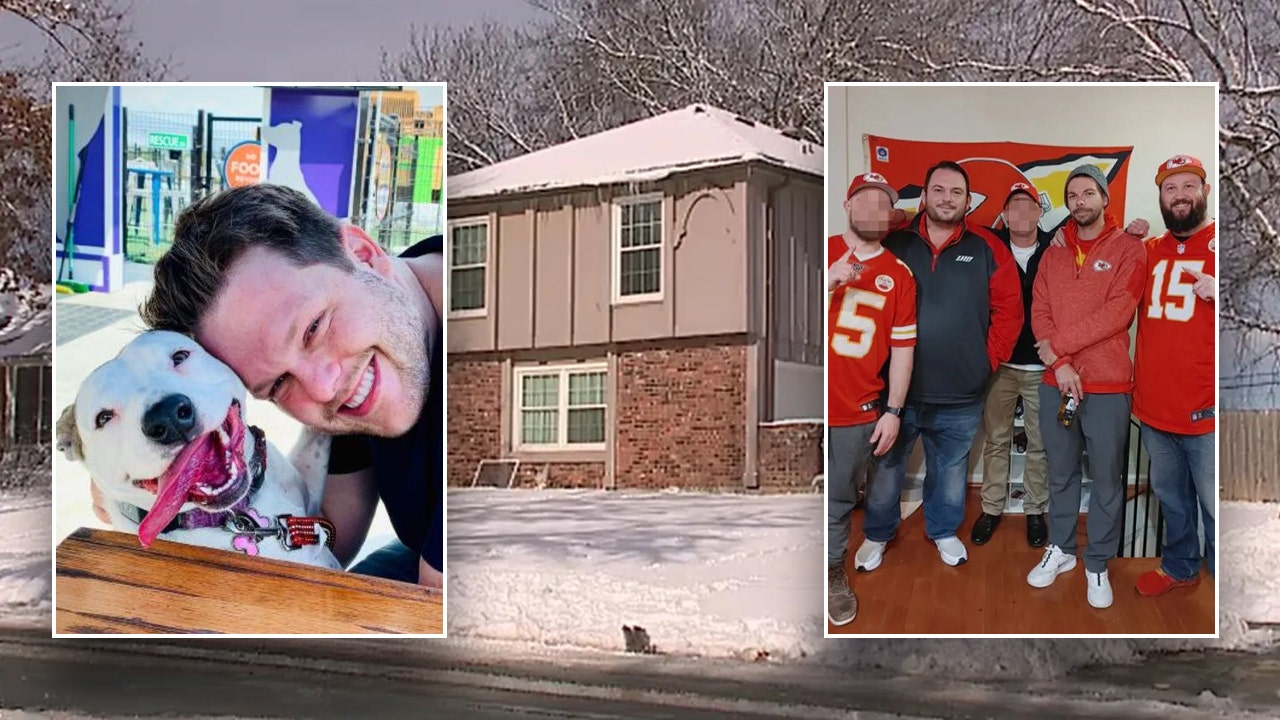
A video showing a detained, handcuffed Jordan Willis was captured by a neighbor on the night police discovered the bodies of his friends Clayton McGeeney, Ricky Johnson and David Harrington in his Kansas City backyard.
Although the video is only seconds long, neighbor Ashton Brady, 25, told Fox News Digital that there was a heavy police presence at the house across his street on Jan. 9 for at least an hour and a half before he went to bed.
First, Brady said, he saw a distressed-looking woman hurrying from the house and making a phone call – according to the Kansas City Police department, McGeeney’s fiancée dialed 911 for a welfare check to the Northwest 83rd Terrace home around 8:51 p.m. that night.
Family members told Fox News Digital that she discovered the first body after she frantically broke onto Willis’ property, unable to reach him or her partner. She allegedly knocked at the door and even shouted Willis’ name from inside the house before making the discovery.
KANSAS CITY CHIEFS FANS DEATHS: JORDAN WILLIS CHECKS INTO REHAB AS FAMILIES AWAIT TOXICOLOGY RESULTS
In a still taken by neighbor Ashton Brady, Jordan Willis can be seen in handcuffs and boxer shorts, surrounded by police on the evening of Jan. 9. His friends Ricky Johnson, David Harrington and Clayton McGeeney were found dead on his property that evening – Kansas City Police have told Fox News Digital that they do not suspect foul play in their deaths. (Fox News Digital)
“I just thought when I saw her, I thought it was weird watching her walk from the side of the house – she came out through the back,” Brady recalled in a Wednesday interview. “It was weird, the pace she was walking and talking on the phone. She looked back over her shoulder every so often at the house.”
“She looked upset for sure, like she didn’t know what was going on or anything,” he said.
Brady went back into his house, but returned to watch the scene across the street after seeing the lights of an ambulance through his bedroom window.
“We woke up and there were cops up and down the street and caution tape – you couldn’t go anywhere.”
By the time he got back outside, he said, about four police cars had amassed across the street and police officers surrounded a handcuffed man wearing just boxers or sleep shorts.
“He was detained for probably, like, 30 to 45 minutes. He was shirtless for 10 or 15 minutes and then a police officer grabbed a jacket out of the house,” Brady said.
Lights inside the house remained off, but Brady said he could see officers’ flashlights through its windows as police conducted their search. At some point, he said, he could see lights coming from the backyard.
As time passed, the police presence grew – what was initially just four cars became eight or 10 on the small street, he said.
“He was handcuffed and the woman was with the other police talking, so I figured a dispute broke out, and they were getting both sides of a story,” Brady said. “I thought ‘maybe they just got into an argument’ – at the time I didn’t know they found bodies… I thought it was strange that I saw the police go through the house.”
“People asked if I saw any bodies come out, I never did,” he said.
Attorney and retired NYPD inspector Paul Mauro told Fox News Digital that no meaningful insights about the case can be inferred from the manner in which Willis was detained:
“You can cuff for your own safety, and they did have three [dead on arrivals], so they didn’t know what they were into here,” Mauro said of police at the scene.
HIV scientist Jordan Willis, 38, checked himself into a rehab facility after his three friends were found dead in his backyard on Jan. 9. It is unclear whether drugs played a role in their death, as their toxicology results are still pending. (GitHub)
After about an hour and a half, Brady said, the woman and the man he now knows to be Willis were taken away in police cars. At some point Willis was uncuffed, because Brady could “see his arms moving.”
Another neighbor, Maya Dukes, told Fox News Digital that there was still a police presence at Willis’ home around 4 a.m. the next day.
“We woke up and there were cops up and down the street and caution tape – you couldn’t go anywhere,” she recalled. “They didn’t have their lights on or anything, they were just out on the street and at that house.”
WATCH NEIGHBOR’S VIDEO:
Brady would only learn the extent of the tragedy that took place across the street the next day:
“My roommate texted me at work – I was like ‘holy s—, I didn’t know that.”
Brady said that he and his roommate had just moved from elsewhere in Kansas City to the house across the street from Willis, and had spent the previous week settling in. He was away on a hunting trip with friends on the weekend of the Kansas City Chiefs game against the Los Angeles Chargers, when the men were last seen alive at Willis’ home on Jan. 7.
KANSAS CITY CHIEFS FANS FOUND DEAD IN FRIEND’S BACKYARD: WHAT TO KNOW
David Harrington, Clayton McGeeney and Ricky Johnson were found dead outside their friend’s Kansas City home on Jan. 9, 2024. (Ricky Johnson/Facebook)
Dukes said she noticed trucks parked outside the house because they were parked in “a weird spot where people don’t normally leave their cars.”
The two trucks are visible in Brady’s video. Family members of the deceased men have criticized Willis for not noticing that his friend’s vehicles were still on his street and thinking something was amiss.
In the days following Willis’ arrest, Johnson’s family told Fox News Digital they retrieved their son’s vehicle. Brady said the other car left the street, as well, but was unsure whether it was driven or towed away. It is unclear when the three men arrived at Willis’ home.
KANSAS CITY CHIEFS FAN DEATHS: JORDAN WILLIS ‘DEPRESSED’ OVER ‘WILD SPECULATIONS’ ABOUT PALS, SOURCE SAYS
An exterior view of the backyard and porch of Jordan Willis’s home in Kansas City, Missouri on Friday, Jan. 26, 2024. The bodies of Willis’ three friends – Ricky Johnson, Clayton McGeeney, and David Harrington – were found in Willis’ backyard, with one body found on the porch, on Jan. 9, 2024, two days after attending a Kansas City Chiefs watch party at the home. (DWS for Fox News Digital)
“It’s kind of weird,” Brady said of moving into his new home as the tragedy was unfolding. “It’s been… I don’t know, it’s been interesting for me. At first, I didn’t know if I should say anything [about the video], I didn’t know how big of a deal it was. I kind of wish I didn’t say anything because now my phone’s blowing up and people are hitting me up. [But] I just feel for the families… hopefully it helps a little bit.”
He said he had never seen Willis before that night.
“I have theories on it,” Brady said when asked what he thought of the mysterious deaths across the street. “I personally, I don’t know. It’s weird to me. The weirdest thing to me is if it was an overdose, no one called or anything like that – I went to school and partied – usually when something like that happens, when you call the police or the ambulance, no one usually gets in trouble.”
Ashton Brady poses for a photo on his front porch in Kansas City, Missouri on Tuesday, Jan. 30, 2024. Brady’s neighbor, Jordan Willis, was briefly detained while police searched his home after three of his friends were found dead in his backyard after a football watch party earlier in January. (DWS for Fox News Digital)
The Kansas City Police Department has told Fox News Digital that the deaths of the three men are “100 percent not being investigated as a homicide,” and that Willis is not considered a suspect. Toxicology reports will take six to eight weeks to process, according to the private company contracted by Platte County to carry out autopsies, while their full autopsy reports will not be released for another 10 to 12 weeks.
Willis’ attorney, John Picerno, said that his client works from home, slept for “a lot” of the time between allegedly seeing the three men out of his house after the Chiefs game. Therefore, Picerno said, he did not see messages or phone calls, and did not hear concerned loved ones knocking at his door.
PARENTS OF KANSAS CITY CHIEFS FANS FOUND DEAD THINK VICTIMS ‘SAW SOMETHING THEY SHOULDN’T HAVE SEEN’
Family and friends of Clayton McGeeney, left, David Harrington, center, and Ricky Johnson, right, are clamoring for answers after the three men inexplicably died in freezing temperatures outside their friend’s Kansas City home. (Facebook)
CLICK HERE FOR THE FOX NEWS APP
Willis checked himself into an inpatient rehab facility shortly after moving out of his house and is “facing his addiction head-on” after the “enormous, heartbreaking wake-up call” of “los[ing] three of his close friends under extremely tragic circumstances,” a source close to the family told Fox News Digital.
Two men were seen loading Willis’ belongings into a U-Haul truck in the days following Jan. 9, neighbors said – the source said that it has since been moved into storage, and that he is “still cooperating with the police department in their investigation.”
Read the full article from Here

Cleveland, OH
Cleveland councilman warns of planned outages coming to city’s west side during high heat

CLEVELAND, Ohio (WOIO) – Cleveland City Councilman Charles Slife warned of a planned and temporary power outage from First Energy on Wednesday afternoon amid dangerously high temperatures.
MORE: Widespread power outages plaguing Cleveland
According to the post, First Energy is working to install two new poles, one in Lakewood and one on Rocky River Drive near St. Joseph Academy.
19 First Alert Days: First Alert Weather Days continue through Friday for heat, Saturday for storms
“This work is being done to bolster the electrical grid, which is being strained by heavy use due to high temperatures, and to avoid widespread and long-lasting outages,” the post said.
Slife emphasizes that Wednesday’s outages are temporary and intentional.
PUCO rejects FirstEnergy’s attempt to loosen reliability standards
The outages are expected to impact the northern half of Ward 15 and may last up to an hour.
Slife said he would provide more details when available.
19 News has reached out to First Energy for more information.
MORE: Where to find cooling centers in Northeast Ohio
Copyright 2026 WOIO. All rights reserved.


MISSOULA, Mont. — Two Indiana men accused of helping illegally obtain oxycodone from Montana pharmacies have pleaded guilty to federal charges, Acting U.S. Attorney Mark Steger Smith said.
Jaylan Javier Wash, 23, pleaded guilty Monday to one count of conspiracy to possess with the intent to distribute oxycodone.
Wash faces up to 20 years in prison, a $1 million fine, three years of supervised release and a $100 special assessment.
Brandon Lavelle Winfrey, 32, who went by “Juice,” pleaded guilty Tuesday to one count of possession with intent to distribute oxycodone.
Winfrey faces up to 20 years in prison, a $1 million fine, three years of supervised release and a $100 special assessment.
Sentencing is set for Nov. 10, 2026, in Missoula.
The following was sent out by U.S. Attorney’s Office, District of Montana:
Two men from Indiana who helped illegally obtain oxycodone from Montana pharmacies have admitted to charges, Acting U.S. Attorney Mark Steger Smith said.
Jaylan Javier Wash, 23, pleaded guilty Monday to one count of conspiracy to possess with the intent to distribute oxycodone. Wash faces 20 years in prison, a $1 million fine, three years of supervised release and a $100 special assessment.
Brandon Lavelle Winfrey, 32, who went by “Juice,” pleaded guilty Tuesday to one count of possession with intent to distribute oxycodone. Winfrey faces 20 years in prison, a $1 million fine, three years of supervised release and a $100 special assessment.
U.S. Magistrate Judge Kathleen L. DeSoto presided at the change of plea and U.S. District Court Judge Dana L. Christensen will determine a sentence after considering the U.S. Sentencing Guidelines and other statutory factors. Sentencing was set for Nov. 10, 2026, in Missoula. Winfrey and Wash were released pending further proceedings.
The government alleged in court documents that Winfrey and Wash, along with a group of associates, used fake prescriptions to illegally obtain oxycodone. The Chicago-based outfit flew into Montana, visited various pharmacies across the state, and used falsified prescriptions to get oxycodone and other controlled substances. Several members of the group would give the oxycodone to Winfrey and Wash, who then distributed it. Winfrey and Wash paid for expenses and directed group members which pharmacies to hit and when to enter.
The U.S. Attorney’s Office is prosecuting the case. The FBI and DEA conducted the investigation.
-

 Pittsburg, PA5 minutes ago
Pittsburgh’s Fort Pitt Museum reveals roots of Independence Day
-

 Augusta, GA8 minutes ago
Augusta’s new arena reaches major construction milestone
-
Washington, D.C13 minutes ago
Talking with Ohioans at the Great American State Fair
-

 Cleveland, OH20 minutes ago
Cleveland councilman warns of planned outages coming to city’s west side during high heat
-

 Austin, TX23 minutes ago
Texas court orders porn site to pay $9M bond to unlock domain name
-

 Alabama28 minutes ago
New Alabama school threat law is now in effect. Here’s what families need to know.
-

 Alaska35 minutes ago
Five tribes continue legal battle over controversial IPOP gold mining project near Nome
-

 Arizona38 minutes ago
Arizona still pursuing nuclear energy despite hurdles | Arizona Capitol Times


