Midwest
Video shows Kansas City Chiefs watch party host handcuffed after friends’ bodies found

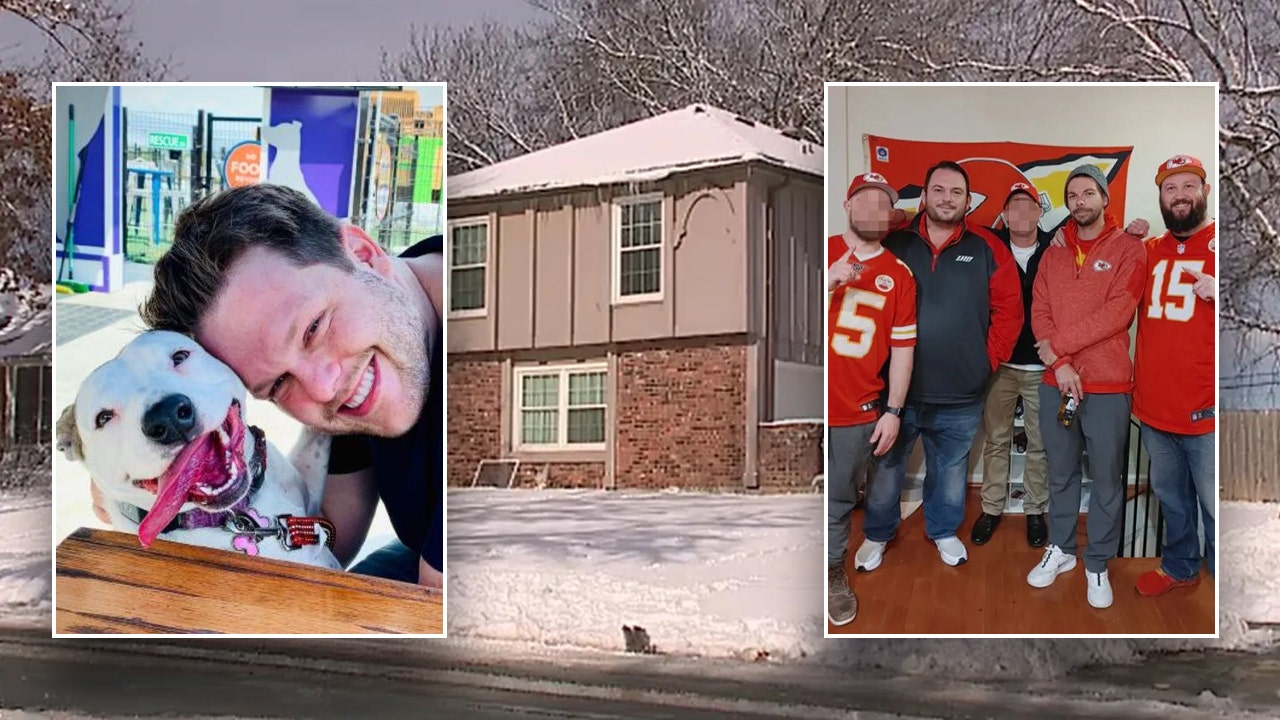
A video showing a detained, handcuffed Jordan Willis was captured by a neighbor on the night police discovered the bodies of his friends Clayton McGeeney, Ricky Johnson and David Harrington in his Kansas City backyard.
Although the video is only seconds long, neighbor Ashton Brady, 25, told Fox News Digital that there was a heavy police presence at the house across his street on Jan. 9 for at least an hour and a half before he went to bed.
First, Brady said, he saw a distressed-looking woman hurrying from the house and making a phone call – according to the Kansas City Police department, McGeeney’s fiancée dialed 911 for a welfare check to the Northwest 83rd Terrace home around 8:51 p.m. that night.
Family members told Fox News Digital that she discovered the first body after she frantically broke onto Willis’ property, unable to reach him or her partner. She allegedly knocked at the door and even shouted Willis’ name from inside the house before making the discovery.
KANSAS CITY CHIEFS FANS DEATHS: JORDAN WILLIS CHECKS INTO REHAB AS FAMILIES AWAIT TOXICOLOGY RESULTS
In a still taken by neighbor Ashton Brady, Jordan Willis can be seen in handcuffs and boxer shorts, surrounded by police on the evening of Jan. 9. His friends Ricky Johnson, David Harrington and Clayton McGeeney were found dead on his property that evening – Kansas City Police have told Fox News Digital that they do not suspect foul play in their deaths. (Fox News Digital)
“I just thought when I saw her, I thought it was weird watching her walk from the side of the house – she came out through the back,” Brady recalled in a Wednesday interview. “It was weird, the pace she was walking and talking on the phone. She looked back over her shoulder every so often at the house.”
“She looked upset for sure, like she didn’t know what was going on or anything,” he said.
Brady went back into his house, but returned to watch the scene across the street after seeing the lights of an ambulance through his bedroom window.
“We woke up and there were cops up and down the street and caution tape – you couldn’t go anywhere.”
By the time he got back outside, he said, about four police cars had amassed across the street and police officers surrounded a handcuffed man wearing just boxers or sleep shorts.
“He was detained for probably, like, 30 to 45 minutes. He was shirtless for 10 or 15 minutes and then a police officer grabbed a jacket out of the house,” Brady said.
Lights inside the house remained off, but Brady said he could see officers’ flashlights through its windows as police conducted their search. At some point, he said, he could see lights coming from the backyard.
As time passed, the police presence grew – what was initially just four cars became eight or 10 on the small street, he said.
“He was handcuffed and the woman was with the other police talking, so I figured a dispute broke out, and they were getting both sides of a story,” Brady said. “I thought ‘maybe they just got into an argument’ – at the time I didn’t know they found bodies… I thought it was strange that I saw the police go through the house.”
“People asked if I saw any bodies come out, I never did,” he said.
Attorney and retired NYPD inspector Paul Mauro told Fox News Digital that no meaningful insights about the case can be inferred from the manner in which Willis was detained:
“You can cuff for your own safety, and they did have three [dead on arrivals], so they didn’t know what they were into here,” Mauro said of police at the scene.
HIV scientist Jordan Willis, 38, checked himself into a rehab facility after his three friends were found dead in his backyard on Jan. 9. It is unclear whether drugs played a role in their death, as their toxicology results are still pending. (GitHub)
After about an hour and a half, Brady said, the woman and the man he now knows to be Willis were taken away in police cars. At some point Willis was uncuffed, because Brady could “see his arms moving.”
Another neighbor, Maya Dukes, told Fox News Digital that there was still a police presence at Willis’ home around 4 a.m. the next day.
“We woke up and there were cops up and down the street and caution tape – you couldn’t go anywhere,” she recalled. “They didn’t have their lights on or anything, they were just out on the street and at that house.”
WATCH NEIGHBOR’S VIDEO:
Brady would only learn the extent of the tragedy that took place across the street the next day:
“My roommate texted me at work – I was like ‘holy s—, I didn’t know that.”
Brady said that he and his roommate had just moved from elsewhere in Kansas City to the house across the street from Willis, and had spent the previous week settling in. He was away on a hunting trip with friends on the weekend of the Kansas City Chiefs game against the Los Angeles Chargers, when the men were last seen alive at Willis’ home on Jan. 7.
KANSAS CITY CHIEFS FANS FOUND DEAD IN FRIEND’S BACKYARD: WHAT TO KNOW
David Harrington, Clayton McGeeney and Ricky Johnson were found dead outside their friend’s Kansas City home on Jan. 9, 2024. (Ricky Johnson/Facebook)
Dukes said she noticed trucks parked outside the house because they were parked in “a weird spot where people don’t normally leave their cars.”
The two trucks are visible in Brady’s video. Family members of the deceased men have criticized Willis for not noticing that his friend’s vehicles were still on his street and thinking something was amiss.
In the days following Willis’ arrest, Johnson’s family told Fox News Digital they retrieved their son’s vehicle. Brady said the other car left the street, as well, but was unsure whether it was driven or towed away. It is unclear when the three men arrived at Willis’ home.
KANSAS CITY CHIEFS FAN DEATHS: JORDAN WILLIS ‘DEPRESSED’ OVER ‘WILD SPECULATIONS’ ABOUT PALS, SOURCE SAYS
An exterior view of the backyard and porch of Jordan Willis’s home in Kansas City, Missouri on Friday, Jan. 26, 2024. The bodies of Willis’ three friends – Ricky Johnson, Clayton McGeeney, and David Harrington – were found in Willis’ backyard, with one body found on the porch, on Jan. 9, 2024, two days after attending a Kansas City Chiefs watch party at the home. (DWS for Fox News Digital)
“It’s kind of weird,” Brady said of moving into his new home as the tragedy was unfolding. “It’s been… I don’t know, it’s been interesting for me. At first, I didn’t know if I should say anything [about the video], I didn’t know how big of a deal it was. I kind of wish I didn’t say anything because now my phone’s blowing up and people are hitting me up. [But] I just feel for the families… hopefully it helps a little bit.”
He said he had never seen Willis before that night.
“I have theories on it,” Brady said when asked what he thought of the mysterious deaths across the street. “I personally, I don’t know. It’s weird to me. The weirdest thing to me is if it was an overdose, no one called or anything like that – I went to school and partied – usually when something like that happens, when you call the police or the ambulance, no one usually gets in trouble.”
Ashton Brady poses for a photo on his front porch in Kansas City, Missouri on Tuesday, Jan. 30, 2024. Brady’s neighbor, Jordan Willis, was briefly detained while police searched his home after three of his friends were found dead in his backyard after a football watch party earlier in January. (DWS for Fox News Digital)
The Kansas City Police Department has told Fox News Digital that the deaths of the three men are “100 percent not being investigated as a homicide,” and that Willis is not considered a suspect. Toxicology reports will take six to eight weeks to process, according to the private company contracted by Platte County to carry out autopsies, while their full autopsy reports will not be released for another 10 to 12 weeks.
Willis’ attorney, John Picerno, said that his client works from home, slept for “a lot” of the time between allegedly seeing the three men out of his house after the Chiefs game. Therefore, Picerno said, he did not see messages or phone calls, and did not hear concerned loved ones knocking at his door.
PARENTS OF KANSAS CITY CHIEFS FANS FOUND DEAD THINK VICTIMS ‘SAW SOMETHING THEY SHOULDN’T HAVE SEEN’
Family and friends of Clayton McGeeney, left, David Harrington, center, and Ricky Johnson, right, are clamoring for answers after the three men inexplicably died in freezing temperatures outside their friend’s Kansas City home. (Facebook)
CLICK HERE FOR THE FOX NEWS APP
Willis checked himself into an inpatient rehab facility shortly after moving out of his house and is “facing his addiction head-on” after the “enormous, heartbreaking wake-up call” of “los[ing] three of his close friends under extremely tragic circumstances,” a source close to the family told Fox News Digital.
Two men were seen loading Willis’ belongings into a U-Haul truck in the days following Jan. 9, neighbors said – the source said that it has since been moved into storage, and that he is “still cooperating with the police department in their investigation.”
Read the full article from Here


Along with marching in the parade, the high schools will tour the U.S. Capitol, visit Mount Vernon and other monuments and museums.
Around 80 Grand Island students are making the trip. Lee said the students cover their own costs, with fundraising largely run though the school’s booster program helping offset the expense.
Bishop Neumann’s 53 students benefited from community donations, along with a holiday greenery sale and fundraisers, which Kellett said helped cover airfare and other costs.
For both directors, the trip carries extra weight tied to the nation’s 250th anniversary.
“That’s a pretty big milestone,” Lee said. “And to be able to be a part of that is pretty neat.”
Kellett said the moment will stay with students long after the parade ends.
“These kids, they’ll be around for the 300th anniversary of the country, and they’ll be able to look back and tell their grandkids, ‘you know, I was there at 250 and was able to march in the National Independence Day Parade,’” Kellett said.
Both bands have spent the summer preparing. Grand Island started working on its music after its final spring concert in May, rehearsing its marching and music together on Tuesday evenings.
Bishop Neumann has rehearsed continuously over the summer and marched in two parades to prepare, a 150th anniversary celebration in Weston and the Papillion Days parade.
Kellett said the band’s last rehearsal in Wahoo drew residents who lined the streets holding signs and cheering the students on.
“The students have come in, and they’ve worked really hard,” Kellett said. “They have their music memorized and they’ve worked on their marching skills, and so all that effort into this they’re ready to go for the parade.”
The parade starts at 9:30 a.m. CT Saturday at Third Street and Constitution Avenue.

The president will deliver remarks at the Burning Hills Amphitheatre after touring the Theodore Roosevelt Presidential Library, which is expected to open to the public on the nation’s semiquincentennial.
Trump arrived in Bismarck aboard the new Qatar-gifted Air Force One plane. From there, he traveled to Medora, in the western part of the state, for a private tour of the presidential library.
His speech is scheduled to start at 1:15 p.m. local time.

HAMDEN, Ohio (AP) — The 16 children found living in “deplorable” conditions inside a small, dilapidated rural Ohio home are part of the same family, officials said Wednesday.
Authorities arrested four adults Tuesday on felony child endangerment charges after finding the children in the home. Some were in dire need of medical treatment, authorities said.
Vinton County prosecuting attorney William Archer said the four adults were charged with second-degree felony child endangering because it involves “serious physical harm.”
Gary Siders Jr., Gary Siders Sr., Christina Siders and Elizabeth Siders appeared in court Wednesday where a judge entered not guilty pleas on their behalf.. They have not yet been assigned lawyers.
Ohio Attorney General Andy Wilson said Wednesday that the conditions inside the house in the tiny village of Hamden were almost indescribable, saying it “really looked third world.”
“It’s just almost beyond comprehension,” he said without providing details about what was inside.
It appeared that the children spent most of their time in just one room for much of the four years they lived there, Wilson said.
The house sits on a road tucked away alongside a steep railroad embankment, where tracks carry rumbling trains through Hamden. On Wednesday, its doors and windows stood open to the 94-degree Fahrenheit (34-degree Celsius) heat. A tangle of discarded children’s items — two busted bicycles, a plastic play table, a beach pail and two infant carriers — stood in a pile in the yard.
The Ohio Bureau of Investigation and local sheriff’s department searched the home on Tuesday.
The children ranged in age from 1 1/2 years to 18 years old and included both boys and girls, officials said. Seven were transported to hospitals in Columbus and two were flown by helicopters.
Hamden has a population of less than 1,000 people and is about 60 miles (97 kilometers) southeast of Columbus.
___
Seewer reported from Toledo, Ohio.
-

 Montana6 minutes ago
University of Montana welcomes Jeremiah Shinn as 20th president
-

 Nebraska9 minutes ago
Two high schools will represent Nebraska in the National Independence Day Parade
-
 Nevada14 minutes ago
Tesla Semi involved in first fatal crash, killing 2 in Nevada
-

 New Hampshire21 minutes ago
Have You Ever Actually Talked to a New Hampshire Police Officer? Here’s Your Chance
-

 New Jersey24 minutes ago
Exclusive | NJ’s suburbs are in a full-blown bidding war frenzy — with houses going 33% above asking
-

 New Mexico29 minutes ago
Dispatches from Route 66: Finding queer hope in New Mexico and Arizona
-

 North Dakota39 minutes ago
WATCH LIVE: Trump speaks in North Dakota ahead of July Fourth
-
Ohio44 minutes ago
Children found in ‘deplorable’ Ohio home were part of same family


