Politics
Opinion: Need help finding a good book? Try one your 9th grader isn't allowed to read


I have discovered many wonderful books, mostly in the young adult category, by reading news stories about what’s being banned in public schools these days: “Gender Queer,” the riveting, upsetting graphic novel about the nonbinary author’s journey of self-discovery; “Dear Martin,” in which a Black teenager who is wrongfully arrested while trying to help his drunk ex-girlfriend get home writes an imaginary letter to Martin Luther King Jr.; and “Paradise Lost,” John Milton’s 17th century epic poem about the fall of Adam and Eve.
Wait, what?
Not joking.
Opinion Columnist
Robin Abcarian
At the end of last year, according to the Orlando Sentinel, “Paradise Lost” was one of 673 titles removed from public school classroom shelves in an Orlando-area district in response to new state laws that require librarians and teachers to review all classroom books and banish ones that are pornographic or depict “sexual conduct.”
As the Sentinel explained, “New state training … warns them to ‘err on the side of caution’ when approving books and warns that they can face criminal penalties and the loss of their teaching certificates if they approve inappropriate books.”
Florida’s censorship efforts are part of a book-banning frenzy sweeping through the more conservative parts of our allegedly free-speech-loving country.
“We have recorded instances of book bans in 30 states,” said Kasey Meehan, the Freedom to Read director at PEN America, which advocates for free expression and fights censorship. “Florida and Texas are leading the way, as well as Missouri, Pennsylvania, Iowa and Utah,” she said.
In Idaho, librarians are so demoralized by the censorious political climate — one official in the city of Buhl referred to the local librarian as a “groomer” — that more than half recently told the state’s library association that they are thinking of leaving the field, according to the Idaho Capital Sun.
Mostly, the pressure to censor is coming from the right, which has pushed book bans under the banner of “parental rights.” Efforts originating from the left, Meehan told me, often involve protests against white authors using the N-word. In 2020, the Burbank Unified School District took some books off required reading lists, such as Harper Lee’s “To Kill a Mockingbird” and Mark Twain’s “Adventures of Huckleberry Finn,” after parents complained that the books were racist. However, Burbank Supt. John Paramo told me Tuesday that they are still available in the school and classroom libraries.
Books targeted by conservatives often feature characters who are not white, or who are not heterosexual.
In January 2022, a North Carolina parent asked his school district to take “Dear Martin” off the required reading list in his son’s high school English class. Tim Reeves told a local TV news station that he did not object to the novel’s message about racial profiling, per se. Rather, he objected to the liberal use of vulgar words. “Words that start with the letter S,” as he put it. “Words that start with the letter F.”
“Dr. Martin Luther King would not want vulgarity or sexual innuendos [to] be used to teach the lesson about racism and brutality,” said Reeves. I don’t know about that. Seems like King would maybe have been more interested in ending racial profiling than worrying about how fictional kids talk.
Anyway, thanks to Reeves, I downloaded “Dear Martin,” the widely acclaimed debut novel by Nic Stone, a Black woman whose father is a police officer. The book was inspired by the same events that inspired the Black Lives Matter movement — police killings of unarmed Black men and women. “I wondered: what would Dr. King say or do if he were living in our present social climate?” wrote Stone in her author’s note.
Thanks to the magic of my search function, I detected 10 F-words, 39 S-words, 30 “damns” and three “goddamns” in the text of “Dear Martin.”
As someone who is raising a teenager, that sounded about right to me. You should hear how the kids talk when they think no adult is near.
You might think book bans are beneficial to a young author. Hey, all publicity is good publicity, right? But this is not the case, said Meehan.
“When their works are banned,” she told me, “it can have a sizable impact on their revenue. Those authors are less likely to get invited for a school visit or a public library reading or a Zoom classroom visit. Those are revenue generators that kid-lit authors rely on.”
If you are a famous author, like Ann Patchett, or perhaps a dead one, like Milton, a ban might not hurt at all. It might even help.
When Patchett learned this month, for example, that two of her books had been banned in Orange County, Fla., she trolled the censors on Instagram:
“It’s a pretty big day for me personally,” said Patchett. “My first novel, “Patron Saint of Liars,” is about a home for unwed mothers in rural Kentucky. … They have the baby and give the baby up for adoption, just like they tell us to do in the state of Florida. I would actually think this book would be required reading.” (Her other banned novel, “Bel Canto,” features a hostage-taking and ends with the terrorists being killed. With guns. “Maybe in the state of Florida that would be OK too, because they don’t ban guns,” Patchett suggested.)
It’s not just sexual, gender and racial themes that incense some on the right, Meehan said. Parents have also banned books that include scenes of violence (Frank Herbert’s sci-fi classic “Dune”), sexual abuse (Margaret Atwood’s “The Handmaid’s Tale”), drug use (Stephen Chbosky’s “The Perks of Being a Wallflower”) or suicide (Jay Asher’s “Thirteen Reasons Why”).
“It’s content that makes people feel uncomfortable,” said Meehan. “But isn’t that the beauty of books?”
It is.
Just think how much discomfort — and enlightenment — “Paradise Lost’s” most famous line, uttered by that great fictional character Satan, delivers: “Better to reign in Hell, than serve in Heaven.”

Politics
DOJ expands indictment against SPLC, alleging $4M secretly funneled to KKK and extremist groups

NEWYou can now listen to Fox News articles!
The Department of Justice last month announced an indictment against the Southern Poverty Law Center (SPLC), alleging that the civil rights nonprofit defrauded donors by secretly paying informants associated with extremist organizations, including the Ku Klux Klan.
A federal grand jury in the Middle District of Alabama returned an 11-count indictment in April charging the SPLC with six counts of wire fraud, four counts of making false statements to a federally insured bank and one count of conspiracy to commit concealment money laundering, according to the Justice Department.
The superseding indictment retains those charges while expanding on the alleged misconduct.
According to the DOJ, the SPLC “secretly funneled” more than $3 million in donor funds between 2014 and 2023 to numerous individuals associated with extremist organizations, including the Ku Klux Klan, United Klans of America, the National Socialist Movement, participants in the Unite the Right rally and the Aryan Nations-affiliated Sadistic Souls Motorcycle Club.
NEO-NAZIS, ‘SADISTIC’ BIKERS AND CHARLOTTESVILLE ORGANIZER: 5 OF THE MOST SHOCKING SPLC INFORMANTS
The Southern Poverty Law Center has widespread influence in education. FILE: Acting Attorney General Todd Blanche, left, and SPLC interim President and CEO Bryan Fair are shown in a split image as the Justice Department pursues charges against the Southern Poverty Law Center. (Nathan Posner/Anadolu via Getty Images; USA TODAY Network via Imagn Images)
The original indictment alleged approximately $3 million in payments between 2014 and 2023.
“The SPLC’s paid informants (‘field sources’) engaged in the active promotion of racist groups at the same time that the SPLC was denouncing the same groups on its website,” the indictment states.
Prosecutors further allege the SPLC opened bank accounts tied to fictitious entities in order to conceal donor funds that were allegedly routed to confidential sources.
MIKE DAVIS: SOUTHERN POVERTY LAW CENTER: A TALE OF A RACISM SCAM
The Southern Poverty Law Center (SPLC) building seen in March 2020 in Montgomery, Alabama. (Barry Lewis/InPictures via Getty Images)
According to the indictment, the SPLC began operating a covert informant network in the 1980s, and between 2014 and 2023 allegedly paid those sources in a clandestine manner.
The DOJ alleges an SPLC employee instead encouraged the pair to remain involved and offered them a monthly salary of $1,200.
The two subsequently agreed to remain in the organization, according to the indictment.
DR. BEN CARSON: I KNOW HOW BAD THE SPLC WAS, IT CAME AFTER ME AND PUT ME AT RISK
Acting Attorney General Todd Blanche spoke during a press conference alongside FBI Director Kash Patel at the Department of Justice on April 21, 2026, in Washington, D.C., following the indictment of the Southern Poverty Law Center. (Nathan Posner/Anadolu via Getty Images)
Prosecutors allege an SPLC employee instructed the individuals to claim they worked for a company called Rare Books and helped college students with research and writing assignments if anyone questioned the source of their income.
The indictment alleges donor funds were used to pay both individuals through SPLC accounts.
According to prosecutors, the pair were also reimbursed for expenses related to Ku Klux Klan activities, including cross-burning events and associated costs such as wood and fuel.
One of the individuals is also accused of recruiting new members using donor-funded payments. The indictment further alleges the SPLC knew donor funds were used to purchase materials for Ku Klux Klan garments.
In a statement to Fox News Digital, attorney Abbe Lowell, who represents the SPLC, denied the allegations.
A composite image shows Acting Attorney General Todd Blanche overlaid on photographs of the Department of Justice and FBI headquarters in Washington, D.C. (Valerie Plesch/Bloomberg via Getty Images; Graeme Sloan/Bloomberg via Getty Images)
“This apparent superseding indictment attempts to shore up the flaws in the initial charges, but it changes nothing,” Lowell said.
“The SPLC did not lie to its donors, it did not mislead banks it did business with, and its informant program prevented violence and saved lives,” he continued.
“It appears the Justice Department shared the indictment with media before it was unsealed by the court – another example of the government’s troubling handling of this case.”
“We will be addressing these irregularities with the court and look forward to presenting the truth at trial,” he added.
NONPROFIT REVENUE TOTALS SURGE AMID GROWING SCRUTINY AFTER MAJOR FRAUD CASES
SPLC interim President and CEO Bryan Fair speaks during a wreath-laying ceremony at the Southern Poverty Law Center Civil Rights Memorial in Montgomery, Ala., on March 5, 2026. (Jake Crandall/Advertiser / USA TODAY NETWORK via Imagn Images)
The superseding indictment also notes that the SPLC’s reported revenue increased from roughly $38.7 million in 2010 to more than $129 million in 2023, an increase of approximately 233%.
According to the filing, the organization’s net assets grew from approximately $238 million to nearly $787 million during the same period.
The SPLC is a longtime nonprofit organization that says it combats white supremacy and extremism through research, reporting and monitoring efforts intended to assist law enforcement and the public.
During a news conference announcing the original indictment, Acting Attorney General Todd Blanche alleged the SPLC paid members of extremist groups so it could generate “work product” documenting their activities.
CLICK HERE TO DOWNLOAD THE FOX NEWS APP
“To that end, [SPLC] was doing the exact opposite of what it told its donors it was doing – not dismantling extremism but funding it,” Blanche said.
Fox News Digital’s Alexandra Koch, David Spunt, Jake Gibson and Alec Schemmel contributed to this report.
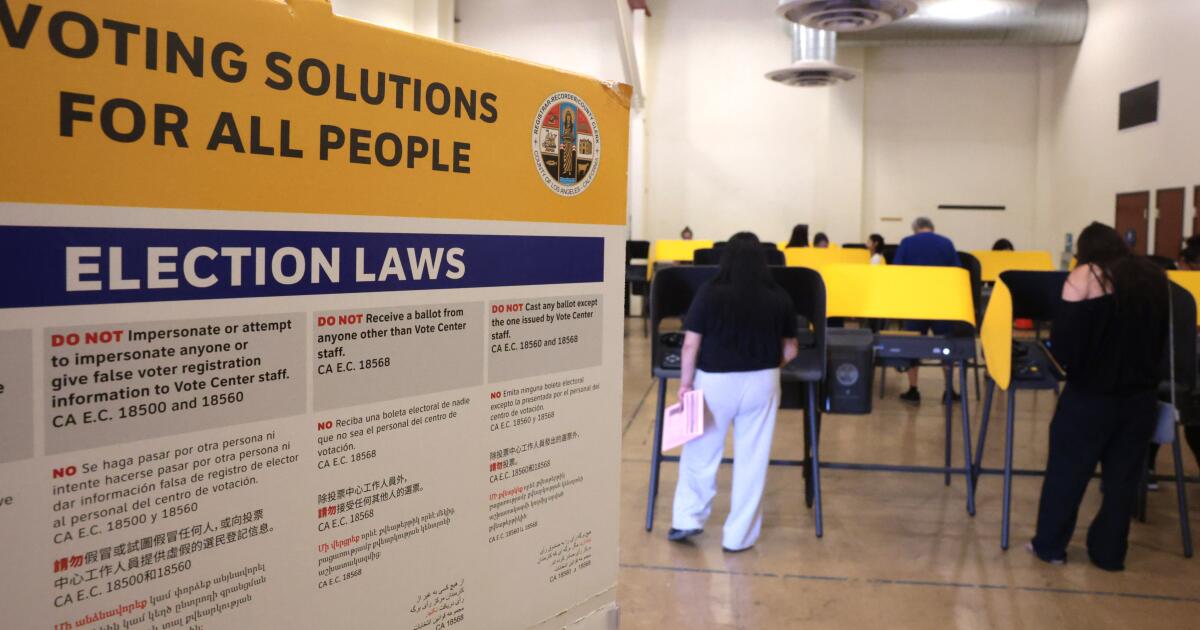
Buoyed by a new Congressional map favoring their party, California Democrats were eyeing Tuesday’s primary elections as a critical first step toward flipping a handful of House seats and taking back power in Washington.
Results from California’s massive and slow-moving election process were not immediately clear late Tuesday, as polls closed and mail ballots continued to be processed and counted. Still, Democrats were bullish about their chances of advancing candidates to November’s general election in all five districts that were redrawn in their favor as a result of last year’s Proposition 50 ballot measure.
“The path to winning back the House starts with voting in the June 2nd primary,” the California Democratic Party posted online Monday.
Meanwhile, California Republican Party Chairwoman Corrin Rankin urged Republican voters to make their own voices heard too.
“Like President Trump said, we need to make it too big to rig,” Rankin said on “The Benny Show.” “We need to swamp the vote.”
One of the most closely watched races was in the redrawn 22nd Congressional District in the Central Valley, where incumbent Rep. David Valadao (R-Hanford) is facing challenges from moderate Assemblymember Jasmeet Kaur Bains (D-Delano) and progressive college professor Randy Villegas.
Another closely watched race was in the redrawn 48th Congressional District in San Diego and Riverside counties, where Rep. Darrell Issa (R-Bonsall) decided to retire rather than run for reelection, and where Republican San Diego County Supervisor Jim Desmond — who is endorsed by Trump — is running against a pack of Democrats.
Prop. 50 — which Californians passed with nearly 65% of the vote a year ago — was California Democrats’ response to Texas Republicans redrawing their state’s Congressional maps in the GOP’s favor, at President Trump’s behest. It was also the only major Democratic counterpunch in the wider mid-decade redistricting brawl that has spread across the country in the last year.
Experts expect the redistricting battle to deliver a net gain of a handful or more House seats to Republicans. But Democrats could gain even more ground given Trump’s lousy approval ratings and the long history of midterm election losses for the president’s party.
Combined, those factors make the battle for control of the House incredibly close, which in turn makes the five seats up for grabs in California pivotal — and potentially decisive.
Tuesday’s primaries won’t determine if any of those five seats will indeed flip parties in November. However, the primaries will define those head-to-head races to come and better inform the odds of Democrats toppling Republican incumbents, experts said.
In addition to flipping the seats currently held by Valadao and Issa, Democrats are hoping to pick up three additional seats.
In the 1st Congressional District — which after Prop. 50 lost rural reaches of northeast California and picked up liberal North Bay communities — various candidates were vying for the seat long held by the late Rep. Doug LaMalfa (R-Richvale), who died in January. They include Democratic state Sen. Mike McGuire and Republican Assemblymember James Gallagher, who is endorsed by Trump.
Voters from the existing district are also voting in a special election Tuesday to fill the remainder of LaMalfa’s term.
In the 3rd Congressional District, which lost an eastern rural stretch along Nevada and now holds more tightly to the Sacramento suburbs, Rep. Ami Bera (D-Elk Grove) — who currently represents a different district — is running to remain in Congress in a new seat.
Meanwhile, the 3rd Congressional District’s incumbent, Rep. Kevin Kiley (I-Rocklin), is seeking to do the opposite. He quit the Republican Party, became an independent and is now running for Bera’s current seat in Congressional District 6, which includes the city of Sacramento and Placer County suburbs.
In the 41st Congressional District, which became more liberal after Prop. 50 by losing voters in Riverside County and gaining them in Los Angeles County, a slate of candidates — including Rep. Linda Sánchez (D-Whittier), who currently represents a different district — are running to replace Rep. Ken Calvert (R-Corona). Calvert, a 17-term incumbent, decided to run in the neighboring 40th Congressional District instead.
In the 40th Congressional District, which covers a swath of inland Orange County and portions of San Bernardino and Riverside counties, incumbent Rep. Young Kim (R-Anaheim Hills) is now going head-to-head with Calvert, while also facing several Democratic challengers.
Other districts that were not part of the Prop. 50 shuffle are also attracting attention.
In the 11th Congressional District in San Francisco, several Democratic candidates are vying to replace Rep. Nancy Pelosi (D-San Francisco), the retiring former House Speaker, including state Sen. Scott Wiener; tech millionaire and Democratic political operative Saikat Chakrabarti; and Connie Chan, a member of the San Francisco board of supervisors who Pelosi endorsed.
Democrats are also closely watching several races where younger Democrats and progressives are challenging older incumbent Democrats, and where newer Democratic incumbents are seeking to hold onto their seats in relatively competitive districts.

NEWYou can now listen to Fox News articles!
LOS ANGELES — Outside a Bristol Farms market in LA’s Westchester neighborhood, residents who spoke to Fox News Digital all agreed that homelessness is a top problem facing the city, but disagreed on which mayoral candidate is the right choice to clean it up.
“Love him,” Shelley Zuckerman said about reality television star and independent candidate Spencer Pratt, adding that homelessness is a main motivator of her support for the reality TV star’s mayoral run.
“The fact that he’s not a politician, so he may or may not be a liar, we don’t know that yet, and I know that he wants to do something for LA that the politicians have been saying they’re going to do and then don’t,” Zuckerman added. “And I know politics works, that once you get in there you can’t always do what you want to do, but at least he’s got the passion.”
SPENCER PRATT SAYS HIS POLICY WILL FORCE HOMELESS OUT OF LA AND INTO CITIES LIKE SEATTLE
Los Angeles residents say homelessness is the top problem facing the city as they head to the polls for the mayoral primary. (Fox News Digital)
When asked if crime was a motivating factor to vote for Pratt, Zuckerman’s husband Saul responded, “Of course.”
The couple says they are supporting Republican Steve Hilton for governor.
Patrick Reynolds, who lives in the neighborhood, said he is “not happy with any of the candidates” and called Pratt a “clown” before saying he voted for incumbent Mayor Karen Bass “a little reluctantly.”
Homelessness has been a top-of-mind concern for voters in Los Angeles, and despite Bass being mayor for the last four years, Reynolds said he believes she’s the best choice on that front.
Reynolds, who said he is supporting billionaire Democrat Tom Steyer for governor, spoke at length about the problems with homelessness, including a local park he said has become “too dangerous” to visit in recent years.
KAREN BASS GRILLED OVER BROKEN HOMELESSNESS PROMISE, BLAMES BUREAUCRACY FOR SLOWED PROGRESS
Mayoral candidate Spencer Pratt hosts a campaign block party on 10th Avenue in Los Angeles on May 20, 2026. (Robert Gauthier/Los Angeles Times)
“Homelessness for sure,” a woman named Diane, who said she voted for Bass, told Fox News Digital, “That’s number one on my list, and I think she’s tried very hard to fix that problem. It’s a big problem, I know. And I just think she is down to earth. She’s not some rich billionaire, which I appreciate.”
Diane said she is supporting former Department of Health and Human Services Secretary Xavier Becerra, a Democrat who served in the Biden administration, for governor because he is a “good guy.”
“I like that he is an immigrant and that he has worked his way up in this world,” Diane said. “I think he has a good sensibility. I like also that he isn’t a billionaire. I can relate to him.”
Dan Madden, a resident of nearby Manhattan Beach, told Fox News Digital that if he could vote in LA proper, he’d go with Pratt.
WHO IS TOM STEYER? ANTI-ICE BILLIONAIRE IN CA GOVERNOR’S RACE FACES SCRUTINY OVER DETENTION INVESTMENTS
A Los Angeles city councilwoman and progressive candidate for mayor Nithya Raman, left, pictured alongside incumbent mayor Karen Bass, right. (Ronaldo Bolaños/Los Angeles Times via Getty Images; Justin Sullivan/Getty Images)
“That’d be my man,” said Madden, who added that he is voting for Hilton for governor. “The last 20 years in Los Angeles has been screwed.”
“It’s getting worse,” Madden said about the homeless situation in the Los Angeles area. “They cleaned up here and there. Spots, especially along the beach, coastline, you see it cleaned up. Two months later, everybody’s back.”
CLICK HERE TO DOWNLOAD THE FOX NEWS APP
Pratt, a registered Republican running as an independent, faces off in a nonpartisan mayoral primary against incumbent Mayor Karen Bass, a Democrat, and City Councilmember Nithya Raman, a socialist.
Tuesday’s election will determine which two candidates advance to the November general election. If a candidate receives more than 50% of the vote, they will automatically be named the next mayor.
-

 Denver, CO4 minutes ago
Defensive lineman Jordan Miller has a tough battle to make the Broncos’ final 53-man roster
-

 Seattle, WA11 minutes ago
VIDEO: Mayor Wilson proposes renewing, expanding Seattle Transit Measure by doubling the sales-tax percentage that funds it.
-

 San Diego, CA14 minutes ago
Morning Report: Runoffs Largely Set
-

 Milwaukee, WI19 minutes ago
MPS staffer who got plea deal in slapping case had earlier incident
-

 Atlanta, GA26 minutes ago
19 new metro Atlanta restaurants opened in May, but 11 closed
-

 Minneapolis, MN29 minutes ago
Motorcyclist seriously injured in north Minneapolis hit-and-run
-

 Indianapolis, IN34 minutes ago
New stores in Indianapolis include indoor kid’s playground, cafe
-

 Pittsburg, PA41 minutes ago
Blanche says DOJ

