Indiana
Boston Celtics squander electric start, rally to beat Indiana Pacers anyways, 129-124


The Boston Celtics and Indiana Pacers have gone on a wild ride together this season. Facing off for an In-Season Tournament-augmented five regular season matchups, they’ve traded blows exceptionally often across the first half of the season. The teams entered their fifth and final matchup of the regular season looking to break a 2-2 tie on the year, a slate that has been hotly contested outside of a blowout win in November for the Celtics. In the end, it was the Celtics who got the last laugh, recording a 129-124 win at TD Garden to claim the season series.
This fifth game was a little different than the rest. The Celtics got their first look at an old foe in a new environment tonight, as they faced off with Siakam for the first time as a Pacer — just his seventh game for the team. While Siakam has been settling in to his new digs, one wrinkle of note has been how he’s had to do it without the services of his co-star. Tyrese Haliburton returned to the Indiana lineup tonight, having been inactive for the Pacers’ last five games, and 10 of their last 11. This was just the duo’s second game together, though it was short-lived — Haliburton recorded just 22 minutes as the Pacers approached his return to play with extreme caution.
The starting five carried the bulk of the load tonight. All five starters scored at least 17 points on the evening, compared to just 16 combined for the bench. Leading the way was Jayson Tatum, who scored a hyper-efficient 30 points (12-of-19 shooting) while grabbing seven rebounds and dishing seven assists. Jaylen Brown added 25 of his own, while Jrue Holiday scored 17 on 6-of-8 shooting and Kristaps Porzingis recorded a 17-point, 12-rebound double-double.
After starting off slowly against the Clippers and Pelicans, the Boston offense looked more lively as play began this evening. Each member of the starting lineup found his way onto the scoreboard, and only Holiday connected on fewer than two buckets. The Celtics were going to need every point tonight, facing an explosive Pacers offense with its beating heart, Haliburton, back on the court. But Indiana shot just 36.7% compared to Boston’s 53.3% in the first quarter, and the Celtics took a 36-26 lead into the second quarter.
Nobody started out quicker this evening than White, who appears to have fully broken out of a January slump that has seen him shoot just 38% from the field for the month. White was crucial down the stretch of Monday’s win over the Pelicans, making plays on both ends of the floor in crunch time to secure the win, and that high level of play carried over to this game. He scored 24 points on 8-of-16 shooting for the night, and recorded a crucial block on a corner three-point attempt to help secure the game for Boston. Not a bad way to break a slump.
Though Al Horford (neck/rest) and Luke Kornet (hamstring) missed the game, the Celtics enjoyed an increasingly rare opportunity to deploy their default starting lineup. Those starters took a buzzsaw to the Indiana defense. Even as the Pacers’ offense found a bit of momentum, they still wound up buried under a mountain of Celtic points. Led by 23 from Tatum and double-digit scoring from four of their starters (Holiday scored eight), the Celtics followed their 36-point first quarter with 45 in the second, and took a comical 81-66 lead into the halftime break.
Quietly, the first half ended on a bit of a sour note for the Celtics. It’s odd to say about a team that scored 81 points in a half, but Boston seemed to lose their edge just a bit in the closing minutes. A buzzer-beating heave from Haliburton found the bottom of the net, sucking a bit of the air out of the room for the Celtics’ offense.
That negative momentum carried over to the third quarter, where, unbelievably, the Celtics found their lead cut to single digits as the Indiana run stretched to 16-4. Rebounding was a substantial culprit here, possibly suggesting tired legs on the part of Boston. The Pacers piled up an unacceptable 19 offensive rebounds on the night, deflating the Celtics’ defense by finding a number of second-chance scoring opportunities. Boston’s lead dwindled down to just three points by the eight-minute mark.
The Celtics course-corrected slightly as the returned from a Joe Mazzulla timeout, in part due to some heady play from Brown. The Pacers were still able to complete the comeback. The tied the game up at 91 apiece with just over five minutes to play in the third, and briefly took the lead moments later at 94-93. The Celtics received a boon in the ensuing minutes, though, as Haliburton hit his minutes cap in his return from injury and found himself resigned to the bench for the remainder of the contest. Absent their offensive engine, the Indiana offense faltered ever so slightly, and the Celtics were able to take a three-point lead into the final quarter, 106-103.
Tonight, the fourth quarter was going to be a matter of stamina. Staring down their second tightly contested game against a likely playoff team in as many nights, the Celtics were going to have to earn another win just like Mazzulla asked for the night before. Nothing had come easy since the midway point of the second quarter, and that didn’t look likely to change in the fourth.
As the final frame began, the Celtics pounced early. Apart from a mental mistake by Neemias Queta on a jump ball, they played sharply and recorded a quick 9-3 run to push back ahead by nine points. The lead stretched back into the double-digits after a timeout, the Celtics firmly placing themselves in the driver’s seat. The lead would remain around nine points for the next several minutes of play.
The final two minutes of the game saw an Indiana rally. The Pacers capitalized on mental mistakes by the Celtics to go on a quick 6-0 run and abruptly draw back within three points with just over a minute remaining. Given a pair of crucial chances to close the gap, though, the Pacers found themselves stymied by the Boston defense twice in a row. White blocked a corner three, and Tatum blocked a layup after the Pacers retained possession, and the Celtics finally shut the door on Indiana for the regular season.
Next up, the Celtics will conclude their season series with a Los Angeles Lakers team in an increasing state of disarray, on the TD Garden floor this Thursday at 7:30 EST on TNT.



Indiana
Where to watch Phoenix Mercury vs Indiana Fever on June 22: TV channel, start time and streaming
The WNBA has returned with a brand new collective bargaining agreement and a league full of loaded rosters as the 2026 season tips off.
A rookie class headlined by Dallas Wings top pick Azzi Fudd, Minnesota’s Olivia Miles and Washington’s Lauren Betts is ready to make a mark in the pros while the defending champion Las Vegas Aces look to keep their dynasty alive with a fourth title in five years.
As the the season gets going under a new media rights deal, it can be tough to figure out which channel each team is playing on every night. Here’s everything you need to know to tune in when the Indiana Fever host the Phoenix Mercury on Monday.
What time is Phoenix Mercury vs Indiana Fever?
Tip off between the Indiana Fever and Phoenix Mercury is scheduled for 8 p.m. (ET) on Monday, June 22.
How to watch Phoenix Mercury vs Indiana Fever on Monday
All times Eastern and accurate as of Monday, June 22, 2026, at 6:10 a.m.
Watch the WNBA all season on Fubo
WNBA scores and results
See scores, results for all of today’s games .
See WNBA scores, results from June 21
Odds for WNBA games today
The latest WNBA odds can be found below from the best sports betting apps . Some odds may include games scheduled on future dates.
Indiana
Indiana mother fatally shot after suspect tries to rob son during Facebook Marketplace meetup

A northern Indiana mother was allegedly shot and killed by a man her son met online through Facebook Marketplace about selling a watch, according to WNDU, the NBC affiliate in South Bend.
Jean Gragg, 40, was shot in the head on Wednesday, June 10, in South Bend, Indiana, and died the following Saturday. Police said prior to the shooting, Gragg’s son arranged to meet with an 18-year-old man he had been communicating with through Facebook Marketplace.
According to authorities, Gragg’s son arranged to sell the individual, identified as John Harrison Ford, a watch.
WNDU reported the son told police that Ford ended up pulling out a gun while he was looking at the watch and tried taking it from him. Gragg then got in between them and chased Ford away from the home.
Police said security camera video captured the 18-year-old shooting at Gragg after she turned around and began heading back toward the house. Gragg was taken to an area hospital, where she died three days later.
During an interview with law enforcement, Ford reportedly admitted to shooting Gragg. He was later charged with murder, felony murder, attempted murder and attempted armed robbery.

U.S. Education Secretary Linda McMahon, left, joins Indiana Gov. Mike Braun and state Education Secretary Katie Jenner for a ceremonial signing of the state’s waiver from provisions of the Elementary and Secondary Education Act on Tuesday, June 16, 2026, at Plainfield High School. Photo by Mackenzi Klemann, Indiana Capital Chronicle.
By Mackenzi Klemann
Indiana Capital Chronicle
PLAINFIELD — Indiana K-12 educators will soon have less paperwork following the U.S. Department of Education’s approval of a waiver exempting the state from provisions of the federal Elementary and Secondary Education Act.
The state applied for the waiver in December to streamline education spending and align its new A-F accountability measures with federal law.
The waiver consolidates federal funding from portions of Titles I, II, III and IV – grants used to support things like low-income students, teacher training, English language learners and school safety – totaling $50 million over the next four years.
U.S. Education Secretary Linda McMahon, who visited Plainfield High School Tuesday for a ceremonial signing of the waiver, said the change frees $20 million in state and local funds from “bureaucratic red tape” so schools can reallocate money to the classroom.
The waiver also OKs the use of college and career readiness metrics like work-based learning and credentials toward high school accountability scores, a crucial component of Indiana’s new A-F system.
“President Trump told me I’d be successful in my job when I fired myself or worked myself out of a job,” McMahon said, “but his vision isn’t about me or one position. It’s about breaking up the education bureaucracy in Washington, D.C., a system that too often enriches adults while stifling progress for kids and empowering states to drive a new era of excellence for students across the country.”
She added, “We must breathe innovation into education, not suffocate it with top-down mandates, because we certainly know that one size does not fit all in education.”
Indiana is the third state approved for the waiver, nicknamed “Return Education to the States,” following Iowa and Louisiana.
States already control educational standards, curriculum and assessments. The waivers grant states greater control over how to spend federal K-12 funding too.
Indiana’s waiver consolidates funding for various education programs, which McMahon likened to a block grant, so schools no longer need to meet separate reporting requirements for each grant.
“At the heart of all this there is a simple, urgent belief: We must focus our time and energy on the work that propels us forward,” Indiana Secretary of Education Katie Jenner said. “We work to serve students, not to serve bureaucratic, outdated processes and paperwork.”
Less Paperwork, More Classroom Time

Indiana Education Secretary Katie Jenner leads a discussion about the state’s new federal education waiver. Photo by Mackenzi Klemann, Indiana Capital Chronicle.
Educators in attendance Tuesday praised what they see as a move away from bureaucracy.
“Too often these programs had differing goals and really specific requirements that might have been at odds with one another,” said Betsy Wiley, president and CEO of the Institute for Quality Education.
“There’s just no proof that, that extra bureaucracy is leading to higher standard achievements,” said Keeanna Warren, chief executive officer of Purdue Polytechnic High School.
Plainfield Community Schools Superintendent Andy Allen said he anticipates significant savings as the district will be able to redeploy office staff, many of whom are trained educators, to the classroom due to the reduction in compliance paperwork.
“Just because we have less compliance (paperwork) doesn’t mean we just do less,” he said. “Now we get back out in the buildings, we get back in front of kids, we get back in front of teachers, get connected with our community to make sure we have our best voices leading work for our kids and our community.”
The waiver could also benefit outside programs like the Boys and Girls Club’s summer learning labs.
Duane Wilson, chief executive officer of the Boys and Girls Club for the northern Indiana corridor, said the organization serves 5,800 Hoosier students throughout the state, but with additional funding the club could reach 10,000 Hoosier children next year.
The club is “moving the needle for kids,” Jenner said, but its rapid growth exceeded what the state could provide. “We’re seeing it in the short-term assessments. We’re seeing it in our state assessments.”
-

 Politics2 minutes ago
Cops could be forced into race-based guessing game after Supreme Court move, Thomas joins dissent
-

 Health9 minutes ago
8 common food preservatives linked to higher risk of high blood pressure and heart disease
-

 Sports12 minutes ago
2026 World Cup Golden Glove: Martínez, Simon Tied Atop Oddsboard
-
Business24 minutes ago
Music mogul Clive Davis, producer and label executive who signed musicians like Janis Joplin, Bruce Springsteen and Whitney Houston, has died
-
Entertainment27 minutes ago
Netflix expands library of kid-centric programs
-
 Lifestyle32 minutes ago
Contributor: ‘The Fast and the Furious’ took the Asians out of an Asian American story
-
 Politics39 minutes ago
Supreme Court says ex-LAPD officer may be sued for excessive force in street shooting
-
 Sports47 minutes ago
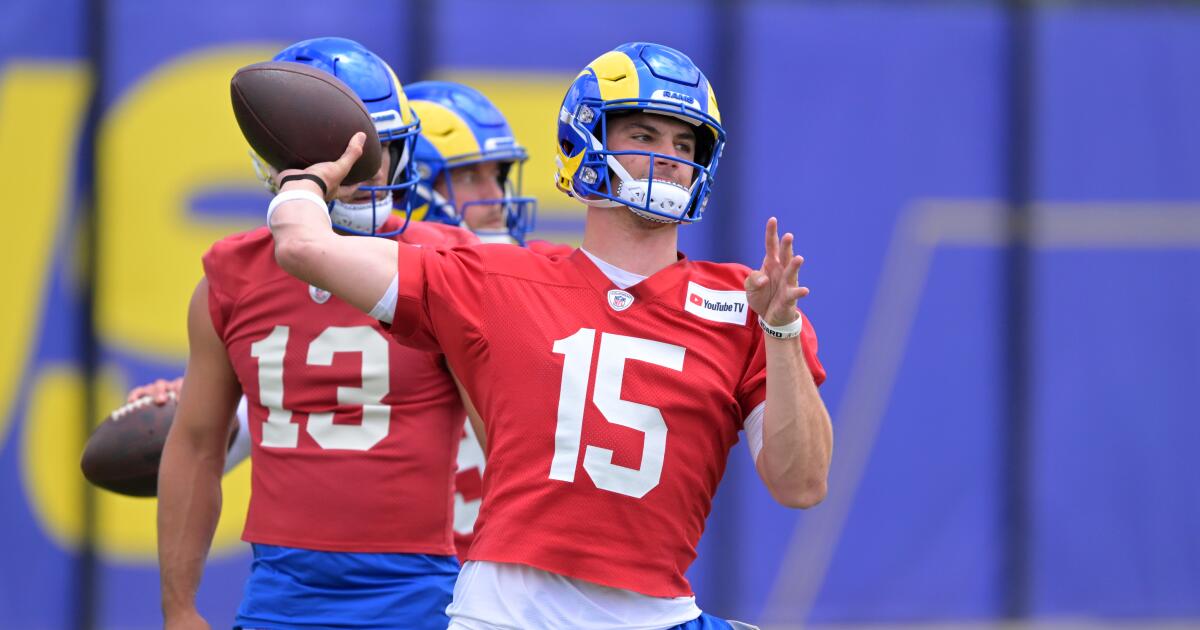
Rams QB Ty Simpson embracing an unusual bedtime routine to spur his development