Midwest
Iowa secretary of state introduces bill that could limit 14th Amendment ballot challenges against Trump

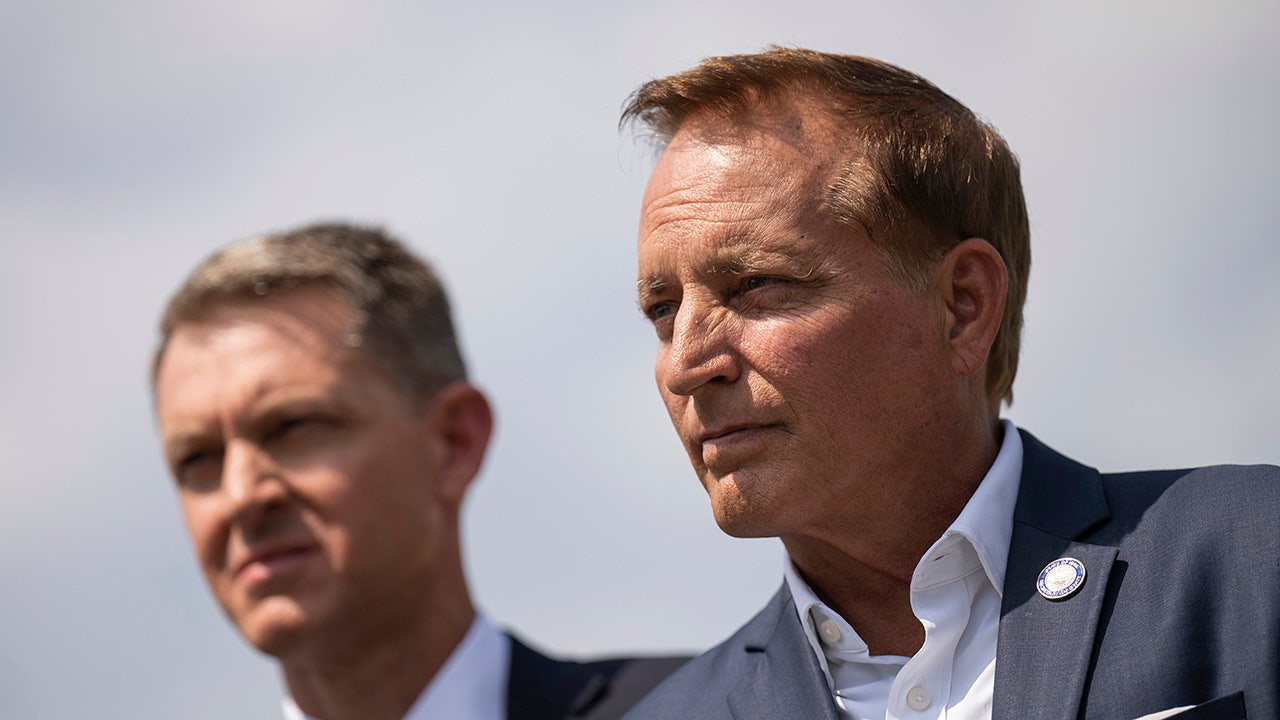
Iowa Secretary of State Paul Pate introduced a bill that reportedly could limit challenges to former President Trump’s eligibility for the 2024 ballot.
The legislative proposal comes amid efforts in several states to challenge Trump’s eligibility under Section 3 of the U.S. Constitution’s 14th Amendment, which prevents individuals from holding office again if they “have engaged in insurrection or rebellion” against the United States.
“The Iowa Secretary of State’s Office accepts the recognized political parties’ certifications of their candidates for president and vice president in good faith. This is a technical bill that clarifies which objections the objection panel has jurisdiction to consider but does not prevent anyone from taking legal action or pursuing challenges in court,” Ashley Hunt, a spokesperson for Pate’s office, said in a statement to Fox News Digital on Thursday.
Asked directly if the bill could limit challenges to Trump’s eligibility under the 14th Amendment, Hunt said the bill would not bar lawsuits in court that aim to block candidates from the ballot. Rather, the bill places restrictions on Iowans who object to the eligibility of presidential and vice presidential candidates through petitioning the state commissioner of elections.
“This bill does not limit someone’s ability from taking legal action or pursuing challenges in court. It simply clarifies the process for the objection panel,” Hunt wrote.
According to the pre-filed bill’s text, which has been visible on the Iowa state legislature’s website since Jan. 18, Pate’s proposal seeks to limit the grounds for challenging all federal candidates, including those running for president and Congress, to questions about age, residency, citizenship and whether their nominating papers meet all the legal requirements.
HAWAII DEMOCRAT INTRODUCES BILL TO BAN TRUMP FROM BALLOT
In Iowa, political parties must submit a certificate with the names of their presidential and vice presidential candidates to the secretary of state’s office 81 days before the general election.
“The bill limits objections to the eligibility of a candidate for a federal office that may be filled with the state commissioner of elections to objections to the legal sufficiency of the nomination petition or certificate of election, or to the residency, age, or citizenship requirements as described in the Constitution of the United States,” according to the proposal text. “With respect to nominations for president or vice president of the United States, the bill allows objections only to the legal sufficiency of the certification of nomination. The certificate of nomination shall be presumed valid.”
The bill also removes the requirement for federal candidates to sign a statement that they are aware they are disqualified from holding office if convicted of a felony. Under current state law, all candidates running for office – local, state and federal – must do so. Currently, Trump is facing 91 felony charges spanning four criminal cases.
Iowa Secretary of State Paul Pate (Drew Angerer/Getty Images)
“It would pretty clearly foreclose any challenge to a presidential candidate for being not qualified under the United States Constitution,” Derek Muller, an election law professor at the University of Notre Dame Law School, told the Des Moines Register of the proposal. “So, it would be designed to foreclose a challenge like those filed in Colorado in Maine.”
Hunt told the Register that current law presumes the paperwork candidates file to run for office is valid and provides limitations to what issues are eligible for objection.
The new bill, she explained, would further clarify Iowa’s process for objections.
“This simply extends that same standard to all candidates explicitly,” Hunt told the newspaper.
Former President Trump attends a watch party during the Iowa Republican presidential caucuses in Des Moines on Jan. 15, 2024. (Jim Watson/AFP via Getty Images)
“To the best of our knowledge, in 2015, Mr. Trump met the Constitutional requirements to be president and continues to do so,” Hunt said. “Mr. Trump has not been convicted of anything that disqualifies him to be president. This bill simply helps clarify the objection process for Iowa.”
MAINE OFFICIAL APPEALS HER REMOVAL OF TRUMP FROM VOTING BALLOTS TO STATE’S TOP COURT
“The U.S. Constitution sets eligibility requirements for Congress and POTUS,” Hunt added. “This update ensures affidavits comply with those requirements.”
Trump swept the Iowa caucuses and then won the New Hampshire primaries this month as the presidential nominating contest turns its focus on the South Carolina primary next month.
Former President Trump acknowledges supporters during his caucus night event, Jan. 15, 2024, in Des Moines, Iowa. (Chip Somodevilla/Getty Images)
The Colorado Supreme Court, in a split decision, and Maine’s Democrat secretary of state, Shenna Bellows, cited the 14th Amendment in barring Trump from the ballot in their respective states for allegedly inciting the Jan. 6, 2021, riot at the U.S. Capitol. More recently, a Hawaii Democrat senator introduced a bill that also aimed to block candidates, citing the insurrection clause.
The timelines are tight as Super Tuesday approaches on March 5. The U.S. Supreme Court is hearing arguments in the Colorado case on Feb. 8, which likely means there would not be enough time to meet statutory deadlines for Bellows to reissue a ruling on Trump’s ballot status and for additional appeals to be filed before Election Day.
Lawsuits in Minnesota, Michigan, Arizona and Oregon aiming to block Trump from the 2024 ballot have already been dismissed on procedural grounds, Newsweek reported.
The Illinois State Board of Elections is also reportedly weighing a challenge to Trump’s eligibility.
The Associated Press contributed to this report.
Read the full article from Here



See surveillance footage of slapping incident at Riverside High School
Demitrios Visvardis, a former paraprofessional, pleaded guilty to misdemeanor battery for slapping Shrone Dunn, an 18-year-old with cerebal palsy.
Courtesy of Milwaukee Police Department
When family members of a special education student voiced displeasure with a deferred plea agreement for former MPS paraprofessional Demitrios Visvardis in February, they were told it was fair given his lack of prior offenses.
Visvardis was charged with battery four months earlier in connection with an incident involving Shrone Dunn, 18, of Riverside High School.
“This ain’t nothing but a slap on the wrist,” Tyrone Dunn, Shrone’s father, said during the plea hearing. “We’re looking for justice.”
Milwaukee County Judge David Borowski assured Dunn of District Attorney Erin Karshen’s ability to fully prosecute based on what was known.
But records obtained by the Journal Sentinel through an open records request raise questions about Visvardis’s history, and how much was known before the plea deal was reached.
Visvardis has no prior criminal record, but documents in his personnel file at Milwaukee Public Schools reference a 2024 accusation that he struck a special education student.
In a December 2025 letter filed after a disciplinary hearing, MPS hearing officer Natalie Fluker said the November 2025 incident involving Shrone Dunn was “the second time in a year that [Visvardis has] been accused of slapping a vulnerable student.”
The letter references findings made by hearing officer Gary Johnson during disciplinary proceedings related to the 2024 incident.
Earlier incident also involved slapping
According to the December letter, another Riverside High School staff member expressed concern to Principal Jeff Lasky after witnessing Visvardis slap an intellectually disabled student on October 10, 2024. As with the incident involving Dunn, review of security footage confirmed the allegations.
Visvardis physically kept the student on a vent near an exit on the first floor of the school building despite the student’s multiple attempts to get up, according to the letter. Describing the footage, Johnson wrote, “The student appears to scream and you turn and slap him on the face. You then exit the hallway.”
Visvardis apologized for the incident, stating it was the worst thing he’d ever done.
Milwaukee Public Schools failed to report prior incident
According to the MPS employee handbook, the district generally follows a progressive discipline model that depends on the behavior and frequency of occurrences.
Johnson found the first incident to be “especially egregious, considering the unnecessary and excessive force” used on Student A and recommended a departure from the progressive discipline model. The departure meant Visvardis would be issued a three-day unpaid suspension and required enrollment in a course in nonviolent crisis intervention.
The school district did not directly respond to questions from the Journal Sentinel about whether the police were notified of the incident in 2024. It also declined to say whether Student A’s parents were informed or what steps were taken to protect the student following the incident.
“The safety of our students is our highest priority,” Stephen Davis, a media relations manager at Milwaukee Public Schools, told the Journal Sentinel in an emailed statement. “We cannot discuss the details of any personnel matter, and the current administration would not be able to speak about how a prior case was addressed in 2024.”
But according to Milwaukee Police Department records, no report associated with Visvardis exists since January 2021 beyond the report on his arrest on November 13, 2025. That’s the day after Riverside cameras captured footage of Visvardis slapping Dunn “with an open hand to the left side of face,” according to police records.
Review hearing scheduled for this week
Visvardis is due back in court on Thursday, June 4.
According to the deferred prosecution agreement obtained by the Journal Sentinel, he will be eligible to seek employment in a “school, group home or any other place of employment where he would interact with other vulnerable people” this month, given successful completion of an anger management treatment program.
Meanwhile, the Dunn Family has filed a lawsuit against the City of Milwaukee, Milwaukee Board of School Directors, and Visvardis.
April Quevedo covers Metcalfe Park for the Journal Sentinel’s Neighborhood Dispatch. Contact: aquevedo@usatodayco.com.
Neighborhood Dispatch reporting is supported by Northwestern Mutual Foundation, Journal Foundation, Bader Philanthropies, Greater Milwaukee Foundation, and reader contributions to the Journal Sentinel Community-Funded Journalism Project. Journal Sentinel editors maintain full editorial control over all content. To support this work, visit jsonline.com/support. Checks can be addressed to Local Media Foundation (memo: “JS Community Journalism”) and mailed to P.O. Box 85015, Chicago, IL 60689.
The JS Community-Funded Journalism Project is administered by Local Media Foundation, tax ID #36-4427750, a Section 501(c)(3) charitable trust affiliated with Local Media Association, and EnMotive, a subsidiary of USA TODAY Co.

Minneapolis police are investigating a hit-and-run that left a man seriously injured Tuesday afternoon.
The crash happened near Oliver Avenue North and Lowry Avenue North just before 2 p.m., according to the Minneapolis Police Department.
Investigators say an SUV struck another vehicle, which then collided with a motorcyclist. The driver of the SUV then fled the scene.
The motorcyclist was taken to the hospital with potentially life-threatening injuries. Police say the driver of the other vehicle was not injured.
No arrests have been made as of Tuesday night.

ICYMI: Top 5 IndyStar business stories in May 2026
A busy month at the Indianapolis Motor Speedway reignited debates about hotels and the downtown heliport. Plus, Eli Lilly celebrated 150 years.
May came and went, and with it, we saw the closest Indianapolis 500 finish in history, the 150th anniversary of Eli Lilly and a contested primary election day.
There’s also been some movement in retail news ahead of the summer shopping season. On the north side, a new women’s clothing store opened while a piercing studio set up shop in Speedway. Meanwhile, an indoor children’s play place opened on the near north side.
Read on for four spots that recently opened and one in Broad Ripple that said farewell.
Openings
Monkee’s
8659 River Crossing Blvd., monkeesofindianapolis.com, opened in March
Monkee’s of Indianapolis, a high-end women’s clothing store, opened recently on the north side in the Shops at River Crossing near the Fashion Mall. The brand Monkee’s started in the South three decades ago and has since grown to nearly 70 locations. In Indianapolis, Missy Llewellyn and Whitney Schmitt started the franchise to bring the clothing brand to the Circle City.
The Nest Play Cafe
515 E 22nd St Suite 101, indynestplaycafe.com, opened early May
The Nest Play Cafe opened at the corner of Central Avenue and 22nd Street, offering an indoor space for parents and caregivers to bring their children to play. Caregivers can book 90-minute play sessions for $15 per child over the age of one. Tickets for additional siblings run $10. The cafe sells coffee and snacks, too.
Open Monday, Wednesday and Thursday 8 a.m. to 4:30 p.m.; Friday 8 a.m. to 6:30 p.m.; Saturday and Sunday 8 a.m. to noon. Closed Tuesdays.
Forget Me Not Piercing Studio
5324 W. 16th St., jessflowerspiercings.square.site, opened May 27
A new piercing studio opened in Speedway at the end of May just days after the Indianapolis 500. Forget Me Not Piercing offers traditional lobe, helix and conch piercings along with nostril and septum piercings. Artist Jess Flowers opened the one-woman shop on 16th Street.
Open Sunday and Thursday 1 p.m. to 5 p.m. and Wednesday, Friday and Saturday 1 p.m. to 7 p.m.
Black Orchid Barbers Fountain Square
1201 Prospect St. Suite 100, blackorchidbarbers.com, opened in May
Black Orchid, a local barbershop known for its sharp haircuts with a side of humor, opened its Fountain Square spot, marking the company’s seventh brick-and-mortar location. Walk-ins are welcome but Black Orchid recommends grabbing a time slot online for your preferred service.
Open Monday through Saturday 10 a.m. to 6 p.m.
Closures
Vitality IV Bar
6302 Guilford Ave., vitalityivbar.com
An IV-wellness spot in Broad Ripple shut its doors last month. Vitality IV Bar was located next to the Thieves cocktail lounge, formerly the Broad Ripple Starbucks location, before it went out of business.
Vitality IV still operates an Indianapolis-area location on Mass Ave downtown at 749 Massachusetts Ave where customers can book a variety of infusions with vitamins.
See a store opening or closing near you? Contact IndyStar reporter Alysa Guffey at alysa.guffey@indystar.com.
-

 Denver, CO4 minutes ago
Defensive lineman Jordan Miller has a tough battle to make the Broncos’ final 53-man roster
-

 Seattle, WA11 minutes ago
VIDEO: Mayor Wilson proposes renewing, expanding Seattle Transit Measure by doubling the sales-tax percentage that funds it.
-

 San Diego, CA14 minutes ago
Morning Report: Runoffs Largely Set
-

 Milwaukee, WI19 minutes ago
MPS staffer who got plea deal in slapping case had earlier incident
-

 Atlanta, GA26 minutes ago
19 new metro Atlanta restaurants opened in May, but 11 closed
-

 Minneapolis, MN29 minutes ago
Motorcyclist seriously injured in north Minneapolis hit-and-run
-

 Indianapolis, IN34 minutes ago
New stores in Indianapolis include indoor kid’s playground, cafe
-

 Pittsburg, PA41 minutes ago
Blanche says DOJ

