Midwest
Iowa secretary of state introduces bill that could limit 14th Amendment ballot challenges against Trump
Iowa Secretary of State Paul Pate introduced a bill that reportedly could limit challenges to former President Trump’s eligibility for the 2024 ballot.
The legislative proposal comes amid efforts in several states to challenge Trump’s eligibility under Section 3 of the U.S. Constitution’s 14th Amendment, which prevents individuals from holding office again if they “have engaged in insurrection or rebellion” against the United States.
“The Iowa Secretary of State’s Office accepts the recognized political parties’ certifications of their candidates for president and vice president in good faith. This is a technical bill that clarifies which objections the objection panel has jurisdiction to consider but does not prevent anyone from taking legal action or pursuing challenges in court,” Ashley Hunt, a spokesperson for Pate’s office, said in a statement to Fox News Digital on Thursday.
Asked directly if the bill could limit challenges to Trump’s eligibility under the 14th Amendment, Hunt said the bill would not bar lawsuits in court that aim to block candidates from the ballot. Rather, the bill places restrictions on Iowans who object to the eligibility of presidential and vice presidential candidates through petitioning the state commissioner of elections.
“This bill does not limit someone’s ability from taking legal action or pursuing challenges in court. It simply clarifies the process for the objection panel,” Hunt wrote.
According to the pre-filed bill’s text, which has been visible on the Iowa state legislature’s website since Jan. 18, Pate’s proposal seeks to limit the grounds for challenging all federal candidates, including those running for president and Congress, to questions about age, residency, citizenship and whether their nominating papers meet all the legal requirements.
HAWAII DEMOCRAT INTRODUCES BILL TO BAN TRUMP FROM BALLOT
In Iowa, political parties must submit a certificate with the names of their presidential and vice presidential candidates to the secretary of state’s office 81 days before the general election.
“The bill limits objections to the eligibility of a candidate for a federal office that may be filled with the state commissioner of elections to objections to the legal sufficiency of the nomination petition or certificate of election, or to the residency, age, or citizenship requirements as described in the Constitution of the United States,” according to the proposal text. “With respect to nominations for president or vice president of the United States, the bill allows objections only to the legal sufficiency of the certification of nomination. The certificate of nomination shall be presumed valid.”
The bill also removes the requirement for federal candidates to sign a statement that they are aware they are disqualified from holding office if convicted of a felony. Under current state law, all candidates running for office – local, state and federal – must do so. Currently, Trump is facing 91 felony charges spanning four criminal cases.
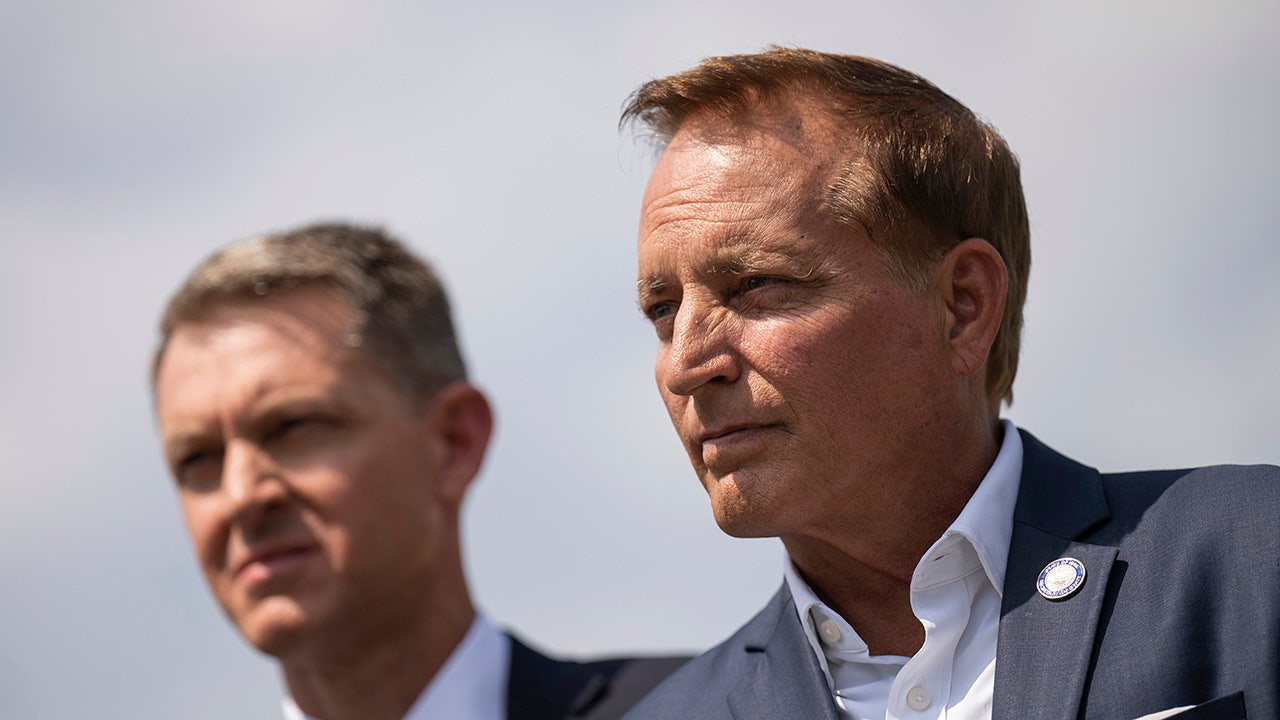
Iowa Secretary of State Paul Pate (Drew Angerer/Getty Images)
“It would pretty clearly foreclose any challenge to a presidential candidate for being not qualified under the United States Constitution,” Derek Muller, an election law professor at the University of Notre Dame Law School, told the Des Moines Register of the proposal. “So, it would be designed to foreclose a challenge like those filed in Colorado in Maine.”
Hunt told the Register that current law presumes the paperwork candidates file to run for office is valid and provides limitations to what issues are eligible for objection.
The new bill, she explained, would further clarify Iowa’s process for objections.
“This simply extends that same standard to all candidates explicitly,” Hunt told the newspaper.
Former President Trump attends a watch party during the Iowa Republican presidential caucuses in Des Moines on Jan. 15, 2024. (Jim Watson/AFP via Getty Images)
“To the best of our knowledge, in 2015, Mr. Trump met the Constitutional requirements to be president and continues to do so,” Hunt said. “Mr. Trump has not been convicted of anything that disqualifies him to be president. This bill simply helps clarify the objection process for Iowa.”
MAINE OFFICIAL APPEALS HER REMOVAL OF TRUMP FROM VOTING BALLOTS TO STATE’S TOP COURT
“The U.S. Constitution sets eligibility requirements for Congress and POTUS,” Hunt added. “This update ensures affidavits comply with those requirements.”
Trump swept the Iowa caucuses and then won the New Hampshire primaries this month as the presidential nominating contest turns its focus on the South Carolina primary next month.
Former President Trump acknowledges supporters during his caucus night event, Jan. 15, 2024, in Des Moines, Iowa. (Chip Somodevilla/Getty Images)
The Colorado Supreme Court, in a split decision, and Maine’s Democrat secretary of state, Shenna Bellows, cited the 14th Amendment in barring Trump from the ballot in their respective states for allegedly inciting the Jan. 6, 2021, riot at the U.S. Capitol. More recently, a Hawaii Democrat senator introduced a bill that also aimed to block candidates, citing the insurrection clause.
The timelines are tight as Super Tuesday approaches on March 5. The U.S. Supreme Court is hearing arguments in the Colorado case on Feb. 8, which likely means there would not be enough time to meet statutory deadlines for Bellows to reissue a ruling on Trump’s ballot status and for additional appeals to be filed before Election Day.
Lawsuits in Minnesota, Michigan, Arizona and Oregon aiming to block Trump from the 2024 ballot have already been dismissed on procedural grounds, Newsweek reported.
The Illinois State Board of Elections is also reportedly weighing a challenge to Trump’s eligibility.
The Associated Press contributed to this report.
Read the full article from Here

Illinois
Historical Corn versus Soybean Returns in Illinois – farmdoc daily
Average per acre returns to soybean production have exceeded those for corn production in 10 out of the 13 crop years from 2013 to 2025. The opposite was true over the prior 13 crops years from 2000 to 2012. Acreage trends in Illinois indicate farmers are responding to the shift in relative profitability by planting a smaller percentage of their acres to corn.
Corn versus Soybean Returns in Illinois
Figure 1 shows average corn minus soybean returns for central Illinois grain farms with high-productivity farmland enrolled in Illinois FBFM from 2000 to 2025, with projections for 2026 based on the latest Illinois crop budgets (see farmdoc daily from May 19, 2026).
From 2000 to 2012, average per acre returns to corn production exceeded returns to soybeans in 10 years with an average advantage for corn of $59 per acre. The latter half of this period includes the years of high returns and farm incomes during the biofuel boom resulting from the Renewable Fuel Standard.
The large increases in use of corn for ethanol production largely came to an end by 2013. Since 2013, average returns to soybeans have exceeded those for corn. Soybean returns exceeded corn returns in 10 out of the 13 years from 2013 to 2025, with an average advantage for soybeans of $53 per acre. The 2013 to 2025 period has been characterized by lower returns due to low commodity price levels relative to production costs, which have increased consistently through time. Exceptions include the 2020 to 2022 crop years when a significant amount of ad hoc assistance was provided in response to the pandemic (2020), and corn and soybean prices saw significant increases (2021 and 2022) due in part to supply chain issues associated with the pandemic and the start of the Russia-Ukraine War. The largest return advantage for soybeans in the last 25 years occurred in 2023 when average soybean returns exceeded corn returns by $237 per acre. Notably, average farmer returns to both corn and soybeans were negative in 2023 but the average loss for soybeans was less than that for corn acres.
Acreage Allocation Trends
Figure 2 shows the percentage of total tillable acres planted to corn by grain farms enrolled in FBFM in the northern (upper panel), central (middle panel), and southern (lower panel) regions of Illinois from 2003 to 2024. The percentage of acres planted to corn has trended down slightly in all three regions over the past 12-15 years, a period which corresponds with the greater relative returns to soybean acres. This indicates a response from farmers in adjusting their crop rotation decisions to the shift in relative profitability.

Historically, a higher percentage of acres have been planted to corn in northern Illinois. This is due to continuous corn rotations being more common in the northern region of the state, which can be linked to greater feed demand from beef and dairy operations in that region of Illinois among other factors. Corn and soybeans are by far the primary crops planted over the past 25 years in both northern and central Illinois, with both typically accounting for 95% or more of total planted acreage. Thus, reductions (increases) in corn acreage are typically offset by corresponding increases (reductions) in soybean acres. The proportion of corn acres in northern Illinois has dropped back under 60% in recent crop years after exceeding that level from 2007 to 2018 with a peak of just over 69% in 2011. The share of corn acres in central Illinois has dropped down to around 50%, trending down from a peak of nearly 60% in the 2007 crop year.
Southern Illinois has historically had the smallest percentage of acres planted to corn. While planted on a small percentage of total acres, wheat more commonly enters farmers’ crop rotations in southern Illinois, often with wheat followed by double-crop soybeans. The percentage of corn acres has trended down from around 47% in 2012 to around 40% in 2024.
Discussion
The shift towards higher returns to soybeans over the last 13 crop years can be linked to a number of factors.
- Since the 2012 drought, both corn and soybean yield performance has, on average, been relatively good across Illinois. Average soybean yields in particular have been strong, exceeding trend levels in all years but 2019. Anecdotal evidence suggests that farmers are improving management decisions and practices on soybean acres, moving to earlier planting dates and adopting new technologies such as seed treatments which can improve yields particularly in stressful conditions (see the Illinois Soybean Management Guide for more information).
- Except for the three-year period from 2020 to 2022, market returns have been relatively poor for corn and soybean producers since 2013. The non-land costs to produce soybeans are smaller than those for corn. Fertilizer costs have been volatile and machinery costs have been on the rise, particularly since the pandemic and 2020 crop year – both of which are lower for soybeans than for corn.
- While trade policies over the past decade have negatively impacted export markets for U.S. agricultural commodities, and in particular for U.S. soybeans, trade aid payments have helped to partially offset those losses.
- The RFS was a rising tide that tended to lift all boats in the form of higher commodity prices in the latter half of the 2000s. The initial impact of U.S. biofuel policy was arguably more beneficial to corn, but over time the role of biodiesel has increased resulting in greater demand for feedstocks, primarily soybean oil (see farmdoc daily from April 12, 2024). The share of acreage planted to corn in Illinois rose to meet the increase in demand for ethanol and has declined back to levels similar to the early 2000s. In contrast, the share of acres planted to soybeans declined and then increased as relative returns have shifted.
- The planting flexibility provision of the 1996 farm bill has provided farmers a better ability to respond to return conditions through acreage adjustments (see farmdoc daily article from March 3, 2025).
A key question is whether returns will continue to favor soybeans over corn for grain farms in Illinois and across the Midwest. If so, will producers continue to shift towards more soybean acres in their crop rotations? This would imply some farmers moving to planting soybeans to the same land in consecutive years (i.e. soybeans on soybeans). Agronomists tend to advise against planting multiple years of soybeans in a row due to concerns over disease, weed, and other pest pressures and the potential for the development of pest resistance to existing tools (Illinois Soybean Management Guide). However, research is being done on continuous soybean rotations in the Midwest (see here for an example of a recent study in Iowa).
Over the next few months we plan to provide a short series of articles which take a closer look at the shift in relative profitability of corn versus soybeans over the past 25 years. These will include more analysis of the factors that have contributed to the shift and whether we should expect the trend to continue.
Acknowledgments
The authors would like to acknowledge that data used in this study comes from Illinois Farm Business Farm Management (FBFM) Association. Without their cooperation, information as comprehensive and accurate as this would not be available for educational purposes. FBFM, which consists of 4,900 plus farmers and 80 plus professional field staff, is a not-for-profit organization available to all farm operators in Illinois. FBFM field staff provide on-farm counsel with recordkeeping, farm financial management, business entity planning and income tax management. For more information, please contact the State FBFM Office located at the University of Illinois Department of Agricultural and Consumer Economics at 217-333-8346 or visit the FBFM website at www.fbfm.org.
References
Gerveni, M., T. Hubbs and S. Irwin. “FAME Biodiesel, Renewable Diesel, and Biomass-Based Diesel Feedstock Trends over 2011-2023.” farmdoc daily (14):71, Department of Agricultural and Consumer Economics, University of Illinois at Urbana-Champaign, April 12, 2024.
Illinois Soybean Management Guide, 2025. University of Illinois Extension.
Paulson, N., G. Schnitkey, C. Zulauf and B. Zwilling. “Spring Revision to 2026 Illinois Crop Budgets.” farmdoc daily (16):88, Department of Agricultural and Consumer Economics, University of Illinois at Urbana-Champaign, May 19, 2026.
Zulauf, C., J. Coppess, G. Schnitkey and N. Paulson. “US Corn, Soybean, and Wheat Acres in the Planting Flexibility Era.” farmdoc daily (15):40, Department of Agricultural and Consumer Economics, University of Illinois at Urbana-Champaign, March 3, 2025.
Indiana
Indiana football has top-rated transfer in ESPN rankings, and 3 in top 20
Indiana football’s Curt Cignetti raises concerns over costs
Indiana coach Curt Cignetti is speaking out on rising roster costs. Cignetti says players should get paid, but universities can’t handle it.
Josh Hoover is replacing a guy who won the Heisman Trophy while leading Indiana football to a national championship. No pressure there, right?
Being the guy who replaces the guy brings Hoover the distinction as the top college football transfer entering the 2026 season, according to Billy Tucker of ESPN.
The Hoosiers have four players on this 100-player list, three of them in the top 20.
According to the story: “Each player is ranked based on a team’s need and what physical skill set they bring to their new team.”
Buy IU football championship merch
Need: “With Fernando Mendoza off to the NFL and backup Alberto Mendoza having transferred to Georgia Tech, the Hoosiers needed another experienced passer capable of sustaining College Football Playoff expectations in Bloomington. Indiana has become one of the portal’s premier destinations for quarterbacks, and Hoover, who transferred from TCU, is next in line after Kurtis Rourke and national champion and Heisman winner Fernando Mendoza.”
Value: “Hoover gives (coach) Curt Cignetti extensive experience, skill and production after throwing for 9,629 yards and 71 touchdowns at TCU. He is a confident gunslinger who thrives pushing the ball vertically and operating within RPO concepts. His swagger and aggressiveness should unlock explosive plays through the air, albeit with some volatility. Hoover has 42 career turnovers and only one season without double-digit interceptions.”
No. 11: Nick Marsh, Indiana wide receiver
Need: “Marsh is a proven No. 1 receiver as the Hoosiers transition to a new era at the position after Omar Cooper Jr. and Elijah Sarratt moved on to the NFL. They couldn’t afford to wait on a younger, more projectable receiver. Marsh instead is a ready-made top target and established focal point. He should be the clear primary receiving option.”
Value: “A former ESPN 300 recruit, Marsh led Michigan State in receiving in back-to-back seasons, totaling 100 catches for 1,311 yards and nine touchdowns. At 6-3, 203 pounds, he brings Big Ten-ready size paired with vertical speed, allowing him to win downfield and on contested 50-50 opportunities. He is effective as a deep threat and as a physical receiver who can work through contact. Cignetti saw Marsh’s ability up close. He had 12 catches for 142 yards and two touchdowns across two games against Indiana, reinforcing his ability to elevate the passing attack immediately.”
No. 18: Tobi Osunsanmi, Indiana edge rusher
Need: “Adding Osunsanmi, a Kansas State transfer, will help Indiana reload for its national title defense. The Hoosiers lost Mikail Kamara, Stephen Daley and Kellan Wyatt, creating a clear need along the defensive front. Osunsanmi is an ideal plug-and-play addition. The versatile pass rusher should translate fluidly to defensive coordinator Bryant Haines’ scheme.”
Value: “Osunsanmi suffered a season-ending injury that forced him to miss the second half of last season, but he flashed during the spring, creating havoc up front. He brings a strong combination of speed and power to pressure offensive tackles. His power allows him to play stout at the point of attack, set the edge or walk blockers back into the backfield to collapse the pocket. He also has the quickness and agility to win on loops and stunts, along with a motor that shows up in pursuit outside the box.”
Need: “The Hoosiers lost their two leading rushers from last season’s championship team with running backs Roman Hemby and Kaelon Black, who combined for 2,160 yards, off to the NFL. Though they return two other productive backs in Khobie Martin and Lee Beebe Jr., they also added production in the transfer portal with Richard, a Boston College back with a scheme-fitting skill set. The 5-8 rusher didn’t have many Power 4 offers out of high school, but one of the first programs to offer him was James Madison when Cignetti was at the helm.”
Value: “Richard had a very productive season in 2025 with 749 yards on the ground. He has a compact build that helps him play with a low center of gravity and the ability to break tackles. His running style is patient as he has a good feel to cut off the backside of blocks. He runs behind his pads and finishes runs with good demeanor. As a receiver out of the backfield, he also provides a reliable checkdown option. Cignetti noted that he liked what Richard did this spring as he will have the opportunity to be impactful and a reliable option at running back for an Indiana team that is looking to repeat.”
Want more Hoosiers coverage? Sign up for IndyStar’s Hoosiers newsletter. Listen to Mind Your Banners, our IU Athletics-centric podcast, on Apple Podcasts, Spotify or wherever you get your podcasts. Watch the latest on IndyStar TV: Hoosiers.
Iowa
Zach Lahn projected to win Iowa GOP governor primary, upsetting Trump’s pick in a state Democrats hope to flip
Zach Lahn will win the Republican primary for Iowa governor, CBS News projects, overcoming a Trump-backed congressman and setting up a November contest against Democrat Rob Sand that could be one of this year’s most competitive gubernatorial races.
Lahn — a farmer and businessman who has touted his ties to the “Make America Healthy Again” movement — prevailed over a crowded GOP field on Tuesday. Sand, who serves as state auditor, ran for the Democratic nomination unopposed.
His victory bucks the recent winning streak of Trump-backed candidates and marks an upset over Rep. Randy Feenstra, who didn’t attend any primary debates and was viewed by many observers as a frontrunner. President Trump endorsed Feenstra last week, calling him “MAGA all the way,” and several top Iowa GOP figures backed him.
Feenstra conceded late Tuesday night, saying in a speech surrounded by his family that the outcome “wasn’t what I wanted.”
Describing himself as a sixth-generation Iowan, Lahn owns a family farm and runs the agriculture, real estate and technology investment firm Homeplace Ventures. He previously worked for the conservative group Americans for Prosperity. He’s running on a populist-inflected platform that he branded “Iowa First” and has said he wants to boost local ownership of farmland, stem the flow of younger Iowans out of the state and address Iowa’s high cancer rate.
“I fear every day we are losing the Iowa we love,” Lahn said in his victory speech Tuesday, castigating out-of-state investors that he says “treat Iowa land like it’s a commodity instead of our inheritance.”
Lahn was endorsed last year by MAHA Action, a group founded by allies of Health and Human Services Secretary Robert F. Kennedy Jr., and he picked up support from the late Charlie Kirk’s Turning Point Action last week. He was also endorsed by former Rep. Steve King, who was known for incendiary comments about race before Feenstra ousted him in a 2020 primary.
Three other candidates also ran: former Iowa Department of Administrative Services Director Adam Steen, state Rep. Eddie Andrews and former state Rep. Brad Sherman.
Lahn will now face Sand, a two-term state auditor who defeated a GOP incumbent in 2018 after working in the state attorney general’s office.
Sand has focused his campaign on government accountability and faulted Republicans for the state’s economic issues, while pitching universal pre-K and criticizing a school voucher program introduced by GOP officials. He has also sought to cultivate a moderate image on social issues, as Republicans try to cast him as a liberal in centrist’s clothing.
In a campaign video late Tuesday, Sand said Republican voters are “welcome in this campaign,” adding that the state’s political system is “broken” and “all you would get with Zach Lahn it is more of the same.”
Once considered a swing state, Iowa has trended sharply red in recent years as Democrats increasingly struggle on rural Midwestern terrain. Mr. Trump won the state three times in a row, including by a 13-point margin in 2024, and GOP Gov. Kim Reynolds won reelection by 18 points four years ago. Iowa hasn’t elected a Democratic governor in two decades, and Sand is the only statewide elected Democrat, after he won reelection by fewer than 3,000 votes in 2022.
But Democrats are hopeful that a challenging political environment for Republicans, both nationally and in Iowa, could make them more competitive in the midwestern state. The Cook Political Report has rated the Iowa gubernatorial race a tossup, one of five states with that distinction this year, and the University of Virginia’s Center for Politics says the race leans red.
Reynolds — who has led the state since 2017 — has one of the lowest approval ratings of any governor nationwide. Iowa farmers also struggled last year after the trade war with China caused Beijing to cut American soybean imports, pushing down prices of one of Iowa’s most widely grown crops, and the war with Iran has caused a run-up in fuel and fertilizer prices.
Reynolds declined to run for reelection this year, setting up Iowa’s first gubernatorial election without an incumbent in the race since 2006.
Lahn lent his campaign $2 million last year, but is heading into the general election at a fundraising disadvantage. His campaign had just over $700,000 on hand as of mid-May, compared to nearly $18.3 million for the Sand campaign. Sand’s wife runs a sizable food and health products company founded by her family called the Lauridsen Group, and the Democrat’s campaign coffers have been bolstered by millions in contributions from his in-laws.
Sand raised about $9.7 million between the start of the year and mid-May, just over $3 million of which came from members of his wife’s family. Lahn raised just under $1 million.
Beyond the governor’s race, Iowa also has an open Senate contest after Ernst declined to seek reelection, drawing interest from Democrats, though Republicans likely have a sizable edge. Democrats are also heavily targeting two of Iowa’s four House seats, including the 1st District, where incumbent GOP Rep. Mariannette Miller-Meeks won by fewer than 1,000 votes in 2024.
-
Austin, TX18 seconds agoNew Texas law tightens rules for autonomous vehicle companies, including Waymo
-
Alabama6 minutes agoIn Alabama Primary Elections, Incumbent Utility Regulators Feel the Squeeze of High Energy Prices – Inside Climate News
-
Alaska13 minutes ago
Dutch Harbor Remembrance Day 2026 – Mike Dunleavy
-
Arizona16 minutes agoArizona State Adds Alabama Assistant Michael White To Coaching Staff
-
Arkansas21 minutes agoArkansas driver’s licenses and state IDs now available in Apple Wallet
-
California28 minutes agoCalifornia’s race for governor and other key primaries remain unsettled as vote count continues
-
Colorado31 minutes agoColorado community reels after police say driver with revoked license hits three pedestrians, killing one
-
Connecticut35 minutes agoNight forecast for June 2