Pennsylvania
‘Who does the world’s water belong to?’ Pa. Senate committee holds privatization hearing
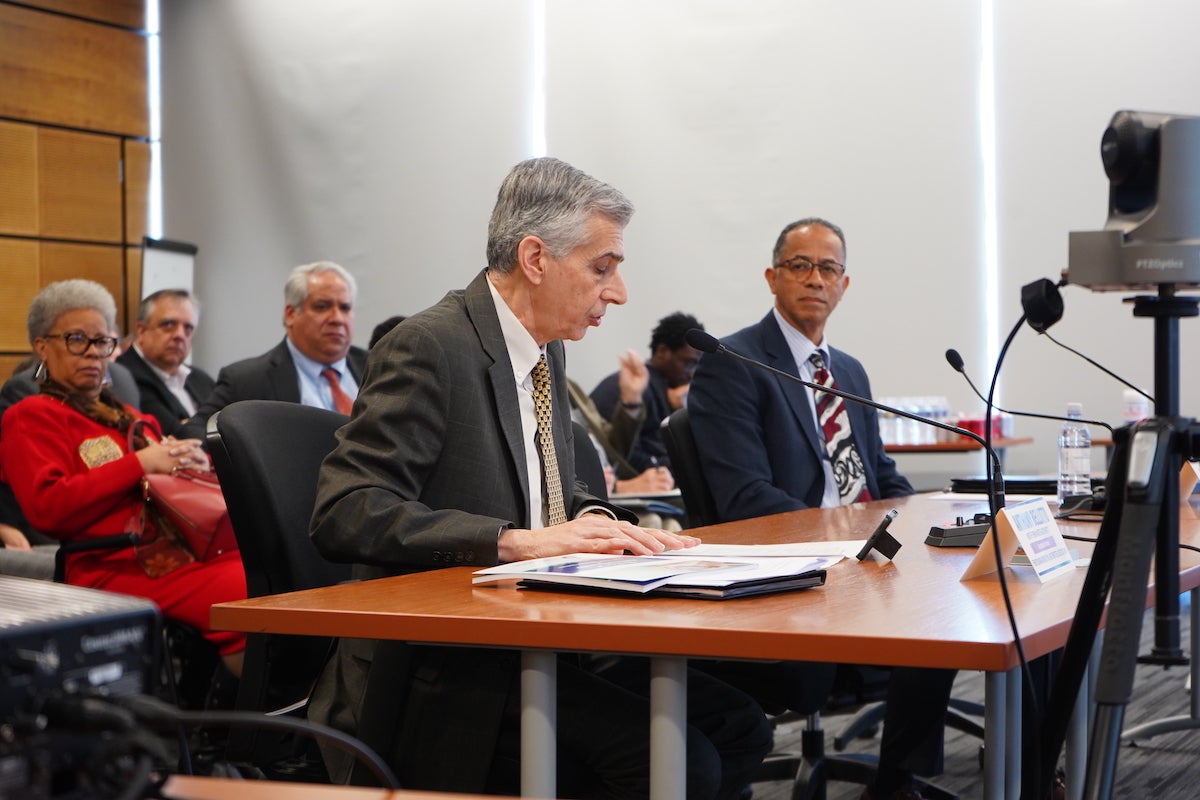
At a Senate Democratic Policy Committee hearing Monday in West Whiteland Township, Chester County, two panels of advocates, experts, and impacted residents debated Act 12’s impact on skyrocketing rate hikes and discussed legislative changes to remedy the situation.
“The fight we’ve been involved in here in southeastern Pennsylvania ultimately revolves around one fundamental question,” said David McMahon, of Neighbor’s Opposing Privatization Efforts (NOPE), to a full room of spectators. “Who does the world’s water belong to?”
McMahon said Act 12 has made it too easy to take what was once a public resource, and put it in the hands of profit-making companies.
Suburban Philadelphia is a hot spot for water privatization including Aqua Pennsylvania’s takeover of Willistown Township’s sewer system in 2022 and Pennsylvania American Water’s acquisition of Upper Pottsgrove’s wastewater system in 2020. The trend spans state lines, and more than two dozen public water suppliers have been bought by investor-owned utilities across the region in the past five years.
Soon after the passage of Pennsylvania’s Act 12 in 2016, the Bryn Mawr-based Aqua, which owns water companies nationwide, purchased water systems in Cheltenham and Limerick, among other places.
The Pennsylvania Public Utility Commission has approved 22 acquisitions since the law’s passage. Advocates and lawmakers alike believe the subsequent spending spree to be no accident.
“Act 12 of 2016 made significant changes to the way water and wastewater systems are valued for acquisition,” said state Sen. Katie Muth, chair of the Pennsylvania Senate Democratic Policy Committee at the hearing.
In written testimony to the legislators, Aqua Pennsylvania President Marc Lucca defended the company’s practices, saying it has learned a lot since Act 12 was adopted.
“We’ve heard concerns around the impact of purchase price on customer rates, transparency of the sale process, and ensuring that terms of contracts are met. To be clear, we stand ready to work to address those issues,” Lucca said.
However, Lucca rejected any notion that Act 12 should be repealed, arguing that municipality owned water utilities do not have the funds to update their aging systems.
“In summary, our nation’s infrastructure is failing because of lack of investment. We are leaving the next generation a significant problem they need to address simply because we did not. The condition of these systems occurred long before Act 12 so I simply do not agree with the sentiment that removing it will correct these problems,” Lucca said.
Public resource vs. private commodity
Bill Ferguson, a co-founder of Keep Water Affordable and a New Garden Township resident, testified that private water companies exist to expand and increase profits.
He acknowledged that’s what corporations do.
“Our issue is with their methods used to acquire the municipal utilities, [which is] required to realize that growth,” said Ferguson. “Then there’s the municipal governments, too often infatuated by the seductive siren song of a huge candy jar of money — free money. It’s like winning the lottery but that money is in no way free. The failure of local government to properly serve their citizens is probably our biggest concern.”
He said ratepayers are paying for “Big Water’s” profits and deals. He likened the publicly owned water acquisitions to offering a car dealership $80,000 for a vehicle they’re selling for $40,000.
”That’s what’s happening under Act 12. Both parties at the negotiating table want the highest price possible. You’d ask why would Big Water want to pay higher prices? It’s simple. The more they pay, the higher their profits, as long as the purchase price goes into the rate base. And that’s what Act 12 enables. It enables the increase in rate base. The water companies cannot lose. It is one sweet deal for them,” Ferguson said.
Anthony Bellitto, executive director of the publicly owned North Penn Water Authority and a representative with the Pennsylvania Municipal Authorities Association (PMAA), said the PMAA’s stance is that Act 12 should be repealed.
In the case that it is not repealed, Bellitto said the organization suggests Act 12 be amended to include a voter referendum and a scope limitation to distressed municipalities.

Bellitto said any assertion that low rates equals infrastructure disinvestment is false.
“We’re a nonprofit,” Bellitto said.We provide low cost and high value to our customers. At North Penn Water Authority, our average customer spends $1 per day for all the water for a household.”
Bellitto criticized the for-profit business model in public utilities due to the high salaries of top executives.
“My entire organization of North Penn Water Authority — 52 employees. Our whole aggregate salary is four and a half million dollars. There you go. You got the whole company doing all the work every day, 52 employees making the same amount of money as the top guy at Aqua. This is why they have to raise the rates,” he said.
“This aggressive push to privatize municipal systems is driven by an upper management of these private utilities who are motivated by their own personal financial benefit,” Bellitto said.
But not everyone who testified wants to kill Act 12.
In some municipalities that have garnered the interest of private water companies — like Chester and Towamencin, residents have gone on the offensive to block the deals, oftentimes clashing with elected leaders. Results, however, have been mixed.
Kofe Osei, an organizer with NOPE and a newly elected Towamencin Township Supervisor, said privatization efforts have had a negative impact on democracy. He said Pennsylvania American Water’s attempt to purchase Towamencin’s sewer system, which is tied up in court, has laid bare issues of the state’s referendum laws.
“Even in the face of lawsuits from residents to compel the township to exit the sale, the pro-sale supervisors have committed public dollars in our budget to defending their clearly unpopular decision in court,” Osei said.
Pennsylvania
Man cited after abandoning car in frozen pond at Pennsylvania country club: Police
A man has been cited after police said he drove a vehicle into a frozen pond at a country club in Pennsylvania, left the scene, then spent the night in a hotel.
According to the East Lampeter Township Police Department, on Thursday, Feb. 26, 2026, around 10:38 a.m., officers were called to the Lancaster Country Club after receiving reports about a vehicle in a pond.
Police said that, through an investigation, it was learned that Sung Chun, a 50-year-old man from Hoboken, New Jersey, had driven onto the property the day before around 8:30 p.m., crossed portions of the golf course, and ultimately ended up in a pond.
Chun then exited the vehicle and walked away without reporting the incident and spent the night at a nearby hotel, according to police.
Credit: East Lampeter Township Police Department

Credit: East Lampeter Township Police Department
Police said Chun returned to the location while police were on scene investigating the incident and was ultimately cited with “Trespass by Motor Vehicle.”
Pennsylvania
State College, Pennsylvania: 2026 USA TODAY 10BEST Readers’ Choice Awards
Pennsylvania
What the war with Iran could mean for gas prices in western Pennsylvania
The war with Iran could start impacting your wallet as soon as today.
Jim Garrity from AAA East Central says oil prices are up.
“They’re hovering around $72. They were pretty consistently around $65, $66 for a while,” he said.
Nationally, AAA said the average for a gallon of regular sits at about $3, up approximately six cents from last week.
In Pennsylvania, it’s around $3.12 a gallon, and in the Pittsburgh region, it’s around $3.24 a gallon. That’s actually down about four cents from last week.
Garrity added that gas prices this time of year would already be increasing, usually because of higher demand for the warmer months and the production of the summer blend of gas used for those months.
The impacts of what’s happening in Iran may not be immediate, which could be part of why our region and the state overall have not seen a spike yet, he said.
“It could be a couple of days later. It could be up to a week later,” Garrity said.
A lot of people are watching what happens with the Strait of Hormuz. Iran borders it to the north, and 20% of the world’s oil goes through it.
Iran is one of the world’s biggest oil producers, and China gets a lot of that oil.
“If there is an impact there, you could see oil start to come in from other parts of the world, which has a downstream effect on [the United States],” Garrity said.
One way you can save on gas if prices increase in our area is by slowing down.
“When you drive faster every five miles, over 50 miles an hour, your fuel efficiency is going down,” Garrity said. “You’re making the car work harder, making the gasoline consumption less effective.”
Garrity added that in 2022, when our area and many others saw some of the highest gas prices ever recorded, people changed their driving habits.
“We saw people make seemingly permanent changes to their driving behaviors, driving less in general, consolidating trips,” he said.
-
World6 days agoExclusive: DeepSeek withholds latest AI model from US chipmakers including Nvidia, sources say
-
Massachusetts6 days agoMother and daughter injured in Taunton house explosion
-
Denver, CO6 days ago10 acres charred, 5 injured in Thornton grass fire, evacuation orders lifted
-
Louisiana1 week agoWildfire near Gum Swamp Road in Livingston Parish now under control; more than 200 acres burned
-
Oregon4 days ago2026 OSAA Oregon Wrestling State Championship Results And Brackets – FloWrestling
-
Florida2 days agoFlorida man rescued after being stuck in shoulder-deep mud for days
-
Technology1 week agoArturia’s FX Collection 6 adds two new effects and a $99 intro version
-
News1 week agoVideo: How Lunar New Year Traditions Take Root Across America