
Pennsylvania
‘Who does the world’s water belong to?’ Pa. Senate committee holds privatization hearing
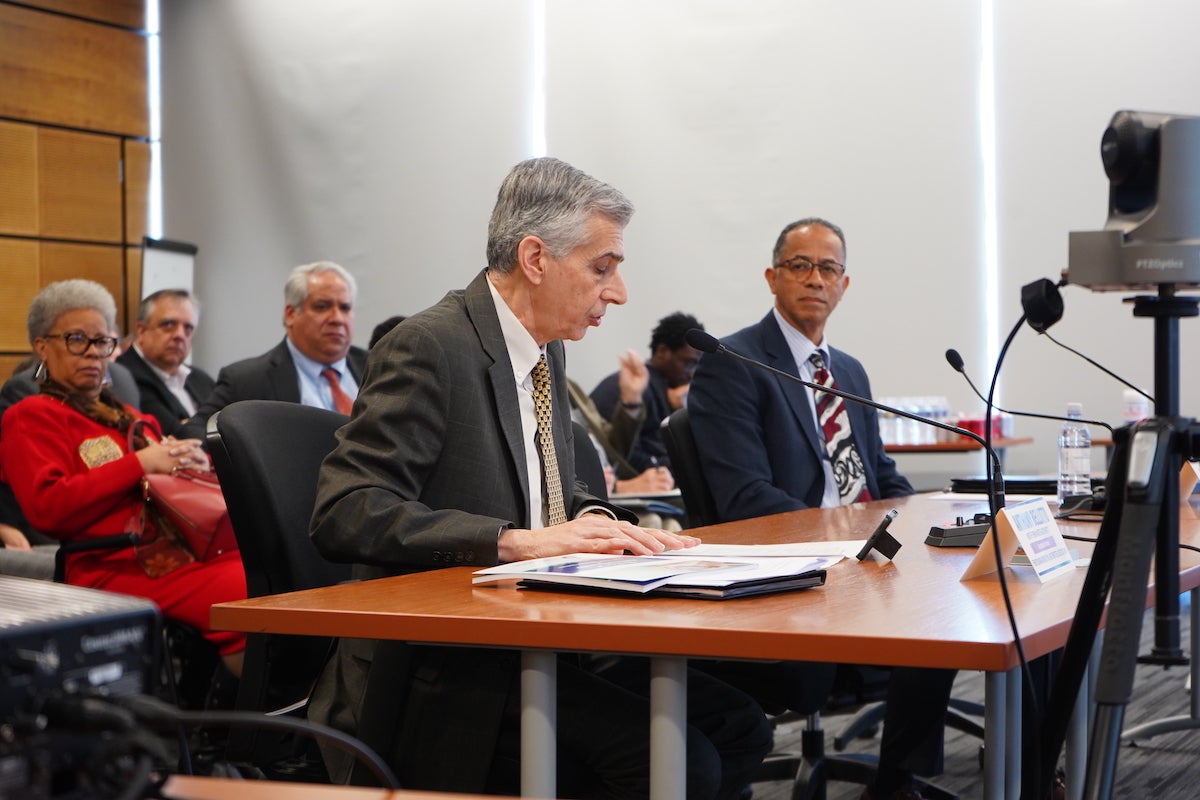
At a Senate Democratic Policy Committee hearing Monday in West Whiteland Township, Chester County, two panels of advocates, experts, and impacted residents debated Act 12’s impact on skyrocketing rate hikes and discussed legislative changes to remedy the situation.
“The fight we’ve been involved in here in southeastern Pennsylvania ultimately revolves around one fundamental question,” said David McMahon, of Neighbor’s Opposing Privatization Efforts (NOPE), to a full room of spectators. “Who does the world’s water belong to?”
McMahon said Act 12 has made it too easy to take what was once a public resource, and put it in the hands of profit-making companies.
Suburban Philadelphia is a hot spot for water privatization including Aqua Pennsylvania’s takeover of Willistown Township’s sewer system in 2022 and Pennsylvania American Water’s acquisition of Upper Pottsgrove’s wastewater system in 2020. The trend spans state lines, and more than two dozen public water suppliers have been bought by investor-owned utilities across the region in the past five years.
Soon after the passage of Pennsylvania’s Act 12 in 2016, the Bryn Mawr-based Aqua, which owns water companies nationwide, purchased water systems in Cheltenham and Limerick, among other places.
The Pennsylvania Public Utility Commission has approved 22 acquisitions since the law’s passage. Advocates and lawmakers alike believe the subsequent spending spree to be no accident.
“Act 12 of 2016 made significant changes to the way water and wastewater systems are valued for acquisition,” said state Sen. Katie Muth, chair of the Pennsylvania Senate Democratic Policy Committee at the hearing.
In written testimony to the legislators, Aqua Pennsylvania President Marc Lucca defended the company’s practices, saying it has learned a lot since Act 12 was adopted.
“We’ve heard concerns around the impact of purchase price on customer rates, transparency of the sale process, and ensuring that terms of contracts are met. To be clear, we stand ready to work to address those issues,” Lucca said.
However, Lucca rejected any notion that Act 12 should be repealed, arguing that municipality owned water utilities do not have the funds to update their aging systems.
“In summary, our nation’s infrastructure is failing because of lack of investment. We are leaving the next generation a significant problem they need to address simply because we did not. The condition of these systems occurred long before Act 12 so I simply do not agree with the sentiment that removing it will correct these problems,” Lucca said.
Public resource vs. private commodity
Bill Ferguson, a co-founder of Keep Water Affordable and a New Garden Township resident, testified that private water companies exist to expand and increase profits.
He acknowledged that’s what corporations do.
“Our issue is with their methods used to acquire the municipal utilities, [which is] required to realize that growth,” said Ferguson. “Then there’s the municipal governments, too often infatuated by the seductive siren song of a huge candy jar of money — free money. It’s like winning the lottery but that money is in no way free. The failure of local government to properly serve their citizens is probably our biggest concern.”
He said ratepayers are paying for “Big Water’s” profits and deals. He likened the publicly owned water acquisitions to offering a car dealership $80,000 for a vehicle they’re selling for $40,000.
”That’s what’s happening under Act 12. Both parties at the negotiating table want the highest price possible. You’d ask why would Big Water want to pay higher prices? It’s simple. The more they pay, the higher their profits, as long as the purchase price goes into the rate base. And that’s what Act 12 enables. It enables the increase in rate base. The water companies cannot lose. It is one sweet deal for them,” Ferguson said.
Anthony Bellitto, executive director of the publicly owned North Penn Water Authority and a representative with the Pennsylvania Municipal Authorities Association (PMAA), said the PMAA’s stance is that Act 12 should be repealed.
In the case that it is not repealed, Bellitto said the organization suggests Act 12 be amended to include a voter referendum and a scope limitation to distressed municipalities.

Bellitto said any assertion that low rates equals infrastructure disinvestment is false.
“We’re a nonprofit,” Bellitto said.We provide low cost and high value to our customers. At North Penn Water Authority, our average customer spends $1 per day for all the water for a household.”
Bellitto criticized the for-profit business model in public utilities due to the high salaries of top executives.
“My entire organization of North Penn Water Authority — 52 employees. Our whole aggregate salary is four and a half million dollars. There you go. You got the whole company doing all the work every day, 52 employees making the same amount of money as the top guy at Aqua. This is why they have to raise the rates,” he said.
“This aggressive push to privatize municipal systems is driven by an upper management of these private utilities who are motivated by their own personal financial benefit,” Bellitto said.
But not everyone who testified wants to kill Act 12.
In some municipalities that have garnered the interest of private water companies — like Chester and Towamencin, residents have gone on the offensive to block the deals, oftentimes clashing with elected leaders. Results, however, have been mixed.
Kofe Osei, an organizer with NOPE and a newly elected Towamencin Township Supervisor, said privatization efforts have had a negative impact on democracy. He said Pennsylvania American Water’s attempt to purchase Towamencin’s sewer system, which is tied up in court, has laid bare issues of the state’s referendum laws.
“Even in the face of lawsuits from residents to compel the township to exit the sale, the pro-sale supervisors have committed public dollars in our budget to defending their clearly unpopular decision in court,” Osei said.
Pennsylvania
June 18 Playbook: A Pessimistic Pennsylvania
Pennsylvania
Showers Thursday morning, warm and gusty for the afternoon
Tomorrow’s front looks weaker with just a few showers early in the morning…
EVENING: Increasing clouds, summer-like. Temps near 80.
TONIGHT: Mostly cloudy and warm. Low 68.
THURSDAY: Scattered showers between 6-10am. Clearing, windy and warm for the afternoon. High 88.
Wednesday felt a little more like summer as temperatures reach 85 degrees. The humidity still remains tolerable this evening as clouds increase from an approaching front.
The cold front arrives Thursday morning, leading to a broken line of scattered showers between 6-10am. Once the front clears, gusty winds between 20-30mph will develops with afternoon temperatures near 88 degrees. A little unusual for a post cold front!
The upcoming weekend will be dry with low humidity and lots of sunshine. It should be a great weekend to spend with Dad! We’ll keep you posted, but the next chance for rain will be another front next Monday.
– Meteorologist Eric Finkenbinder
Pennsylvania
Pennsylvania legislation seeks more safeguards for online gamblers after a record year
Content on this page may include affiliate links. If you click and sign up/place a wager, we may receive compensation at no cost to you.
A bipartisan package of bills would eliminate certain online gambling deposit methods, limit promotions, and strengthen protections for self-excluded gamblers.
Pennsylvania iGaming operators pulled in a record $2.78 billion in revenue last year, but some lawmakers want more responsible gaming consumer protections. State Reps. Tarik Khan (D-Phila) and Jamie Flick (R-Lycoming/Union) have introduced bipartisan legislation to provide better safeguards for PA online gamblers. Their series of bills seeks to add more protections, such as reduced deposit periods and limits on iGaming marketing.
Restrictions on push notifications, text marketing, credit cards & more
Dubbed Protecting Public Health in Online Gambling, Flick’s and Khan’s legislation breaks down into the following three parts:
- Pennsylvania Online Consumer Protection Act – Would establish “reasonable limits” on the frequency of deposits into online gambling accounts. It would also limit text message solicitations and push notifications involving sportsbook and casino bonus codes, while protecting against youth-targeted gambling ads and expanding responsible gaming programs.
- Prohibiting Funding of Online Gambling – Seeks to prohibit credits from being used to fund accounts at PA online casinos, sportsbooks, and poker sites.
- Strengthening Self-Exclusion Protections – Would ban online gambling operators from sending promotions, advertisements, or bonuses (e.g., free spins) to gamblers who’ve self-excluded from Pennsylvania’s gambling market.
Protecting young people and problem gamblers
Khan, who’s been a certified nurse practitioner since 2011, views Pennsylvania’s growing online gambling habit as a potential health challenge.
“As a nurse practitioner, I believe we should address problem gambling the same way we address other public health challenges: with prevention, education, treatment and commonsense safeguards,” Khan stated via his website.
“Our bipartisan bill package will help protect young people, individuals and families while supporting responsible gaming.”
Flick is primarily concerned with the number of young Pennsylvanians who are being exposed to ads involving sports betting, poker, and online casino games for real money.
“Too many young people are being exposed to online gambling through constant advertising and unprecedented access from their phones and devices,” said Flick. “These bills are about putting reasonable safeguards in place, promoting responsible gaming and helping ensure that young people and families are protected from gambling-related harm.”
New Pennsylvania online casino revenue record
The amount of revenue that Pennsylvania gambling sites are raking in continues to increase year after year. The $2.78 billion iGaming revenue figure from 2025 was up 27.22% from the previous year, when PA online casinos netted $2.18 billion.
While the Keystone State doesn’t break its iGaming revenue numbers down by game type, we can reasonably assume that the bulk of it comes from real money online slots.
Sports betting also experienced a record year, hitting $602.5 million, up 17.97% from 2025. The vast majority of this amount came via online sports gambling.
While this revenue increase is good for some of the best online casinos and sportsbooks in the state, it can also spell potential underlying problems. Khan and Flick are seeking to reduce some issues through their bills.
Responsible gambling
Bettors must be 21 years or older and otherwise eligible to register and place wagers at online casinos. If you or someone you know has a gambling problem, please seek assistance from trained professionals such as the Problem Gambling Help Network at 1-800-MY-RESET.
-
Miami, FL3 minutes agoMiami ‘At the Top’ for Star In-State 2028 Running Back
-
Boston, MA8 minutes ago
Boston Bruins are retiring Patrice Bergeron’s No. 37 next season
-
Denver, CO15 minutes agoBroncos make decision on tryout quarterback, sign 2 players
-
Seattle, WA18 minutes ago
Fox Soccer broadcast coming to Seattle waterfront ahead of US game
-
San Diego, CA30 minutes agoSan Diego begins installing parking meters in San Ysidro business district
-
Milwaukee, WI33 minutes ago$95,000 worth of Milwaukee tools stolen in Plover
-
Atlanta, GA38 minutes agoStaycations Are Trending: Atlanta Events Worth Staying Home For In June
-
Minneapolis, MN45 minutes agoMinneapolis Big Honking Truck Parade returns to Nicollet Mall on June 18
