Lifestyle
After a grueling 2023, here are 4 predictions for media in 2024


The numeral 2024 in Times Square in New York City on Dec. 20. 2023, after traveling across the country, beginning in Los Angeles.
David Dee Delgado/Getty Images
hide caption
toggle caption
David Dee Delgado/Getty Images

The numeral 2024 in Times Square in New York City on Dec. 20. 2023, after traveling across the country, beginning in Los Angeles.
David Dee Delgado/Getty Images
Given how turbulent 2023 turned out, saying it was a challenging year for media feels like the understatement of the decade.
Here’s what we survived: Two lengthy strikes by Hollywood writers and performers that paralyzed new production, crippling the business in ways we’re just beginning to fathom. Layoffs in the media sector totaling more than 20,000 positions, according to one study. Hikes in subscription fees, which hit consumers of almost every major streaming service, including Netflix, Disney+, Hulu and Apple TV+, and confrontations between media companies and cable providers leading to questions on whether cable TV can even survive in the streaming era.
But experience has taught me that, when it comes to the media business, things are rarely as bad – or as good – as they initially seem. So, my predictions for media in 2024 may sound negative — based mostly on a growing cynicism about the abilities of those leading our biggest media companies to meet a historically challenging moment. But I’m also, oddly, a bit optimistic.
In other words, as clueless or greedy as media executives get, this critic remains convinced talented creators, journalists and performers will find a way to excel.
We’ll probably have fewer TV/streaming series. But that will likely be a good thing.
One minute, analysts were complaining about the glut of TV and streaming programming at the beginning of 2023 — offering too much material for anyone to keep tabs on — before the cancellation of shows and the tactic of completely removing titles from streaming services as tax write-offs drew howls of criticism as the year wore on.
Unfortunately, the numbers won’t get much better in 2024. I fear the economic hit media companies likely took from the strikes and the added costs incurred by new contract terms will result in fewer shows getting made and even more shows getting the ax in the new year. But the silver lining here: given that 2022 saw nearly 600 separate series available to viewers, the industry was long overdue for serious shearing, anyway.
The key to bringing the glut of TV down to a manageable level for the average consumer is ensuring the right programs survive – including shows featuring marginalized groups and cultures. After a year in which programs like A Black Lady Sketch Show, Reservation Dogs, the LGBTQ-centered reboot of A League of Their Own and the Black-centered revival of The Wonder Years all went away, the industry must work overtime to ensure diversity doesn’t decline along with the number of TV series.
Streamers will cost more. But you’ll have even more subscription options.
One of the sneakiest media trends in 2023 was all the different techniques streaming services used to squeeze additional revenue from subscribers. Amazon announced, for example, that Prime Video subscribers will begin to see ads in their streaming content on Jan. 29, but customers can pay an additional $2.99 for ad-free content. Netflix eliminated its cheapest ad-free tier months ago, forcing those who wanted to avoid ads to buy the pricier, premium subscription. And lots of services cracked down on password sharing while boosting prices.
Still, streaming services’ drive for profit also creates more opportunities for consumers. Some platforms have worked out limited deals to share content with other services, bringing select HBO titles to Netflix. Streamers are also bundling services, with Disney offering Disney+ and ESPN+ to Charter cable customers for a single price, while Verizon has brought together Max and Netflix. We’re back to the future as companies and consumers rediscover the cost savings of advertisements and bundling that were always hallmarks of cable TV.
I also think we’re going to see a landscape where there is a small number of giant streaming services and a bunch of boutique specialty platforms, with midlevel players like Peacock and Paramount+ facing increasing economic pressure to join bigger companies (hence the rumors about Warner Bros. Discovery talking about merging with Paramount Global and rumors that Comcast might also benefit from buying Paramount.)
Journalists took a serious hit in 2023. But the fight against misinformation is only beginning.
One bright spot for journalism in 2023 was the gigantic settlement Fox News paid for airing and repeating lies about the last presidential election and the dethroning of the news channel’s biggest star, Tucker Carlson. What remains astonishing is how little those moves have curbed similar rhetoric on other media platforms about the election or the continued influence of toxic ideologues like Carlson and Megyn Kelly.
Expect that fight to only grow more intense in 2024, as the presidential season unfolds and people actually begin voting in primaries (I’m still upset by news items that say a given candidate is “ahead” when no one has voted yet, and we’re only talking about poll results.) Kudos to news outlets that have adopted journalism professor Jay Rosen’s admonition to avoid “horse race”-style reporting to cover “the stakes“ for the next election, particularly The Atlantic‘s entire issue devoted to the possible consequences if Donald Trump wins a second term as president.
Not the odds, but the stakes.
That’s my shortand for the organizing principle we most need from journalists covering the 2024 election. Not who has what chances of winning, but the consequences for our democracy. Not the odds, but the stakes. https://t.co/czKcpu3GXV
— Jay Rosen (@jayrosen_nyu) March 5, 2023
Still, in addition to the job losses, the media’s addiction to toxic but buzzy personalities remains a serious flaw. Too many supposedly serious news platforms refuse to accept that the worst outcome for shameless attention addicts like George Santos isn’t breathless coverage denouncing his lies, but no coverage at all. No more updates on certain people’s Cameo posts or social media outbursts — yes, NPR has covered such things, too — the real solution to handling some awful public figures is to deprive them of the media oxygen they need to survive.
Late night television and cable TV will continue to decline. But they will also survive.
I’ve said and written this a few times: New media doesn’t kill old media. It just forces it to change.
The scariest media moments of 2023 involved watching Internet-led disruption come for familiar forms of media, like late night TV and cable systems. Big names like The Late Late Show‘s James Corden and The Daily Show‘s Trevor Noah and Roy Wood Jr. left the late night genre, only to be replaced by a game show and… nothing, yet.
CBS might yet find a hit with After Midnight, the sort of game show it tapped to replace Corden’s program, and Comedy Central may yet conclude its yearlong spasm of guest hosts by finding the one person ready to take The Daily Show into the future. But it feels more like a sector of media that produced an awful lot of modern comedy stars is on the ropes with no clear way back to the top.
Similarly, accelerated cord-cutting and homogeneity of content – cue the jokes about how ridiculous MTV’s marathon airings of Ridiculousness have become – threaten to permanently hobble the industry that gave us modern-day quality TV in HBO, CNN and ESPN.
Because I’m also an optimist, I’m hopeful both these corners of media will find new directions in 2024, led by innovators we may not even know yet. But they’re likely to be in a much-reduced form, a bracing reminder that change eventually comes for us all in media.
And, sometimes, what’s left is a shadow of what once was.


Swift has attended fashion’s biggest night, the Met Gala, a handful of times over the years. Perhaps no appearance was more memorable than 2016’s event where it was not her dress, but her hair that made an impact. Swift’s bleached platinum bob at the star-studded fund-raiser that year was part of a short-lived era known as “Bleachella” to some fans.
Some fans believe the 2016 event, which both Swift and her ex-boyfriend, the actor Joe Alwyn attended, is where the couple might have first encountered one another. A moment Swifties think the songstress referenced in “Dress,” singing “flashback when you met me, your buzz cut and my hair bleached,” a line that describes how both stars looked that night.
For her first time as host on “Saturday Night Live,” a then 19-year-old Swift arrived having already written the song she would sing as the opening monologue. Seth Meyers, the show’s head writer at the time, later recalled bringing Swift into Lorne Michaels’s office, where she performed a “perfect” musical monologue and noted it was better than what the show’s writers had concocted for her to deliver. Swift has served as host and musical guest on the sketch-comedy show over the years. She’s also made repeated cameo appearances, including appearing alongside Kerry Washington and Betty White in a “Californians” sketch in 2015 for the show’s 40th anniversary.
In 2023, Swift and Travis Kelce both made cameo appearances on the show. The same day, they were also spotted by tabloids holding hands in New York City, one of the earliest public glimpses of them as a couple.
The iconic arena in Midtown Manhattan will serve as the venue for a private, two-day event around the wedding of Swift and Kelce on July 2 and 3. The first event will reportedly be a smaller gathering of 100 people for a rehearsal dinner at the Infosys Theater, a venue inside the Garden, while as many as 1,000 guests are expected to arrive at the venue the next day for a larger celebration, with possible stage appearances. Swift has some history with the Garden, performing there several times over the years, as well as sitting courtside and cheering the Knicks to a win during a game earlier this summer.
Whenever the singer is spotted coming and going from the Greenwich Village recording studio — which was founded by Jimi Hendrix and has hosted icons like the Rolling Stones and Chuck Berry over the years — fans are immediately abuzz with whispers about new music. Swift has worked there with Jack Antonoff, her longtime collaborator, on albums including “Lover” and “Folklore,” as well as re-releases of her older albums.
Swift has been spotted plenty of times at this Italian hot spot in the West Village neighborhood of Manhattan, most recently in May, celebrating Lena Dunham’s 40th birthday. If you can’t get a table, try your hand at making their famed — and delicious — salad dressing.
For a period between 2016 and 2017, Swift rented a four-story townhouse in Manhattan’s West Village. The pad appears to have inspired her 2019 track “Cornelia Street” from the album “Lover.” It’s a road she’ll never walk again, at least according to her lyrics.
Fans still regularly visit the house, even though it has been nearly a decade since Swift inhabited the home, which has an indoor swimming pool. In 2023, some Swifties made pilgrimages to the location after news broke on her split with the actor Joe Alwyn, whose relationship fans believe to be the inspiration for many of the tracks on “Lover.”
Swift’s residence in the TriBeCa neighborhood of Manhattan has grown over the years. She initially bought two penthouses from the “The Lord of the Rings” director Peter Jackson in 2014. A fan who once visited the apartment recalled Swift’s father saying that when his daughter first viewed the place, the actor Ian McKellen, who had been living there, was sitting in the kitchen. She has since purchased several adjacent properties.
Fans have seen glimpses of the home on social media over the years and, more recently, watched Swift use a fire extinguisher to put out a small candle blaze in the kitchen in a video posted by Swift’s recent musical collaborator Gracie Abrams.
Good luck getting a table here if you are not Swift or Kelce. The upscale American restaurant in SoHo is known for comforting dishes like a French dip sandwich and an ice cream sundae, as well as its savory sour-cream-and-onion martini from the cocktail menu. Swift has visited several times — including outings with Gigi Hadid and Sabrina Carpenter.
In “Delicate,” Swift sings of an unnamed “dive bar on the East Side.” Swifties believe this dark speakeasy on East Seventh Street is that bar. Fans also believe the song was written about Swift’s ex-boyfriend, the actor Joe Alwyn. The pair broke up in 2023; later that year she met Kelce.
This exclusive, members-only club in Lower Manhattan is frequented by plenty of celebrities, including Swift. The club bans photography and videos, as well as members of the media, and patrons are barred from identifying others in the room on social media or to the press.
Still, even with the privacy rules, there have been plenty of posts and photos documenting Swift coming and going from Zero Bond. There was a visit in 2023 with the actor Miles Teller and his wife, Keleigh, as well as a recent celebratory evening with the Haim sisters in June after the group watched the Knicks win at Madison Square Garden in matching shirts. There have also been multiple visits with Kelce over the years.
Swift spent part of her 34th birthday celebration at this rustic American restaurant on the Lower East Side of Manhattan. Wearing a black minidress bedazzled with a moon and stars — a nice nod to the visual themes of her “Midnights” era — she partied the night away at Freemans’ upstairs cocktail bar with guests including Jack Antonoff, Blake Lively, Zoë Kravitz, the Haim sisters, Sabrina Carpenter and her childhood best friend, Abigail Anderson Berard, who was immortalized in Swift’s song “Fifteen.” The pop star was also seen dining here with Gracie Abrams earlier that same year.
People line up for hours — yes, hours — to secure a spot at this restaurant in the Carroll Gardens neighborhood of Brooklyn. The brick-oven pizza spot, which is B.Y.O.B. and cash only, is a favorite of pizza connoisseurs — though not those at The New York Times — and celebrities alike. (Its owner has said he does not accept reservations.) Beyoncé, Jay-Z, the Beckhams and, of course, Swift have all been seen dining here, though unclear if they had to sweat it out in the line like us mere mortals. Swift, who once sent her dad to hand out pizzas, though likely not from Lucali, to fans camping out in New York to watch her perform on “Good Morning America,” has shared meals here with famous friends including Blake Lively and Selena Gomez, as well as a date night with Kelce.
The Brooklyn neighborhood where, if Swiftie lyrical interpretations are to be trusted, Swift left a now-infamous scarf at the home of one Maggie Gyllenhaal around 2010. Swift was dating Gyllenhaal’s brother, Jake, at the time and their relationship is believed to have inspired Swift’s “All Too Well,” a 2012 heart-wrencher of a song beloved by many fans, which Rolling Stone once ranked as her best song. “You keep my old scarf from that very first week,” Swift sings. In 2017, Maggie Gyllenhaal told Andy Cohen on “Watch What Happens Live” that she was “in the dark about the scarf.”
Swift later released an updated, 10-minute version of the track in 2021. A red scarf featured prominently as a thematic motif in “All Too Well: The Short Film,” which Swift also released that same year.
Lifestyle
DLTA’s former Ace Hotel is reborn as a ‘creative hub’ — and yes, you can still sleep there
The historic 1920s tower that once housed the beloved Ace Hotel is entering a new era just in time for the summer.
Two years after opening in the iconic Spanish Gothic building on South Broadway, Stile Downtown Los Angeles has unveiled its multimillion-dollar renovation and its expansion from a limited-service hotel to a full “creative hub.” The makeover adds a 24/7 membership-based creative lab with state-of-the-art music studios, co-working lounges, an updated rooftop bar called Somewhere Special, a restored theater and a curated retail shop for the community.
“We don’t really want to call it just a hotel — it’s more of a hub,” says Jaisun Ihm, CEO of AJU Continuum, the investment company that purchased the historic space.
Throughout the space are throwback touches — for instance, hotel guests can borrow a Walkman and browse the curated cassette library with titles like Sade’s “Promise,” Paula Abdul’s “Forever Your Girl” and the Isley Brothers’ “Between the Sheets.”
Behind the massive overhaul is South Korea-based AJU Continuum, which purchased the property in 2019 but didn’t change the name until 2024. The project marks the investment company’s first U.S. expansion.
“We don’t really want to call it just a hotel — it’s more of a hub,” says Jaisun Ihm, CEO of AJU Continuum, which is best known for its culture-forward Ryse Hotel in Seoul. With Stile, Ihm says their mission was to “connect L.A. to Seoul.”
Ryse, Ihm says, encapsulates today’s eclectic lifestyle hotel: “It’s grounded in street culture. We say it’s iconoclastic. It’s youthful in nature.”
AJU Continuum teamed up with L.A. architecture and interior design studio Design, Bitches — the group behind the chic Checker Hall in Highland Park and Verve Coffee Roasters in the Arts District. Ihm didn’t care that it was Design, Bitches’ first hotel venture. After working with several firms over the years, he was tired of seeing the same aesthetic everywhere and wanted to work with a team that would bring a “bold” perspective, he says.
When the creatives at Design, Bitches got the invitation, they were all in. “I’ve always wanted to do a hotel,” says RA Rudolph, the studio’s co-founder. “I love hotels and I have opinions,” she adds laughing.
For Angelenos who frequented the Ace Hotel, a maverick venue that helped revitalize downtown L.A. for a decade beginning in 2014, walking through Stile will feel both familiar and new. While the building’s bones remain intact — a requirement of its historic-cultural monument designation — the space has an industrial-modern twist inspired by L.A.’s creative spirit.
For example, the United Theater on Broadway, which was once the 1927 flagship movie palace for the influential United Artists collective (Mary Pickford, Charlie Chaplin, Douglas Fairbanks and D.W. Griffith), now features fresh carpet, modernized sound and stage equipment and roughly 125 new light fixtures inspired by the lobby’s original Spanish Revival-style chandelier. As a nod to the building’s legacy, where Hollywood’s earliest icons broke away from major studios to control their own work, AJU Continuum has launched its own in-house booking team for the live entertainment venue. Also, the giant neon “Jesus Saves” sign that has sat atop the building since its days as a church is still there — and the owners have no plans to remove it.
1

2

3

4

5

1. A clawfoot tub inside the Loft King Suite. 2. Lounge chairs inside the Loft King Suite. 3. Hotel guests lounge in the rooftop pool. 4. Adriana Castellanos and friends hanging out in the lobby bar. 5. Photos taken in the photo booth at the Somewhere Special rooftop bar.
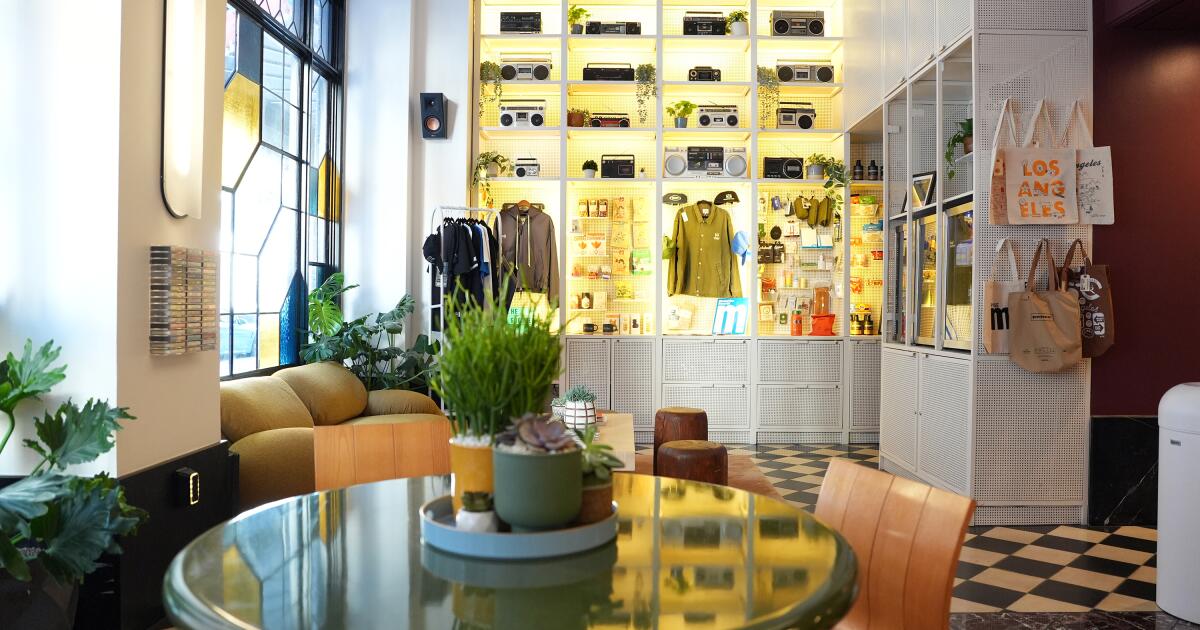
Some of the most significant changes can be found in the hotel lobby, which features a curated convenience store called the Goodie Shop, which is adorned with throwback boomboxes. Located next to the front desk, which was significantly condensed, the store is filled with a selection of California-sourced snacks and beverages, lifestyle goods, Stile-branded merch and travel essentials (phone chargers, toothpaste, hair care, etc.).
On the opposite side of the lobby is SparkHouse, a private members club and creative hub for up-and-coming musicians and creatives. The two-story space features professional recording studios, podcast and video suites, co-working lounges and meeting spaces, which are slated to open by early next year once permits are approved, Ihm says. SparkHouse’s cafe and bar is open to the public and sells tea, coffee (try the honey matcha latte), wine, beer cocktails and small bites. Ihm says programming at SparkHouse will include listening sessions, live showcases and even a mentorship program for rising artists.

“I’ve always wanted to do a hotel,” says RA Rudolph, the co-founder of Design, Bitches.
The rooftop bar, which offers stunning skyline views of the city and a pool, is now called Somewhere Special. The design team removed about 90% of the plants that used to pack the area to maximize space for dancing and mingling. Also, the pool area, now painted in a playful shade called Carrot Orange, has more seating and a photo booth nearby.
All 182 guest rooms were given a fresh coat of dusty rose paint, new custom carpet, furniture and upgraded bathrooms. In each room, you’ll find Korean amenities like face masks, a custom robe by a local brand called Room Service Los Angeles and books from the former Los Angeles University Cathedral that occupied the space from 1991 to 2011. With the hotel motto being “stay by your own rules,” Rudolph says it was important for them to make the rooms adaptable to each guest’s needs and to prioritize comfort. The result is uncommon room layouts like the tri-suite king room equipped with two twin-sized beds and a king bed split by a privacy divider that doubles as a playful art installation. Rudolph, who used to travel often with her now-adult children, says that’s the type of room she always wished had existed.
Stile’s arrival comes at a precarious moment for downtown L.A. In recent years, the neighborhood’s once buzzy hospitality and nightlife scene has experienced dwindling foot traffic, slow pandemic recovery and increased vacancies. Some business owners say crime and neglect are driving away customers. Nearly 1,000 businesses left downtown in 2024. Launching a high-concept lifestyle hotel is a bold gamble.

The Goodie Shop, a new curated convenience store, is filled with a selection of California-sourced snacks and beverages, lifestyle goods and travel essentials.
But Ihm says he hopes that Stile will help rejuvenate the area and create an ecosystem that will support neighboring businesses as well. Rudolph says she’s already starting to see that change.
“It’s been nice to see that in the last year that I’ve been coming here to work on the project, it’s livened back up again,” she says. “Especially this block, it feels better.”

Inside the World Cup Cultural Exchange
Getty Images/Getty Images
hide caption
toggle caption
Getty Images/Getty Images
What does America look like to visitors?
We’re finding out in real time as fans and athletes from all over the world visit the United States for World Cup matches across the country. From Ranch dressing, to the wonders of all-you-can-eat buffets, tourists are getting a taste of all the USA has to offer, but how do we square the warm welcome for the World Cup with the United States’ recent stances on immigration? Brittany is joined by immigration reporter Jasmine Garsd, and NPR reporter Juliana Kim to find out.
Want more global perspectives on culture? Check out these episodes:
How often do you think about the American Empire?
Make life harder (and better): Learn another language.
Support Public Media. Join NPR Plus.
Follow Brittany on Instagram: @bmluse
For handpicked podcast recommendations every week, subscribe to NPR’s Pod Club newsletter at npr.org/podclub.
This episode was produced by Liam McBain and Corey Antonio Rose. It was edited by Neena Pathak. Our Supervising Producer is Cher Vincent. Our Executive Producer is Barton Girdwood. Our VP of Programming is Yolanda Sangweni.
-

 Lifestyle21 minutes ago
Map: See Taylor Swift’s NYC Hotspots Ahead of Her MSG Wedding
-

 Education26 minutes ago
Opinion | 13 George Washington Interpreters on Embodying an Icon
-

 Technology33 minutes ago
Mystery box shows are complicated for everyone — even the actors
-

 World36 minutes ago
After 1,000 days of war: Many Israeli children carry trauma into summer break
-

 Politics48 minutes ago
Trump admin axes ‘Green New Scam’ appliance rules as Europe bakes in brutal heat
-

 Health51 minutes ago
5 of America’s greatest medical breakthroughs revealed as the nation marks 250 years
-

 Sports56 minutes ago
USA World Cup star calls lack of appeal process for teammate’s red card ‘bogus’
-

 Technology1 hour ago
Booking a summer trip? Here’s what you’re giving scammers

