World
Why Trump Is Imposing Tariffs on Mexico


President Trump on Saturday ordered 25 percent tariffs on all Mexican exports to the United States and a similar levy on all Canadian goods, except for a 10 percent tariff on Canadian energy. His move sent shock waves through both nations, whose leaders have warned that the tariffs will harm all three countries and disrupt their deeply interwoven economies.
On his first day in office, Mr. Trump had vowed to impose punitive tariffs on Mexican and Canadian exports on Feb. 1, to force the two countries to better secure their borders against the flow of undocumented migrants and drugs.
The tariffs target the United States’ closest neighbors and key trading partners. Mexico became the United States’ largest trading partner last year, exporting a variety of goods, including automobiles and avocados, while Canada is the largest foreign supplier of crude oil to the United States.
Mexican officials have criticized the tariffs, arguing that they will not only harm Mexico’s economy, but will also hurt U.S. companies that have production plants in Mexico, including General Motors and Ford. American consumers are also likely to see higher prices for fruits, vegetables and other products.
President Claudia Sheinbaum of Mexico said on Friday that the country was “prepared for any scenario.” She has suggested that Mexico could retaliate with tariffs of its own.
Here is what to know about the tariffs:
Why is Trump imposing tariffs on Mexico?
Mr. Trump placed Mexico and the U.S. southern border at the center of his presidential campaign, railing against record levels of undocumented immigrants entering the United States, as well as the movement of fentanyl into the country. (Border crossings are currently at significantly lower than the record levels in 2023.)
Mr. Trump accused Mexico of allowing a “mass migration invasion” into the United States, claiming that this had brought “crime, and drugs,” crushed wages and overwhelmed school systems.
It is not the first time Mr. Trump has used tariffs as a strategy to achieve policy objectives involving immigration.
During his first term, he threatened to impose taxes on Mexican products to pressure the country’s president at the time, Andrés Manuel López Obrador, into cracking down on migration.
As a result, Mexico deployed National Guard officers across the country to take on illegal immigration and agreed to the expansion of a program that allowed migrants seeking asylum in the United States to remain in Mexico while their legal cases proceeded.
What has Mexico done to counter the flow of immigrants over the U.S. border?
Mexico has significantly increased immigration enforcement in recent years, particularly during the Biden administration. It has added hundreds of immigration checkpoints across the country, including along once-deserted sections of the border, conducted inspections on commercial bus routes and drastically increased detentions.
To deter people from reaching border cities like Tijuana, a top migrant entry point near San Diego, Mexican authorities raided hotels and safe houses, increased security at official crossings and installed new border checkpoints where migrants were passing through a gap in a wall.
Mexico also moved migrants away from the border, using chartered flights and buses to drop large numbers of people in southern cities like Villahermosa. The strategy contributed to a plunge in apprehensions of people trying to cross along the southern border at the start of last year.
The government also introduced bureaucratic obstacles for migrants trying to make it to the United States. At one point, it stopped issuing documents that allowed migrants and refugees to stay in Mexico.
Karoline Leavitt, the White House press secretary, alluded to these actions this past week when she said the Trump administration had seen “a historic level of cooperation from Mexico” on border security.
What has Mexico done to control the trafficking of fentanyl?
Ms. Sheinbaum has taken a far tougher line than her predecessor in cracking down on the criminal groups involved in the fentanyl trade.
Mr. López Obrador prioritized tackling the social and economic root causes of drug crime over enforcement actions. But during Ms. Sheinbaum’s first four months in office, Mexican security forces have conducted major seizures of fentanyl and stepped up operations to locate and destroy clandestine fentanyl laboratories. Security forces have also targeted key members of the Sinaloa cartel, the powerful criminal organization largely responsible for the fentanyl pouring over the southern border.
In December, Mexican security forces seized more than a ton of fentanyl, the equivalent of more than 20 million doses of fentanyl pills, in what Ms. Sheinbaum described as “the largest mass seizure of fentanyl pills ever made.”
Mexico’s security minister, Omar García Harfuch, announced this past week that since Ms. Sheinbaum took office on Oct. 1, more than 10,000 people had been arrested on serious criminal charges, including homicide. Mexican authorities also have seized 90 tons of drugs, including more than 1.3 tons of fentanyl, and destroyed more than 139 laboratories, Mr. Garcia Harfuch said.
Some of the most decisive efforts to curb rampant violence have focused on the state of Sinaloa, where rival factions of the Sinaloa cartel have turned the state into a war zone after Ismael “El Mayo” Zambada Garcia, a top leader of the cartel, was lured onto a plane under false pretenses and sent to the United States, where he is under indictment.
Though there is no evidence that these enforcement actions have made a significant dent in the Sinaloa cartel’s production abilities, analysts say that it has sent a clear message about Mexico’s commitment to make good on Mr. Trump’s demands.
“There are thousands of clandestine fentanyl kitchens in Sinaloa alone, and the drug is so immensely profitable the cartel is not just going to hand it over to the authorities,” said Eduardo Guerrero, a Mexican security analyst.
“But the important thing was to show that Mexico is working harder and faster and making good in this promise to produce results,” he added.
Mexico has also recently passed a constitutional reform to prohibit the production, distribution and sale of chemical precursors needed to manufacture fentanyl. It has also increased laws around offenses related to fentanyl.
What has Mexico told Mr. Trump about its efforts?
After Mr. Trump’s victory, Ms. Sheinbaum said he should consider what Mexico has done to curb the flow of fentanyl and illegal immigration.
In a letter to Mr. Trump, Ms. Sheinbaum said a “comprehensive” migration policy to care for migrants arriving in Mexico from different countries and seeking to reach the United States had led to a 75 percent drop in encounters along the United States-Mexico border from December 2023 to November 2024.
Half of the migrants who arrived in the United States entered with a legal appointment to claim asylum since the United States introduced an app that allowed migrants to make those appointments, she added. (The Trump administration has shut down the app-based entry program.)
“For these reasons, migrant caravans no longer arrive at the border,” she said.
Ms. Sheinbaum, in the same letter, reiterated Mexico’s “willingness to prevent the fentanyl epidemic” from continuing to take a toll in the United States, and highlighted enforcement actions that resulted in the seizure of tons of synthetic drugs.



NEWYou can now listen to Fox News articles!
An island-wide blackout plunged Cuba into darkness Monday as the country’s deepening energy crisis continues to strain its fragile power system.
The outage affected roughly 10 million people before limited electricity service was restored in some areas.
“A total disconnection of the National Electric Power System is occurring,” Cuba’s state-run Electric Union said Monday morning. “The causes are being investigated.”
Cuba has faced increasingly frequent power outages in recent years as the country struggles with chronic fuel shortages and deteriorating electrical grids. The crisis worsened when President Donald Trump imposed additional sanctions in January and threatened tariffs on countries that provide oil to the island.
MILLIONS LOSE POWER ACROSS CUBA AS TRUMP SANCTIONS CONTINUE TO FUEL ONGOING ENERGY CRISIS
People walk on the street during a blackout in Havana, Cuba, Monday, July 6, 2026. (Ramon Espinosa)
During Monday’s blackout, public transportation was largely halted, and officials said tens of thousands of surgeries were canceled nationwide, according to The Associated Press (AP).
Authorities later said one generating unit had resumed operations roughly two hours after the collapse.
“Microsystems are already operational throughout the country, to ensure protection for vital services,” the Electric Union said.
RUSSIAN ‘DARK FLEET’ TANKER BELIEVED TO BE DELIVERING OIL TO CUBA, DETECTED OFF US COAST AMID TRUMP BAN
A child walks with a bottle of oil past a solar panel set up on the street to charge batteries during a blackout in Havana, Cuba, Monday, July 6, 2026. (Ramon Espinosa)
The energy minister said officials were working to restore power while accusing the U.S. of contributing to Cuba’s energy struggles.
“Vital services continue to be protected, amidst this complex situation exacerbated by the energy blockade we face,” Vicente de la O Levy said.
Cuban President Miguel Díaz-Canel also blamed U.S. policies, describing the energy blockade as a “genocidal” measure imposed by Washington.
“While the U.S. tries to induce a social explosion through asphyxiation by blocking fuel access to #Cuba, the UNE mobilizes to reverse the SEN outage,” Díaz-Canel said, referring to Cuba’s National Electric Power System.
“What the electrical workers are doing in the midst of a genocidal energy blockade is heroic.”
A woman with her son signals a car on a dark street during a blackout in Bauta municipality, Artemisa province, Cuba, on March 18, 2024. (YAMIL LAGE/AFP via Getty Images)
CLICK HERE TO DOWNLOAD THE FOX NEWS APP
Cuba’s energy crisis intensified earlier this year after a U.S. military operation captured Venezuelan President Nicolás Maduro and halted Venezuelan oil exports, cutting off a key source of fuel for the island.
While Cuba produces only about 40% of the fuel it needs, a Russian tanker delivered roughly 730,000 barrels of oil to the country in March, supplies that were depleted by the end of April, according to The AP.
To conserve fuel, the Cuban government has imposed scheduled power outages that have lasted more than 24 consecutive hours in some areas, the outlet said.
A blackout in early March affected Cuba’s western provinces, while a separate outage in mid-March plunged the entire island into darkness.

People in Cuba already faced an ongoing economic and humanitarian crisis, largely due to a US blockade.
Published On 7 Jul 2026
Cuba has suffered its third nationwide power blackout since the start of the year, as the country’s fuel reserves diminish and its electric grid crumbles due to an energy crisis precipitated by the US fuel blockade.
The blackout in the country of nearly 10 million people was reported on Monday by the state-run Electric Union, which said that the cause is under investigation.
list of 4 itemsend of listRecommended Stories
Cuba’s Energy and Mines Minister Vicente de la O Levy said protocols were quickly activated to restore electricity throughout Cuba after the outage.
“Vital services continue to be protected, amidst this complex situation exacerbated by the energy blockade we face,” he said.
Grid operator UNE said it was providing electricity to some vital services, including hospitals and food production centres, but by late afternoon was able to serve only 1 percent of the capital, Havana’s, demand.
Cuba was already struggling with fuel supplies before US President Donald Trump cut off oil deliveries from Venezuela to the island in January. But Trump’s actions, including threatening tariffs on any country that sells or provides oil to Cuba, have made things significantly worse, and deepened the island’s financial crisis. As a result, blackouts and power cuts have accelerated.
Since January, Washington has only allowed one oil tanker, from Russia, to pass its blockade and dock in Cuba, as part of a sanctions campaign aimed at ending more than six decades of communist government in Havana.
Trump has pointed to the US abduction of Venezuela’s socialist president, Nicolas Maduro, in January, and his replacement with a successor that can be pressured to work with the US, as a potential blueprint for Cuba.
Cuban President Miguel Díaz-Canel accused the US of trying to “incite social unrest by strangling Cuba’s fuel supply”.
“The actions of electrical workers in the midst of a genocidal energy blockade are heroic,” he wrote on social media.
The blackout is the eighth on the island of 9.6 million people since late 2024. It comes as the state imposes power cuts across the country – over 30 hours straight in parts of Havana and over 70 hours in some rural areas – in a desperate attempt to preserve fuel.
“Living like this is agony,” Meyboll Font, a 51-year-old self-employed social media community manager, told the AFP news agency.
Font said her Havana neighbourhood has been surviving on just “three or four hours of power a day”, but that the blackout was worse because “you never know when it [electricity] will return”.

MADRID (AP) — A large wildfire in the south of France prompted Tour de France organizers to ban fans on Monday from attending the finale of the third stage of the cycling showpiece race.
After a couple of days in Spain, the race entered France with a stage to the Pyrenees town of Les Angles, about 60 kilometers (37 miles) from a fire that has burned almost 1,821 hectares (4,500 acres) of land.
Tour de France organizers said the large wildfire currently in the Pyrénées-Orientales required a large mobilization of wildfire-fighting resources, internal security forces, and other government agencies.
“The top priority remains the protection of people, property, and natural areas, as well as bringing the fire under control,” authorities said.
As a result, organizers decided that once the peloton reaches France for the last 40 kilometers (25 miles), the publicity caravan — a 10-kilometer (6-mile) procession of sponsor vehicles that precedes the race — would not be able to operate.
Only riders and vehicles essential to the race would be allowed on the route, and spectators were asked not to gather on the roadside or at the finish area.
Stage 3 started from the Spanish town of Granollers, where temperatures reached around 35 degrees Celsius (95 Fahrenheit), race organizers said, quoting the Spanish Meteorological Agency.
Nearly 700 firefighters were battling the blaze, which led authorities on Sunday night to order the evacuation of more than two dozen villages.
Europe is the world’s fastest-warming continent, with temperatures increasing twice as fast as the global average since the 1980s, according to the European Union’s Copernicus Climate Change Service.
Globally, 2025 was the third-hottest year on record, bringing severe heatwaves across Europe.
Scores of wildfires break out in Greece
In Greece, 96 wildfires had broken out over the past 48 hours, the country’s government spokesman Pavlos Marinakis said Monday. The vast majority were quickly brought under control before they could spread, he said.
Scientists warn that climate change is exacerbating the frequency and intensity of heat and dryness, especially in southeastern Europe, making the region more vulnerable to health impacts and wildfires.
The most significant fire broke out Sunday afternoon in the Mandra area west of the capital, Athens. Authorities deployed 29 aircraft and more than 200 firefighters in a race to tame the blaze before nightfall, when firefighting planes can no longer operate. By Monday, the fire had abated, although it had not been fully extinguished.
Several parts of the country were listed as being at a high or very high risk of wildfires on Monday due to strong winds. One wildfire that broke out in the southern island of Crete triggered evacuation orders for a village near the town of Ierapetra. The blaze, which was burning through mainly agricultural land, was being fanned by strong winds, the fire department said.
Another heatwave in Spain and Portugal
In the Iberian Peninsula, another surge in heat spread across Spain and Portugal, where hundreds of firefighters were also working to contain wildfires.
Spain’s weather agency AEMET warned that a heatwave that began Sunday would endure at least until Thursday, bringing elevated daytime and nighttime temperatures. Across much of Spain, including the capital Madrid, daytime highs were expected to range between 37 C and 42 C (99 F and 108 F) on Monday and Tuesday.
Overnight conditions were also forecast to be uncomfortably hot, with temperatures easily exceeding 20 C (68 F) — which scientists refer to as ‘tropical nights’. This means people might not be recovering properly from daytime heat in the overnight hours.
In Portugal, inland locations saw temperatures soar Monday, while coastal Lisbon also baked under temperatures reaching 33 C (91 F). Temperatures were expected to drop later in the week.
___
Associated Press writers John Leicester in Paris and Elena Becatoros in Athens contributed to this report
-

 World5 minutes ago
Cuba plunges into third major blackout this year as power crisis worsens
-

 Politics8 minutes ago
Top Platner ally turns on him after bombshell rape allegation rocks campaign: ‘Red line’
-

 Health13 minutes ago
Experimental vaccine shows promise against dangerous intestinal illness
-

 Sports20 minutes ago
England’s Jordan Henderson officially ruled out after freak fall causes fracture, opts for surgery
-

 Technology23 minutes ago
Starship delivery robots leave campuses for cities
-
 Business28 minutes ago
Orange County real estate investor pleads not guilty in $100 million bank fraud case
-
 Entertainment35 minutes ago
Tom Sandoval’s ex Victoria Robinson accuses him of abuse; her restraining order is denied
-
 Politics43 minutes ago
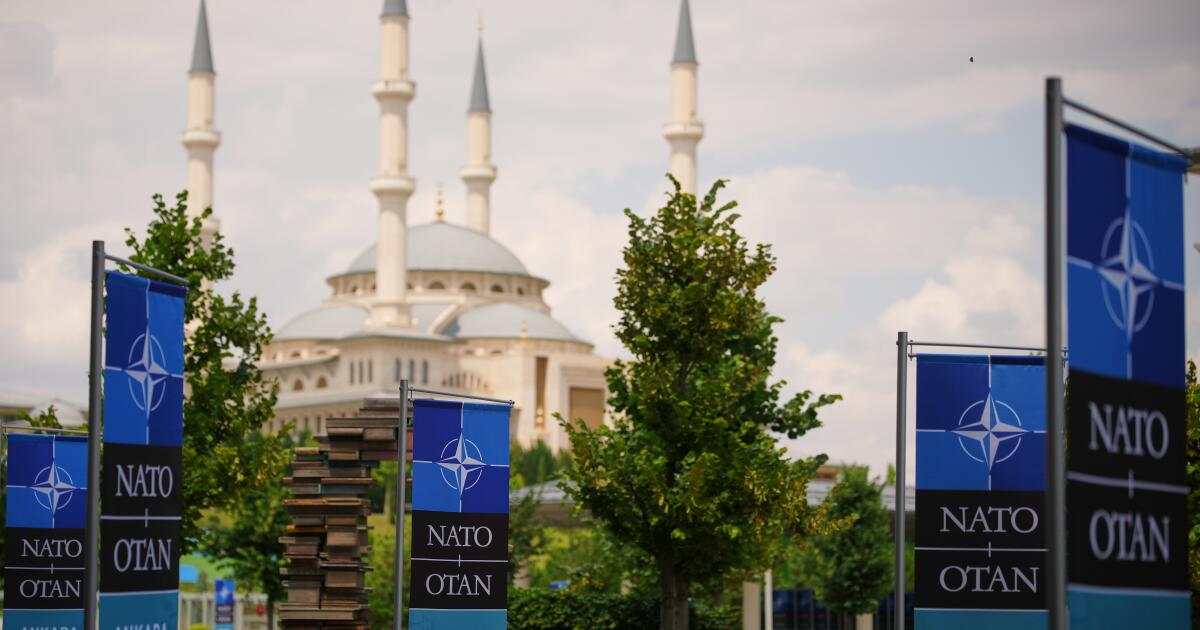
Trump heads to NATO as tensions simmer with Europe

