Wyoming
Big Piney’s Miller Ranch is recognized for bridging the conservation gap

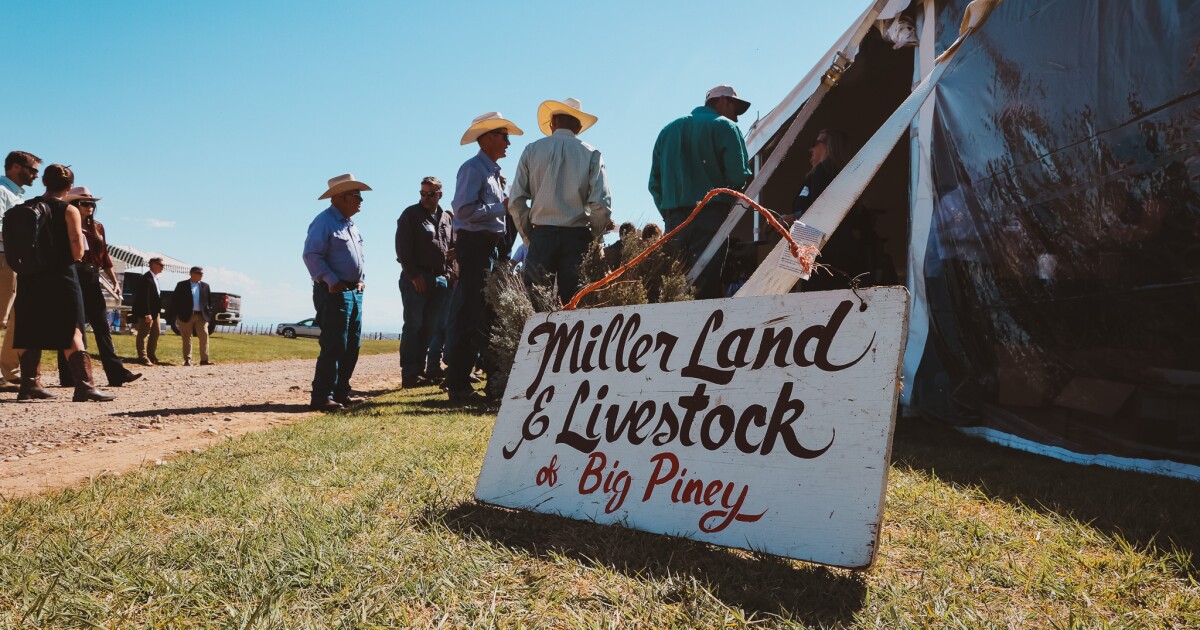
Cowboy hats, boots and even spurs peppered the crowd of ranchers, lawmakers and wildlife advocates at Miller Land and Livestock. The sixth generation ranch, nestled between Big Piney and the Wyoming Range, hosted a recent conservation event.
“We’re all about horses and cattle, but we really like our birds too,” said Mike Miller, who runs the ranch with his wife, Tara Miller, and the help of their sons, Will and Wes, and grandsons, Kaleb and Blu.
The Miller Ranch’s conservation efforts caught the eye of the National Audubon Society – specifically, their work to preserve bird habitat.
“Every year we have a [bird] family around our house. Last year was ferruginous hawk,” Mike said as birds chirped in the background. “This year, it’s an owl family. They’re really fun to watch. They’re pretty stoic individuals.”
The Audubon’s event was pegged as a “Sagebrush Celebration”, with a nod to the Miller’s recent ‘bird-friendly habitat certification from the Society. It’s a coveted title given to ranches who have prioritized conservation. The Millers said they couldn’t have gotten to this place without state and federal assistance.
Caitlin Tan
/
Wyoming Public Media
“They all have been a godsend to ranchers,” said Tara to the crowd of about 70. “The help and knowledge we have gained from them is invaluable.”
This is noticeably a different tone from Wyoming’s growing number of lawsuits against federal agencies over conservation efforts and management of natural resources. Wyoming often argues that local knowledge isn’t being prioritized in these efforts.
But not at the Miller Ranch. In attendance was Gov. Mark Gordon, and he said this is an example of the system working.
“Wildlife migrates across federal, state and private lands, each with management objectives,” Gordon said to the crowd of ranchers, wildlife advocates and lawmakers. “It’s only when people come together, with leadership from folks like Mike and Tara, that we can actually get that solved on the ground in a way that makes sense to wildlife, because wildlife don’t understand red lines.”

Jaden Bales
/
Wyoming Wildlife Federation
The Millers are the 11th ranch in Wyoming to receive the Audubon recognition. The society highlighted the Miller’s strategic rotational grazing of their cattle.
“Short, intense grazing periods create patches of short vegetation suitable for species like the Burrowing Owl and Ferruginous Hawk,” according to an Audubon press release. “Extended periods of rest from grazing allow for taller habitat structures, benefiting species like the Lark Bunting, Loggerhead Shrike and Sagebrush Sparrow.”
Speaker of the Wyoming House Albert Sommers (R-Pinedale) also acknowledged the Millers’ efforts, saying collaboration is key for conservation.
“If we can’t find ways to work together, to preserve these working landscapes, we’re going to be in a far worse place than we are today,” Sommers said.
Right now, Wyoming is in talks with the Bureau of Land Management (BLM) over a newly proposed sage grouse management plan. The goal is to prevent an Endangered Species listing. Science shows conservation of sagebrush and limited disturbance can slow the population’s decline.
A final version of the plan is expected in the coming months. Then, the work will start. That means collaboration between federal, state and local landowners, like the Millers.
Tara acknowledged all the hard work it takes to do so. It’s been a learning process since she married into the family 50 years ago.

“I was glad to be a cowgirl marrying a good looking, fun loving bronc rider and had little idea of the lifetime commitment I was making to a big ranch,” she said.
But Tara said she wouldn’t have it anyother way. The Millers have built a reputation for not only their ranching and conservation, but also their horse breeding program.
They won Best Remuda from the American Quarter Horse Association in 2021, which awards ranches across the country with top of the line home-raised ranch horses.
Just this year, Mike Miller was inducted into the National Reined Cow Horse Association Hall of Fame. He earned more than $623,000 and made it to multiple cow horse final showing events since the late 1980s – all achieved on horses bred and raised on their wildlife-friendly ranch.



The Platte County Attorney’s Office has nearly doubled the possible penalties for a Wyoming reporter accused of forging exhibits in an environmental case tied to her staunch opposition to a wind farm.
The 10 new counts against April Marie Morganroth, also known as the Wyoming-based reporter Marie Hamilton, allege that she convinced her landlords that she’d been approved for a home loan to buy their property, and grants to upgrade it.
Hamilton was already facing 10 felony charges in a March 9 Wheatland Circuit Court case, as she’s accused of submitting forged documents and lying under oath before the Wyoming Industrial Siting Council.
That’s an environmental permitting panel that granted a permit to a NextEra Resources wind farm, which Hamilton has long opposed. She’s also reported on NextEra’s efforts and the community controversies surrounding those.
Then on Wednesday, Platte County Attorney Douglas Weaver filed 10 more felony charges: five alleging possession of forged writing, and five more alleging forgery.
The former is punishable by up to five years in prison and $5,000 in fines; the latter by up to 10 years in prison and up to $10,000 in fines.
Hamilton faces up to 65 years in prison if convicted of all charges in her March 9 case. The March 25 case would add up to 75 years more to that.
Both cases are ongoing.
Hamilton did not immediately respond to a voicemail request for comment left Thursday afternoon on her cellphone. She bonded out of jail earlier this month. The Platte County Detention Center said Thursday it does “not have her here.”
The Investigative Efforts Of Benjamin Peech
Converse County Sheriff’s Lt. Benjamin Peech investigated both cases at the request of Platte County authorities, court documents say.
When he was investigating evidence that Hamilton submitted forged documents and lied under oath for Industrial Siting Council proceedings, Peech also pursued Hamilton’s claim that she owned property on JJ Road, and that she’d bought it with a U.S. Department of Agriculture loan.
The property, however, is registered under Platte County’s mapping system to a couple surnamed Gillis, says a new affidavit Peech signed March 19, which was filed Wednesday.
Peech spoke with both husband and wife, and they said they had the home on the market to sell it, and Hamilton contacted them in about July of 2025.
Hamilton told the pair that she and her husband wished to buy the property and were pre-qualified for a USDA loan through Neighbor’s Bank, wrote Peech.
But the property didn’t meet the standard of the loan, Hamilton reportedly continued. Still, she’d been approved for a USDA grant to work on the problems with the property and bring it up to the standards to qualify for the loan, she allegedly told the homeowners.
Papers
Hamilton provided the couple and their realtor with letters from USDA showing her loan pre-approval and grant approvals, the affidavit says.
During the lease period that followed, Hamilton was late “often” with rent and didn’t provide the couple with work logs until pressed, Peech wrote.
In early 2026, the lieutenant continued, the homeowners became concerned and asked Hamilton about her progress improving the property.
Hamilton reportedly sent the homeowners two invoices from contractors, showing she’d paid for work to be done. She said the wind had delayed that work, wrote Peech.
The affidavit says the Gillis couple sent Peech the documents Hamilton had reportedly given them, along with supporting emails showing those had come from one of Hamilton’s email addresses.
The Loan approval documents showed the respective logos for USDA Rural Development and Neighbor’s Bank at the top of each page, the lieutenant wrote, adding that the documents assert that Hamilton and her husband had been approved for the loan.
“There was then a list of items that needed to be completed — 14 items — prior to Final Loan Approval,” related Peech in the affidavit.
A signature at the bottom reportedly read, “Sincerely, USDA Rural Development Neighbors Bank Joshua Harris Homebuying Specialist.”
Grant Document
The documents purporting Hamilton had received a grant also showed the USDA Rural Development logo at the top of each page, with the names of Hamilton and her husband, other boilerplate language and a description of a $35,000 home buyer’s grant.
The project was about 65% complete at the time of review, the document adds, according to Peech’s narrative.
Peech describes more documents: a January notice, an invoice bearing the logo and name of “Cowgirl Demolition and Excavation, LLC,” and another invoice bearing the logo and name of “Pete’s Builders Roofing and Restoration.”
Real Estate Agent
Peech spoke with the Gillises’ real estate agent, Kay Pope, and she said she’d tried to verify the USDA grant and pre-approval by calling Susan Allman, who was listed in the documents as the Casper-based USDA agent. Pope left several messages without response, the affidavit says.
Pope spoke with Hamilton’s real estate agent, and he said he’d spoken to Allman, and he gave Pope a phone number.
Cowboy State Daily has identified Hamilton’s real estate agent and tried to contact him for further clarification.
Pope called that number and left messages without response, wrote Peech.
Peech then called a USDA Rural Development office and spoke with a Janice Blare, deputy state director, he wrote.
Peech sent the three USDA letters to Blare and gave her “all of Hamilton’s names and aliases,” he added.
The lieutenant wrote that Blare later told him the USDA investigated the letters and determined no evidence existed to show the USDA had issued them.
No records existed either, of Hamilton “using all her alias permutations” or her husband within either the USDA loan program or grant program, wrote Peech.
The USDA didn’t have an office at the address listed in two of the letters. The address pertains, rather, to a dirt lot. The USDA Rural Development office didn’t have a program titled “Rural Communities Home Buyer Program” as listed on two of the letters.
On Nov. 6, 2025, the date of the first letter purporting Hamilton had been approved for the grant program, all U.S. government offices including USDA were on furlough, noted Peech from his discussion with Blare.
A person named Susan Allman didn’t appear in USDA’s employee records, Blare reportedly added.
The Phone Call
Peech called the cellphone number one of the letters listed for Allman, “and this was disconnected,” he wrote.
The number Hamilton’s real estate agent had given was a voice over internet protocol number that Bandwidth LLC operates but is assigned to Google, added Peech.
Meanwhile, Converse County Investigator Amber Peterson spoke with the construction and roofing companies listed in the documents.
Chad Derenzo of Pete’s Roofing confirmed the logo and name listed on the documents were his company’s own — but said his company hadn’t issued the bid listed in those documents, according to the affidavit.
“Their company had never contracted to do work for Hamilton or at the… JJ Road address,” the document says.
The invoice also bore an address in Torrington, Wyoming, and his company doesn’t have a Torrington office, said Derenzo, reportedly.
Jessica Loge of Cowgirl Demolition and Excavation gave similar statements, saying the documents bore her logo, but her company hadn’t issued the bid or contracted with Hamilton.
Clair McFarland can be reached at clair@cowboystatedaily.com.
Wyoming
Wyoming State Parks announces pause on potential visitor center project at Sinks Canyon State Park

Wyoming
Coyote Flats Fire near containment as critical fire danger hits Black Hills, Wyoming counties

RAPID CITY, S.D. (KOTA) – The grass is starting to return in the Black Hills, but the damage left behind by last week’s wildfire is still visible beneath the surface. The Coyote Flats Fire is now almost completely contained, but fire officials say the work for crews who battled the flames is far from finished.
“It’s been a long week,” said Gail Schmidt, fire chief for the Rockerville Volunteer Fire Department. Schmidt said firefighters worked the Coyote Flats Fire for multiple days as the blaze forced hundreds of people to leave their homes.
Schmidt also warned the timing is concerning.
“It’s early,” she said. “It’s early — and that’s the more concerning part. We haven’t even hit summer yet.”
Some of the same crews, Schmidt said, have moved from the Black Hills to a second wildfire — the Qury (pronounced “Koo-RAY”) Fire. That fire has burned nearly 9,200 acres and was holding at 70% containment as of Monday.
Between multiple wildfires and routine emergency calls, Schmidt said the pace doesn’t slow down.
“The world does not stop just because there was a fire,” she said. “Life continues. We still have our day jobs that we need to go take care of.”
Another challenge arrives Wednesday, with critical fire danger forecast across the Black Hills and into parts of Wyoming, including Sheridan, Campbell, Crook and Weston counties. Forecast conditions include wind gusts up to 40 mph and humidity as low as 12%.
Schmidt said she believes fire lines are in good shape, but she’s watching the weather closely after recent high-wind events.
“Saturday night, 50 mile an hour winds — that was multiple days ago, and there’s been a lot of work done since,” she said. “I personally am pretty confident that we’re going to be able to hold this fire through today.”
While spring is typically the region’s wetter season — which can help reduce fire behavior — Schmidt urged residents not to become complacent as wildfire season ramps up.
See a spelling or grammatical error in our story? Please click here to report it.
Do you have a photo or video of a breaking news story? Send it to us here with a brief description.
Copyright 2026 KOTA. All rights reserved.

Virginia bill targets vape shops that sell to underage buyers – WTOP News

These Wisconsin Rapids restaurants are offering Easter specials

West Virginia Agencies Shielding Details on $1.44B DOE Coal Bail-out Loan from Public – CleanTechnica

Wyoming Reporter Now Facing An Additional 10 Felony Charges

Nonprofits face challenges with cryptocurrency | Samuel French

Florida High School Football Rankings: Top 25 teams – Oct. 21

How old is Bo Nix? What to know about Oregon quarterback ahead of 2024 NFL Draft

Cleary's 21 help Le Moyne down Central Connecticut State 69-64 in OT

99th annual Pony Swim held in Virginia

Indiana Members Credit Union announced as new anchor tenant at Bottleworks District

Video: Will ICE Change Under Its New Leader?

DHS shutdown breakthrough comes at cost for Republicans as funding fights nears end

Rubio joins crucial G7 talks as Iran war set to dominate second day

A surprise resignation could open the door for an independent to win a Montana Senate seat

Video: Savannah Guthrie Says She Believes Her Mother Was Taken for Ransom
-

 Detroit, MI1 week ago
Drummer Brian Pastoria, longtime Detroit music advocate, dies at 68
-

 Science1 week ago
How a Melting Glacier in Antarctica Could Affect Tens of Millions Around the Globe
-

 Movie Reviews1 week ago
‘Youth’ Twitter review: Ken Karunaas impresses audiences; Suraj Venjaramoodu adds charm; music wins praise | – The Times of India
-
 Science1 week ago
I had to man up and get a mammogram
-

 Sports6 days ago
IOC addresses execution of 19-year-old Iranian wrestler Saleh Mohammadi
-

 New Mexico4 days ago
Clovis shooting leaves one dead, four injured
-

 Texas1 week ago
How to buy Houston vs. Texas A&M 2026 March Madness tickets
-

 Tennessee4 days ago
Tennessee Police Investigating Alleged Assault Involving ‘Reacher’ Star Alan Ritchson