Utah
College Football 25 simulation: Who wins when Utah State visits USC?


Note: With EA Sports’ College Football 25 bringing college football back to the video game world, the Deseret News is simulating every Utah State game against an FBS opponent this season.
Utah State started its 2024 season with a solid warm-up game against Robert Morris last week.
This week? Bring on the No. 13 USC Trojans.
The Aggies head to LA Memorial Coliseum for a matchup where USU will be heavy underdogs.
Can Utah State show well in California?
The Deseret News ran a simulation of the game on EA Sports College Football 25, and it had positives — and expected struggles — for the Aggies.
How the simulation was set up
There were a couple ground rules in place: The simulation used 12-minute quarters — with the option to adjust that if necessary in future simulations — and I let the computer simulate the game with no user interference.
Injuries and depth chart changes were also implemented, and it changed a couple things for Utah State.
After starting quarterback Spencer Petras was injured in the Aggies’ opener and his status for the USC game was questionable, I went ahead and moved Bryson Barnes into the starting QB spot for the game.
Running back Roberts Briggs was also slide down the depth chart — he suffered a season-ending injury last week — but on the CFB 25 lineup, Briggs still could theoretically get a few carries because I could only move him to third on the depth chart.
For USC, there was one roster move: pushing linebacker Mason Cobb, a former Provo High star, down the depth chart after his injury in Week 1. He is questionable for the game, but in this case, better safe than sorry (though he still ended up playing some in the game).
How did the simulation between Utah State and USC play out?
Final score: USC 45, Utah State 23
Key sequence: The Barnes-to-Jalen Royals connection was humming in the first half, and Royals caught his second touchdown pass of the day on a 28-yarder with 1:14 left until halftime to push Utah State ahead 17-14.
USC, after a slow start, jump-started its offense on the ensuing drive, though.
Woody Marks broke off a 31-yard run on third down three plays into the drive, then Miller Moss connected with the Trojans’ top wide receiver, Zachariah Branch, for a 39-yard touchdown with 26 seconds on the clock to put USC up for good.
Moss threw a beautiful ball that Branch caught in the back of the end zone for the momentum-swinging score.
How the game transpired: Things looked good early for Utah State, even after a Barnes interception on the game’s first possession.
The Aggies rebounded by taking their second drive into USC territory and converting a third down to advance inside the Trojans 30 before the possession stalled. Elliott Nimrod scored the game’s first points on a 39-yard field goal.
Following USC’s second straight three-and-out to start the game, Royals got behind the USC defense and scored on a 64-yard touchdown pass to make it 10-0 Aggies.
That score seemed to wake up the Trojans.
USC’s offense finally got on track and scored two touchdowns — a pair of Marks short scoring runs — to go ahead 14-10, which set up the wild final two minutes of the first half where each team scored a touchdown.
Utah State briefly kept it competitive in the third quarter.
After Branch snagged another touchdown grab to push the USC lead to 28-17, Royals caught a 75-yard touchdown pass — his third of the day — on Utah State’s first play of the ensuing possession to cut the lead to 28-23. Utah State went for two to try and make it a three-point game, but the run was stuffed well short of the end zone.
From there, USC enforced its will.
The Trojans methodically moved the ball and scored touchdowns on two of their next three possessions while Utah State punted twice in a row. A Barnes interception deep in Aggie territory led to the game’s final score, a 37-yard USC field goal late in the fourth quarter.
Star players: Even in a loss, Royals was a star. He finished with six catches for 261 yards and three touchdowns, scoring on touchdowns of 64, 28 and 75 yards.
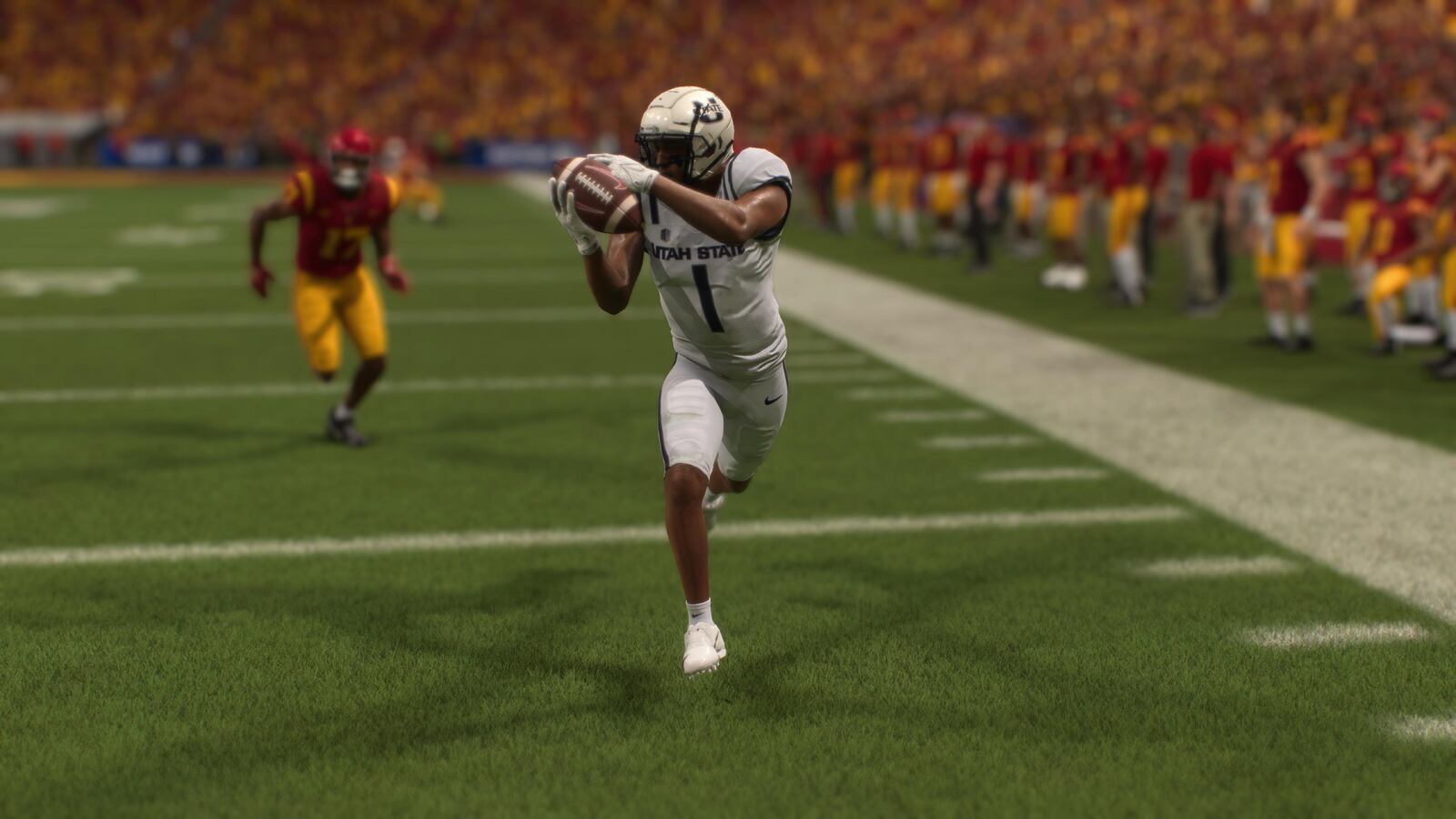
Barnes threw for 338 yards, three touchdowns and two interceptions.
On the USC side, Moss threw for 312 yards, three touchdowns and one interception, Marks ran for 246 yards and three touchdowns and Branch caught 11 passes for 138 yards and two scores. He also had a couple nice punt returns to set up the USC offense.
Final stats: The Trojans ended the game with 553 yards, while Utah State had 417.
The Aggies’ run game was contained, putting up 79 yards, while USC was able to control the clock by rushing for 241 yards.
The Trojans also held a 2-1 advantage in turnovers.
How realistic was the simulation?
My analysis: Other than the high passing numbers for Barnes and a painfully slow start for USC, this one seemed to be right on track with what could happen in the game.
Then again, the final result — a 22-point USC victory — seems right in line with what is expected to happen, so some of the details to get to that final really aren’t that big of a deal.
If a game like this happens, it would provide some positives for Utah State to take back to Logan.



Utah’s Republican-controlled legislature is escalating its fight against the state’s anti-gerrymandering law after a series of court rulings threatened the congressional map that has long favored the GOP.
In the latest move, lawmakers passed a new rule over the weekend that blocks many voters from withdrawing their signatures from a petition that sought to repeal Proposition 4 ahead of a Monday deadline, undermining efforts by grassroots groups to preserve the reform. That could affect the result of the petition after some voters said they were misled by Republicans who asked them to sign.
The move comes as redistricting battles intensify across the US ahead of the midterm elections. Courts in several states are weighing lawsuits over congressional maps, while Donald Trump has urged Republican governors to redraw districts in ways that could strengthen GOP control of House seats.
On 25 August 2025, third district judge Dianna Gibson ruled that Utah lawmakers had unconstitutionally overridden Proposition 4, the 2018 voter-approved initiative that created an independent redistricting commission, set neutral mapping criteria and required greater transparency in the process.
Gibson sided with the League of Women Voters of Utah and Mormon Women for Ethical Government, striking down the state’s 2021 congressional maps and reinstating Proposition 4 as a binding law, which allows independent bodies to redraw the districts. The ruling aligned with public opinion as well, according to the conservative Sutherland Policy Institute, which found that 85% of registered Utah voters support involving an independent commission in redistricting.
Gerrymandering’s impact has been most severe in Salt Lake county, Utah’s youngest and most populous county, which heavily leans Democratic. The 2021 Republican-drawn maps split the county across all four districts, diluting urban Democratic votes and entrenching GOP dominance.
“Salt Lake county was chopped into pieces,” said Katharine Biele, president of the League of Women Voters of Utah. “This new map reunifies the county, so people there have a fair chance to be heard.” By consolidating the county into a single district, the revised map restored genuine electoral competition; it could also give Democrats a fair chance to win one of Utah’s four congressional seats in the midterm elections.
But the sense of optimism many in Salt Lake City felt in August has steadily faded as Republicans have passed layers of legislation aimed at weakening or repealing Proposition 4. After the district court ruling last year, Utah’s Republican leadership quickly rejected the decision. Some lawmakers even threatened to impeach Judge Gibson.
As it became clear that Proposition 4 could deliver an additional seat to Democrats, the fight drew national attention. Trump and JD Vance both weighed in, framing the dispute as part of a broader struggle over election rules, with Trump immediately taking to social media, calling the proposition “unconstitutional” and the judges part of the “Radical Left”.
“What’s really frustrating is seeing that instead of listening to the people, and to the courts who are trying to keep them in line, they’re just trying to change the rules,” said Elizabeth Rasmussen, executive director of Better Boundaries, an advocacy group that had been running an awareness effort urging petition signers to withdraw their signatures before the Republican’s latest legislation.
In late January, Utah Republicans passed legislation adding two seats to the state’s supreme court. The state’s governor, Spencer Cox, quickly signed the bill into law, expanding the court from five to seven justices. Critics argue the move amounts to court expansion aimed at blunting the impact of rulings related to Proposition 4.
“Disagreement with judicial decisions is normal,” Rasmussen said, referencing criticism from the Trump administration and frustration expressed by the governor. “But impeaching a judge because you lost is not. Trying to rewrite the rules after the fact is not. Court-packing is not how this system works.”
(The Guardian reached out to the Utah governor’s office for comment multiple times but had not received a response at the time of publication.)
In early February, with the deadline to file for re-election just over a month away, two Utah Republican members of Congress, representatives Celeste Maloy and Burgess Owens, filed a federal lawsuit challenging the state court’s order to reinstate the district court-approved map. They argued that the ruling violated the US constitution and asked the US district court for Utah to restore the map passed by the Republican-controlled legislature in 2021.
Later that month, a three-judge federal panel rejected the GOP-led effort to block the new House map. The judges denied Republicans’ request for a preliminary injunction, allowing the revised map to be used in this year’s election and giving Democratic candidates a potential opportunity to win a US House seat. (The Guardian reached out to the Utah GOP for comment in December but had not received a response as of publication.)
Biele, of the League of Women Voters of Utah, sharply criticized Republican lawmakers, calling the move an abuse of power. “Every time they lose, or get a ruling they don’t agree with, they change the rules so it works for them,” she said.
But in a final push to overturn Proposition 4, Utah Republicans announced last Monday that they had submitted enough verified signatures to qualify a repeal measure for the November ballot, with a deadline to verify on 9 March. Once verified, county clerks were expected to publish the names of signers, triggering a 45-day window during which voters could withdraw their signatures – a process later threatened by the weekend legislation to make it harder to do so.
Rasmussen, executive director of Better Boundaries, said the bill was pushed through with little public scrutiny. “This bill was obviously planned to pass as the clock ran out with very little public input,” she said. “It was introduced at 11pm on a Friday, the last night of the legislative session, and was signed into law only 12 hours later.” She added that the move reflects a broader problem.
“This type of legislative behavior is what happens when there aren’t any checks on power.”

The Mammoth had strong pushes in the game, especially over the last five minutes of the third period; however, the team struggled to sustain that effort through a full 60 minutes. Following the game, Guenther and Tourigny reflected on what Utah needs to improve to find a higher level of their team game.
“We had a good start, but I think we could not sustain the pressure,” Tourigny said postgame. “The most important thing was our simplicity. I think we complicated too many things offensively that allowed them to cut plays and counterattack and that’s what I didn’t really like. I think we needed to establish our simplicity and that’s the way we scored our first goal, but we did not sustain that. A little bit disappointed. I think we finished the third period strong with a good forecheck. That’s the way we should have played for 60 (minutes).”
“Not our best game I don’t think,” Guenther said postgame. “Just feed into their hands for whatever reason. They’re really good transitionally and just a little bit stubborn. Not enough shots but got a point. Still important to get points. Put us in a good spot heading into the last game (of the road trip).”
A positive takeaway from tonight is Guenther hitting the 30-goal benchmark for the first time in his career. Guenther is one of 21 players to hit 30 goals in the NHL this season and the forward is on a four-game point streak (3G, 3A) on the road trip.
“Really good backcheck from (Schmaltz),” Guenther recalled on his first period goal. “Kind of a 2-on-1 with me and (Keller). Usually, we try to get it up, but I feel like the goalie was there, so I just tried to slide it through, and I got lucky and it went in. So nice play by those two guys.”
Not only does Guenther have three goals in the last four games, he has five goals since the Olympic break (7GP). He reflected on the confidence he has with his game and his development.
“It’s nice,” Guenther shared. “That’s kind of what’s got me into the league is being able to score. I think that I’ve rounded out my game and become a more complete player, but that’s still what I’m good at. It’s nice to contribute that way, and there’s still a lot of games to go.”
“For me what I like about (Guenther) this year is he has more ways to (score),” Tourigny explained. “It’s not just his shot; he has more than that. He’s been playing good lately since the start of the trip, I like his game.”
It’s a quick turnaround for Utah as the Mammoth play the Minnesota Wild tomorrow night. However, tomorrow is an opportunity to adjust and make improvements from tonight’s game. The Mammoth have won the first two games in their season series with the Wild, and Utah expects a strong effort from Minnesota.
“We’ve played them well too and I feel like they haven’t played their best against us,” Guenther shared. “So, they’re going to come with a good push. We’re on a back-to-back so I think just how smart we are and how we handle the first five, 10 minutes will be important.”
Additional Notes from Tonight (per Mammoth PR)
- Defensemen Nick DeSimone and Ian Cole each had assists on Hayton’s goal in the first. Both blueliners have assists in two-straight games.
- Keller has extended his point streak to four games (1G, 5A). He has now registered 14 points in nine contests since the start of February (3G, 11A).
- Guenther has now scored in three of four games on this road trip, with six points in those contests (3G, 3A). Guenther and Keller are tied for most goals by any Utah skater in a single season (30).
Upcoming Schedule

SALT LAKE CITY (KUTV) — The widow of Afa Ah Loo, the man killed during a No Kings Rally in Salt Lake City, filed a lawsuit against protest organizers and the man accused of firing the fatal shot.
Laura Ah Loo filed the lawsuit Monday, claiming the armed “peacekeeper” and the protest organizers’ negligence caused the death of her husband.
The protest was part of the No Kings Rally, which was held in every state nationwide on June 14, 2025. The National 50501 organization led the movement, with local groups organizing protests in their respective states.
In Salt Lake City, an estimated 10,000 people showed up to protest.
During the event, Matthew Alder, a member of the security team, allegedly fired into the crowd after spotting a protester carrying a rifle. Prosecutors said he shot three times, striking the armed protester and killing a bystander.
The widow of the man killed is now suing Alder for negligence, with the lawsuit saying it “should have been obvious that any errant shot fired would pose a lethal danger to bystanders.”
MORE | ‘No Kings’ Protest Shooting:
The lawsuit claims that there was no imminent threat, but even if he believed there to be one, Alder could have moved several feet to the west and shot against a wall and not into the crowd.
“Defendant Alder, with little to no known training in crowd control or de-escalation, failed to clear an area behind Gamboa and instead simply started to fire his gun,” the lawsuit reads.
Laura Ah Loo is also suing organizers, claiming they didn’t properly train or vet all the members of the security team, nor did they inform law enforcement and the public of the armed peacekeepers.
“Defendants’ breaches of these duties resulted in a perfect storm of negligence that caused the only known fatality among a march of millions of Americans,” the lawsuit reads.
She is seeking damages for pain and suffering, lost wages and economic support, and funeral costs.
JOIN THE CONVERSATION (3)
___

Minnesota3 minutes ago
Proposal would ban crypto ATMs in Minnesota

Mississippi9 minutes ago
Mississippi First Congressional District Primary 2026: Live Election Results, Buck vs. Johnson

Missouri15 minutes ago
Missouri Supreme Court hears arguments on congressional redistricting map – Missourinet

Montana21 minutes ago
Montana AG letter alleges Helena violates law banning ‘sanctuary cities’

Nebraska27 minutes ago
Shelter in place issued after suspicious object found in mailbox

Florida1 year ago
Florida High School Football Rankings: Top 25 teams – Oct. 21

Oregon2 years ago
How old is Bo Nix? What to know about Oregon quarterback ahead of 2024 NFL Draft

Connecticut2 years ago
Cleary's 21 help Le Moyne down Central Connecticut State 69-64 in OT

Virginia2 years ago
99th annual Pony Swim held in Virginia

Indiana2 years ago
Indiana Members Credit Union announced as new anchor tenant at Bottleworks District

News3 hours ago
Map: 2.3-Magnitude Earthquake Reported North of New York City

Politics5 hours ago
Trump stirs GOP primary drama with visit to Massie’s Kentucky home turf

World6 hours ago
Israeli air strike targets building in south Lebanon

News6 hours ago
Ed Martin, outspoken Justice Department lawyer, is formally accused of ethical violations | CNN Politics

Politics17 hours ago
Trump reveals top issues GOP should focus on to secure midterms victory: ‘I’ve never been more confident’
-

 Wisconsin1 week ago
Setting sail on iceboats across a frozen lake in Wisconsin
-

 Massachusetts1 week ago
Massachusetts man awaits word from family in Iran after attacks
-

 Maryland1 week ago
AM showers Sunday in Maryland
-

 Pennsylvania5 days ago
Pa. man found guilty of raping teen girl who he took to Mexico
-

 Florida1 week ago
Florida man rescued after being stuck in shoulder-deep mud for days
-

 Sports6 days ago
Keith Olbermann under fire for calling Lou Holtz a ‘scumbag’ after legendary coach’s death
-

 Detroit, MI4 days ago
U.S. Postal Service could run out of money within a year
-

 Miami, FL6 days ago
City of Miami celebrates reopening of Flagler Street as part of beautification project