Utah
College Football 25 simulation: Who wins when Utah State visits USC?


Note: With EA Sports’ College Football 25 bringing college football back to the video game world, the Deseret News is simulating every Utah State game against an FBS opponent this season.
Utah State started its 2024 season with a solid warm-up game against Robert Morris last week.
This week? Bring on the No. 13 USC Trojans.
The Aggies head to LA Memorial Coliseum for a matchup where USU will be heavy underdogs.
Can Utah State show well in California?
The Deseret News ran a simulation of the game on EA Sports College Football 25, and it had positives — and expected struggles — for the Aggies.
How the simulation was set up
There were a couple ground rules in place: The simulation used 12-minute quarters — with the option to adjust that if necessary in future simulations — and I let the computer simulate the game with no user interference.
Injuries and depth chart changes were also implemented, and it changed a couple things for Utah State.
After starting quarterback Spencer Petras was injured in the Aggies’ opener and his status for the USC game was questionable, I went ahead and moved Bryson Barnes into the starting QB spot for the game.
Running back Roberts Briggs was also slide down the depth chart — he suffered a season-ending injury last week — but on the CFB 25 lineup, Briggs still could theoretically get a few carries because I could only move him to third on the depth chart.
For USC, there was one roster move: pushing linebacker Mason Cobb, a former Provo High star, down the depth chart after his injury in Week 1. He is questionable for the game, but in this case, better safe than sorry (though he still ended up playing some in the game).
How did the simulation between Utah State and USC play out?
Final score: USC 45, Utah State 23
Key sequence: The Barnes-to-Jalen Royals connection was humming in the first half, and Royals caught his second touchdown pass of the day on a 28-yarder with 1:14 left until halftime to push Utah State ahead 17-14.
USC, after a slow start, jump-started its offense on the ensuing drive, though.
Woody Marks broke off a 31-yard run on third down three plays into the drive, then Miller Moss connected with the Trojans’ top wide receiver, Zachariah Branch, for a 39-yard touchdown with 26 seconds on the clock to put USC up for good.
Moss threw a beautiful ball that Branch caught in the back of the end zone for the momentum-swinging score.
How the game transpired: Things looked good early for Utah State, even after a Barnes interception on the game’s first possession.
The Aggies rebounded by taking their second drive into USC territory and converting a third down to advance inside the Trojans 30 before the possession stalled. Elliott Nimrod scored the game’s first points on a 39-yard field goal.
Following USC’s second straight three-and-out to start the game, Royals got behind the USC defense and scored on a 64-yard touchdown pass to make it 10-0 Aggies.
That score seemed to wake up the Trojans.
USC’s offense finally got on track and scored two touchdowns — a pair of Marks short scoring runs — to go ahead 14-10, which set up the wild final two minutes of the first half where each team scored a touchdown.
Utah State briefly kept it competitive in the third quarter.
After Branch snagged another touchdown grab to push the USC lead to 28-17, Royals caught a 75-yard touchdown pass — his third of the day — on Utah State’s first play of the ensuing possession to cut the lead to 28-23. Utah State went for two to try and make it a three-point game, but the run was stuffed well short of the end zone.
From there, USC enforced its will.
The Trojans methodically moved the ball and scored touchdowns on two of their next three possessions while Utah State punted twice in a row. A Barnes interception deep in Aggie territory led to the game’s final score, a 37-yard USC field goal late in the fourth quarter.
Star players: Even in a loss, Royals was a star. He finished with six catches for 261 yards and three touchdowns, scoring on touchdowns of 64, 28 and 75 yards.
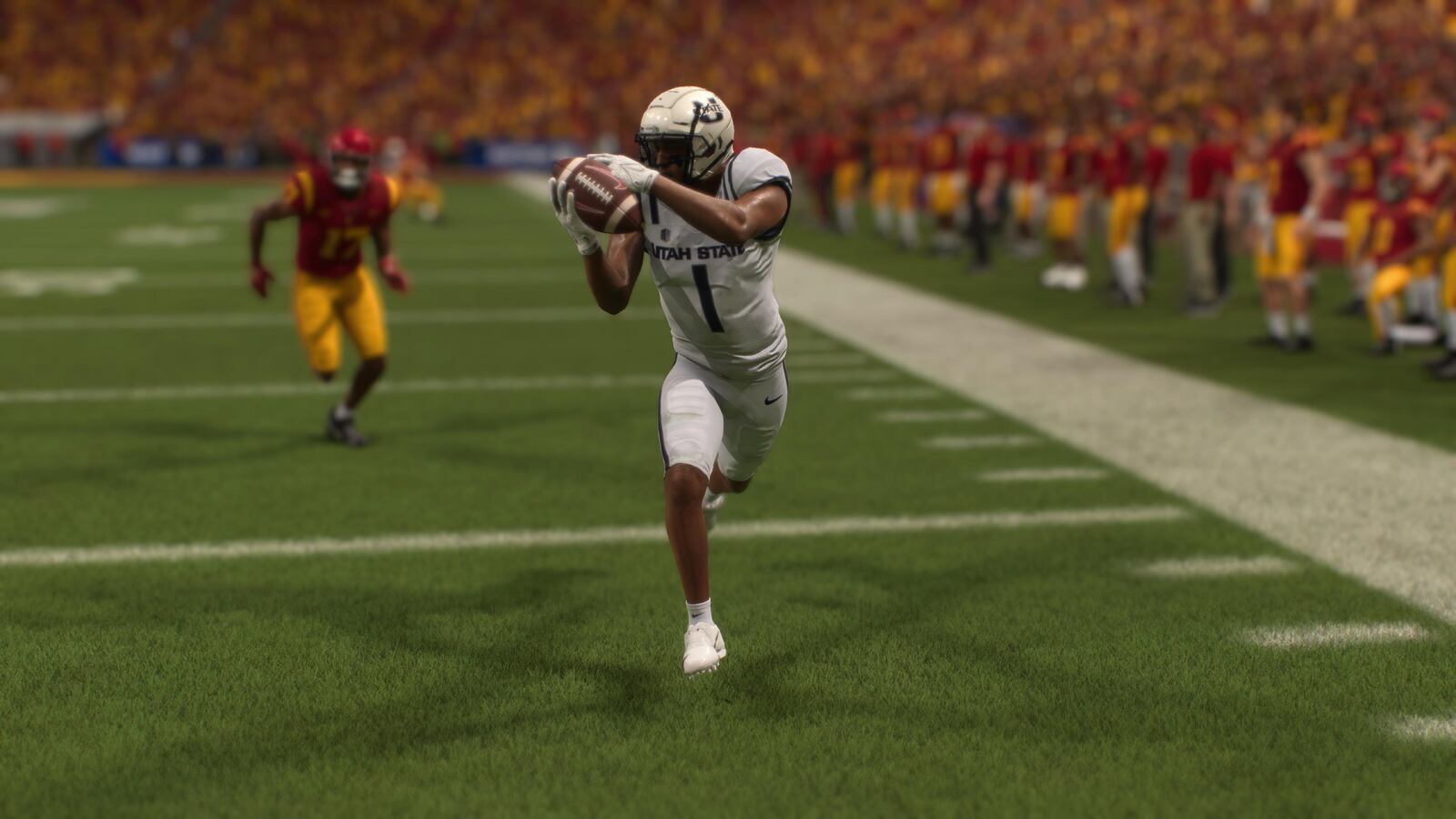
Barnes threw for 338 yards, three touchdowns and two interceptions.
On the USC side, Moss threw for 312 yards, three touchdowns and one interception, Marks ran for 246 yards and three touchdowns and Branch caught 11 passes for 138 yards and two scores. He also had a couple nice punt returns to set up the USC offense.
Final stats: The Trojans ended the game with 553 yards, while Utah State had 417.
The Aggies’ run game was contained, putting up 79 yards, while USC was able to control the clock by rushing for 241 yards.
The Trojans also held a 2-1 advantage in turnovers.
How realistic was the simulation?
My analysis: Other than the high passing numbers for Barnes and a painfully slow start for USC, this one seemed to be right on track with what could happen in the game.
Then again, the final result — a 22-point USC victory — seems right in line with what is expected to happen, so some of the details to get to that final really aren’t that big of a deal.
If a game like this happens, it would provide some positives for Utah State to take back to Logan.



- President Donald Trump is expected to sign executive orders reducing the size of Utah’s Grand Staircase-Escalante and Bears Ears national monuments on Monday.
- The monuments have shifted in size between administrations, with Trump reducing them in 2017 and President Joe Biden restoring their original boundaries in 2021.
- Environmental groups and Utah officials are divided over the potential reduction, with critics threatening legal challenges and supporters seeking more local control.
President Donald Trump plans to sign an executive order on Monday afternoon shrinking the size of two national monuments in Utah, which currently cover a combined 5,094 square miles, the Deseret News confirmed on background with a Utah source.
The two national monuments — Grand Staircase-Escalante and Bears Ears — have oscillated in size through the previous several presidential administrations.
Grand Staircase-Escalante National Monument was created by President Bill Clinton in September 1996. Bears Ears National Monument was created by President Barack Obama in December 2016. Both designations received a mixed reception among Utahns.
In 2017, Trump reduced Bears Ears by about 85% and Grand Staircase by about 46%.
Then when former President Joe Biden took office in 2021, he restored them to their original sizes.
Trump is expected to sign the executive orders in the Oval Office on Monday at 4:30 EST.
In a statement to the Deseret News on Friday, the White House said, “Any policy announcement will come directly from the President. This reporting about potential executive orders is pure speculation.”
National monument designations place restrictions on what recreational and economic activity residents and visitors can do on the land. The designation also prohibits anyone from pursuing new mining claims, oil and gas leasing, coal exploration or new commercial infrastructure projects.
However, the Bureau of Land Management previously found that Bears Ears and Grand Staircase have little to offer in terms of oil and gas potential, the Deseret News previously reported.
For nearly three decades since Clinton designated the first monument, Utah’s federal delegation has asked for reductions in land size for more local control, recreation and grazing.
Recently, Utah Rep. Celeste Maloy challenged the monument’s resource management plan to return to a plan the first Trump administration outlined in 2020 with help from local Utahns.
However, her bill died after missing a key deadline to make it to the Senate for a vote.
People react to the potential land reduction

Based on an initial report by ABC4, environmental groups are already vocalizing their disapproval over a potential reduction of monument land.
Southern Utah Wilderness Alliance Executive Director Scott Braden described the potential executive order as “unlawful, unwise and unacceptable,” in a press release sent to the Deseret News.
“This action will only bring uncertainty and chaos to places that should instead be protected for their rich biodiversity, unique geology, and remarkable cultural values,” he wrote. Braden said SUWA was preparing to fight the executive order through lawsuits or by lobbying in Congress.
On X, former Utah state Sen. Nate Blouin referenced the land reduction in conjunction with the Babylon Fire, which as of Friday is 25% contained and has covered more than 100,000 acres in southeastern Utah.
“As the largest wildfire in the U.S. burns pristine landscapes in southeastern Utah, Trump is threatening to shrink both Grand Staircase & Bears Ears National Monuments,” Blouin wrote. “This unprecedented move is happening without input from the region’s ancestral inhabitants.


PROVO — The preliminary hearing for Tyler Robinson is expected to wrap up Friday morning in Provo. But it will still be several weeks before a decision is made on whether there is enough probable cause to bind him over for trial.
Robinson, 23, is charged with 10 crimes, the most serious being aggravated murder, in the death of conservative political activist Charlie Kirk, who was shot and killed on the campus of Utah Valley University on Sept. 10, 2025. A preliminary hearing is held to determine whether there is sufficient probable cause to go to trial on the charges levied against a defendant.
The Utah County Attorney’s Office finished calling their witnesses to testify on Thursday. Robinson’s defense team, who have already called two forensic experts from the FBI and ATF to testify, are expected to call one more on Friday before resting. Robinson has been attempting to cast doubt on the reliability of DNA testing, arguing that test results are subjective.
Prosecutors have objected several times to the line of questioning, arguing that it falls well outside the bounds of what is needed for a preliminary hearing. Even 4th District Judge Tony Graf warned defense attorney Michael Burt on Thursday during one line of questioning, “I feel we are exiting the orbit of probable cause.”
At the end of a preliminary hearing, both sides typically give closing arguments, and the judge decides if there is enough evidence for a defendant to proceed to trial. On Thursday, Graf granted a defense motion for each side to first submit briefs summarizing their arguments. The state will submit its brief by July 28, followed by the defense’s reply on Aug. 11 and the state’s rebuttal on Aug. 18. After that, another hearing will be held on Sept. 1 for both sides to present their cases in court.
Also on Thursday, portions of the video interview of Robinson’s roommate and boyfriend at the time of Kirk’s death, Lance Twiggs, were shown to the courtroom after much debate.
In addition, screenshots of the text messages exchanged between Twiggs and Robinson, a note Robinson left for Twiggs and messages on Discord that Robinson allegedly sent to his friend group prior to turning himself in, were all displayed in court.
For each piece of evidence introduced during the week-long hearing, Graf has had to decide:
- Whether to admit that evidence into the record;
- Whether that evidence should be shown to everyone in the courtroom;
- Whether that evidence can be filmed by the livestream camera broadcasting the hearing.
Robinson’s defense team remains adamant that broadcasting evidence to people outside the courtroom will jeopardize their client’s right to a fair trial by prejudging a future jury pool. Prosecutors want the evidence shown to everyone for the sake of transparency. Graf has compromised on several pieces of evidence by allowing them to be displayed to people in the courtroom but not on the livestream feed.
The extended debates over what evidence can be shown to the public and what is only viewed by attorneys and the judge have prompted Jeff Neiman, the attorney for Erika Kirk and the Kirk family, to address the courtroom several times, both in person and in a briefing filed Wednesday night, calling on the court to make all evidence public.
“For 10 months, the victim’s family has waited for this preliminary hearing. Erika Kirk, the widow of Charlie Kirk, and his grieving parents traveled to this courtroom for one reason: to be present at these proceedings and to bear witness to the evidence concerning the death of their husband and son. At certain points throughout the preliminary hearing, the Kirk family sat in the room while evidence was admitted but not presented for their viewing. They were present in body, yet denied the very thing their presence was meant to secure: their ability to meaningfully observe the preliminary hearing,” Neiman said. “The victim’s family’s position is simple. At a minimum, every exhibit entered into evidence during the preliminary hearing must be visible to every person lawfully present in the courtroom.”
Erika Kirk and Charlie Kirk’s parents have been in the courtroom all week for the preliminary hearing.
At Neiman’s request, Graf agreed that at the end of court on Friday, he will show to the courtroom only the enhanced UVU surveillance video allegedly showing Robinson’s movements across the roof of the Losee Center and when he drops off the roof and runs to a wooded area off Campus Drive. The video includes moments in which film editors zoom in on the alleged gunman and impose a red circle around him to make it easier to view. The video was originally submitted as evidence but was only shown to Graf and attorneys.
Friday’s hearing begins at 9 a.m. Watch it livestreamed here:


It’s on nights like these that I’m reminded of the ravine that divides the NBA from all other levels of basketball. This Summer League tilt was sloppy on both sides, and not many fringe players earned an NBA contract tonight, by the looks of it.
This matchup has always been about the number-one pick AJ Dybantsa and the number-two pick Darryn Peterson. Rivals since high school, these two are in an eternal struggle for the designation of being “number-one”. They wanted to be the best in their high school class. They wanted to be the first off the board in the NBA Draft. Rest assured, these two will be battling for Rookie of the Year honors by the season’s end.
Advertisement
Both stars were fully aware of the magnitude of this game, and both wanted to be the first to strike in the Thomas and Mack Center.
Dybantsa took his first touch all the way to the basket and forced up an off-kilter shot that missed everything.
Peterson took the ball the other way and forced up a top-of-the-key three-pointer that missed badly.
Dybantsa quickly picked up the slack, flipping an under-and-around lay-in and following that up with a good leading bounce pass through traffic to find a cutting teammate.
From there, the 1-2 combo settled in and let the game flow around them.
For the first time in a Utah Jazz uniform, Darryn Peterson walked among mortal men as a commoner. He had a very slow start in his Las Vegas debut, opening the night 0-for-3 from the floor and even whiffing on his first all-or-nothing foul shot. His steps were hurried, and he stood unstable before his first trip to the bench. Not quite so infallible outside of the mountain air in Salt Lake City.
Advertisement
AJ claimed the first quarter, dicing up the defense with fadeaways, dribble chains, and this vicious, inhumane slam that will dominate your social media feed for the next day or so.
Washington set the tone for some — should we say physical — defense out on the perimeter, and the officials gave the Wizards liberty to reside in Peterson’s chest for the majority of the game. The number-two pick couldn’t get himself into a rhythm as he’d step out of bounds, dribble off his foot, and sputter under the heat of the Wizards’ aggressive double-team scheme.
They were incredibly handsy from end to end, frustrating Jazz ball handlers as the whistles piled up at the other end.
Advertisement
AJ Dybantsa lives at the foul stripe — that’s his superpower — and he has since his days at BYU, where he led the nation in foul shots taken per game. Perfectly within his idiom, Dybantsa was 6-of-7 from the foul stripe — keeping in mind the experimental do-or-die free throw rule. Considering how much more physical the Wizards played at the defensive end, it’s a mystery how the Wizards managed to reside in the comfort of the bonus for the entire first half.
Neither player was efficient from the floor, but Dybantsa won the first half of this marquee matchup.
Dybantsa finished the first half with 19 points on 4-of-12 shooting.
Peterson lagged behind with 11 points on 3-of-9 shooting and a pair of dimes.
The lead shrank to single digits, and what appeared to be a blowout in the first half — Washington led by as much as 20 — rapidly drew tighter in the second half. It had become a two-possession game before the clock hit 0:00 in the third quarter.
Advertisement
Both stars lived up to the bill in this one, clearly displaying their individual talents despite their efficiency not leaping off the box score.
Peterson’s tendency to cough up possession has to get straightened out. He’ll be a target for his whole career, so learning to handle and exploit on-ball pressure will be critical to maximize his effectiveness and keep his teammates involved.
Cody Williams stole the show a bit for the Jazz, despite a rocky opening to the night. Though he struggled to stop Dybantsa on the defensive end, he notched 16 points on great efficiency (6-11, 2-3 3PT) plus 5 rebounds. He’s not a ball-handler, despite the Jazz’s wishes, but thrived on a newly added stepback mid-range jumper tonight.
Dybantsa had a strong night, finishing with 27 points on 7-for-18 shooting, 7 rebounds, and 2 steals.
Advertisement
The Wizards ultimately won this game behind the strength of their NBA guys, Tre Johnson and Will Reily, who combined for 41 to pair with Dybantsa’s 27. They also strongly benefited from Jamir Watkins, Darryn Peterson’s assignment fouling a grand total of 9 times (not a typo).
Peterson likewise fouled 9 times in this one, an ugly blemish on what was an unsteady night for the rookie. He finished with 24 points on 6-18 shooting and 2-7 from three-point land (thanks to a bank-shot heave at the final horn). Dybantsa will be crowned the winner of this head-to-head with Peterson thanks to better highlights and the team win, but neither player dominated, despite what X will likely tell you.
Washington defeats Utah with a final score of 92-88.
Calvin Barrett is the Associate Editor for SLC Dunk. Originally from Springville, Utah, he currently lives in Japan and has covered the NBA and college athletics since 2024.
-

 Technology10 minutes ago
Are you filthy enough for a $700 portable shower?
-

 World11 minutes ago
Former British MP and reality TV star Ann Widdecombe found dead; man arrested for murder
-

 Politics18 minutes ago
Trump takes unusual step, lets bipartisan housing bill become law unsigned amid SAVE pressure campaign
-

 Health25 minutes ago
Eating common dairy food every day may slow biological aging, study suggests
-

 Sports28 minutes ago
CM Punk to defend Undisputed WWE Championship against Cody Rhodes at SummerSlam
-

 Technology33 minutes ago
Would you pay $8,000 for a robot to fold laundry?
-
 Business40 minutes ago
Legendary Television City may be be sold in further blow to Hollywood
-
 Entertainment43 minutes ago
‘Foreign Tongues’ is the funniest Rolling Stones album in decades

