Connect with us

Seattle, WA

Seattle’s massive fault may result from oceanic crust ‘unzipping itself’ 55 million years ago

Published

on

Seattle’s massive fault may result from oceanic crust ‘unzipping itself’ 55 million years ago


A hazardous fault line that runs south of downtown Seattle may have formed when the edge of the North American continent tore apart 55 million years ago, a new study suggests.

Seattle sits atop the Cascadia Subduction Zone, where the Explorer, Juan de Fuca and Gorda tectonic plates slide beneath the much larger North American Plate. This eastward movement pulled a string of volcanic islands similar to present-day Iceland toward the continent and eventually caused a collision that’s still visible in the bedrock beneath the city.

New maps of this bedrock reveal the collision was extremely messy, with the northern half of the island chain riding the oceanic crust and slipping under the continent and the southern half piling onto the continent. The twist in Earth’s crust where the islands switched from being subducted to obducted, or added to the top of the continent, would have been under tremendous strain and likely ripped in half.

“It would have been this slow, ongoing tear, almost like the crust unzipping itself,” study lead author Megan Anderson, a geophysicist with the Washington Geological Survey, said in a statement. “As this progressed, the tear fault got longer and longer.”

Advertisement

Nearly 75% of the US is at risk from damaging earthquakes, new map reveals

The tearing likely ended when the islands finished scrunching into the continent. Anderson and her colleagues tested this scenario using computer models and found that the resulting gash in Earth’s crust overlapped perfectly with Seattle’s fault line. The wear and tear the surrounding crust would have suffered also aligned with a network of shallow faults beneath the densely populated Puget Lowland area.

The modern Seattle fault zone cuts directly through the densely populated Puget lowlands, including Seattle and its metro area. Fifty million years ago, the continent tore in two here, setting the geologic stage for the modern faults, according to a new Tectonics study. (Image credit: Washington Geological Survey)

Previous research into the region’s splintered geological past relied on seismic data, which are sound waves that travel at different speeds underground depending on the layers of rock they encounter. 

For the new study, published Feb. 6 in the journal Tectonics, the researchers mapped the density and composition of rocks beneath western Washington state using gravity and magnetic-field measurements. Then, they paired their results with seismic data and collected rock samples to build a clear picture of the area’s geology.
Advertisement

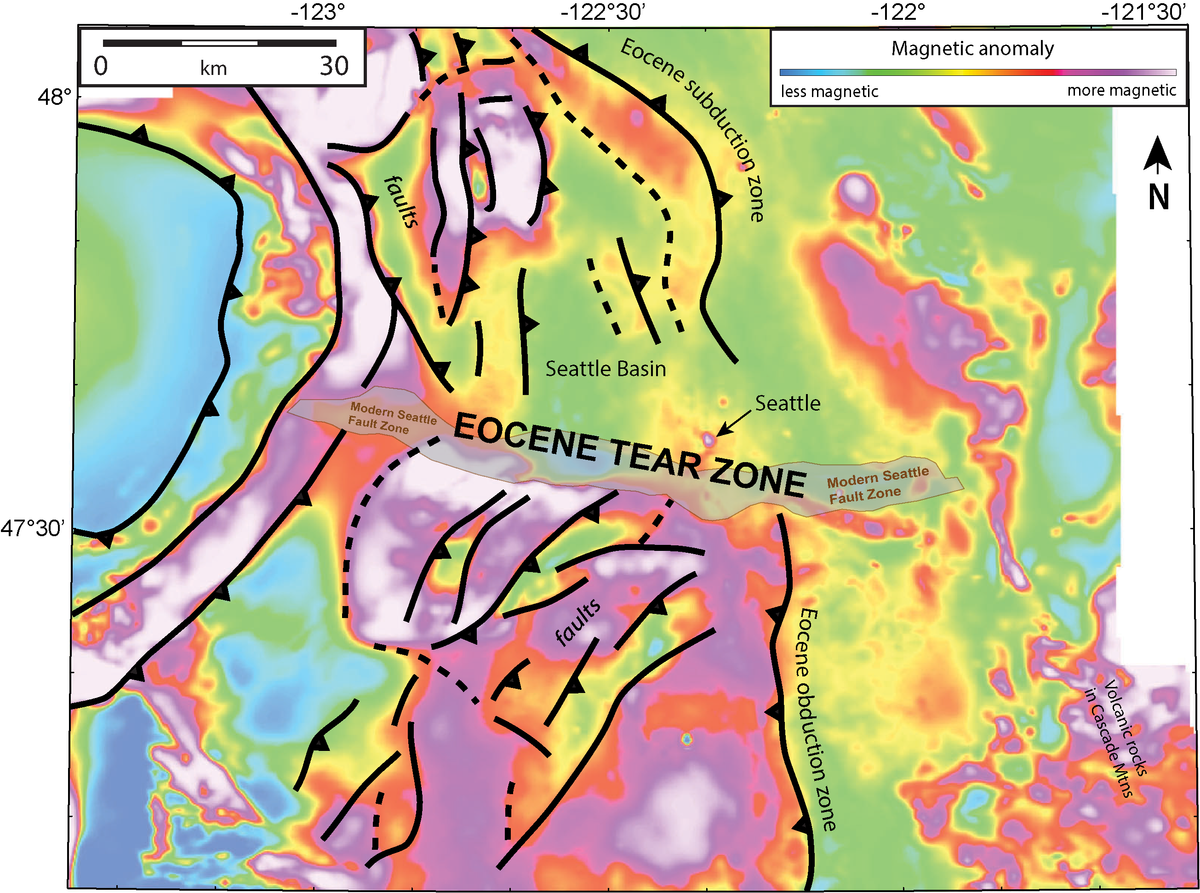
Magnetic map of seattle tear zone

Aerially collected magnetic data (background colors) of western Washington reveal that faults (black lines) on either side of the modern Seattle fault are oriented in different directions, suggesting a significant disconnect between the north and south. A massive tear between subducting and obducting (sinking and accumulating) material could have formed from the strain, authors of a new Tectonics study posit. (Image credit: modified from Anderson et al./Tectonics)

The magnetic data revealed secrets that seismic data alone couldn’t have unveiled — namely, that magneticity alternates within the bedrock and that rocks on each side of the Seattle fault line are angled away from each other. Slabs of rock to the north of the fault line lie in a northwest-to-southeast diagonal, whereas slabs to the south are angled from northeast to southwest.

“These are all very different orientations,” Anderson said. “It’s very hard to do that unless there’s a place where the structures get disconnected from each other and then restart.”

The results point to a new origin story for the Seattle fault line — one that could help scientists fine-tune their earthquake hazard models. The most recent damaging earthquake in western Washington state was the magnitude 6.8 Nisqually earthquake, which struck in 2001. Massive quakes also occurred in 1700 and around A.D. 900, when the simultaneous rupture of faults shook the Seattle area.

“There’s a lot more uncertainty about the Seattle fault than, for example, the San Andreas fault,” Anderson said. “The Seattle fault could generate something like a magnitude 7.2 earthquake, and we want to be prepared for it. There’s still a lot to learn so that engineering geologists can do better simulations for earthquakes and understand the potential risks to our communities.”


Source link

Advertisement

Seattle, WA

WEST SEATTLE CRIME WATCH: Gunfire at Westcrest Park

Published

on

WEST SEATTLE CRIME WATCH: Gunfire at Westcrest Park


Source link

Continue Reading

Seattle, WA

Evacuations ordered in 3 south Seattle suburbs after levee fails after week of heavy rain

Published

on

Evacuations ordered in 3 south Seattle suburbs after levee fails after week of heavy rain


SEATTLE (AP) – Officials ordered immediate evacuations in three south Seattle suburbs Monday after a levee failed following a week of heavy rains.

The evacuation order from King County in Washington state covered homes and businesses east of the Green River in parts of Kent, Auburn and Tukwila.

Emergency shelters have been set up at the following locations:

  • Auburn Community and Event Center, 910 9th St. SE, Auburn, WA, 98002
  • Ray of Hope Shelter, 2806 Auburn Way N. Auburn, WA, 98002
  • Evergreen State Fairgrounds, 14405 179th Ave. SE., Monroe, WA 98272 (Open 24 hours) – Pets welcomed

The National Weather Service issued a flash flood warning covering nearly 47,000 people.

“Conditions are dangerous and access routes may be lost at any time,” the weather service said in a post on X.

Advertisement

The levee breach followed a week of heavy rain and flooding that inundated communities, forced the evacuations of tens of thousands of people, and prompted scores of rescues throughout western Washington state


Source link

Advertisement
Continue Reading

Seattle, WA

Report: Seattle Mariners a front-runner for Cards’ Donovan

Published

on

Report: Seattle Mariners a front-runner for Cards’ Donovan


The Seattle Mariners have emerged as one of two front-runners in trade talks with the St. Louis Cardinals for utilityman Brendan Donovan, The Athletic’s Katie Woo reported on Saturday.

Drayer: How Polanco’s departure impacts Seattle Mariners’ offseason

Woo reported a league source said trade discussions between the Mariners and Cardinals have been heating up since the Winter Meetings, and that switch-pitcher Jurrangelo Cijntje and outfielder Lazaro Montes – two of Seattle’s top-seven prospects, per MLB pipeline – are two names St. Louis has inquired about, among others.

The Cardinals will not trade Donovan unless they are “blown away” by the return, and it’s believed they are looking for at least two prospects, per Woo’s reporting.

Advertisement

The San Francisco Giants were the other of the two front-runners Woo named. She also said that both the Mariners and Giants remain engaged in talks with the Arizona Diamondbacks about second baseman Ketel Marte.

Can the M’s give up what Arizona wants for a Ketel Marte trade?

Donovan, who will turn 29 next month, has two years of club control remaining. He’s played every position except catcher during his four-year career, with the majority of his time coming at second base and left field. He would figure to mainly factor in at second base and third base for the Mariners, who have young players like Cole Young, Ben Williamson and Colt Emerson vying for time at those positions.

Donovan was a first-time All-Star in 2025, batting .287 with a .353 on-base percentage, .422 slugging percentage, .775 OPS, 32 doubles, 10 home runs and 50 RBIs in 118 games. His 13% strikeout rate ranked in the 92nd percentile of big league hitters and his 13.4% whiff rate in the 95th percentile, per Baseball Savant.

Advertisement

Over four MLB seasons, Donovan has a career .282 average with a .361 on-base percentage, .411 slugging percentage, .772 OPS, 97 doubles, 40 homers and 202 RBIs in 492 games. He won the NL Gold Glove for utility players during his rookie season in 2022.

As for the prospects Woo reported the Cardinals inquiring about, the 22-year-old Cijntje is Seattle’s No. 7 prospect, per MLB Pipeline. The unique pitcher had a 3.99 ERA and 1.22 WHIP while holding opponents to a .207 average, striking out 120 batters and walking 51 in 108 1/3 innings pitched over 26 appearances (23 starts) across High-A and Double-A in 2025.

The 21-year-old Montes is considered to be the best power-hitting prospect in the Mariners’ farm system and is their No. 3 overall farmhand, per MLB Pipeline. The slugging outfielder hit .241 with a .354 on-base percentage, .504 slugging percentage, .858 OPS, 19 doubles, seven triples, 32 home runs, 89 RBIs, 83 walks and 169 strikeouts over 131 games across High-A and Double-A this year. Montes finished tied for third in home runs among minor leaguers across all levels.

The report that the M’s are one of the top contenders for Donovan came on the same day as they lost out on re-signing their top remaining free-agent target, second baseman/designated hitter Jorge Polanco, who reportedly agreed to a two-year, $40 million deal with the New York Mets.

More Seattle Mariners offseason coverage

• Backup catcher target emerges for Seattle Mariners, per reports
• Drayer: Mariners’ plan for 2B and 3B coming more into focus
• Salk: What we know and think about Seattle Mariners’ offseason needs
• Why Nolan Arenado could make sense as a Seattle Mariners trade target
• Drayer: Mariners’ plan for 2B and 3B coming more into focus
• The one move Passan says could make Mariners the AL favorites

Advertisement


Source link

Continue Reading

Trending