San Francisco, CA
Video shows coyote swimming in San Francisco Bay as population grows on Angel Island

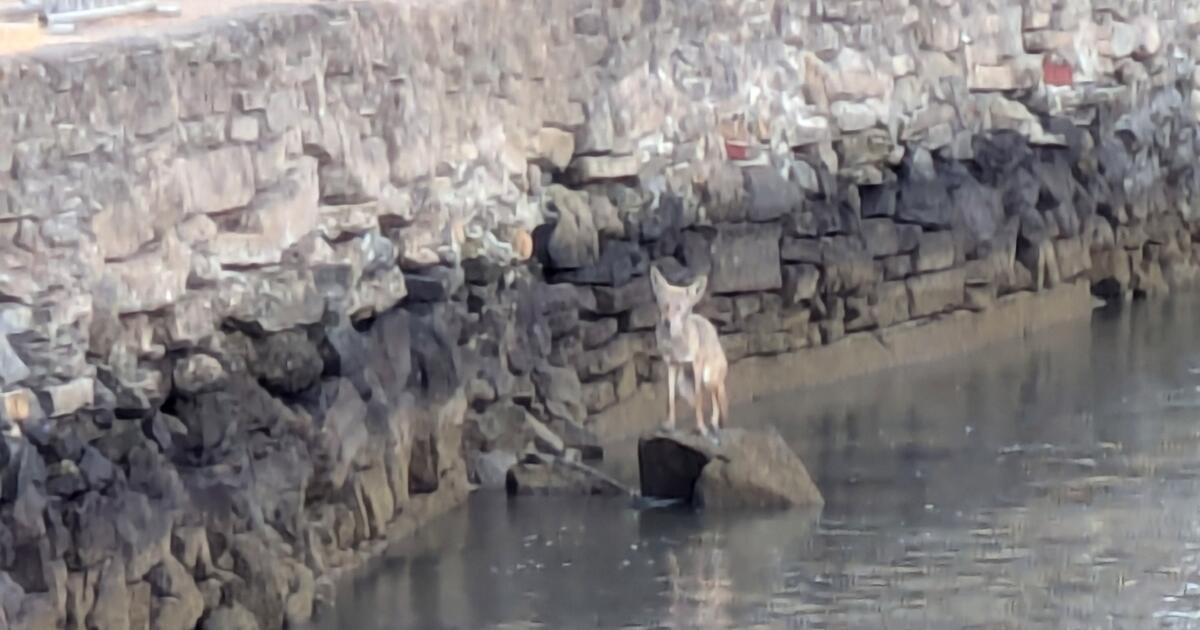
It was a sight that prompted even seasoned wildlife watchers to do a double take: A coyote swimming in San Francisco Bay a quarter of a mile off Angel Island.
“I was surprised because it was so far from land,” said California State Parks environmental scientist Bill Miller, who saw the coyote last month while aboard a boat bound for the island.
At first he thought it was a seal or a sea lion. Then he saw the pointed ears.
The canine’s snout sliced determinedly through the water as it dog-paddled along, before eventually turning around and swimming back to Angel Island.
Staff at Angel Island State Park posted a video of the unusual encounter to Instagram, prompting concerned comments from people who assumed the coyote was in distress. Miller had the same thought at first, but the coyote appeared to be a strong swimmer, he said.
In any event, State Parks has a policy of not interfering with wildlife, he said.
This wasn’t the first time a coyote has attempted to make the mile-long trip across Raccoon Strait between Angel Island and the town of Tiburon in Marin County.
At least one of those voyages was successful. Before 2017, there is no record of coyotes ever existing on the island. Scientists are now studying about 14 coyotes that live there, all of them related, to see how they interact with the island’s once-plentiful mule deer.
A coyote trots on Angel Island in San Francisco Bay in April.
(California State Parks)
The first coyote who swam across to Angel Island was alone, said Casey Dexter-Lee, a State Parks interpreter who lives on the island and has worked there for nearly 25 years. It may have been chasing prey or seeking new territory, but no one knows for sure, she said.
About a year later, a second canine appears to have made the trip, potentially enticed by the first coyote’s calls echoing across the strait, she said.
“We could hear them talking back and forth, especially at night,” she said. “So it’s possible that encouraged the second coyote to swim over.”
Another hypothesis, which is supported by genotype data, is that a lone pregnant female initially swam over and gave birth on the island, said Brett Furnas, an environmental scientist with the California Department of Fish and Wildlife.
Either way, the coyotes found a ready food source in the fawn of mule deer, which themselves have a controversial history on the island. Their numbers were controlled by human hunting for millennia, first by the Coast Miwok people, and then by the U.S. Army, which used the island as a military base, Dexter-Lee said.
When the island became a state park in the late 1950s to early 1960s, the population exploded, leading to concerns about starvation and prompting the state to regularly cull the deer, she said. The population appeared to have stabilized in recent years, until the coyotes came.
Preliminary estimates suggest the deer population has dropped by about half — from roughly 100 to fewer than 50 — since the coyotes’ arrival, Miller said. He is working with Furnas and others at the Department of Fish and Wildlife to study how this predator-prey relationship will play out. The research effort is in its second year of what scientists hope will be five.
Researchers have set up game cameras to capture images of deer and coyotes, and they regularly collect scat from both species. From that, they can learn what the animals are eating and collect DNA that enables them to identify individuals and tease out family relationships.
They’ve learned that the coyotes are all descended from one female. The population is in its third generation and is mostly consuming rats and mice.
The Angel Island mole, a unique subspecies endemic to the island, seems to be just a small part of their diet, which came as a relief.
It’s unclear what will happen to the island’s coyotes in the future. One big question is whether there’s enough food to support what is now a sizable and growing population, Furnas said. On top of that, he said, coyotes tend to want to disperse and establish new territories. And yet the long trip across the bay, with its strong currents, is not an easy one.
Furnas pointed out that the coyote seen swimming in the bay wasn’t trying to reach the island but to get away.
“That’s consistent with dispersal,” he said. “I think some of those coyotes are now saying, ‘Hey, we want our own territory,’ and they’re trying to swim back to Marin.”


San Francisco Supervisor Jackie Fielder will resume her duties next week after taking a three-month leave of absence due to mental health.
“I’m coming clear-eyed and grounded and eager to serve in this role again,” Fielder said in a video posted to social media Tuesday.
Fielder was first elected in 2024 to serve District 9, which includes the Mission District and Bernal Heights and Portola neighborhoods. In late March of this year, her staffers announced she was taking a leave of absence to address an “acute personal health crisis” after missing a few weeks of Board of Supervisors meetings.
“I left the work that I love so much, not because I wanted to, but because my mental health demanded it, and I say that with no shame,” she said.
In the video statement, Fielder mentioned that the pressure of serving as a supervisor took a toll on her mental health.
“I’ve often felt like the weight of this district and city is on my shoulders, and I, through this leave, have had the silver lining of understanding that it never has,” she said. “I was going 100 miles an hour since early 2023 when I started the campaign for supervisor, and being a grassroots candidate is a lot of elbow grease.”
Fielder’s staff continued some of the work in her district while she was gone. She thanked her colleagues and Mayor Daniel Lurie for their support and allowing her to be excused from meetings.
Fielder will return to work Monday and appear at the June 30 board meeting. She is also expected to host listening sessions in her district through July.
“I am an example that it is possible to come back and heal,” she said. “I could not be more honored to serve and more ready to serve.”
San Francisco, CA
Where to watch Athletics vs San Francisco Giants: TV channel, start time, streaming for June 23


What to know about MLB’s ABS robot umpire strike zone system
MLB launches ABS challenge system as players test robot umpire calls in a groundbreaking season.
The 2026 MLB season has surpassed the quarter mark, and after each team’s first 40 games, there’s plenty of reasons to tune in all summer long.
Chicago White Sox slugger Munetaka Murakami has already proven doubters wrong by launching 17 home runs, Pittsburgh’s Paul Skenes consistently looks like the best version of himself on the mound and Milwaukee ace Jacob Misiorowski is throwing harder than any starter in the majors.
The MLB action continues on Tuesday as the Athletics visit the San Francisco Giants.
Here’s everything you need to know to tune in for the first pitch.
See USA TODAY’s sortable MLB schedule to filter by team or division.
What time is Athletics vs San Francisco Giants?
First pitch between the San Francisco Giants and Athletics is scheduled for 9:45 p.m. (ET) on Tuesday, June 23.
How to watch Athletics vs San Francisco Giants on Tuesday
All times Eastern and accurate as of Tuesday, June 23, 2026, at 6:33 a.m.
Watch MLB all season long with Fubo
MLB regional blackout restrictions apply
MLB scores, results
MLB scores for June 23 games are available on usatoday.com . Here’s how to access today’s results:
See scores, results for all of today’s games.

An abandoned house near San Francisco’s Castro neighborhood that has been popular with squatters for years is now for sale.
On Yukon Street at the edge of Kite Hill in the Eureka Valley neighborhood, the house with arched windows over the garage, including one that’s broken, is listed for $1.3 million.
Listing agent Zara Rowbotham and her brother, James, put together a promotional video highlighting the home’s fixer-upper potential.
There is no running water or power at the house. Neighbors have reported to the city that squatters relieve themselves at the top floor atrium.
“They needed a place to do it, so they had the nice manners to do it in one basket,” Rowbotham said. “Unfortunately it was an outside basket right in front of one of the neighbors’ houses.”
With the nature of San Francisco’s red-hot housing market, Rowbothom said they already have a potential buyer.
Rowbothom added the city is swirling with money right now and there are few places to buy, so properties like the one on Yukon Street – even with a history of squatters – are being snapped up quickly. Rowbothom said they’re going for millions of dollars, with people paying cash a lot of the time.
-

 Vermont6 minutes ago
Vermont trooper found justified in fatal Putney shooting
-

 Virginia7 minutes ago
Virginia House honors ABC13’s Noreen Turyn as she retires after 36 years
-

 Washington14 minutes ago
Social media reacts to former BYU star AJ Dybantsa going No. 1 in 2026 NBA draft
-

 Wisconsin21 minutes ago
Cult-classic filmed in central Wisconsin returns to big screen, with enhancements, this weekend
-

 West Virginia24 minutes ago
WVDNR accepting applications for waterfowl hunt at McClintic WMA
-

 Wyoming29 minutes ago
American Rare Earths strengthens board with veteran Wyoming mine builder ahead of planned Nasdaq listing
-

 Crypto36 minutes ago
Crypto’s Liquidity Outlook Darkens as Fed Hawkish Pivot Pushes Hike Odds to 77%
-

 Finance39 minutes ago
Building a scalable finance function at Coca-Cola Europacific Partners

