San Francisco, CA
From All-Star to architect: How Buster Posey plans to rebuild the Giants


SCOTTSDALE, Ariz. — Buster Posey’s spring training office, at one corner of a sprawling indoor facility attached to Scottsdale Stadium, is nondescript and mostly barren, save for some apparel boxes that have stacked up behind his desk. The walls are noticeably empty, devoid of mementos from a catching career that included an MVP, a Gold Glove and five Silver Sluggers. The only hint that one of the most celebrated players in San Francisco Giants history now occupies a space reserved for the head of baseball operations is a nameplate outside the door.
Posey, six days shy of his 38th birthday and less than six months removed from accepting a job few people of his stature have ever taken on, spent a dozen years trying to will the Giants to victory. Now, he has a different role: to methodically guide them there, inch by inch, meeting by meeting, transaction by transaction.
It has required some letting go.
“As a player, I would come in every day and have a list in my mind of what I wanted to accomplish, whether it was in the weight room or hitting or catching, and now, in this role, I think the best way to describe it is — it’s kind of a lack of control, as much as anything,” Posey said. “Because you had the ability as a player to directly impact outcomes, and now the impact is trying to create a roster of guys that have the same mentality and want to go out and try to win a lot of baseball games.”
That, essentially, is the goal. Posey was at the center of World Series titles in 2010, 2012 and 2014, but the Giants have made the playoffs only twice since. Under Farhan Zaidi, the man Posey replaced as president of baseball operations in September, the Giants didn’t win enough games and didn’t make enough strides to justify the losses. Also, according to many of those who know the organization intimately, the Giants seemed to lack identity, allure, soul.
Posey is striving to change that. He wants to build the Giants into a consistent, sustained winner, just like Zaidi attempted to do over the past six years, but he also wants them to be fun. He wants to deviate from the analytical roster-building approach that has overtaken the industry, prioritizing hyper-efficiency and placing less emphasis on aptitude and experience. He wants to construct indelible Giants teams the community can rally around, the way it used to for most of the previous decade.
Posey has often said that people in his position are in the “memory-making business,” a nod to his belief that these aren’t just baseball teams they’re overseeing, but civic institutions.
His playing career taught him that.
“I’ve met fans before that genuinely feel like they know me, just because of how much baseball is on TV,” Posey said. “That’s something that’s important to me. I want our fan base to have that connection with our players. I’m hopeful that the 10-year-old out there is pulling on his or her mom’s coattail and saying, ‘I want to go in because I want to see Player X-Y-Z today.’ They want to go buy the jerseys. So yeah, it is about winning. First and foremost, it’s about winning. But I think the stories make the winning even better.”
Posey, who retired three seasons ago, will be eligible for the Hall of Fame beginning in 2027. Given the recent induction of Joe Mauer, another standout catcher who didn’t accumulate the aggregate numbers of a traditional Hall of Famer but made up for it with a dominant peak, there’s a good chance he’ll be enshrined in Cooperstown then. He’d do so on the heels of a playing career that saw him earn more than $150 million, which makes one wonder why Posey would willingly take on such a demanding job.
To him, it’s simple: He feels a responsibility to the Giants, and he continues to possess this unrelenting desire to test himself.
“It’s a challenge, and it’s hard to turn down a challenge,” Posey said. “You want to see, ‘Is it something that I can do?’ ‘Is it something that I’m going to like doing?’ ‘Is it something that I’m going to be good at?’ There’s obviously questions. You’re like, ‘I don’t know, am I going to be good at this?’ It’s not the same as playing baseball. It’s different.”
POSEY ADDRESSED THE Giants before their first full-squad workout Feb. 17, stressing the importance of fundamentals and the power of cohesion. He is still trying to figure out how to balance interacting with players and maintaining a healthy distance from the clubhouse, as most front-facing executives tend to.
“I want to be available, I want them to know I care, I want them to know that I’m watching — but I don’t want to overstep, either,” Posey said. “There are going to be tough conversations, inevitably, at some point. I hope to operate, in a way, as transparent as I can with them. There’s certain things that you’re not going to say just because they don’t need to be said; they’re irrelevant at some point. And there’s going to be times, I know, when players will be frustrated. But my intent is going to be whatever is best for the San Francisco Giants, and hopefully that will come through.”
Posey isn’t too far removed from being one of them. After opting out of the COVID-19-shortened 2020 season to stay with his wife, Kristen, while they cared for an adopted set of premature twin girls, Posey came back in 2021, made his seventh All-Star team, then promptly retired.
Patrick Bailey, the Giants’ current catcher, was a 22-year-old finishing his first full season of professional baseball then. He chuckled when asked if he thought Posey would be running the baseball-operations department within three years.
“Nah,” he said. “I figured he’d still be playing.”
Posey initially returned to his home state of Georgia to begin a new chapter in his life. It lasted about a year. In September 2022, he joined the Giants’ ownership group and also formed part of a six-person board of directors, a role that included participating in meetings about payroll configuration and providing input on player acquisitions.
Posey also became involved in high-profile recruiting efforts, most notably around Shohei Ohtani, whose signing with the rival Los Angeles Dodgers in December 2023 — the continuation of a trend that had seen other stars like Aaron Judge and Bryce Harper sign elsewhere — prompted Posey to voice his concern that negative perceptions about San Francisco were hurting their chances. Nine months later, when the Giants were working to lock up Matt Chapman, Posey invited the All-Star third baseman to his home, added a no-trade clause, eliminated deferrals and helped finalize a six-year, $151 million extension.
Posey can’t recall a specific moment that prompted him to pursue this job but said his “wheels started turning a little bit” while serving on the board.
“I thought that one day it might be something fun to try,” he added. “I didn’t think it’d be as quick.”
Other members of the Giants’ ownership group initially thought about having Posey serve as an assistant within Zaidi’s baseball-operations department, chairman Greg Johnson told ESPN. “But the more we went down that path, the more we realized that that could create more tension and uncertainty in the clubhouse having those two heads there, and that really got us to the point of talking directly to Buster about doing it.
“My feeling was he was a little hesitant at first,” Johnson added, “and I think we were a little hesitant. I think we kind of felt like the perfect scenario would be maybe a couple more years down the road, but timing doesn’t always work out that way.”
The more the two sides spoke, the more Posey seemed to warm up to the idea. Kristen’s support solidified his decision.
“I’m very lucky to have such a supportive wife because I went from basically being a full-time man-ny to now having a full-time job,” Posey said. “It’s been an adjustment at home.”
Posey has another set of twins, a boy and a girl, who are 13 now, old enough to possess vivid memories of their father as a star baseball player. The younger pair are just 4. Part of the reason he took this on was because he wanted his children to see him working. He felt it would be important for them to witness the value of structure and sacrifice. But he probably could have accomplished that with one of the cush special-assistant jobs bestowed upon distinguished former players.
It didn’t have to be this.
“I think he’s crazy,” said Zack Minasian, the Giants’ general manager and Posey’s new right-hand man, with a laugh. “But he said this to me once before: ‘You got to be a little psycho to be a catcher, and maybe you got to be a little psycho to run baseball operations.’”
A MONTH INTO Posey’s time in the job, baseball’s elite gathered in San Antonio for the general managers meetings. On the first night, at a cocktail hour at one of the bars inside the JW Marriott, Minasian joked that Posey should wear his name tag.
“Really?” Posey said.
“No,” Minasian told him. “Everyone knows who you are.”
Minasian had spent the past 20 years working in baseball operations, 14 of them with the Milwaukee Brewers. He’s familiar with the dynamics between the 30 front offices — the cliques that form, the relationships that are built, the fraternizing that often takes place, even among rival staffs. But he wondered how Posey was experiencing it for the first time. At one point he leaned over and asked if any of this was surprising. Posey’s response was telling: “Shouldn’t we want to kill them?”
Posey has long been considered a natural leader — so much so that his longtime agent and current adviser, Jeff Berry, has not so jokingly suggested he could be president — and a calming presence. But within him also lies a relentless competitor. During his playing days, it was constantly in plain view. Now, that part of him comes out more subtly.
Minasian has noticed it in the aggression that will spill out of him if a meeting doesn’t go a certain way, or in how direct he’ll get when on the phone with another agent.
“It’s like watching him play,” Minasian said. “It’s a slow burn — calm, cool, under control, but then it burns extremely hot.”
Before this offseason, Posey had never directly negotiated with an agent or worked out a trade with another executive. He didn’t know the collective bargaining agreement intimately, had probably a surface-level understanding of other teams’ farm systems and wasn’t well-schooled in the infinite minutiae of roster management. Ambition will only take him so far. But those who knew him during his playing days are quick to point out other attributes that might ease the transition.
Stephen Vogt, the Cleveland Guardians manager who once served as Posey’s backup, called him “the smartest player on the field.” Toronto Blue Jays starter Kevin Gausman, a former Giant, called Posey “one of my favorite teammates,” noting his attention to detail but also how easy he was to talk to. Chris Young, the longtime pitcher who is now the Texas Rangers’ president of baseball operations, thinks Posey will be a good delegator, a crucial trait while overseeing such a massive enterprise.
“I don’t doubt he’ll have his moments when he struggles with it,” Young said, “but Buster is so thoughtful and humble and caring, and those qualities will take him a long way.”
Four months into his tenure, Posey’s first major trade saw the father of two sets of twins break up another set of twins, sending reliever Taylor Rogers to the Cincinnati Reds. His first major free agent signing saw him break his own franchise record for largest contract — one Posey didn’t know he still held.
Ten days into December, the Giants signed veteran shortstop Willy Adames to a seven-year, $182 million deal, addressing their biggest need with the best available player to fill it. They did so by acting aggressively, landing Adames before Juan Soto chose his next team and the other finalists could pivot. Money is what probably made the difference, as is often the case, but Adames was swayed by Posey’s authenticity.
“He was straightforward — that he doesn’t want to basically ruin his legacy as a winner now that he’s in a front office, and that obviously he took this job sooner than he expected and he’s not going to do that to just come over here and be another guy,” Adames recalled. “And I believe that.”
The rest of the offseason developed slowly. Pursuits of Garrett Crochet, Corbin Burnes and Roki Sasaki, frontline starters who could have bolstered a rotation that accumulated the fewest innings in the National League last season, didn’t materialize, prompting Posey and Minasian to take a chance on 42-year-old Justin Verlander. Trade proposals for arbitration-eligible players like Camilo Doval, LaMonte Wade Jr. and Mike Yastrzemski never made enough sense to pull the trigger.
Given that they were basically doing this for the first time, Minasian could sense that other front offices were “feeling us out,” trying to determine how they’re wired.
Posey, he believes, could sense it too.
“As a competitor,” Minasian said, “I think he had a lot of fun with that.”
POSEY IS ONE of only five heads of baseball operations who played in the major leagues, along with the Rangers’ Young, Craig Breslow of the Boston Red Sox, Chris Getz of the Chicago White Sox and Jerry Dipoto of the Seattle Mariners.
Over these first few months, Posey has leaned heavily on Young, who pitched in the big leagues from 2004 to 2017. His best advice, though Posey isn’t sure if he borrowed it from someone else, was that baseball is composed solely of two entities: the players on the field and the fans in the stands.
“The rest of us,” Young told him, “are just hanging on.”
Posey is trying to keep that front of mind.
“This isn’t about me,” he said. “This is ultimately about the guys on the field and how they play. I think that’s really a big piece of this to me, is for them to understand — ‘If this works well, it’s because you’re playing well.’ There’s only so much you can do.”
Young, 45, admittedly still struggles with relinquishing that control. As a player, he said, “I knew what I needed to do to help the team succeed, and it was about me taking care of myself. I was not solely focused, but I was focused solely internally. In this role, it’s about everything externally facing him. It’s about on a daily basis helping others and empowering people and choosing the right people. And it’s about everybody else.”
Posey has left a lot of the logistics to Giants assistant GM Jeremy Shelley, who has been with the organization for more than 30 years. Minasian has also carried a major load.
During his extensive time as a pro-scouting director, Minasian took pride in being able to play GM for 29 other teams, accumulating foundational knowledge on the types of players they valued and what they tried to leverage. Through that, he also built the kind of relationships with agents and executives that Posey is only beginning to carve out. Minasian had most of the initial conversations over the offseason, and Posey would usually take over near the end, which speaks to what might be one of his most valuable traits.
Posey’s presence, some believe, should help the Giants lure free agents.
“I mean, you have [Verlander] and me already,” Adames said. “And now we’re going to change the culture, and we’re going to put the message out there that this is different now. We’re trying to build something great; we’re trying to build greatness here. And now with him running things to go recruit, it’ll be awesome. Because if you talk to players, and they don’t like who’s running the team, they don’t like what they’re doing in the organization — a free agent guy’s not going to come here.
“But now that you do things differently here — and he’s trying to do something great — of course the word’s going to come out like that. Guys are going to think differently about San Francisco now.”
The Giants share a division with the Dodgers, who look especially dominant these days. The San Diego Padres and the Arizona Diamondbacks also project to be better this season. The Giants need some of their promising young starting pitchers to blossom. They need their offense to become more menacing. And they need to revitalize a farm system that ranks 29th heading into the season, according to ESPN’s Kiley McDaniel, largely because of recent graduations but also because the Giants have not capitalized enough on first-round picks.
Success, then, could take a while. But Posey has seemingly been drawn to the process. He spent the offseason coming into the offices as often as possible to get familiar with names and faces and found himself talking to a lot of intelligent people who often shared unique ideas. They energized him. And through that, Posey began to experience a different type of satisfaction.
“I’ve always loved baseball,” he said. “Since I was little, I love playing it. But I guess what I have learned just in these first four or five months is that it’s a different type of enjoyment, being involved this way, but there’s still a lot of passion there on my end.”
POSEY’S MOTHER-IN-LAW DIDN’T want him to take this job at first. She was worried about how it might tarnish his pristine image with the Giants’ fan base, which, given the fraught nature of making so many high-level decisions in what amounts to a game of chance, doesn’t seem unreasonable. But Posey isn’t letting his mind go there.
“I guess I’m not worried about it just because ultimately I know, my family knows, people close to me know, that I’m going to do this to the best of my ability, and I’ll care about any decision that I make and every conversation that I have,” he said. “I’m really hopeful that it’s successful. But if it’s not, life goes on. It’ll be OK.”
Posey wants a front office group that is unafraid of how outsiders might react to certain transactions, and he wants his players to “be themselves.”
He also wants the Giants to get back to basics.
Advanced metrics are now ingrained in the fabric of every team, but it’s clear that Posey, more so than most of his peers, wants to blend them with some of the concepts that were valued when he played and are generally now dismissed as old-school philosophies.
Posey thinks RBIs matter. He values the off-field benefits of having veteran players in a clubhouse, speaks about the importance of “using the scoreboard to teach us how to act during a game” — tightening the strike zone when the score is close, not taking an extra base with a big lead — and wants the Giants to develop “complete baseball players” rather than focusing on measurables.
His GM (Minasian) comes from a scouting background. His two advisers are an agent who has loudly spoken out about baseball becoming too analytically inclined (Berry) and a longtime executive who made a name for himself in a different era (Bobby Evans). One of the men tasked with running the Giants’ player-development program (Randy Winn) is an ex-teammate whose post-playing career had been more geared toward coaching.
Early in his tenure, Posey announced he would move the analytics office out of the front of the clubhouse, a decision that was seen mostly as symbolic. For spring training, he invited a host of former Giants players to serve as guest instructors, a rarity under Zaidi.
“We’re in the day and age of analytics, and he’s a little bit more of a traditional thinker,” Giants manager Bob Melvin said. “His instincts really were part of who he was as a player.”
Greg Johnson believes there was “tension between the old-school model and the new-school analytics” under Zaidi, adding: “There was some noise coming from the clubhouse that maybe we didn’t have the right balance.”
Reached by phone, Zaidi, who has since returned to the Dodgers as an adviser, said he never got that impression. Zaidi said he maintained an open-door policy for players to talk about the organization’s process and continually spoke with Melvin to ensure they weren’t operating in either extremity.
“Through that channel, I got positive feedback,” Zaidi added. “When you postmortem things, maybe you have a different lens on it, but it was something that I was very conscious of, throughout my time with the Giants and particularly last year.”
Posey’s focus is not so much on doing things different from Zaidi, he said, but on forging a new identity. Minasian stressed that the Giants will seek a “healthy balance” between new-school and old-school philosophies, and some of the early signs — ordering two Trajekt pitching machines over the offseason, keeping the research-and-development staff intact after lead analyst Michael Schwartze left for the Atlanta Braves — show that numbers will still matter.
But they won’t mean everything, and that in itself feels different.
In his talks with Posey, Verlander found it refreshing to communicate with a decision-maker who valued qualities the analytics could not measure. Whether that will actually yield better results is an open question, one that has been roundly debated for years, but Verlander is hopeful.
“I think it could very much be something that can lead to having a better organization,” Verlander said. “It’s like me pitching and probably him hitting and catching towards the end of his career — you were brought up in an age before analytics, and so you have this wealth of instinct. And this is why it’s hard to put words on it because you have all these instincts that you gained over time from playing the game, and then all of a sudden you’re inundated with numbers.
“I think the best players were able to go, ‘OK, I see this, I see this,’ and put them all together, and you get something magical, really. And if he’s able to do that as a president, as a person bringing in players, there’s potential for something that’s just magical.”



In the North Bay, the SMART commuter rail line will begin work next week to extend service to the city of Healdsburg, with plenty of challenges, both in construction and in finding long-term funding.
As the largest city north of Santa Rosa, Healdsburg is generating considerable excitement among those who await SMART’s arrival. But first there’s a lot of work to do, starting next week.
“It starts with a topographical survey,” said SMART Chief Engineer Bill Gamlen. “Monday, we’ll be moving into geotechnical boring, where we’ll have a drill rig out on the site, and we are taking cores of soil samples. There’ll be a lot of things going in parallel. We’re going to be taking things apart, tearing out old track, taking out old bridges, tearing up grade crossings. The bridge across the Russian River will be one of the first activities there.”
That bridge was built in the 1870s and will need a complete replacement to carry the weight of the modern SMART trains. The prep work will take about a year, with actual construction beginning next spring. The $270 million in funding for the extension is already in place and SMART expects to be pulling into the old Healdsburg station sometime in late 2028.
“We think it’s a big milestone,” said Gamlen. “You know, Healdsburg is a delightful place to go visit on the weekends, and even vacation there. So, we see a lot of ridership heading up to Healdsburg, a destination, probably, more than an origination point.”
But that’s a problem, according to Mike Arnold, an economist and outspoken critic of SMART, living in Novato. Arnold said he thinks SMART will never be financially feasible because it doesn’t take people to any large urban job centers.
“The primary problem is the economics,” he said. “Passenger rail in suburbia just doesn’t get the ridership. And the reason is because there just isn’t a place for people to get to easily. There is no major employment center in either Marin or Sonoma Counties. And so, therefore, when you take people to stations, how are they going to get where they want to go? The answer is, very few of them do, and that’s why they get very few riders.”
Currently, kids and seniors pay no fare, and Arnold said that means more than 40 percent of riders are riding for free. And he points to Hwy 101, where SMART was supposed to relieve traffic during morning commute times.
Changes in work habits, brought on by the pandemic, have decreased the number of commuters, but Arnold said it has simply compressed the traffic jams into a smaller time period, with little impact from SMART.
“You’ve narrowed the peak,” he said. “But when you talk about peak-hour congestion at 7:30 in the morning, it looks like it hasn’t changed at all. And the answer is, based on the count on the cars, it really hasn’t changed at all.”
The debate matters because in June voters will be asked to decide whether or not to extend, for another 30 years, the quarter-cent sales tax to continue funding SMART. The current tax will sunset in 2029, shortly after the Healdsburg extension is scheduled to be finished.
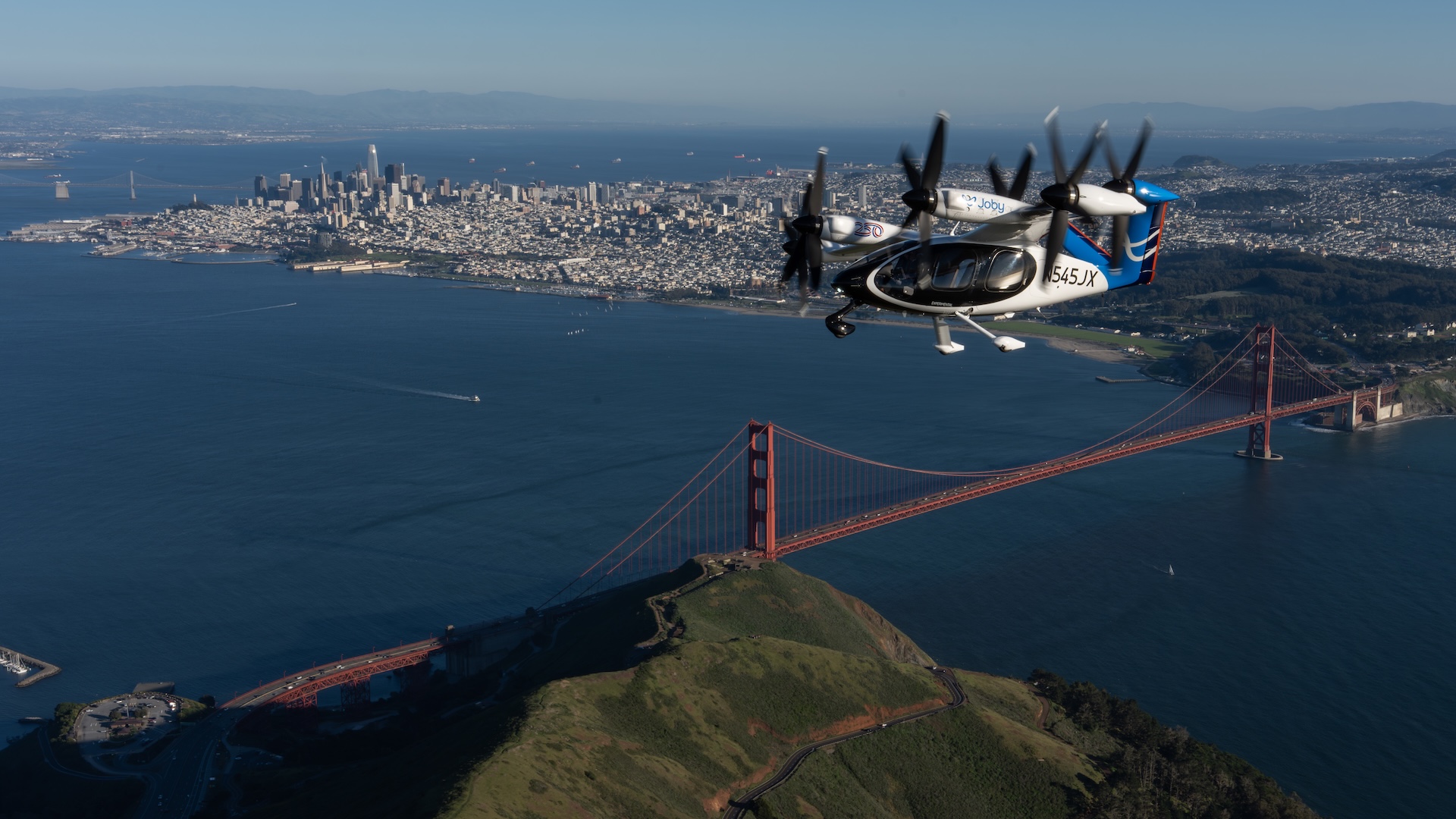
Joby Aviation has kick-started a nationwide tour of its flying taxi. The first flight saw its aircraft fly over the San Francisco Bay Area and around the Golden Gate Bridge.
The flight took place around the same time the FAA announced a nationwide pilot program aimed at finally making commercial air taxi services a reality.
Joby Aviation kickstarts nationwide eVTOL tour
The Joby air taxi is piloted, though the company eventually aims to automate its flight services. It will be capable of flying as many as four passengers on short, urban trips, reaching cruise speeds of roughly 200 mph. Its fixed wings feature six propellers and are capable of swiveling forward after takeoff for increased speed.
Joby Aviation’s nationwide tour, dubbed the “Electric Skies Tour”, will include demonstrations in several cities throughout the US.
In a press statement, the company stated: “With one of the world’s most recognizable skylines as a backdrop, the company showcased its operational readiness in a region defined by traffic congestion, demonstrating that the future of quiet, emissions-free flight, is not just a concept, but nearing commercial readiness.”
The San Francisco flight was conducted using a pre-production prototype, designated N545JX. According to a report by the San Francisco Chronicle, the N545JX aircraft “cruised along in virtual silence” as it flew across the bay. Separately, Joby revealed earlier this month that it had flown its first “FAA-conforming” air taxi.
“With an operational foundation built on thousands of test flights and more than 50,000 miles logged across its fleet, the company is now ready to scale its presence across the US,” the company said in its statement.
The Trump administration’s air taxi push
Joby Aviation also noted that it is among a handful of firms selected as partners in the White House’s recently announced eVTOL Integration Pilot Program (eIPP). The other companies selected are Archer Aviation, BETA Technologies, Electra, Wisk, Ampaire, Elroy Air, and Reliable Robotics.
“Here’s an opportunity for the industry to roll out in a similar way to how Waymo rolled out,” Archer Aviation CEO Adam Archer explained in a video on X after the eIPP announcement. “Rather than an all-or-nothing type certificate where you can go anywhere, or no type certificate where you can’t go anywhere… You can think about it as a few concentrated areas with very, very high margins of safety, allowing us to start very low-level operations, and then expand from there.”
According to Joby, eIPP gives it the opportunity to “begin early operations across 10 states: Arizona, Florida, Idaho, New Jersey, New York, North Carolina, Oklahoma, Oregon, Texas, and Utah.” The company added that the program also has the “potential to meaningfully accelerate the path to commercial service.”
If all goes to plan, Joby Aviation claims it will help realize a society where a daily commute can “take minutes, not hours.”
“Our technology provides an opportunity to build on the immense potential of this region while protecting it for the next generation,” said JoeBen Bevirt, founder and CEO of Joby. “By providing clean, quiet service with minimal infrastructure investment, we are making flight an everyday reality for the community.”

The San Francisco Giants didn’t make that “major” move in the offseason. They saved those for last offseason and last year’s trade deadline.
Still, San Francisco did plenty to position itself as a team that could be better than 81-81 last season. Not all moves are created equal. Not all moves work out the way the franchise hoped. The value of some of those moves have yet to be determined.
But, on their face, here are the moves that already look smart and already look, eh, dumb, going into opening day.
Smart
Signing Luis Arráez
The Venezuela native had a huge World Baseball Classic as his home country won the title for the first time. He had his second career multi-home run game in his WBC career. He returned to spring training and the bat kept cooking. He slashed .353/.389/.412.
While many envisioned him as a leadoff hitter due to his impressive ability to get contact and his three batting titles, San Francisco is toying with batting him later in the order. He’s one of the few contact hitters that could excel in that role, and he gives the lineup flexibility.
Signing Tyler Mahle and Adrian Houser
The Giants may get the best version of both pitchers. Before Sunday’s exhibition game in Sacramento, Mahle had thrown 10 scoreless innings in spring and showed no signs of the shoulder fatigue that limited him last season. Houser has thrown 11 innings and while he hasn’t been as effective, he looks like the innings-eater the Giants hoped they signed.
With the season-ending injury to Hayden Birdsong and the underperformance of the Carsons — Seymour and Whisenhunt — signing the two veterans to inexpensive deals looks smarter by the day.
Signing Harrison Bader
He’s day-to-day with a tight hamstring, but it’s a minor inconvenience this early in the campaign. San Francisco knew what they were getting when they signed him — a Gold Glove level center fielder with a resurgent bat who can make their entire outfield better. It allowed San Francisco to move Jung Hoo Lee to right field, which should improve his defensive numbers. San Francisco locked him into a cheap two-year deal. It should pay off handsomely.
Dumb
Not Signing Left-Handed Relief Help Sooner
San Francisco knew it was going to have some issues at left-handed relief. Erik Miller was going to need time to recover from a back issue. Sam Hentges won’t be ready after arthroscopic knee surgery. Then the Giants lost Reiver Sanmartin for three months to hip surgery. At one point the only healthy left-handed reliever in camp was Matt Gage.
San Francisco tried addressing it by signing Joey Lucchesi. But the Giants released him on Sunday after signing Ryan Borucki. But a bit more careful planning might have lessened San Francisco’s need to scramble this late in camp.
Not Adding Healthy Closing Experience
The Giants signed left-hander Jason Foley to bolster the bullpen. He had 28 saves for the Detroit Tigers in 2024. There was one problem. His recovery from shoulder surgery will keep him out of the lineup until the second half of the season.
That puts the pressure on Ryan Walker to not only be the closer but keep the job. He wants the pressure, he has said repeatedly in camp. He’s held the job before but not consistently. If he meets the moment, the Giants look smart for trusting him. If he can’t, San Francisco doesn’t have a healthy back-up plan until the All-Star break.

Here’s what Metro Detroit homebuyers face heading into spring season

Preparations for SMART expansion to Healdsburg set to begin

Construction underway on Harold Simmons Park’s first attraction

‘Confident’ Bencic takes out Anisimova, eyes Gauff next in Miami

Bruins Sign James Hagens to AHL Amateur Tryout Agreement | Boston Bruins

Florida High School Football Rankings: Top 25 teams – Oct. 21

How old is Bo Nix? What to know about Oregon quarterback ahead of 2024 NFL Draft

Cleary's 21 help Le Moyne down Central Connecticut State 69-64 in OT

99th annual Pony Swim held in Virginia

Indiana Members Credit Union announced as new anchor tenant at Bottleworks District

See TSA Wait Times at Major U.S. Airports

Senate hopeful with deep Dem ties slapped with scathing complaint targeting alleged family payout ‘scheme’

How the Iran war is about to hit your wallet

Suspect in slaying of Loyola University student was in the country illegally, officials say

Video: Plane Collides With Vehicle at LaGuardia Airport
-

 Detroit, MI5 days ago
Drummer Brian Pastoria, longtime Detroit music advocate, dies at 68
-

 Oklahoma1 week ago
Family rallies around Oklahoma father after head-on crash
-

 Georgia1 week ago
How ICE plans for a detention warehouse pushed a Georgia town to fight back | CNN Politics
-
 Science1 week ago
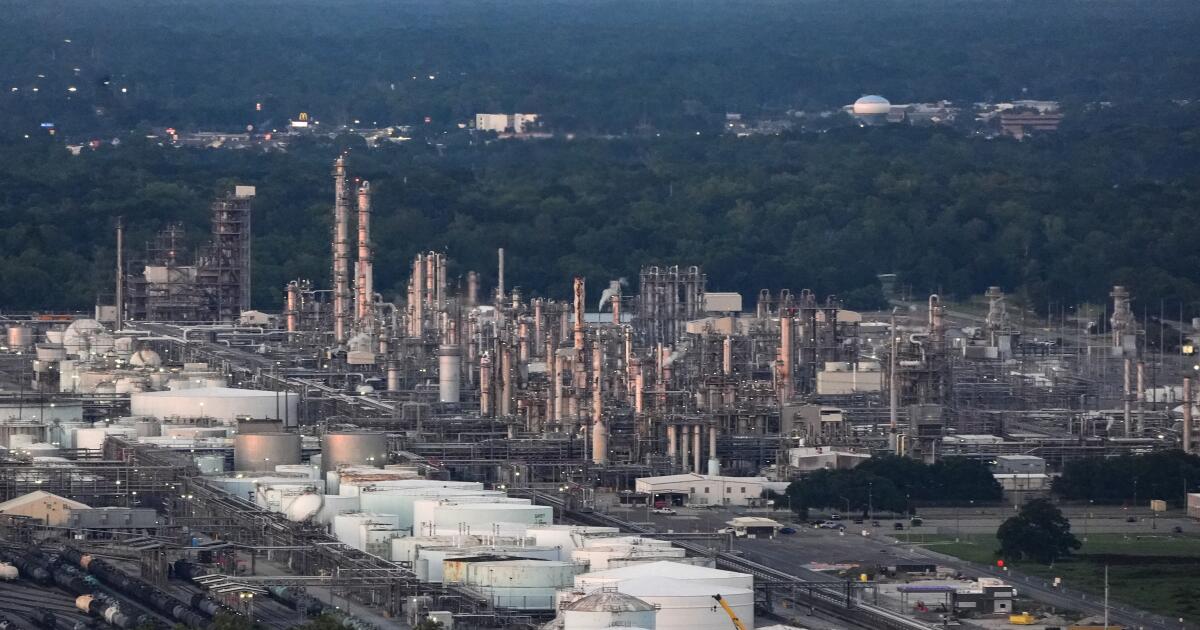
Federal EPA moves to roll back recent limits on ethylene oxide, a carcinogen
-

 Alaska1 week ago
Police looking for man considered ‘armed and dangerous’
-

 Movie Reviews5 days ago
‘Youth’ Twitter review: Ken Karunaas impresses audiences; Suraj Venjaramoodu adds charm; music wins praise | – The Times of India
-
 Science1 week ago
Long COVID leaves thousands of L.A. county residents sick, broke and ignored
-

 Education1 week ago
Video: Turning Point USA Clubs Expand to High Schools Across America