San Diego, CA
Arts and Culture Newsletter: San Diego Asian Film Festival marks 25th year


When the San Diego Asian Film Festival gets under way next Thursday it will mark 25 years of artistic achievement and a quarter-century of growth into an international event.
That growth, says Alex Villafuerte, executive director of the festival-presenting Pacific Arts Movement, has been the result of “grit and determination. Lee Ann Kim assembled a great team that took the festival through its formative years. From there it became an institution that filmmakers from around the world look to to showcase Asian cinema.”
“That very first year, in 2000, we were in classrooms and auditoriums at (the University of San Diego). We’ve grown to a 10-day festival now showing 170 films, making us one of the largest showcases of Asian cinema in the country.”
This year’s festival, with screenings at Regal Edwards Mira Mesa and at the Museum of Photographic Arts at the San Diego Museum of Art in Balboa Park among other venues, will include films from 35-plus countries in 40-plus languages. The schedule is comprised of full-length features, shorts, documentaries, classics and more.
The opening-night screening at the San Diego Natural History Museum will be of “Cells At Work!”, Hideki Takeuchi’s live-action adaptation of a popular manga series by Akane Shimizu. Takeuchi will be on hand for a discussion after the 7 p.m. screening.
For star power, look no further than Yen Tan’s “All That We Love,” screening Nov. 10 and starring Margaret Cho. “It’s a film about a divorcee whose family dog passes and she uses that to reassess her relationship in her life,” said Villafuerte.
That film comes with a note of symmetry: Director Tan had once been a volunteer graphic designer for the SDAFF, and comedian Cho was part of the very first festival 24 years ago. For details, visit sdaff.org/2024.
Theater
Another comedian and another pioneer in the business, Joan Rivers, is the focal point of a world premiere play by Daniel Goldstein at South Coast Repertory Theatre, just north of us in Costa Mesa. It’s simply titled “Joan.”
The production running through Nov. 24 and starring Tessa Auberjonois is part of South Coast Rep’s “American Icon” series, and Rivers was certainly that. This is not a one-person show re-creating Rivers’ act. It’s a full-cast play that concerns itself not only with Rivers’ career but with her life as a mother, to Melissa Rivers.
That it’s advised that the play contains “adult language” should come as no surprise.

Gospel music
Kirk Franklin has been performing his brand of urban contemporary gospel for decades and has earned 20 Grammys along the way. In case you’re wondering where he’s been lately, you can catch up with Franklin when his “Reunion Tour” comes to SDSU’s Viejas Arena on Saturday night.
Franklin, now 54, is bringing some special guests with him: Yolanda Adams, the Clark Sisters, Marvin Sapp and Fred Hammond. The presence of Adams on the bill is a special treat for those who are already fans of the performer known as the “Queen of Contemporary Gospel Music.”
Tickets start at $36 and go up. Way up.

Book event
San Diego’s women authors will be celebrated on Monday at the Mingei International Museum in Balboa Park, when the museum’s “Community Mondays” program teams up with the San Diego Writers Festival for an event titled “Women Powered.”
Besides a book fair, the evening is a launch party for poet Jane Muschenetz and her collection “Power Point.” The free event runs from 6 to 8:30 p.m. Registration is required at sandiegowritersfestival.com.

Movie screening
It takes a lot to get me to a movie theater at 11 o’clock in the morning. It takes a lot to get me to do almost anything (besides working) at 11 o’clock in the morning. But with Mel Brooks’ classic “Young Frankenstein” being currently unavailable on either Netflix or Prime Video, I’m tempted to head to Media Arts Center San Diego’s Digital Gym Cinema on Saturday.
That’s when, at 11 a.m., “Young Frankenstein” will be screened, an event in partnership with the San Diego Public Library. Brooks’ 1974 spoof of Mary Shelley’s 1818 horror story is the best film he ever made and it features iconic comic performances from a great cast led by two gone too soon: Gene Wilder and Madeleine Kahn. Marty Feldman’s Igor and Cloris Leachman’s Frau Blucher are also unforgettable, as is Peter Boyle as the monster and Gene Hackman in a side-splitting cameo as a blind man serving soup and a cigar for that same monster.
U-T arts stories you may have missed this week

UCTV
University of California Television invites you to enjoy this special selection of programs from throughout the University of California. Descriptions courtesy of and text written by UCTV staff:
“Gene Perry & Rumba Ketumba”
Watch the electrifying performance of Gene Perry & Rumba Ketumba recorded at UC San Diego’s Park & Market. Perry, a fixture in San Diego’s music scene since 1974, was born in Santurce, Puerto Rico, and is a pioneer of Afro-Cuban and Afro-Caribbean music. His ensemble, Rumba Ketumba, features a vibrant mix of San Diego natives and international musicians. The group delivers high-energy Afro-Latin, Caribbean and Spanish Rumba rhythms that will keep you moving. “Gene Perry and Rumba Ketumba’s extraordinary musical talent and personalities are hard for audiences to resist,” says host Yael Strom, who has collaborated with the group on several groundbreaking cross-genre projects.
“Storytelling for the Screen: ‘The Citizen’”
Writer/director Sam Kadi and actors William Atherton and Rizwan Manji join moderator Juan Campo for an engaging discussion about “The Citizen.” The film tells the story of Ibrahim Jarrah, an immigrant from the Middle East who arrives in New York City one day before the tragic events of Sept. 11. The panel explores their experiences making the film, drawing inspiration from real Arab American stories, and its continued relevance. They discuss themes of citizenship, the immigrant experience, racial prejudice, and the right to protest, as well as the representation of Arab Americans on-screen. “The Citizen” offers a compelling look at the struggles and triumphs of pursuing the American dream in challenging times.
“AI for Security, Security for AI”
How secure are computers, and how does artificial intelligence impact security? In this program, Christopher Kruegel, professor of computer science at UC Santa Barbara, addresses two important questions in security and AI. First, how AI can enhance security? For decades, traditional machine learning models have been used in security solutions, but recent advances in AI are opening up new and exciting opportunities. Second, the security of AI systems themselves. Like any other software, AI systems are vulnerable to exploitation. Given their critical roles, it is essential to secure AI against attacks such as training data poisoning and adversarial inputs. Join Kruegel as he explores both the promises and the vulnerabilities of AI in today’s digital landscape.
And finally, top weekend events

The best things to do this weekend in San Diego: Nov. 1-3.


A California yoga instructor known as “Namasteve” is leveling up his warrior pose as he battles San Diego’s efforts to end his popular beachfront classes.
Steven Hubbard recently filed his third lawsuit over a 2024 city ordinance that prohibits teaching yoga to four or more people at local beaches and parks.
Hubbard, who’s been teaching yoga by the Pacific Ocean shoreline for 17 years, contends the local law violates his right to free speech because he doesn’t charge his students and instead accepts voluntary donations.
“It does set a dangerous precedent for government to be passing bans on specific types of speech that, for whatever reason, it doesn’t like,” Hubbard’s lawyer, Bryan Pease, told The Independent. “We don’t know why they decided yoga is something they want to target. They’ve never explained it, but it is concerning from a First Amendment perspective.”
Neither the San Diego mayor’s office nor the city attorney’s office replied to inquiries from The Independent.

The yoga ban is buried in a subsection of the San Diego Municipal Code that defines the “services” that are regulated at beaches and parks.
“Examples include massage, yoga, dog training, fitness classes, equipment rental, and staging for picnics, bonfires or other activities,” it says, marking the only time yoga is mentioned.
At the time the ordinance was introduced, Pease said, it was “put on the city council agenda as a sidewalk vending ordinance.”
“There was no public notice that they would be targeting the free and donation-based teaching of yoga in parks and beaches,” the lawyer said. “ I don’t even know that the city council members themselves knew what they were voting on.”
Videos posted on Hubbard’s “Namasteve Yoga” page on YouTube show scores of students following his instructions as they face the water in the Southern California sunshine.
San Diego park rangers issued Hubbard a total of 10 citations under the 2024 law, Pease said.
Some were for leading classes from his backyard while livestreaming on YouTube as students apparently watched on their devices by the beach, Pease said.
After Hubbard first challenged the 2024 ordinance in federal court, the judge overseeing the case denied a motion to block its enforcement, saying the First Amendment didn’t protect the teaching of yoga.
But that decision was reversed last year by the U.S. Court of Appeals for the Ninth Circuit, which ruled that Hubbard and fellow yoga teacher Amy Baack were “likely to succeed” in challenging the legality of San Diego’s public yoga ban.

“Teaching yoga is protected speech. The City’s prohibition on teaching yoga in shoreline parks is content-based and fails strict scrutiny,” according to the unanimous decision written by U.S. Circuit Judge Holly Thomas.
Hubbard has also filed two lawsuits in state court, with the most recent on June 22. It was first reported by the Times of San Diego.
It seeks unspecified damages for three tickets he received in May 2025, all of which charged him with giving a lecture without a permit.
The accusation came despite a ruling in the federal case that said requiring a permit to give a lecture “substantially overburdens” the right to free speech, according to Hubbard’s lawsuit.
All the citations issued against Hubbard were dismissed in April when the city attorney’s office didn’t appear in court to prosecute, Pease said.
Meanwhile, city lawyers have issued a series of subpoenas that seek “detailed GPS tracking information, all social media posts from all time and complete financial records for all financial transactions” involving Hubbard and Baack, Pease said.
Pease characterized the move as “pure harassment,” saying it seemed “calculated to have a chilling effect on people’s participation if they think their personal information is going to be obtained through these channels.”
“All that the city attorney has said to me about it is that it’s to prove that this is commercial activity, and they’re going to hire a financial expert to go through all these records,” he said.
A hearing on a motion to quash the subpoenas is scheduled for July 17 in state court, and pretrial discovery in the federal case is pending, with a deadline of August 28.
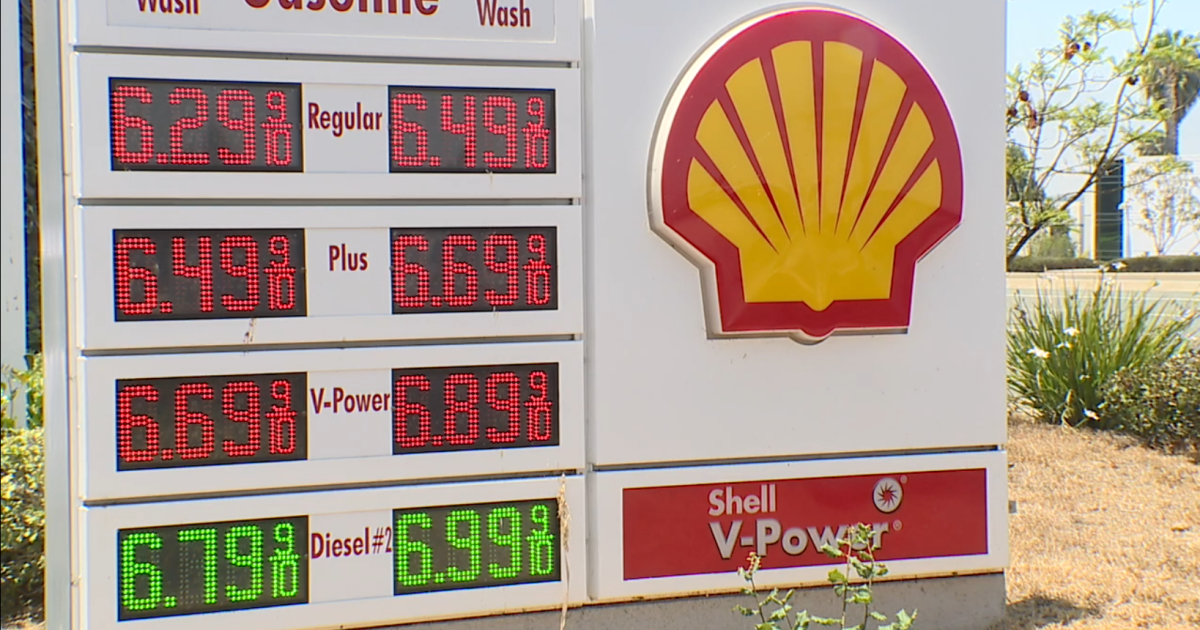
SAN DIEGO (CNS) — The average price of a gallon of self-serve regular gasoline in San Diego County dropped for the 44th time in 45 days today, falling eight-tenths of a cent to $5.42, its lowest amount since March 12. The average price has fallen 74.9 cents over the past 45 days, including eight-tenths of a cent Saturday, according to figures from the AAA and Oil Price Information Service. It is 9.8 cents less than one week ago and 53.2 cents less than one month ago, but 80 cents more than one year ago. The national average price dropped for the 43rd time in 45 days, falling six-tenths of a cent to $3.804, its lowest amount since March 17.
It has decreased 76 cents over the past 45 days, including 1.3 cents Saturday. The national average price is 6.3 cents less than one week ago and 41.6 cents less than one month ago, but 65.6 cents more than one year ago. “Crude oil prices have fallen to their lowest levels in months, dropping to the $60 a barrel range,” the AAA said Thursday. “Overall, gas prices remain the highest they’ve been in 4 years, but the downward trend since late May is welcome news during the busy summer driving season.”
Copyright 2026, City News Service, Inc.

-

 Health2 minutes ago
Biohacker hoping to live to 160 reveals alarming diagnosis: ‘My stomach is eating itself’
-

 Sports5 minutes ago
FIFA president addresses Trump call amid scrutiny over decision on USA World Cup star
-

 Technology10 minutes ago
Fake Booking.com travel credit scam targets travelers
-
 Business17 minutes ago
Many indie festival films struggle to get distribution. Alamo Drafthouse is trying to change that
-
 Entertainment20 minutes ago
AI actor Tilly Norwood to star in first movie
-
 Politics32 minutes ago
Trump says he disputed U.S. star player’s suspension, calling it ‘stain’ on World Cup
-
 Science35 minutes ago
14 propositions that could remake California taxes, housing, healthcare and elections
-
 Sports40 minutes ago
Lakers lose Rui Hachimura, who signs two-year deal with the Clippers

