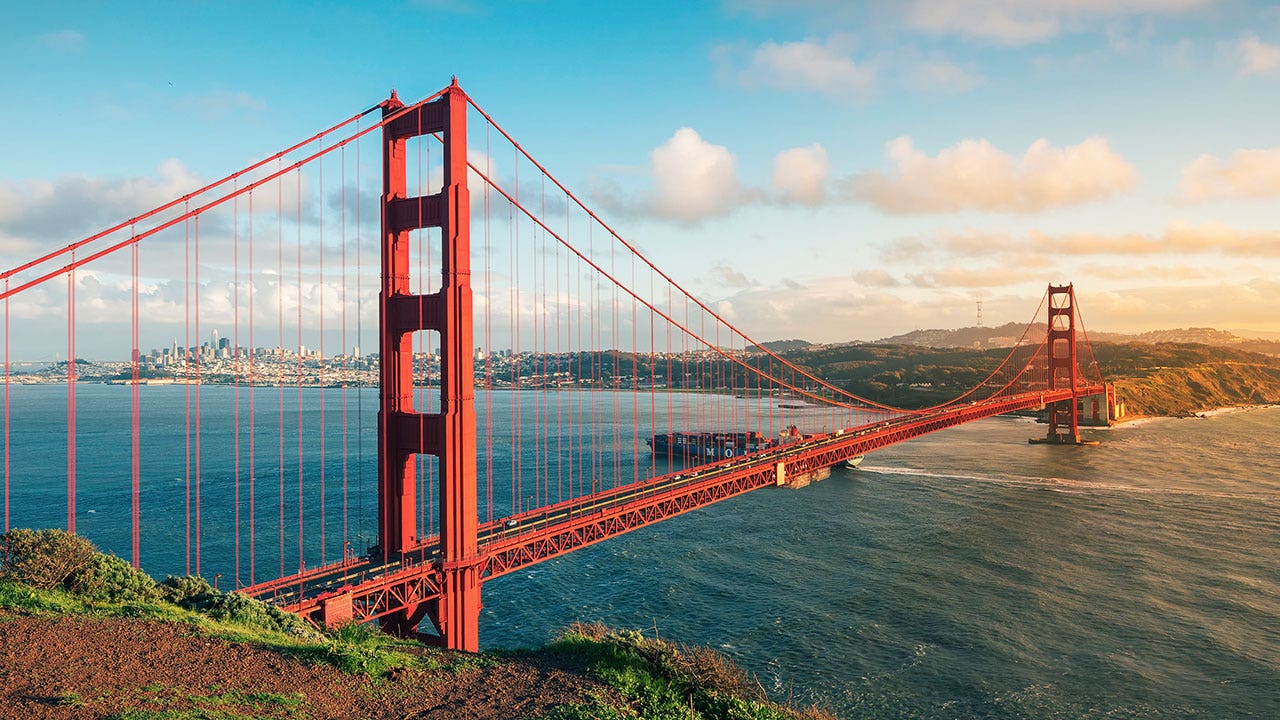
Former residents report having found better quality and cost of living outside the Bay Area, where homelessness and housing prices have skyrocketed.
“It’s a challenging place to live — the most expensive metro area in the country for consumer prices and buying a home. In a recent poll of Bay Area residents, nearly half said they were considering leaving in the next few years,” the East Bay Times reported.
One family who left the Bay Area to live in Idaho said that homelessness had become a problem.
“The homeless situation in downtown Martinez was just getting out of hand,” Ken Freeze told the Times.
(Nearly half of Bay Area residents considered leaving the city due to rising costs and costs of living, according to a report.)
Advertisement
“Beautiful Marina Park was just littered with needles. People didn’t want to take their families down there,” he added.
MASK MANDATES RETURN FOR HEALTH CARE FACILITIES IN DEEP BLUE STATE
In 2005, Freeze and his wife bought several acres of land in Placerville, California, with plans to retire.
“But by the time retirement rolled around, the state had changed too much for them,” the Times reported.
Per the Times, “They decided to swap out the foothills of the Sierra Nevada for the foothills in Idaho, and move to Meridian, a fast-growing suburb of Boise. They’d first traveled there in August 2017 for the total solar eclipse, and were struck by the good condition of the roads and how affordable the homes were.”
Advertisement
But the Freezes weren’t the only ones attracted to the area.
Gov. Gavin Newsom is trying to crack down on homelessness, cleaning up trash and threatening to strip municipalities of funding if they do not take action against the issue.(AP Photo/Steven Senne)
“In the short time we’ve been here, areas that when we first moved here were just open fields are now apartment complexes and buildings,” Freeze told the East Bay Times. “I’d just like to see them pull back the reins a little bit and let the infrastructure take a breath.”
WHY TRUMP IS HEADED INTO ‘THE BELLY OF THE BEAST’: THE STRATEGY BEHIND HIS BLUE STATE STOPS
Another Bay Area couple felt the housing squeeze and saw prices elsewhere “too good to pass up.”
Advertisement
They found a house in Phoenix they loved and “now pay less for their mortgage than they did for their one-bedroom in San Bruno.”
As the Times reported, “It came with a pool, palm trees and a view of the mountains. ‘You can’t get all that in California anymore, unless you’re Elon Musk,’ [Jared] Troutman joked.”
A family from Oakland moved to the South due to the area feeling like a “third-world country.”
“I didn’t want to wait until everything got worse than it already was,” Mary Ezell-Wallas said.
Oakland Homeless encampment(Getty Images)
Advertisement
“Living in Oakland was stressful every day and night,” she said.
She explained further, “It’s so much better down here.”
Ezell Wallace, a resident of Oakland for nearly four decades, ran a beauty parlor in the 90s. She said Oakland had good shopping downtown back then.
“We could get anything we wanted real fast,” Ezell-Wallace said.
Advertisement
She added, “I thought Oakland was one of the greatest places there was.”
Joshua Q. Nelson is a reporter for Fox News Digital.
Joshua focuses on politics, education policy ranging from the local to the federal level, and the parental uprising in education.
Joining Fox News Digital in 2019, he previously graduated from Syracuse University with a degree in Political Science and is an alum of the National Journalism Center and the Heritage Foundation’s Young Leaders Program.
Advertisement
Story tips can be sent to joshua.nelson@fox.com and Joshua can be followed on Twitter and LinkedIn.
Strip gaming executives can put their best spin on the numbers, but local tourism indicators remain a major concern. Casino operators seeking to draw more people through the door still have much work to do.
The Nevada Gaming Control Board released January gaming numbers Friday. The news was underwhelming. The state gaming win was down 6.6 percent from a year earlier. The Strip took the largest hit, an 11 percent drop. But the gloomy returns were spread throughout Clark County: Downtown Las Vegas was off 5.2 percent, Laughlin suffered a 3.3 percent decline and the Boulder Strip dipped by 7 percent.
For the current fiscal year, gaming tax collections are up a paltry
2.1 percent, below budget projections.
The red flags include more than gaming numbers. Recently released figures for 2025 reveal that visitation to Las Vegas fell nearly 8 percent from 2024, which represented the lowest total since the pandemic in 2021. Traffic at Reid International Airport fell more than 10 percent in December and was down 6 percent for the year. Strip occupancy rates fell 3 percent in 2025.
Advertisement
To be fair, this is not just a Las Vegas problem. International travel to the United States was down
4.8 percent in January, Forbes reported, the ninth straight month of decline. Travel from Europe fell 5.2 percent, and passenger counts from Asia fell 7.5 percent. Canadian tourism cratered by 22 percent.
No doubt that President Donald Trump’s blustery rhetoric has played a role in the decline, but there’s more at work. International tourism has been largely flat since Barack Obama’s last few years in office. But domestic travel has held relatively steady although it is “starting to cool,” according to the U.S. Travel Association. Las Vegas hasn’t been helped by high-profile complaints last year about exorbitant Strip prices for parking, bottled water and other staples. Casino operators responded by offering discounts, particularly for locals, and they’ll need to continue those policies into 2026.
The tourism downturn has ramifications for the state budget, which relies primarily on sales and gaming tax revenues to support spending plans. “Nevada’s employment and economic challenges reflect deep structural factors that extend beyond cyclical economic fluctuations,” noted a recent report by economic analyst John Restrepo. “The state’s extreme concentration in tourism and gaming creates unique vulnerabilities.”
The irony is that state and local politicians have been talking for the past half century about “diversifying” the state economy. In recent years, that effort has primarily consisted of handing out millions in tax breaks and other incentives to attract businesses to the state. A dispassionate observer might ask whether that approach has brought an adequate return on investment.
LAS VEGAS, N.M. — The approaching desert dusk did nothing to settle Travis Regensberg’s nerves as he and a small herd of stray cattle awaited the appearance of a state livestock inspector with whom he had a 30-year feud.
This was Nov. 3, 2023, and, as Regensberg tells it, the New Mexico Livestock Board had maintained an agreement for almost a decade: Livestock Inspector Matthew Romero would not service his ranch due to a long history of bad blood between the two men. False allegations of “cattle rustling” had surfaced in the past, Regensberg said.
A dramatic standoff that evening, caught on lapel camera video, shows Regensberg at the entrance gate of his ranch. Defiant, Regensberg says anyone but Romero can pick up the stray cattle he had asked state livestock officials to pick up earlier in the day. Romero, who is backed up by two New Mexico State Police officers, directs Regensberg to open the gate or he will be arrested.
Advertisement
“You guys can send somebody who is not Matthew Romero,” Regensberg says in the video, which The New Mexican received through a public records request.
Then-New Mexico Livestock Board Deputy Director Darron “Shawn” Davis can be heard in the video during a call on Romero’s phone, saying, “Matthew, go ahead and arrest Mr. Regensberg for obstruction.”
Regensberg, a contractor and rancher, filed a civil rights lawsuit in February against the New Mexico Livestock Board, Romero and Davis, alleging an “appalling misuse” of power from the state agency. Initially filed in the state District Court in San Miguel County, the suit has been moved to U.S. District Court.
Advertisement
Travis Regensberg, rancher and contractor, practices his throw on a roping dummy in his barn in Las Vegas, N.M., on Feb. 17, 2025.
Gabriela Campos/The New Mexican
Regensberg, 60, maintains the incident that evening and the criminal charges later filed against him marked a “conspiracy” on the part of state livestock officials to use the weight of the agency to ruin his reputation amid a long-standing grudge held by Romero.
Advertisement
The District Attorney’s Office in San Miguel County filed criminal charges against Regensberg after the incident, although he was not arrested that night. The counts included unlawful dispossession of animals, livestock running at large and use of a telephone to intimidate and harass — all of which were dismissed “with prejudice,” meaning prosecutors could not refile them, in late 2024. An unlawful branding charge also did not stick.
Regensberg’s suit asserts the board pursued charges of cattle dispossession against him, even though he had called livestock officials and told them to pick up the stray cattle that had wandered onto his property. It says the agency also pursued a charge of cattle running at large, after state officials left a gate open on his property, allowing some of his own cattle to get loose that night.
Romero and Davis both declined to comment on the case.
Davis said he retired in July after 25 years with the agency, noting his retirement was unrelated to the case.
Romero has also retired from the agency; the livestock board did not answer a question about whether his retirement had any connection to the lawsuit.
Advertisement
Legal counsel for the defendants filed a 30-page motion Feb. 16 seeking to dismiss the case, arguing the defendants had cause to charge Regensberg.
“In this view, Plaintiff appears to argue that his history of conflict with Defendant Romero legally permits him to obstruct the performance of Defendant Romero’s duties. No facts support that this unlawful obstruction was anticipated,” the motion states.
“Just like any individual would not be able to choose which [state police] officer could pull them over for a traffic infraction, Plaintiff is not allowed to unilaterally decide which [livestock] Inspector would show up to a call,” the motion continues.
Unlawful impound?
The dislike between the two men evidently started when they were teenagers or in their early 20s. The suit states the pair had once shared rides to bull-riding events at rodeos, but the relationship soured when Regensburg made a certain pointed comment to Romero.
Advertisement
The lawsuit lays out subsequent flare-ups between the two men, including at a Wagon Mound rodeo and at a state park in San Miguel County where Romero was working as a ranger.
A small herd of Travis Regensberg’s cattle eat feed on his property in Las Vegas, N.M.
Advertisement
Gabriela Campos/The New Mexican
Belinda Garland, executive director of the New Mexico Livestock Board, declined to comment on the case.
“This matter is currently before the courts,” she wrote in an email. “Out of respect for the legal process, we cannot comment further. We intend to vigorously defend against the allegations and are confident in our position.”
State police officers were able to defuse the situation that night and convince Regensberg to let officials onto his property after they promised to manage any conflicts between him and Romero.
Advertisement
Someone left a gate open when they entered, allowing about 20 of Regensberg’s cattle to escape. All of those cattle were gathered back onto his ranch, except for a steer.
He alleges state officials later impounded the steer and sold it for just $75 at the Belen livestock auction without telling him.
In the motion to dismiss the case, lawyers for Romero, Davis and the livestock board say officials had informed Regensberg earlier in the day the cattle belonged to a neighbor.
“Plaintiff refused to allow [his neighbor] to pick up the cattle and demanded that NMLB come get the cattle, even though he was told that the cattle were [his neighbor’s] cattle by a NMLB Inspector,” the motion states. “Plaintiff fed and watered the cattle, without consent of the owner.”
Regensberg said he did not turn the cattle over to his neighbor because the receipt his neighbor presented to him from a Valencia County livestock auction showed they had been purchased at 2:56 p.m. that day, while the stray cattle had turned up on his property that morning.
Advertisement
“The invoice shown to him was for cattle purchased only minutes earlier at location more than a two-hour drive from Regensberg’s ranch in Las Vegas,” his lawsuit says.
Legal counsel for the livestock board have offered up a different narrative.
“By refusing to allow Defendant Romero on his property, and by knowingly herding, locking away, feeding, and watering [his neighbor’s] cattle, there was more than enough probable cause to charge Plaintiff with unlawful disposition of an animal,” states the motion to dismiss.
“I’m just going to go with obstruction, failure to comply,” Romero says in the lapel camera video, talking to two state police officers about Regensberg, who by that time in the evening had gone into his own residence on the property. “I can get him on unlawful impound, too.”
The history
Advertisement
What occurred Nov. 3, 2023, could have been a fairly routine job for state livestock agents, according to the lawsuit. Stray cattle had wandered onto Regensberg’s land that morning through a gate opened by a family member who had driven onto his property.
Regensberg, the suit states, herded the strays into an enclosure around 11:15 a.m. and then called a state livestock inspector to remove the animals, following what he believed to be correct protocol.
Eventually Regensberg, according to the lawsuit, fed the cattle as the day lengthened and as no state inspectors had come to remove the animals. Regensberg was told Romero was the only agent available to get the stray cattle, even as he insisted the agency send someone else.
Advertisement
Travis Regensberg takes a bag of feed out to his cattle followed by his dog Rooster in Las Vegas, N.M., on Feb. 17, 2025.
Gabriela Campos/The New Mexican
The suit states Romero had previously accused Regensberg in a 2014 lawsuit of threatening to kill him, so Regensberg was concerned Romero would try to shoot him that night.
Advertisement
In the late 1980s or early 1990s, according to the lawsuit, Regensberg was riding a motorcycle on a park roadway heading to a July 4 family gathering when he was stopped by Romero, who told him motorcycles were prohibited from the park and he would have to leave. Regensberg sought to explain he was on his way to a family gathering and would only ride on the road.
“Romero flared, insisting Regensberg’s motorcycle was prohibited and demanded he leave the Park,” the lawsuit says. “Regensberg left, which meant he missed the family gathering. After becoming a livestock inspector, Romero began confronting and harassing Regensberg at various events.”
‘A matter of principle’
It is not the first such lawsuit the agency has recently faced.
A suit filed in a little over a year ago in state District Court by Mike Archuleta, a Rowe cattleman, accuses the board of violating his civil rights by relying on false accusations made by a Texas-based rancher as the basis for seizing five unbranded calves from their home in 2023 and selling them at auction before the couple could prove through DNA testing the animals belonged to them.
Advertisement
Travis Regensberg gathers his rope while practicing his throw on a roping dummy in his barn in Las Vegas, N.M., on Feb. 17, 2025.
Gabriela Campos/The New Mexican
Advertisement
Regensberg, a team roper, reflected on how the whole affair has hurt his reputation in the small communities where he has spent his whole life.
He thinks the power of the state should not be used to settle what is, in his view, a personal score. Bringing feed pelts out to the pasture on a recent day — the wind tearing across the landscape and tearing at his clothing — Regensburg said he had to sell about 30 head of cattle just to pay legal fees.
“It’s about accountability,” he said of the lawsuit. “It’s a matter of principle.”
PORTLAND, Ore. (KATU) — A member of Oregon’s Iranian community on Monday reacted to American and Israeli strikes in his home country and the death of Iran’s supreme leader over the weekend.
That reaction came as the conflict in the Middle East expanded into a third day. President Donald Trump indicated it could go on for several weeks.
Amin Yousefimalakabad says right now he is concerned about his family, who he says lives near military bases in Tehran, the capital of Iran.
He described businesses with shattered windows and explosions near his family’s home.
Advertisement
At the same time, Yousefimalakabad says he felt relief learning about the killing of the ayatollah.
He says he fled Iran four years ago after facing political persecution.
“I used to be a political prisoner in Iran. I got arrested in one of the protests that happened in Iran, and I was under torture for two weeks,” he said in an interview with KATU News. “They put me in prison for six months. I had, even when I was thinking about those days, it made my body shake from inside because I didn’t deserve that. I just wanted the first things that I can have in a foreign country like America in my country. I wanted freedom. I wanted to have freedom of speech, freedom of religion, to choose who I want to be.”
Meanwhile, Yousefimalakabad says he still can’t return to Iran, fearing he would be punished for his Christian beliefs and says although the regime could change, the ideology in Iran might not.