West
Reparations supporters vow payback after CA state Democrats block two bills: 'Political price to pay'

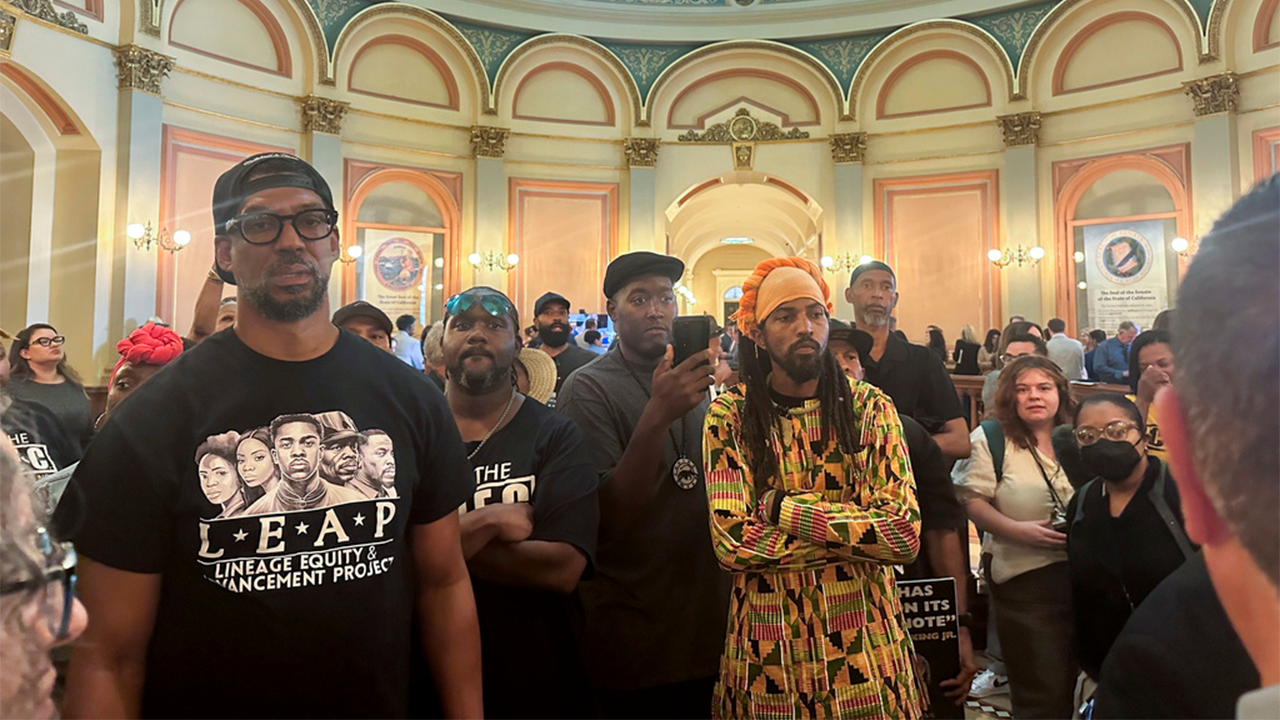
Protests erupt in California over shelved reparations bills
Let’s Win for America Action co-chair Janelle King discussed the Kamala Harris campaign’s effort to garner support from labor leaders, Democrats’ effort to defend her ‘flip-flops’ and protests over shelved reparations bills in California.
A pair of reparations-related bills for the descendants of enslaved Black Americans failed to pass in the California legislature last week, but supporters say they’re not going down without a fight.
The two bills led by Democrats that would have greenlit reparations were considered key components of some lawmakers’ ambitious efforts to pass legislation aimed at atoning for what they said was a legacy of racist policies that drove disparities for Black people, from housing to education to health. Authored by Democratic state Sen. Steven Bradford of Inglewood, Senate Bill 1331 would have created a new state fund for reparations, while Senate Bill 1403 would have established a state agency to oversee these efforts and determine who would be eligible.
After hours of heated debate and protests last week, Democratic state lawmakers and the California Legislative Black Caucus chose to proceed without the bills. While the Democratic-led California legislature did pass a spate of other bills aimed at remedying past racial injustices, none of these would provide direct payments to African-Americans.
BLACK CALIFORNIANS WARN NEWSOM OF ‘DIRECT IMPACT’ ON HARRIS AFTER DEMOCRATS KILL SLAVE REPARATION BILLS
Members of Coalition for a Just and Equitable California protest and demand lawmakers take up a vote on two reparations bill in the rotunda on the last day of the legislative year Saturday, Aug. 31, 2024, in Sacramento, Calif. (AP Photo/Tran Nguyen)
Reparations supporters, however, are vowing revenge, CalMatters reported. Some are reportedly weighing the idea of recalling Black caucus members and other state Democrats who blocked the bills from going through.
“They plan on showing up at town hall meetings in some of the legislators’ districts, and at least one group has filed an ethics complaint with the special committee on legislative ethics against the caucus. The complaint alleges corruption and improper influence played a role in the bills’ fates,” according to CalMatters.
“There has to be a political price to pay,” Chris Lodgson, who has been working with state lawmakers on reparations since 2019, told the nonprofit news organization.
“This hurts in a different way because what we saw was our own people stop our own people. That hits different,” he said.
California Legislative Black Caucus Chair Assemblymember Lori Wilson said Saturday that the Black Caucus pulled the bills, adding the proposals need more work.
“We knew from the very beginning that it was an uphill battle … And we also knew from the very beginning that it would be a multiyear effort,” Wilson told reporters.
PROTESTS ERUPT AT CALIFORNIA STATE CAPITOL AFTER PAIR OF REPARATIONS BILLS SHELVED
Protests erupted outside the Capitol Saturday as reparation advocates demanded the lawmakers who held up the bills be held accountable.
A person wears a Reparations Rally hat during a rally for reparations at the African Burial Ground National Monument on July 23, 2021. (Getty Images)
“This type of betrayal cannot go unanswered,” the Coalition for a Just & Equitable California wrote on X. “There must be a political price to pay. Gone are the days when politicians of any race or party can disrespect Black Americans and expect no political consequences. We are not captured. We do not belong to any party or special interest. We are the living embodiment of our Ancestors who built this state and this country over 400 years and who are owed Reparations. We’re coming…No…We’re HERE, to get our checks and more.”
The California Legislative Black Caucus did not respond to Fox News Digital’s request for comment.
Fox News’ Bradford Bentz contributed to this report.
Read the full article from Here


SALT LAKE CITY — A controversial Utah proposal to crack down on the presence of immigrants in the country illegally that had seemed stalled gained new life Friday, passing muster in new form in a relatively narrow vote.
In a 39-33 vote, the Utah House approved HB386 — amended with portions of HB88, which stalled in the House on Monday — and the revamped measure now goes to the Utah Senate for consideration.
The reworked version of HB386, originally meant just to repeal outdated immigration legislation, now also contains provisions prohibiting immigrants in the country illegally from being able to tap into in-state university tuition, certain home loan programs and certain professional licensing.
The new HB386 isn’t as far-reaching as HB88, which also would have prohibited immigrants in the country illegally from being able to access certain public benefits like food at food pantries, immunizations for communicable diseases and emergency housing.
Moreover, Rep. Trevor Lee, R-Layton and the HB88 sponsor, stressed that the new provisions in HB386 wouldn’t impact immigrants in the country legally. He touted HB88 as a means of making sure taxpayer money isn’t funneled to programming that immigrants in the country illegally can tap.
Rep. Lisa Shepherd, R-Provo, the HB386 sponsor, sounded a similar message, referencing, with chagrin, the provision allowing certain students in the country illegally to access lower in-state tuition rates at Utah’s public universities. Because of such provisions “we’re taking care of other countries’ children first, and I want to take care of Utahns first. In my campaign I ran and said Utahns first and this bill will put Utahns first,” she said.
If we stop young folks who have lived here much of their life from going to school and getting an education, it is really clear to me that we have hurt that person. It’s not clear to me at all that we have benefitted the rest of us.
–Rep. Ray Ward, R-Bountiful
The relatively narrow 39-33 vote, atypical in the GOP-dominated Utah Legislature, followed several other narrow, hotly contested procedural votes to formally amend HB386. Foes, including both Democrats and Republicans, took particular umbrage with provisions prohibiting immigrants in the country illegally from being able to pay in-state tuition and access certain scholarships.
As is, students in the country illegally who have attended high school for at least three years in Utah and meet other guidelines may pay lower in-state tuition, but if they have to pay out-of-state tuition instead, they could no longer afford to go to college.
“If we stop young folks who have lived here much of their life from going to school and getting an education, it is really clear to me that we have hurt that person. It’s not clear to me at all that we have benefitted the rest of us,” said Rep. Ray Ward, R-Bountiful.
Rep. Hoang Nguyen, D-Salt Lake City, noted her own hardscrabble upbringing as an immigrant from Vietnam and said the changes outlined in the reworked version of HB386 run counter to what she believes Utah stands for.
“I fear that what we’re doing here in Utah is we are eroding what truly makes Utah special, the Utah way. We are starting to adopt policies that are regressive and don’t take care of people. Utahns are one thing. Citizens are one thing. People is the first thing,” she said.
Rep. John Arthur, D-Cottonwood Heights, said the measure sends a negative message to the immigrant students impacted.
“If we pass this bill today, colleagues, we will be telling these young people — again, who have graduated from our high schools, these kids who have gone to at least three years of school here — that you’re no longer a Utahn,” he said.
If we are compassionate to those who come the legal way and we are compassionate to those who already live here, that does not mean that we lack compassion for others in other ways.
–Rep. Kristen Chevrier, R-Highland
Rep. Kristen Chevrier, R-Highland, said the debate underscores a “fallacy” about compassion. She backed the reworked version of HB386, saying Utah resources should be first spend on those in the country legally.
“If we are compassionate to those who come the legal way and we are compassionate to those who already live here, that does not mean that we lack compassion for others in other ways,” she said.
The original version of HB386 calls for repeal of immigration laws on the books that are outdated because other triggering requirements have not been met or they run counter to federal law.
The Key Takeaways for this article were generated with the assistance of large language models and reviewed by our editorial team. The article, itself, is solely human-written.

A 26-year-old man had an argument with a co-worker before allegedly fatally shooting the colleague in Washington Heights, prosecutors said Friday.
Bobby Martin, who was charged with first-degree murder Thursday, made his first appearance Friday in Cook County court.
Martin, is accused of killing his co-worker, Antoine Alexander, 32, in a parking lot at 9411 S Ashland Ave about 3:30 p.m. on Tuesday, according to Chicago police.
Prosecutors said Martin and Alexander worked together at an armed security company and got into a verbal altercation inside the guard shack on Tuesday afternoon. During the altercation, prosecutors said Alexander removed his bullet proof vest and threw it to the ground. A witness, another co-worker, then told the defendant and the victim to take the altercation outside.
After stepping outside, the defendant pulled his firearm and fired one shot into the victims abdomen, prosecutors said. The victim’s firearm was holstered at the time of the argument and the shooting. The defendant fled the scene and came into contact with another co-worker, whom he told that he had just shot Alexander.
Alexander was then taken to Advocate Christ Medical Center in Oak Lawn, where he was pronounced dead.
Martin was arrested by authorities three blocks from his home approximately 20 minutes after the shooting, prosecutors said.
Martin was detained and will appear in court again on March 17, authorities said.
.

If the Wyoming House and Senate approve its budget changes, then the chambers’ Joint Conference Committee will have helped the University of Wyoming dodge a $40 million cut, while also limiting the Wyoming Business Council to one year’s funding instead of the standard two.
The Joint Conference Committee adopted numerous changes to the state’s two-year budget draft, but didn’t formally advance the document to the House and Senate chambers. The committee meets again Monday and may do so at that time.
Then, the House and Senate can vote on whether to adopt that draft by a simple majority.
First, UW
Starting in January, the Joint Appropriations Committee majority had sought to deny around $20 million in exception requests the University of Wyoming made, while imposing a $40 million cut to the university’s block grant.
That’s about 10% of the state’s grant to UW but a lesser proportion of the school’s overall operating budget.
The Senate sought to restore the $60 million.
The House sought to keep the denials and cuts, ultimately settling on a bargain to cut $20 million, and hinge UW’s retention of the remaining $20 million on its finding and reporting $5 million in savings.
The Joint Conference Committee the House and Senate sent into a Friday meeting to negotiate those two stances chose to fund UW “fully,” Senate Majority Floor Leader Tara Nethercott, R-Cheyenne, told Cowboy State Daily in the state Capitol after the meeting.
But, $10 million of UW’s $40 million block grant won’t reach it until the school charts a “road map” of how it could save $5 million, and reports that to the Joint Appropriations Committee, she added.
“A healthy exercise, I think, for them to participate in, while the Legislature still allows them to receive full grant funding,” Nethercott said.
“I’m hopeful people feel confident the University is fully funded,” she continued, as it’s “on the brink of receiving a new president, having the resources he or she may need to continue to steer the leadership of the University, our state’s flagship school into the future.”
Hours earlier in a press conference, House Speaker Chip Neiman, R-Hulett, said the Legislature has been clear that UW should avoid “diversity, equity, and inclusion” or DEI programming, and that it’s the position of the House majority that the school should tailor its programming to Wyoming’s true business needs – so UW graduates will stay in the state.
Within an earlier draft of the budget sat a footnote blocking money for Wyoming Public Media — a publicly funded media and radio entity funded through UW’s budget.
That footnote is gone from the JCC’s draft, said Nethercott.
Wyoming Business Council
The Wyoming Business Council is set to receive roughly $14 million, confined to one year, for its internal operations, said Nethercott.
“Both chambers have decided to only fund the operations,” Nethercott said, “not all the grant programs.”
She said that’s to compel the Legislature to revisit the concerns it has with the agency, then return in the 2027 legislative session with a vision for its future.
The Business Ready Communities program is “eliminated,” she said.
JCC member Rep. Ken Pendergraft, R-Sheridan, elaborated further.
Of the appropriation, $12 million is from the state’s checking account, plus the state is authorizing WBC to use $157,787 in federal funds and nearly $1 million from other sources.
“We’re going to take it up as an interim topic in appropriations (committee) and how to rebuild it and make it work the way we think it should work,” said Pendergraft. But the JCC opted to fund the Small Business Development Center for two years, along with Economic Diversification Division for Manufacturing Works, and the Wyoming Women’s Business Center, Pendergraft noted, pointing to that language on his draft budget sheet.
Pendergraft made headlines last year by saying he wanted to eliminate the Wyoming Business Council altogether.
But Nethercott told the Senate earlier this month, legislators have complained of that agency her entire nine-year tenure.
She attributed this to what she called communications shortfalls that may not be intentional. She cosponsored a now-stalled bill this year that had sought to adopt a task force to evaluate WBC.
The Wyoming Business Council’s functions range from less controversial, like helping communities build infrastructure, to more controversial, like awarding tax-funded grants to certain businesses on a competitive application process.
Wyoming Public Television
Wyoming Public Television, which is not the same as Wyoming Public Media, is slated to receive the $3 million it lost when Congress defunded the Corporation for Public Broadcasting, Nethercott said.
It will also receive its usual $3 million from Wyoming.
The entity will not receive another $3 million it had sought to upgrade its emergency-alert towers, said Nethercott, “because we received information from them… they have another source to pay for the replacement and maintenance of the towers.”
Like the Wyoming Business Council, the Wyoming Public TV’s functions range from less controversial to more controversial.
The entity operates, maintains and staffs emergency alert towers throughout Wyoming.
Wyoming Public TV also produces entertainment and informational movies. Its state grants run through the community colleges’ budget.
State Employees
Nethercott noted that the JCC advanced to both chambers an agreement to pay $111 million from the state’s checking account to give state employees raises.
Those raises would bring them to 2024 market values for their work, she noted.
Because that money is coming from the state’s checking account, or “general fund,” and not its severance tax pool as the House had envisioned, then $111 million won’t impact the $105 million investment another still-viable bill seeking to build an “energy dominance fund” envisions.
That bill, sponsored by Senate President Bo Biteman, R-Ranchester, seeks to lend to large energy-sector projects.
Biteman told Cowboy State Daily in an interview days before the session convened that its purpose is to counteract “green” compacts investors have adopted, and which have bottlenecked energy projects.
Wyoming’s executive branch is currently suing BlackRock and other investors on that same assertion.
Clair McFarland can be reached at clair@cowboystatedaily.com.

Polk County library chair questions constitutionality of Tennessee book challenge bill

Texas to require proof of identity, legal status for new vehicle titles March 5, 2026

Utahns first or eroding the Utah way? House OKs measure cracking down on illegal immigration
VT Lottery Mega Millions, Gimme 5 results for Feb. 27, 2026

How to Watch Virginia vs. Duke Basketball Game Online Without Cable

Florida High School Football Rankings: Top 25 teams – Oct. 21

Cleary's 21 help Le Moyne down Central Connecticut State 69-64 in OT

How old is Bo Nix? What to know about Oregon quarterback ahead of 2024 NFL Draft

99th annual Pony Swim held in Virginia

Indiana Members Credit Union announced as new anchor tenant at Bottleworks District

ICE blasts Washington mayor over directive restricting immigration enforcement

Did the EU bypass Hungary’s veto on Ukraine’s €90 billion loan?

How the federal government is painting immigrants as criminals on social media

Where Iran’s ballistic missiles can reach — and how close they are to the US

Has India’s influence in Afghanistan grown under the Taliban?
-

 World2 days ago
Exclusive: DeepSeek withholds latest AI model from US chipmakers including Nvidia, sources say
-

 Massachusetts2 days ago
Mother and daughter injured in Taunton house explosion
-

 Montana1 week ago
2026 MHSA Montana Wrestling State Championship Brackets And Results – FloWrestling
-

 Louisiana5 days ago
Wildfire near Gum Swamp Road in Livingston Parish now under control; more than 200 acres burned
-

 Denver, CO2 days ago
10 acres charred, 5 injured in Thornton grass fire, evacuation orders lifted
-

 Technology7 days ago
YouTube TV billing scam emails are hitting inboxes
-

 Technology7 days ago
Stellantis is in a crisis of its own making
-

 Politics7 days ago
OpenAI didn’t contact police despite employees flagging mass shooter’s concerning chatbot interactions: REPORT