West
Oregon judge denies DOJ request to dismiss lawsuit alleging government's negligence in addressing pollution

- A judge in Oregon has rejected a U.S. Department of Justice request to dismiss a 2015 lawsuit filed by young people.
- The lawsuit alleges that the federal government was aware of the dangers of carbon pollution but continued to support the fossil fuel industry.
- The plaintiffs in the Oregon case argue that the government violated young people’s constitutional rights to life, liberty and property.
A judge in Oregon has rejected a U.S. Department of Justice request to dismiss a 2015 lawsuit brought by young people that alleges the federal government knew the dangers posed by carbon pollution but that it has continued through policies and subsidies to support the fossil fuel industry.
U.S. District Court Judge Ann Aiken said the parties “do not disagree that the climate crisis threatens our ability to survive on planet Earth. This catastrophe is the great emergency of our time and compels urgent action.”
“While facts remain to be proved, lawsuits like this highlight young people’s despair with the drawn-out pace of the unhurried, inchmeal, bureaucratic response to our most dire emergency,” she wrote in her decision late last week.
OREGON APPEALS COURT INVALIDATES STATE CLIMATE PROTECTION PROGRAM RULES
In a statement, Julia Olson, an attorney with the group Our Children’s Trust representing the plaintiffs, said she expects a trial in the case later this year.
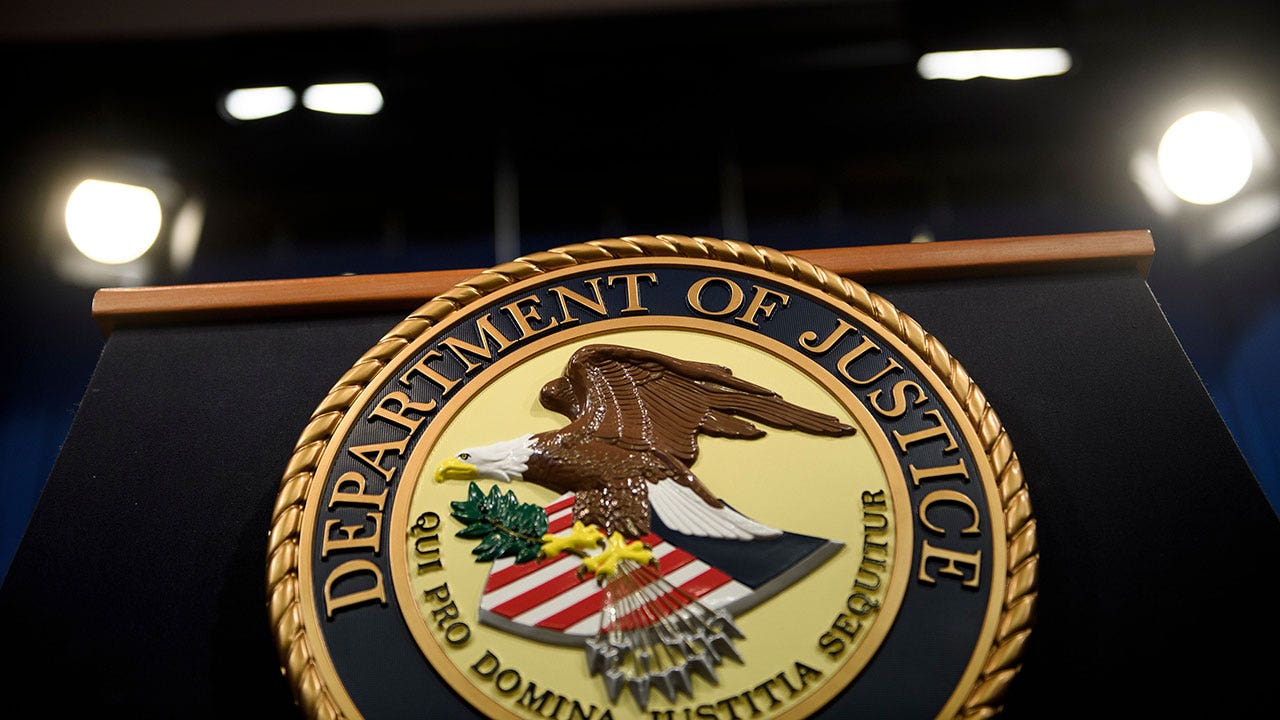
A view of the lecture is seen at the Department of Justice in Washington, DC. A judge in Oregon has rejected a U.S. Department of Justice request to dismiss a 2015 lawsuit filed by young people.
In a similar lawsuit in Montana, a judge last year ruled the Montana Environmental Policy Act violates the plaintiffs’ state constitutional right to a clean and healthful environment. The 1971 law requires state agencies to consider the potential environmental impacts of proposed projects and take public input before issuing permits. The state’s attorney general has appealed that decision.
OREGON POWER COMPANY TO PAY NEARLY $300 MILLION TO SETTLE LATEST LAWSUIT OVER 2020 WILDFIRES
The plaintiffs in the Oregon case argued the government has violated young people’s constitutional rights to life, liberty and property.
Read the full article from Here


Getty
The Denver Nuggets could lose Kentavious Caldwell-Pope in NBA free agency.
After a run with the Denver Nuggets, the two-time NBA champion Kentavious Caldwell-Pope hit the free agency market to sign a lucrative multi-year contract in 2024.
Caldwell-Pope landed a $66 million offer from the Orlando Magic during the summer of 2024. The third season of the deal costs $21.6 million, and it’s up to Caldwell-Pope if he wants to exercise that or become a free agent again.
As the contract is currently on the Memphis Grizzlies‘ books, the team recently landed an update on the veteran’s plans from the NBA insider, Michael Scotto.
Kentavious Caldwell-Pope’s Future Plans Revealed

GettyLOS ANGELES, CALIFORNIA – APRIL 04: Kentavious Caldwell-Pope #5 of the Denver Nuggets looks to pass in front of James Harden #1 of the LA Clippers during a 102-100 Clippers win at Crypto.com Arena on April 04, 2024 in Los Angeles, California. User is consenting to the terms and conditions of the Getty Images License Agreement. (Photo by Harry How/Getty Images)
via Michael Scotto, HoopsHype: Memphis Grizzlies guard Kentavious Caldwell-Pope is expected to exercise his $21.6 million player option for the 2026-27 season, league sources say. It’s the last year of a 3-year, $66 million deal negotiated by Rich Paul of Klutch Sports. More on KCP and Ja Morant on @YESNetwork.
The 33-year-old guard spent just one season with the Magic.
In Orlando, Caldwell-Pope appeared in 77 games. He averaged 8.7 points, while shooting 43.9% from the field and hitting on 34.2% of his threes.
Last summer, the Magic cut ties with Caldwell-Pope in the Desmond Bane blockbuster. The veteran’s first season with the Grizzlies included 51 appearances. He averaged 8.4 points while shooting 31.6% from three.
Back in late February, the Grizzlies announced that Caldwell-Pope would undergo season-ending surgery on his pinky finger.
Although Caldwell-Pope plans to pick up his final option, that doesn’t guarantee he is staying with the Grizzlies for the entire 2026-2027 NBA season. Veteran players with a notable resume on expiring deals tend to get moved to contenders when their current team is in the midst of a rebuild.
An NBA Veteran Worth Looking At
GettyNEW YORK, NEW YORK – JANUARY 25: Jalen Brunson #11 of the New York Knicks dribbles as Nikola Jokic #15 and Kentavious Caldwell-Pope #5 of the Denver Nuggets defends during the first half at Madison Square Garden on January 25, 2024 in New York City. NOTE TO USER: User expressly acknowledges and agrees that, by downloading and/or using this Photograph, user is consenting to the terms and conditions of the Getty Images License Agreement. (Photo by Sarah Stier/Getty Images)
Caldwell-Pope has been in the NBA since 2013.
Coming out of Georgia, he was selected eighth overall by the Detroit Pistons in the 2013 NBA Draft.
After a four-season run with the Pistons, Caldwell-Pope joined the Los Angeles Lakers. During his four-year run with the Lakers, Caldwell-Pope won his first NBA Championship.
The Nuggets traded for the veteran guard during the 2022 offseason. He was moved for Monte Morris and Will Barton. When the Nuggets picked up Caldwell-Pope, he was rewarded with a $30 million extension over two years.
Before leaving Denver, Caldwell-Pope posted averages of 10.4 points, 2.4 assists, and 2.6 rebounds, while shooting 41.5% from three.
He was a member of the Nuggets’ 2023 NBA Championship squad.
Justin Grasso Justin Grasso is an NBA reporter, covering trending league news, transactions, injuries, and player developments. He is a credentialed journalist with nearly a decade of insider access. More about Justin Grasso
More Heavy on Nuggets
Loading more stories

Video shows man allegedly try to push stranger in front of train
Immediate mental health help is available in the U.S. by calling or texting 988 to reach the Suicide & Crisis Lifeline.
A man was charged with attempted murder after a video appeared to show him attempting to push a person in front of a moving train. The moment was captured on surveillance camera footage.
The incident occurred on the Northgate light rail station in Seattle on March 19, as a train was pulling up, according to Storyful.
The video shows a man wearing a black hoodie standing behind a stranger who was on his phone. The man watches the train tracks, and as the train comes into view in the video, the man then pushes the victim, who stumbles forward. When the victim regains his balance, the suspect attempts to push him again and then flees the scene. The victim was able to hold his footing and appears to follow the man.
See shocking video of the attack
Suspect ordered mental health evaluation
Detectives later found the suspect, identified as Elisio Melendez, at a “mental health community facility where he lived,” according to the King County Prosecutor’s Office.
Melendez was later charged with attempted murder in the second degree and is being held on a $750,000 bail, according to King County arrest records obtained by USA TODAY.
Melendez, whose defense team stated has a history of mental illness, reported KOMO News, was ordered to undergo mental health evaluations during his arraignment on Tuesday, March 31.
USA TODAY has reached out to Melendez’s attorney for comment.
Immediate mental health help is available in the U.S. by calling or texting 988 to reach the Suicide & Crisis Lifeline.
Julia Gomez is a Trending reporter for USA TODAY and covers popular toys, space phenomena, scientific studies, natural disasters, holidays, and trending news. Connect with her on LinkedIn, X, Instagram, and TikTok: @juliamariegz, or email her at jgomez@gannett.com.

This year marks the 50th anniversary of Buckley v. Valeo, the Supreme Court ruling that first equated campaign spending with “free speech.” Sixteen years ago, Citizens United extended similar rights to corporations and unions.
The results are clear: an explosion of campaign spending and growing concern that our democracy is being dominated by a small, wealthy few. In California, outside money plays an outsized role, causing our elections to be among the most expensive in the nation.
Polling shows broad, bipartisan agreement that money has too much influence in politics.
Americans want voters and elected officials — not the courts — to set the rules.
The solution is a constitutional amendment to restore the authority of Congress and the states to regulate campaign spending. We have amended the Constitution before to correct our nation’s course. It’s time to do it again and put “We the People” back in charge.
— Rosalind Hirst, Normal Heights

Boston archbishop joins Good Friday walk through Dorchester

Former Denver Nuggets NBA Champ’s Future Plans Revealed

Video shows man attempt to push stranger in front of train in Seattle

Constitutional amendment needed to curb influence of money in politics

Milwaukee Bucks games won’t be on TV in the same place next season

Florida High School Football Rankings: Top 25 teams – Oct. 21

How old is Bo Nix? What to know about Oregon quarterback ahead of 2024 NFL Draft

Cleary's 21 help Le Moyne down Central Connecticut State 69-64 in OT

99th annual Pony Swim held in Virginia

Indiana Members Credit Union announced as new anchor tenant at Bottleworks District

Video: Trump Struck Iran. Now Farmers Are Paying the Price.

What B-52 bombers bring to Iran fight — and what it means for the war now

Podcast: Hungary elects: what is at stake and who is likely to win?

ICE detention deaths are on a record pace. One Texas facility bears the brunt

GOP rails against ‘s— sandwich’ deal as all eyes turn to House to end DHS shutdown
-

 Culture1 week ago
Wil Wheaton Discusses ‘Stand By Me’ and Narrating ‘The Body’ Audiobook
-

 South-Carolina5 days ago
South Carolina vs TCU predictions for Elite Eight game in March Madness
-

 Miami, FL1 week ago
Jannik Sinner’s Girlfriend Laila Hasanovic Stuns in Ab-Revealing Post Amid Miami Open
-

 Culture1 week ago
What Happens When We Die? This Wallace Stevens Poem Has Thoughts.
-

 Minneapolis, MN1 week ago
Boy who shielded classmate during school shooting receives Medal of Honor
-

 Vermont5 days ago
Skier dies after fall at Sugarbush Resort
-

 Education1 week ago
Video: Transgender Athletes Barred From Women’s Olympic Events
-

 Politics5 days ago
Trump’s Ballroom Design Has Barely Been Scrutinized