LAS VEGAS — Retiree Madonna Raffini recently shopped for groceries for herself and her 96-year-old mother.
“I went into Walmart, of all places, and looked at the meat — little teeny steaks. Two of them, less than a quarter-inch thick, $18.99. That’s outrageous,” said the former Wells Fargo employee. “We can’t afford to eat beef anymore, or chicken for that matter. So that’s myNo. 1 beef” in the 2024 election.
Audrey Dempsey, a semiretired small-business owner, and her husband still work at the photography and travel company they founded three decades ago. They are the only workers remaining at the firm that employed nine people before the pandemic decimated their business.
Audrey Dempsey, 72, is an ardent supporter of Vice President Kamala Harris.
Advertisement
(Seema Mehta / Los Angeles Times)
“It went in the toilet, without a doubt. We didn’t know how we were going to pay the bills,” Dempsey said, leaning on a cane because of the physical toll of working the prior night. Despite the nation’s economic recovery, she said many of their former clients have not returned. “Social Security helps us to pay the bills, but we still have to work.”
The 72-year-old Democrat supports Vice President Kamala Harris and Sen. Jacky Rosen, arguing that the Democrats will stop Republicans from gutting Social Security and Medicare and will provide relief for working-class Americans.
Raffini, 74, accuses Democrats of inaction over the last four years, and she said she believes former President Trump and GOP Senate challenger Sam Brown are primed to fix the nation’s problems.
Advertisement
Though the Las Vegas residents have polar-opposite political views, the issues that are most affecting their lives at a time they should be enjoying retirement reflect a concern that is top-of-mind among Nevada voters in the 2024 election — the economy.
Nevada retiree Madonna Raffini is concerned about the high cost of food.
(Seema Mehta / Los Angeles Times)
The cost of living is often mentioned by voters across the nation, as are reproductive rights, immigration and the border.
But economic pain — inflation, a lack of affordable housing, sticker shock when filling gas tanks and grocery carts, fears about steady employment and sustainable wages that can support their families — is acute in conversations with voters in Nevada.
Advertisement
The state, one of a handful of battlegrounds that are expected to determine control of the White House and Congress in Tuesday’s election, was devastated economically by the pandemic because of its reliance on tourism.
Casinos were closed. The state had the nation’s highest unemployment rate — 28.2% — in April 2020, according to the U.S. Bureau of Labor Statistics. Hundreds of thousands of the state’s residents had lost their jobs.
A view of the Las Vegas Strip.
(Myung J. Chun / Los Angeles Times)
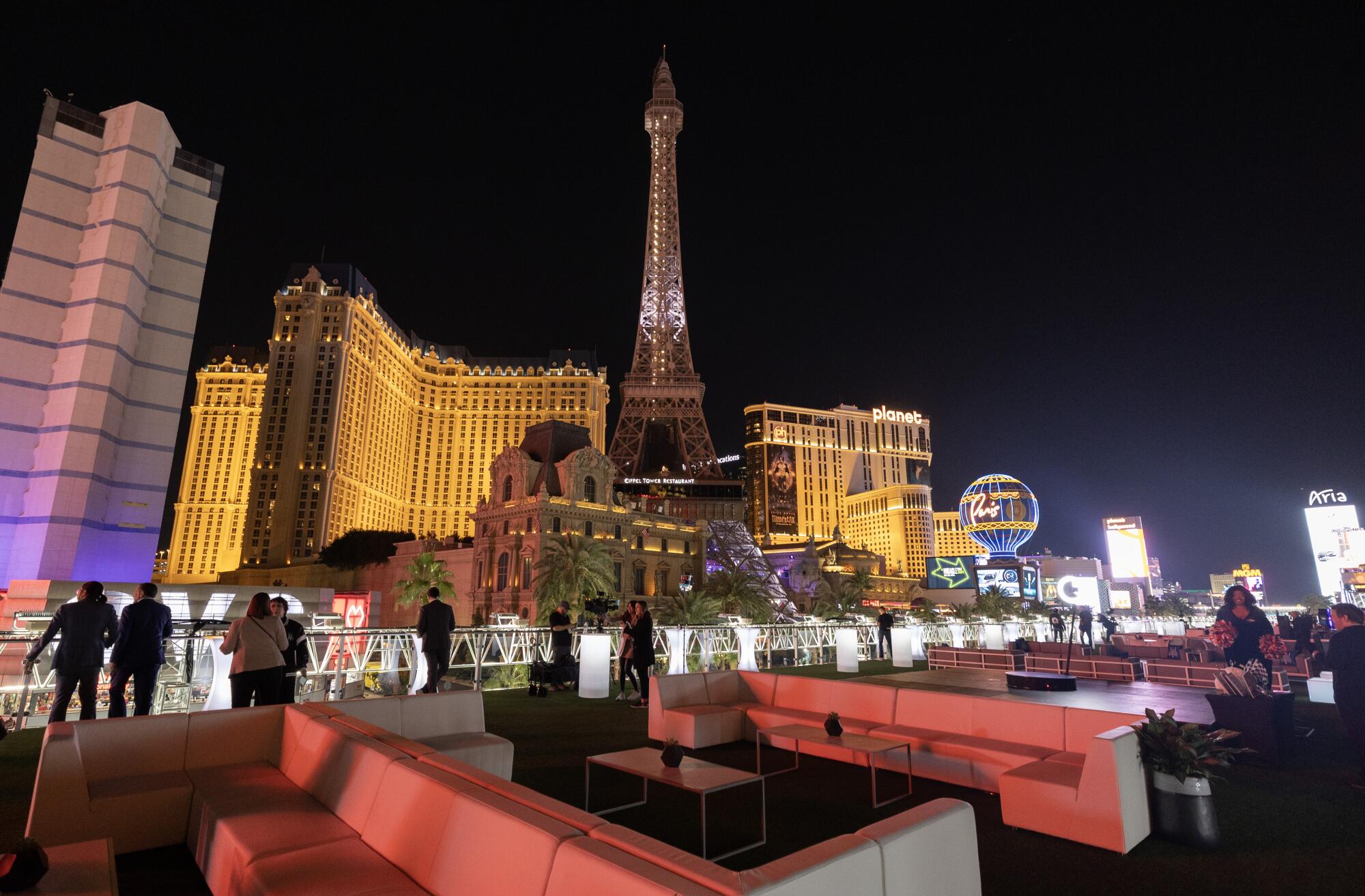
The nation and the state’s economy have recovered. Tourists are flooding Las Vegas’ casinos, restaurants and bars. Major concerts and sporting events have once again become a regular fixture on the Strip. The Super Bowl took place there in February, and the city is hosting a Formula 1 race this month.
Advertisement
David Fott, chair of the political science department and the University of Nevada, Las Vegas, noted that recent economic news — such as a report that showed consumer spending driving economic growth of 2.8% in the last quarter — has been positive.
“But to hear a lot of people talk about it, the economy is in terrible shape,” he said, adding that for Nevadans, that feeling is framed by their experiences during the COVID-19 lockdown and its aftermath.
“I think it’s a hangover, that it’s one of the ways in which the pandemic is not over. We don’t have a downtown that suffers from people working at home and not coming back to the office the way Washington, D.C., does, for example,” he said. “So we don’t have that, but we feel the effects in other ways.”
There are measures that indicate that Nevada is still suffering more than much of the nation. Unemployment in the state dropped to 5.6% in September, according to the labor bureau. Though that’s relatively low, it is the highest in the country except for Washington, D.C.
The cost of housing is another major factor, Fott added.
Advertisement
Homes in the McCullough Hills neighborhood in Henderson, Nev.
(Roger Kisby / Getty Images)
“This is an area where although the overall inflation rate has been dropping, the price of housing does not always reflect that. There’s a lack of affordable housing,” he said. “I read recently that to be able to afford to rent a one-bedroom apartment, someone working minimum wage would have to work two full-time jobs.”
As seen in other states, such as Arizona, the lack of affordable housing is partly blamed on the number of Golden State residents moving to Nevada.
“Our market is infiltrated by Californians coming over with money to pay cash up front,” Fott said.
Advertisement
The state’s leaders are also worried about increasing fuel and food costs for two reasons:
California Gov. Gavin Newsom recently signed legislation allowing regulators to require the state’s fuel refiners to store more fuel in an effort to tamp down spikes in the cost of gas. His plan prompted vocal concerns by Nevada’s Democratic governor and Arizona’s GOP governor about potential gas shortages and increased costs in their states.
Two major grocery chains have proposed a merger that many fear will lead to fewer shops in rural parts of the state, resulting in fewer jobs and higher food prices because of a lack of competition. Many fear this will raise their already expensive grocery bills.
“Every time I hit the grocery store, to be honest, everything is at least double just in recent years,” said Marshi Smith, a registered Republican. “I really worry about my fellow Nevadans, because I have the luxury of staying at home with my kids, but so many families don’t, and they’re suffering, particularly in the urban Las Vegas areas. And I really am concerned about how families are able to make it right now in Las Vegas, so it is a top-of-mind issue for me.”
Marshi Smith said the economic concerns affecting residents nationwide have a disproportionate impact on Nevada.
(Seema Mehta / Los Angeles Times)
Advertisement
Smith, 40, who was raised in Reno and lives in Henderson, a suburb of Las Vegas, added that the economic concerns affecting residents of the entire country have a disproportionate impact on the state.
“If you don’t have extra income to spend, you’re not taking extra vacations,” Smith said. “And Las Vegas, we survive off of tourism. When people don’t have enough money in their pockets to pay their own bills, they’re certainly not going to be coming to enjoy all of the extra entertainment that Las Vegas has to offer.”
The economy was rated the top priority in this election by a quarter of Nevada voters, twice as much as any other issue, according to a recent poll by the New York Times and Siena College.
Polling also reflects a tight presidential race in the state, with former President Trump leading Vice President Kamala Harris by 1.5 percentage points, according to an average of recent surveys by Real Clear Politics. At this point four years ago, President Biden was leading by 4 points.
Advertisement
Rosen is leading her GOP Senate rival, Brown, by 4.3 points. But both parties believe the race is closer.
“This is Nevada. Anybody who’s lived here a long time knows why we’re the battleground state. We’re not just the Battle Born State. We’re the battleground state,” Rosen told reporters Wednesday. “Races are always tight. Races are always tough.”
Nevada Republican Senate candidate Sam Brown chats with volunteers in Reno.
(Scott Sonner / Associated Press)
A prominent GOP political action committee just announced it would spend more than $6 million on ads supporting Brown, a reflection of the importance of the race in determining which party controls the Senate.
Advertisement
On Tuesday, Sen. Steve Daines of Montana, chairman of the National Republican Senatorial Committee, campaigned with Brown at a strip mall in the Spring Valley neighborhood of Las Vegas.
Asked about the importance of the Silver State in Tuesday’s election, Daines pointed to Trump’s frequent appearances in the state as well as his own presence.
“I don’t know if you have to say a lot more about how important Nevada is,” Daines said to chuckles from the crowd.
Trump and Harris have aggressively courted the state’s voters, notably by proposing not taxing tips, a priority for service industry workers. Trump announced his plan in June and Harris soon followed with a modified version, prompting Republicans to mock her.
“Copy Cat Kamala directly plagiarized President Trump’s No Tax on Tips policy proposal to let hard-working service workers keep more of their own hard-earned money,” the GOP nominee’s campaign said in a statement.
Advertisement
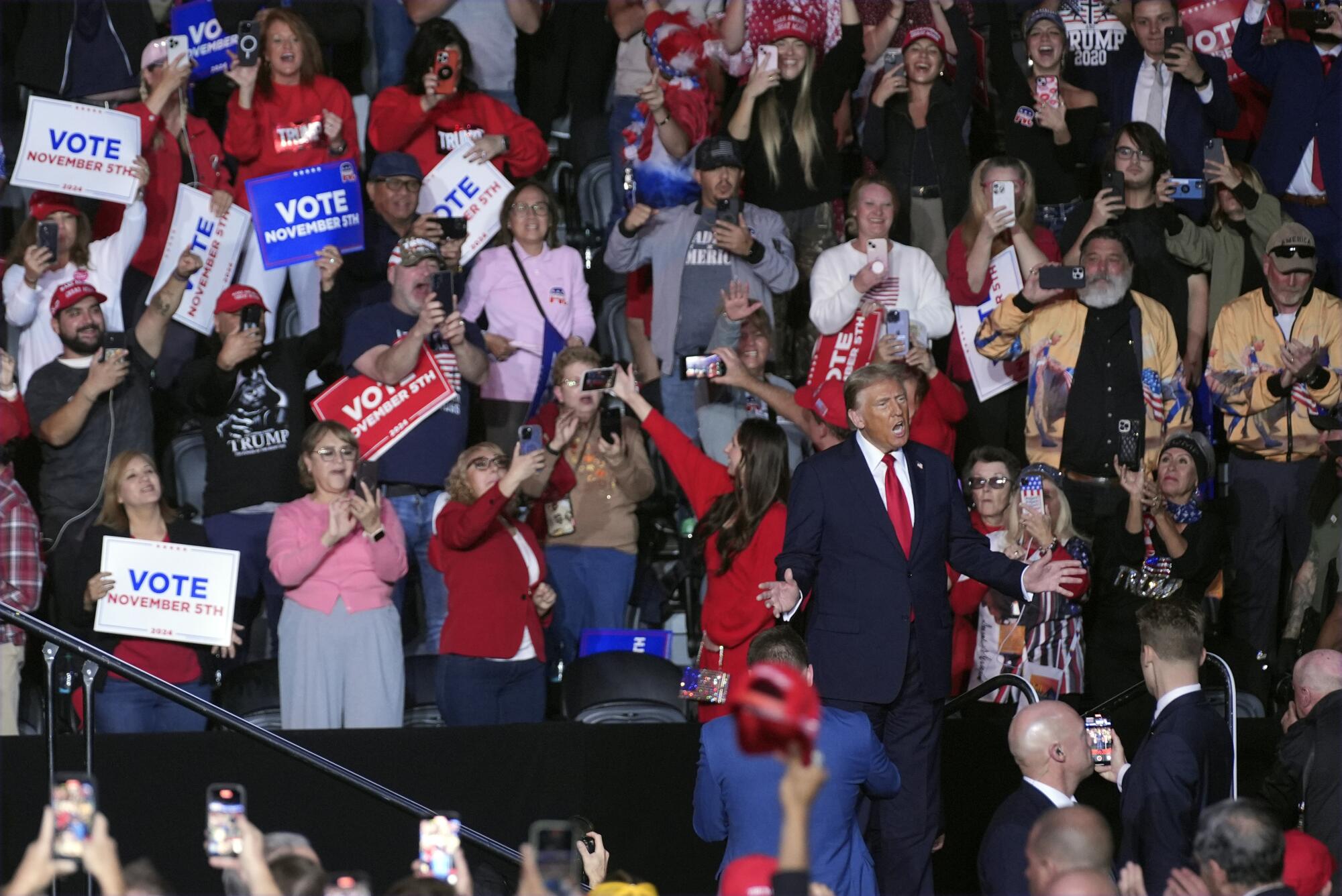
Both held rallies in Las Vegas on Thursday. The Democrat appeared alongside musical icon Jennifer Lopez, the daughter of Puerto Rico residents, in the aftermath of a Trump rally last weekend that featured a comedian describing the U.S. territory as “literally a floating island of garbage in the middle of the ocean.”
Trump appears at a campaign rally Thursday in Henderson, Nev.
(Evan Vucci / Associated Press)
“You are the ones who are going to send a message — that Las Vegas is Harris country,” Lopez said, before turning to the comments at Trump’s rally at Madison Square Garden. “It wasn’t just Puerto Ricans who were offended…. It was every Latino.”
In addition to the presidential candidates’ omnipresence, voters in the state are bombarded by mailers, ads on television, radio and social media, and canvassers knocking on their doors.
Advertisement
Electronic billboards promoting Trump’s campaign along freeways flash messages that the former president is the sole candidate in the race who can secure the border and that Harris will raise taxes. Meanwhile, the vice president is the first politician to advertise her campaign on the 580,000-square-foot LED exterior of the Sphere, a dramatic new entertainment venue near the Las Vegas Strip.
One day of advertising on the exterior of the Sphere costs a minimum of hundreds of thousands of dollars, according to a local CBS affiliate.
Still, many voters seem unimpressed by candidate or celebrity appearances or the deluge of ads.
Raffini and Dempsey have lived in Las Vegas for decades. Despite their shared concerns about the state’s and nation’s future, they have starkly different ideas about who the best candidates are to fix it.
An ad for the Democratic ticket is displayed on the Sphere Wednesday in Las Vegas.
(John Locher / Associated Press)
Advertisement
Dempsey believes Harris’ proposals to lower taxes for middle-class and working-class Americans and to cut taxes for new small business are evidence of who she is striving to help, compared with Trump.
“I think that she totally has the interest of the American people at heart, and I don’t believe he does at all,” Dempsey said.
Raffini, whose husband died because of cancer related to Agent Orange exposure during his military service, admires Brown because of his military service. The GOP candidate was badly wounded while serving in Afghanistan.
She says that while she’s not sure what Trump or Brown will do to improve living conditions in Nevada, she is confident it will be an improvement over the last four years under a Democratic White House.
Advertisement
“Sam and Trump will figure that out,” Raffini said.
LAS VEGAS (KSNV) — A string of deadly crashes in and around Pahrump has prompted Nye County Sheriff Joe McGill to push for more safety measures along dark, sidewalk-free roads.
“The worst penalty is death, if you consider that,” McGill said.
The recent deaths include a single-vehicle rollover on State Route 160 during the morning hours of the last Wednesday in January that killed one person and injured another.
Then, into February, two pedestrians were killed in less than three days.
Advertisement
The first was a 7 p.m. crash on Quarter Horse Avenue. Investigators believe a 2006 Jeep Liberty was driving on the street when it hit a pedestrian, who was pronounced dead at the scene.
A few days later, this last Saturday, state troopers responded to a crash just after sundown at Charleston Park Avenue. A sedan hit a pedestrian, who was also pronounced dead at the scene.
Nevada State Police investigators are still investigating both pedestrian cases before more details are released.
McGill said the recent crashes were enough to spur action.
“When the third one came out, I was sitting at home and watching TV. I looked at my wife and I said, ‘We got to do something about this,’” McGill said.
McGill is responding with a reflective vest giveaway, pointing to limited infrastructure as a possible factor. He noted a lack of street lights off State Route 160 and no sidewalks inside the community.
“The only light that you have is the ambient light from houses and cars so it is really dark,” McGill said.
Advertisement
John Treanor of AAA Nevada said poor visibility can quickly turn dangerous for both drivers and pedestrians.
“It is very easy to be confronted with a situation that you cannot see coming because the visibility might be bad,” Treanor said.
Treanor encouraged pedestrians to carry lights and drivers to be prepared if they end up outside their vehicles in dark conditions.
“Having lights on you. Even carrying a flashlight allows something where a driver can see it,” Treanor said. “If you are a driver, make sure you have the right stuff in your car, in case you do get in a situation where you are on the side of the road and now you are in dark. Make sure you have a kit with some reflectors, some lights. Anything the trunk of your car in case you need it.”
McGill said vigilance is important even in daylight.
“Any time of the day, you have got to be vigilant. You have to keep aware of your surroundings if you are a walker or on a bicycle or if you are the driver,” he said.
Authorities also urged caution as more people may pull off roads in rocky areas along the route toward Death Valley National Park during springtime blooms, increasing the need for drivers and pedestrians to stay alert.
A waterfront mansion on the Nevada side of Lake Tahoe just sold for $46 million, less than three weeks after hitting the market.
The speedy deal marks a departure from the typical U.S. market.
Nationwide, homes took a median 78 days to land a buyer in January, five more than the same time last year and the 22nd straight month of homes taking longer to sell on a year-over-year basis, according to data from Realtor.com.
Mansion Global Boutique: Book Lovers Rejoice: 8 Must-Haves To Build Your Perfect Reading Nook
Advertisement
The lavish log cabin-like residence, in Incline Village, listed on Jan. 24 for $47.5 million. It sold 20 days later, on Feb. 13, listing records show.
The more than 7,000-square-foot residence was built in 2014, and has double-height living spaces, walls of windows, beamed ceilings, fireplaces, and plenty of rustic exposed stone and wood, listing images show.
Advertisement – Scroll to Continue
There’s also a gym, a wet bar, a spa, a wine room, an office, two separate game rooms, seven bedrooms and dramatic Lake Tahoe views. Outside, there’s a private sandy beach, multiple decks, a heated driveway and two exterior fireplaces, according to listing information.
MORE: Visited by Kings and Larger Than Manhattan, Giant Scottish Estate Asks £67 Million
Advertisement
The seller and the buyer are both limited liability companies, according to property records. Both parties were represented by Jeff Brown of Tahoe Mountain Realty, who declined to comment on the deal.
The median home price in Incline Village was $1.595 million as of December, a fall of 3.3% from a year earlier, according to data from Realtor.com. Listings, meanwhile, spent an average of 130 days on the market.