West
Idaho serial killer survives lethal injection attempt, prompting renewed push for firing squad

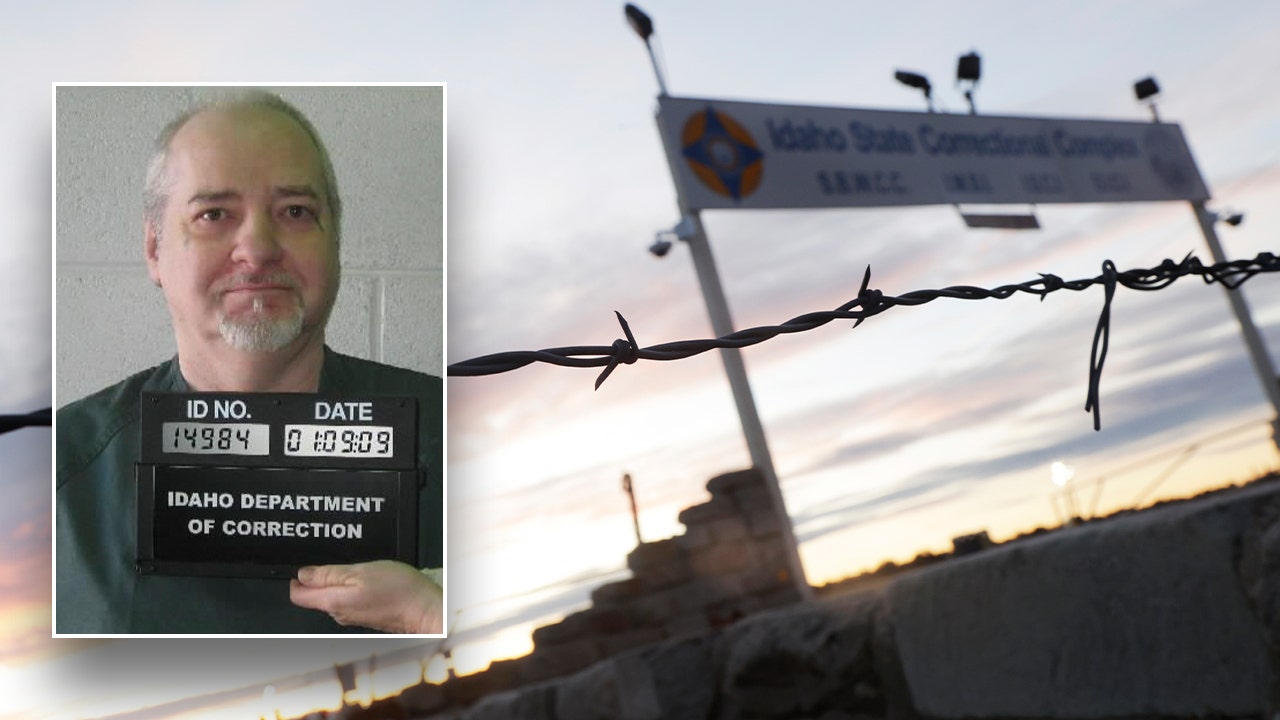
Convicted Idaho serial killer Thomas Eugene Creech survived his scheduled execution last month when his executioners spent an hour trying to find a suitable vein and failed.
He is one of the country’s longest-serving death row inmates, and he’s been sentenced to death more than once, although his latest death warrant has now expired, and authorities are considering their next move.
Fordham Law School Professor Deborah Denno, a leading expert on capital punishment, explained that lethal injection has become less reliable over the years with production of a key drug no longer conducted on American soil.
She added that the death penalty is better delivered by the time-tested firing squad over new methods like Alabama’s nitrogen hypoxia process, which resulted in a gruesome scene during its first use in January.
IDAHO’S MOVE TO RESURRECT FIRING SQUAD ‘MAKES SENSE’ AS ‘QUICKEST, SUREST’ DEATH PENALTY OPTION, EXPERT SAYS
Inset: Mugshot of condemned murderer Thomas Creech. Background: The sun rises on the entrance to the Idaho State prison complex near Kuna, Idaho, Wednesday, Feb. 28, 2024. (AP Photo/Kyle Green, Inset: Idaho Department of Correction)
“The elephant in the room is this has happened so many times. Why weren’t they more prepared?” Denno told Fox News Digital.
There is secrecy surrounding training for such executions and the medical staffs that conduct them, she said. But while there could be more transparency there, and the credentials of the executioners could be presented in substance without sacrificing their anonymity, there is a simpler option.
There’s no shortage of trained marksmen who could take part in a firing squad from 20 yards away, and the method has proven reliable over the centuries.
Creech is the fourth condemned inmate to survive his scheduled lethal injection in just a few years, she said. The method spiraled into chaos after 2009, when the last U.S. manufacturer of one of three drugs closed down, making it difficult for states to obtain, especially since its leading manufacturer, an Italy-based company, opposes the death penalty.
IDAHO GOVERNOR SIGNS LAW ALLOWING FIRING SQUAD EXECUTIONS
“The elephant in the room is this has happened so many times. Why weren’t they more prepared?”
Substitutions have shown poor results, Denno said. And she has concerns about the training for people who administer the drugs, which can be shrouded in secrecy.
“We have every detail on the last meal that these inmates eat. There are articles written down to how many packets of ketchup they use,” she said. “And we just don’t have any details on the actual execution process, but they certainly could be provided while protecting people’s anonymity. And I do think drug companies should be known. We should know where the drugs are coming from.”
That’s why, she says, Idaho’s recently revived firing squad is the most effective method for capital punishment.
IDAHO STUDENT MURDERS SUSPECT BRYAN KOHBERGER COULD FACE DEATH BY FIRING SQUAD UNDER PROPOSED LAW IF CONVICTED
A prison officer patrols near the Idaho State prison complex near Kuna, Idaho, Wednesday, Feb. 28, 2024. (AP Photo/Kyle Green)
“We’ve had three modern firing squad executions, and they have gone off as intended, and the inmate has died quickly and with dignity,” she said. “So, I think that is something to emphasize.”
She pointed to Alabama’s recent experiment with nitrogen hypoxia. Kenneth Smith, a hitman convicted of a 1988 murder for hire, was the first person in the world executed by the method. Like Creech, he survived a prior attempt at lethal injection.
Witnesses reported he suffered convulsive death throes while restrained on a gurney and took far longer to die than expected.
He was supposed to die painlessly and within seconds. Instead, according to the American Civil Liberties Union, he “shook, convulsed, writhed and gasped for minutes until he was pronounced dead at least 22 minutes after the execution began.”
Veterinarians won’t even use the method to euthanize animals due to uncertainty about its effects, the organization noted.
Convicted Idaho serial killer Thomas Eugene Creech survived his scheduled execution last month. (Idaho Department of Correction/AP)
“I think it’s pretty telling that even though some states have presented bills to their legislatures about nitrogen hypoxia, no other state has adopted it since Alabama carried out that execution,” Denno said. “And you can understand why. It was a highly flawed execution, very visibly flawed.”
In Tennessee, where inmates can choose between lethal injection and electrocution, they’ve begun preferring the latter, she said. As a result, she’s previously called for inmates to be given the chance to choose a firing squad, rather than leaving the decision in the hands of the government.
The execution chamber at the Idaho Maximum Security Institution as Warden Randy Blades looks on in Boise, Idaho, Oct. 20, 2011. (AP Photo/Jessie L. Bonner, File)
Creech was first sentenced to death for the murders of John Wayne Bradford and Edward Thomas Arnold in 1974. He was hitchhiking when the two picked him up. Then he shot them from behind.
He escaped death in that case when courts found the state’s old sentencing law to be unconstitutional and his punishment was commuted to life in prison.
He had previously been acquitted of the murder of Paul Schrader, 70, in Tucson, Arizona. However, investigators still think he was the killer. He’s been convicted of five slayings altogether across three states and made dozens of additional confessions, although authorities say most of them are likely bogus.
CLICK HERE FOR THE FOX NEWS APP
In 1981, he used a sock stuffed full of batteries to pummel a disabled inmate named David Dale Jensen to death. He received a new death sentence in 1983 and has since become one of the longest-serving death row inmates in the country.
Fox News’ Anders Hagstrom and The Associated Press contributed to this report.
Read the full article from Here

The Montana Lottery offers multiple draw games for those aiming to win big.
Here’s a look at June 21, 2026, results for each game:
Winning Big Sky Bonus numbers from June 21 drawing
02-07-29-31, Bonus: 02
Check Big Sky Bonus payouts and previous drawings here.
Winning Millionaire for Life numbers from June 21 drawing
02-06-07-13-37, Bonus: 02
Check Millionaire for Life payouts and previous drawings here.
Feeling lucky? Explore the latest lottery news & results
When are the Montana Lottery drawings held?
- Powerball: 8:59 p.m. MT on Monday, Wednesday, and Saturday.
- Mega Millions: 9 p.m. MT on Tuesday and Friday.
- Lucky For Life: 8:38 p.m. MT daily.
- Lotto America: 9 p.m. MT on Monday, Wednesday and Saturday.
- Big Sky Bonus: 7:30 p.m. MT daily.
- Powerball Double Play: 8:59 p.m. MT on Monday, Wednesday, and Saturday.
- Montana Cash: 8 p.m. MT on Wednesday and Saturday.
- Millionaire for Life: 9:15 p.m. MT daily.
Missed a draw? Peek at the past week’s winning numbers.
This results page was generated automatically using information from TinBu and a template written and reviewed by a Great Falls Tribune editor. You can send feedback using this form.


NEW MEXICO (KRQE) – A New Mexico rodeo tradition is changing lives one horse at a time. For years, the Stables at Tamaya have kept old western traditions alive at Santa Ana Pueblo, and they’re also giving dozens of rescue horses a second chance at life.
Every Thursday night under the stable lights at Tamaya, folks from all over gather for a one-of-a-kind rodeo.
Head Wrangler at the Stables at Tamaya, Dominic Duran says, “Our rodeos are so special because they really show the growth of all of our horses out here.”
From team roping to barrel racing and steer stopping the stunts are all performed by none other than rescue horses. “The main thing to know is it’s not a regular rodeo. It’s not about the competition. It’s about the growth of the horses,” explained founder and owner of Tamaya Horse Rehab Connie Collis.

Collis founded Tamaya Horse Rehab 14 years ago, saving horses from across the state and country, providing them with much-needed TLC to get them back on their hooves.
“These horses are all rescued from various situations. We have a lot of owner surrenders. We have horses that we get through the livestock board, neglect cases, abuse cases, as well as some Mustangs,” explained Duran.

The rodeo started shortly after the horse rehabilitation program was launched to generate funding to pay for everything from the alfalfa they eat, to the costly treatments for the dozens of horses in their care.
“Our goal is to make them the best versions of themselves. And so when we take them in, we want to analyze what we have and our goal is to get them as far as we can,” emphasized head wrangler Duran. “Horses are just like people. They need a job and they start to love what they do, just like we do out here.”

Duran says every horse has a different story and journey, but over the years, they’ve helped hundreds, offering them a full and enriching life through riding and activities like the rodeo.
“It is an amazing journey to get one, especially a skinny one or one that has really bad behavioral problems, and turn it around,” shared Collis.
Collis says the rodeo has grown in size every year and has quickly become a beloved tradition at the stables and across the equestrian community, becoming one of their larger fundraisers throughout the year. And with 126 horses in their care right now, they hope more people will make their way out to the stables this summer.

“Whether you’ve been here one time or 10 times, you should definitely come on out and come love on your favorite horses and see what progress they made over the last couple years,” said Duran.
The Stables at Tamaya will continue to run their rodeo season every Thursday from 7 to 9 through the third week of August.
-

 Illinois8 minutes ago
Video shows deadly tornado that hit southern Illinois, killing 2
-
Indiana11 minutes ago
Where to watch Phoenix Mercury vs Indiana Fever on June 22: TV channel, start time and streaming
-

 Kentucky16 minutes ago
All of the 4th of July events, fireworks taking place in Louisville this year
-
Iowa16 minutes ago
Iowa home sales up 17.3% in May – KBOE 104.9FM Hot Country
-

 Louisiana31 minutes ago
Driver dies from gunshot wound after Louisiana State Police chase in New Orleans
-

 Maine38 minutes ago
Matt Dunlap wins primary in Maine’s 2nd District as Democrats seek to hang on to Jared Golden’s seat
-

 Maryland41 minutes ago
AP Decision Notes: What to expect in Maryland’s state primary – WTOP News
-

 Michigan46 minutes ago
WNEM Morning Extra: Lane closures begin across mid-Michigan for bridge inspections, road work

