


Select an option below to continue reading this premium story.
Already a Honolulu Star-Advertiser subscriber? Log in now to continue reading.


In the early hours of August 8, a downed powerline ignited a fire along a roadside on the Hawaiian island of Maui. Wind from Hurricane Dora and dry brush grass fueled the flames that spread through 2,170 acres of Maui’s wooded hills and neighborhoods, leveling the historic coastal town of Lahaina.
More than 8,000 people were displaced from their homes, and 100 people died from the wildfire. The morning after it was extinguished, the Family Life Center, a nonprofit social service provider, was already devising plans to build temporary housing for the thousands of people displaced by the wildfire.
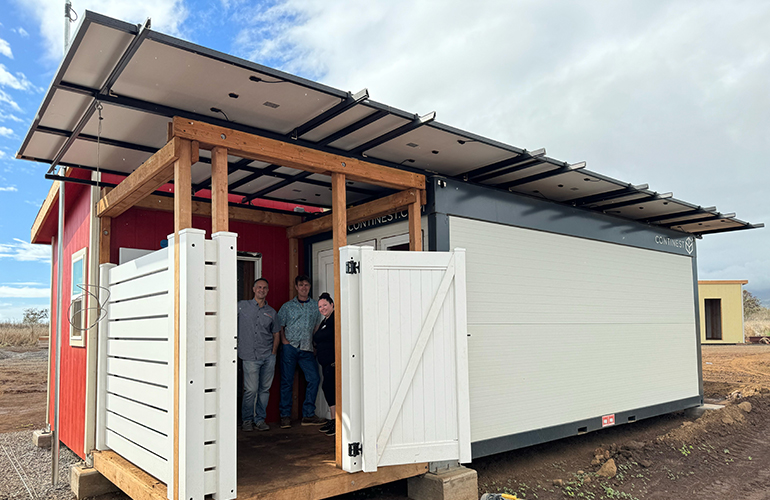
Solar has been installed on the prototype home at Ohana Hope Village. RevoluSun
“We know a lot of people from Lahaina that lost their homes, including some of our clients,” said Ashley Kelly, COO of the Family Life Center. “We tried envisioning a community where they would live, and so we thought of certain clients of ours and reflected on their lifestyles and what they would need.”
With the help of Hawaii Off Grid, a carbon-neutral architecture firm based in Maui, the Family Life Center is spearheading a temporary housing community project called Ohana Hope Village. Hawaii Off Grid provides pro bono architecture services for the Family Life Center and designed an 88-unit off-grid housing project powered by solar + storage technologies.
The housing units are pop-up containers that erect into 20-ft living spaces and will be outfitted with plumbing, bathrooms and a kitchen; a wooden veranda — or a lanai, as it’s locally called — will be built off the side of the building and solar panels will provide shading and additional living space. The goal is to give people a place to live with all the basic amenities expected from a home while the city rebuilds. Construction on the off-grid village is happening right now and should be completed in the next few months.
“If we were to follow what the utility wants us to do and have a 100- or 200-amp service and a meter on every single dwelling unit, or a massive master meter and conductor and transformer and the distribution, we’ll be looking at three- to four-times the cost,” said David Sellers, principal architect for Hawaii Off Grid. “Even though it’s not cheap, obviously, with batteries and PV … but it’s actually cheaper than us installing all of that heavy-duty infrastructure.”
A global and local effort
As the Ohana Hope Village project started to take shape, Kelly identified viable housing units from emergency shelter manufacturer Continest. The Family Life Center purchased the shelters, but none were available in the United States at the time. Continest’s other plant in Hungary had stock, so the company contacted the Hungarian minister of defense to coordinate with NATO to have a C-17 military aircraft transport the shelters to Lahaina.
“When that NATO C-17 landed and the multinational crew came out, I know we were all just crying,” Kelly said. “It was clearly from the other side of the world — help was coming, and our architects really needed the homes on site to really get our plans going.”
The site where the Hope Village is being built is 10 acres of land leased to the Life Center from King’s Cathedral Church for $1 a year. There is no electrical infrastructure on the property, so off-grid solar and energy storage will power the entire community. The project is engaging regional contractors with a focus of including locals displaced by the wildfire in the workforce.
“We also felt it was very important that the local community got to be part of the build,” Kelly said. “We weren’t bringing anyone in from the mainland or anything to build this. We really felt that was part of the healing process.”
Support has been extended from other laborers and material suppliers including RevoluSun, a solar contractor based in Oahu. Along with the nonprofit Footprint Project, RevoluSun has been sourcing and donating solar technologies and construction time to the Hope Village project.
Hans Harder, director of electrical at RevoluSun, is overseeing solar array design and construction, and helped build the system on the first housing unit at the Hope Village. The 7-kW array built on this single-dwelling unit is composed of JinkoSolar 410-W modules, IronRidge racking and Tesla Powerwall 2 battery backup. The remaining houses will have a similar solar wattage.

Ohana Hope Village will be composed of 88 units sourced from emergency housing manufacturer Continest. RevoluSun
The roof surface of the Continest shelter requires a few different mounting methods to secure the modules. Since these units are modular and expected at some point to fold back into the flat position in which they arrived, the solar installers cannot penetrate the roof.
The attachment on the roof surface itself is a stainless-steel welded tab that is adhered to a silicon roof membrane. All four top corners of the shelter have attachment points, like those found on shipping containers, so Harder ran a U-bolt through those gaps and secured them to the array’s mounting rail. Then to prevent wind uplift, steel wire comes down from the corners of the array and mounts to the bottom of the container.
These shelters will be outfitted with all electric appliances, so solar + storage will cover those energy needs. Every six housing units will be built around one community center composed of two 20-ft Continest shelters that will act as a gathering space with laundry facilities. Those will have a 17-kW solar array and energy storage for additional backup for the houses.
“I can’t wait to see it when it’s done,” Harder said. “Right now, it’s still hard to imagine that it’s going to be somewhere that people would want to live. But every time I go there, it does look a little bit closer to what the fancy architectural drawings look like.”
Making it work with what they have
There’s still plenty of work ahead for everyone involved in the Ohana Hope Village project. Sellers said Lahaina was already experiencing a housing crisis prior to the wildfire, and at last count, there are still more than 4,000 displaced Lahaina residents living in hotels.
Ohana will house, at most, 88 families and has already received 500 applications for residence. But it is poised to provide viable relief for Lahaina before the city can repair some of its destroyed infrastructure.
“We want to think about how we’re building in the temporary for emergency housing to show people how we should actually rebuild,” Sellers said.
That quickened construction timeline is possible partially through using renewable energy sources like solar. RevoluSun’s Harder said he witnessed Lahaina residents gathering at homes spared by the fires that were powered by solar, because nothing else around them had electricity. Solar contractors were among the first people to respond after the wildfire, and they powered portable Starlink internet routers with PV so people could contact their families.
The Ohana Hope Village is the next example of solar keeping the power flowing where other infrastructure had failed in Lahaina.
“Usually there’s this anxiety about having solar being completely off-grid, but that was one of the first decisions that was made,” Kelly said. “We had a lot of roundabouts with water and sewer, and the solar was solutioned pretty quickly. Once that decision was made, it was set.”
The Family Life Center hopes to have the housing project completed in the next few months. Kelly said monetary donations are the best way to support the Ohana Hope Village to help subsidize the cost of materials and labor. Donations can be made at ohanahopevillage.com.

Credit: RevoluSun


Already a Honolulu Star-Advertiser subscriber? Log in now to continue reading.

SCITUATE, MASS. (WHDH) – The Scitutate community is fondly remembering a couple killed in a helicopter crash in Hawaii Thursday during a post-retirement trip.
Patrick “P.J.” Haskell, 59, and his wife Margaret Rimmler, 65, lived in a Scituate neighborhood near the ocean. They took a trip to Hawaii last week after Haskell permanently retired from the insurance business he ran with his father for decades.
“We figured Massachusetts was close enough for us, and then when we hear it was our next door neighbor – it was shocking. Absolutely shocking,” said Steve Osborne, a neighbor.
Neighbors said Rimmler worked in the tech marketing field for years, and Haskell had big plans for retirement involving his garden and bee hives.
“He loved his gardening, and he had an overabundance of vegetables in the summertime,” said Mary Talbot, a neighbor.
“I had just spoken to him last week, and he had checked the bees and they all made it through the winter,” Osborne said.
On Thursday afternoon, the sightseeing helicopter the couple was flying in crashed near a remote beach off the coast of Kauai, killing them and one other person. Experts say the area’s geography of tall seaside cliffs and sharp mountain ridges can make for turbulant air and hazardous flying conditions.
In a memorial posting, Haskell Insurance Agency wrote, “Patrick recently retired and along with Margaret, deserved many more years together…Patrick’s kindness and selfless nature impacted all who knew him. He extended respect and compassion to everyone he encountered.”
Neighbors said the couple will be sorely missed.
“They were just the nicest people, the nicest people,” said Osborne. “Every time I look out over there it’s just so sad.”
Federal authorities are investigating the cause of the helicopter crash.
(Copyright (c) 2026 Sunbeam Television. All Rights Reserved. This material may not be published, broadcast, rewritten, or redistributed.)








Jannik Sinner’s Girlfriend Laila Hasanovic Stuns in Ab-Revealing Post Amid Miami Open


South Carolina vs TCU predictions for Elite Eight game in March Madness


Clovis shooting leaves one dead, four injured


Record Heat Meets a Major Snow Drought Across the West


Schumer gambit fails as DHS shutdown hits 36 days and airport lines grow


Boy who shielded classmate during school shooting receives Medal of Honor


Tennessee Police Investigating Alleged Assault Involving ‘Reacher’ Star Alan Ritchson


Trump gives Iran 48-hour ultimatum to reopen Strait of Hormuz or face strikes on power plants
