Hawaii
Four-House Waterfront Compound Built Like a Private Resort on Hawaii’s Big Island


Listing of the Day
Location: Kailua-Kona, Hawaii
Price: $28 million
Perched above Keauhou Bay on the private and historic Ha’ikaua Peninsula on Hawaii’s Kona Coast, this compound offers four fully renovated and furnished homes, more than 600 feet of waterfront and 270-degree views of the Pacific Ocean.
“I’ve been doing this a long time and I’ve never seen anything like this—to have 600 linear feet of oceanfront and this much privacy,” said co-listing agent Rob Kildow, of Hualalai Realty.
“The way this is configured you have no beach in front of you, so you have nobody looking in your windows or walking by,” he said. Yet you have three access points down to the water, which is very swimmable because a nearby reef keeps the water calm.
MORE: The Reign of Portland, Maine, as the Top U.S. Luxury Hot Spot Continues for Third-Straight Quarter
“If you’re looking for a resort lifestyle, 10 minutes down the road is a private golf community with dining and tennis,” Kildow said.
“This is a very special piece of property” due to its association with Hawaiian royalty, including important historical figures like King Kamehameha I and King Kalakaua, he said. In ancient times, Keauhou Bay was a significant cultural and political gathering place for Hawaiian Ali’i (chiefs) and their communities, and the site is where ceremonies, rituals and trade took place.
“The history goes way back,” Kildow said. Only Ali’i were allowed to set foot on Ha’ikaua Point.
Known as Ha’ikaua Point Estate, the 1.3-acre property comprises five contiguous properties acquired over a 10-year period, including the main residence on the point, two oceanfront bungalows and a building with an office, a media room and a four-car garage, according to the listing. A hidden road leads up to the private property.
MORE: Los Angeles’s Luxury Home Prices Surged to Start the Year
“The owners had a vision,” said co-listing agent Kurtis Becker, of Hawai’i Global Luxury Group. “The homes were there. They bought them and remodeled all of this and made them into a single village.”
“This was designed and built to be like your own private resort,” he said. All of the materials were locally sourced, and “there was no question about costs,” Kildow said. “The owner told me, ‘My wife didn’t have a budget and she exceeded it.’”
“This place is bulletproof and the ocean views are unbelievable,” he said.
The main house has open-plan living and dining areas downstairs, and the primary bedroom suite takes up all of the upstairs level, Becker said. Every bathroom has an indoor-outdoor shower.
MORE: This Cape Town Home Has Its Own Underground Shooting Range and Bunker
The estate is being sold fully furnished, including the owners’ art collection, according to the listing. The value of the art collection hasn’t been disclosed.
A portion of the proceeds from the sale will go toward the Jonathan Dale Miller Foundation, which the homeowner and his wife started in 1999 to honor their grandson’s final wish, Kildow said.
The landscaped grounds “have movement to them, with a wonderful flow,” he said. “There is really good energy here.”
“The options are limitless,” he said. “It could be a corporate retreat or a family deal. This has some real underlying meaning and texture and history to it.”
MORE: A Tropical Private Island Atop the Great Barrier Reef Sold at Auction for a Steal
Stats
Including the main house, the two bungalows, and the building with an office and a media room, the home has 8,913 square feet of interior space with eight bedrooms, 10 full bathrooms and one partial bathroom. The parcel measures 1.3 acres.
Amenities
Amenities include a free-form infinity swimming pool, 600-plus feet of private ocean shoreline with access to Keauhou and He’eia bays and the ocean, a large covered patio with multiple seating and dining areas, unobstructed 270-degree ocean, bay and sunset views, two bungalows, an office, a media room and a four-car garage.
MORE: [[
Neighborhood Notes
Kailua-Kona is the second-largest settlement on the island of Hawaii, after Hilo, and the largest on the island’s west side, according to published reports.
The Kona International Airport is 15 to 20 minutes from the home, Becker said. The Kona Coast is known for its calm, blue waters most of the year.
It also has some of the best sport fishing in the world, Kildow said.
Agents: Rob Kildow, director of residential sales and principal broker at Hualalai Realty, and Kurtis Becker, managing director at Hawai’i Global Luxury Group
View the original listing.



Three convicted sex offenders were arrested on Hawaii Island last week for allegedly failing to comply with sex offender registry requirements.
Multiple law-enforcement agencies conducted checks in Kona on registered sex offenders who had been identified as potentially out of compliance with the state’s Sex Offender Registry laws, according the Department of the Attorney General.
As a result of the three-day operation, several individuals were brought back into compliance, and three West Hawaii men were arrested for allegedly failing to comply with the requirements.
The three men who were arrested are Joseph Debus, 56, of Kailua-Kona, Garth Coleman, 53, of Holualoa and Alexsandr Skelcey, 34, of Kailua-Kona.
Debus was convicted of second-degree sex assault in Hawaii in 1993 and sentenced to five years probation with a year in jail. Coleman was sentenced to 20 years in prison for first-degree assault in 2000 after a jury trial in Hawaii. And Skelcey was convicted in Michigan in 2012 of assault with intent to commit sex assault.
“Sex offender registration requirements exist to protect our communities and ensure law enforcement knows where convicted offenders are living,” Tom Alipio, chief of the AG department’s Investigations Division, said in a press release. “Compliance operations like this send a clear message that we will actively monitor the registry, investigate violations and work closely with our law enforcement partners to hold offenders accountable when they fail to meet their legal obligations.”
HPD Chief Reed Mahuna said, “Operations like this allow us to verify that offenders are maintaining strict compliance with registration laws and those who aren’t will be addressed immediately. We will continue to leverage these multi-agency partnerships to keep our island communities safe,”
Members of the public can look up publicly available offender information and subscribe to notifications at sexoffenders.ehawaii.gov/coveredoffender/.
Anyone with information regarding a registered sex offender who may be violating registration requirements is encouraged to contact the Department of the Attorney General’s Investigation Division at (808) 586-1240 or their local law enforcement.

A brush in North Kona, near the Ulu Wini Apartments, has closed a portion of Hina Lani Street, between Route 190 and Ane Keokalole Highway.
According to Hawai‘i Island police, the road is expected to be closed for the next three hours and motorists are advised to avoid the area.
Hawai‘i Fire Assistant Chief Chris Carvalho confirmed at least two engines, two brush trucks, Chopper 2 and a medic vehicle responded to the blaze that started in some bushes.
No evacuations or injuries have been reported at this time.
At 11:09 a.m., an AlertWest camera, installed by Hawaiian Electric in wildfire-prone areas, showed smoke billowing above the Keahuolu Courthouse. As of 12:06 p.m., that smoke appears to have dissipated.
This is a developing story. More information will be provided as it becomes available.
Hawaii
Chinese communist party member arrested in Hawaii on visa fraud charge | Honolulu Star-Advertiser

-
 Science2 minutes ago
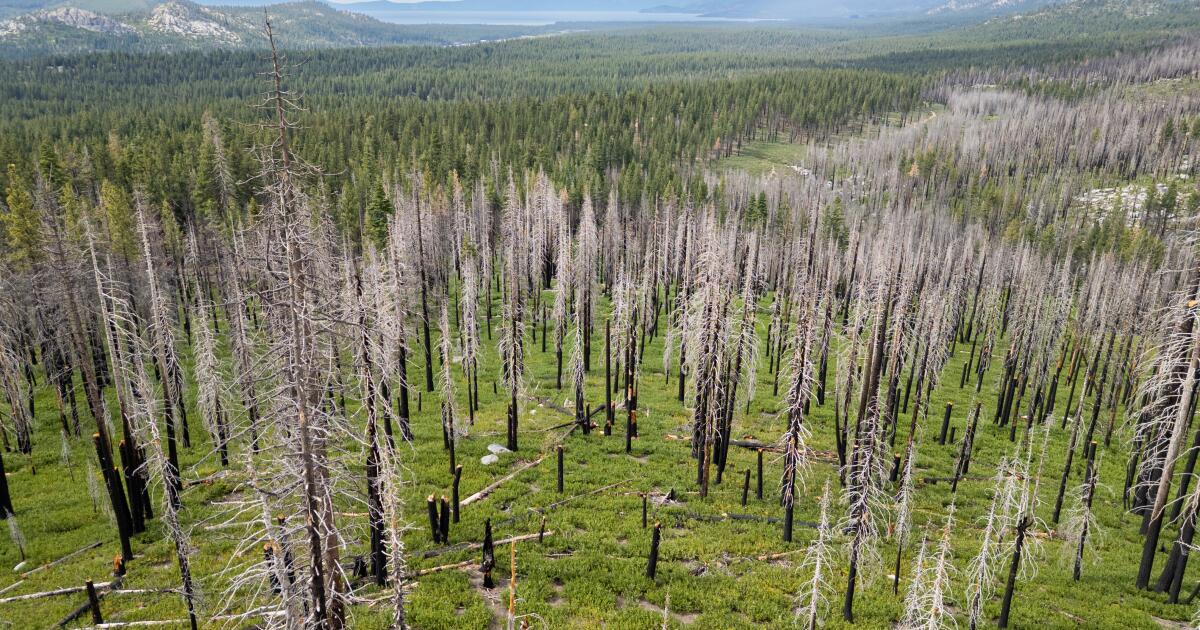
‘I’d rather my house burn down than get cancer’: Herbicide use upends California’s fight to save forests
-
 Sports7 minutes ago
Dodgers scheduled to visit White House in late July to celebrate 2025 World Series win
-

 World17 minutes ago
Former US Olympian pleads not guilty in DC reflecting pool vandalism case
-
 News44 minutes ago
Former Olympian pleads not guilty in reflecting pool vandalism charges
-

 Los Angeles, Ca2 hours ago
Heat advisory, beach hazards in effect as Southern California sizzles
-

 Detroit, MI2 hours ago
Teen on moped hit by car after cruising through stop sign in Detroit
-

 San Francisco, CA3 hours ago
Flight of fancy: San Francisco moves to build private luxury airport terminal
-

 Dallas, TX3 hours ago
Dallas’ digital creator economy is booming. Burnout is too.

