Denver, CO
Record-breaking heat wave arrives in Denver: What to expect across Colorado


DENVER — A scorching-hot weather pattern, unusual for Colorado, will sit over the state for the next several days and is expected to break Denver weather records through the weekend.
The record-breaking heat wave has placed the Denver metro and communities along the Front Range including Fort Collins, Boulder, Fort Morgan under a heat advisory starting at 10 a.m. through 8 p.m. each day on Friday through Sunday.
“102° is our expected high today and it looks like we’ll break that record of 101 degrees this afternoon,” said Denver7 Meteorologist Stacey Donaldson. “This weather pattern is the opposite of what we have during high fire danger periods when the wind is blowing and there’s a lot of action going on. This is more stagnant air that will sit over us.”
Weather forecasters and health officials warn Coloradans to stay hydrated and limit outdoor activities during the peak afternoon hours, especially those people who are susceptible to weather-related health issues.
“Highs will soar into the 100-105 degree range each day, and the prolonged period of heat will add to heat stress on people and outdoor animals,” added the National Weather Service (NWS) in Boulder.
Denver7
DENVER WEEKEND TEMPS AND RECORDS
Here’s a look at the expected high temperatures in Denver and the previous record temps.Friday’s high: 102° | Record temp is 101°Saturday’s high: 102° | Record temp is 102°Sunday’s high: 103° | Record temp is 100°
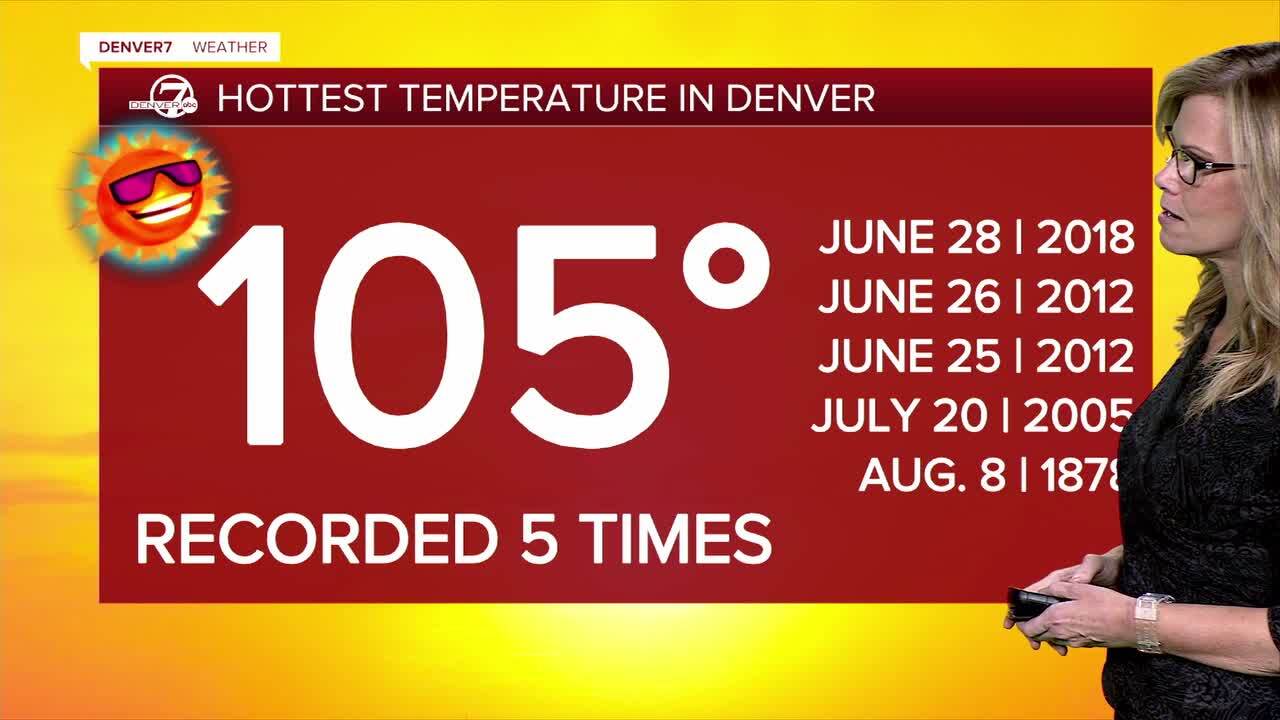
The hottest temperature ever recorded in Denver is 105 degrees and Donaldson said the city has only hit that temp 5 times in the past.
While some Colorado communities could see a 105° degree temp by this weekend, Denver is not expected to reach the all-time record, but here’s when it has happened in the past.
- June 28, 2018
- June 26, 2012
- June 25, 2012
- July 20, 2005
- August 8, 1878
Across Colorado’s urban corridor and northeastern plains, temperatures could range between 98 to 105 degrees or more in some locations.
Denver7
SYMPTOMS OF HEAT EXHAUSTION
Heat exhaustion can develop in just a few minutes. Common symptoms include headache, dizziness, nausea, vomiting, clammy skin and a fast or weak pulse.
According to the Centers for Disease Control (CDC), people suffering from heat exhaustion should sip water, loosen clothes, find a cooler location and apply cool, wet cloths or take a cool bath.
Anyone with heat exhaustion symptoms that last longer than 1 hour or are experiencing worsening conditions should seek immediate medical help.
CDC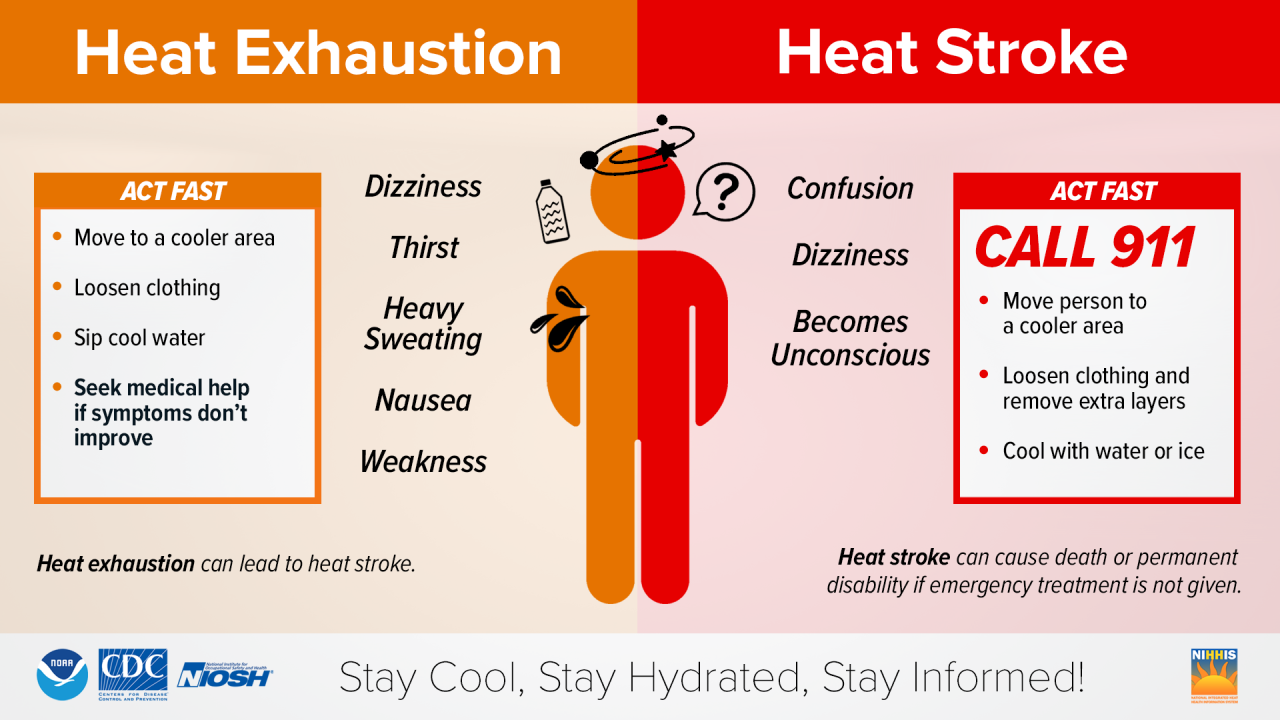
SYMPTOMS OF HEAT STROKE
The CDC says heat stroke is the most serious heat-related illness in which the body temperature can rise to 106° or higher in as little as 15 minutes.
Heat stroke symptoms include confusion, slurred speech, heavy sweating, seizures and can be fatal if not treated.If heat stroke is suspected, 911 should be called and the victim should be moved to a shaded or cooler area and outer clothes should be removed.
The CDC says to help cool the victim, wet the person’s skin, soak clothes in water or apply cold wet cloths to the skin.
In addition to the dangerous heat, air quality in the Denver metro will likely remain a concern over the next several days for all people and especially sensitive populations.
An ozone action day alert has been issued by the Colorado Department of Public Health and Environment (CDPHE) until at least 4 p.m. Thursday.
“Continued hot and stagnant weather will allow ozone to reach the unhealthy for sensitive groups…the highest concentrations are expected in southern and western portions of the Denver Metro area,” said the CDHPE.
There is an increased risk of respiratory problems for children, adults and anyone else with lung issues. The CDHPE urges people with breathing or lung issues to reduce time outdoors and avoid any heavy activity during the upcoming heat wave.
“Just a lot of stagnant air that will be sitting over us for the end of the week and the weekend,” added Donaldson.”
NWS Boulder

RARE 100-DEGREE DAY STRETCH IN DENVER
Denver’s official weather reporting station at Denver International Airport last recorded 100 degrees on June 25, 2024. Before that, the last time Denver officially hit 100° was back on August 5, 2022.
Denver has not experienced a streak of three consecutive 100-degree days since June 2021 and before that way back in July of 2012.2012 was a particularly hot period where Denver saw the most 100-degree days ever in a single year reaching a record 13 days of triple digit heat.
Sunday’s temperature will warm close to the all-time record in Denver of 105°.
If Denver reaches 100 degrees Friday, Saturday and Sunday – that would bring this year’s total to 4 days of 100-degree heat and would rank in the Top 10 of 100-degree days by year.
The heat has already made headlines in Denver this summer after NWS data recorded June as the second-warmest on record just behind the scorcher of 2012.
COLORADO HEAT WAVE | FORECAST TEMPS BY CITY
Here’s a look at how high temperatures are expected to peak starting Friday through the weekend in these Colorado communities. To view the chart in fullscreen mode, click this link.
The potential for record-high temperatures stretches across communities along the I-25 corridor and through the plains. If there is moisture to be had in Colorado, any storms would likely form over mountain communities with most of the rest of the state unfortunately remaining dry, according to the NWS.
“This extended heat can have negative impacts on health, especially those sensitive to heat. It is essential to stay hydrated in these conditions and check on loved ones and pets while these conditions persist,” added the NWS.
PREVIOUS DENVER HIGH-TEMPERATURE RECORDS THIS WEEKEND
To break heat records in Denver, the afternoon high temperatures would need to break these previous records for the following days:
- July 12: 101° set in 1971
- July 13: 100° set in 2003
- July 14: 100° set in 1878
For context, the normal afternoon high in Denver for this time of the year is 90 degrees.
Along with the potential health impacts, Xcel Energy urged customers to follow certain tips to help reduce electricity costs during the upcoming heat wave. Customers can conserve energy by opening interior doors to improve air circulation, closing drapes and blinds during the day, and running large appliances like washing machines outside the hottest periods of the day.
To see the 100-degree temps in Denver infographic in fullscreen mode, click this link.

DENVER WEATHER LINKS: Hourly forecast | Radars | Traffic | Weather Page | 24/7 Weather Stream
Click here to watch the Denver7 live weather stream.






For most food manufacturers, it makes more financial sense to bake, brew, cook or create their product somewhere where the square footage is a little less expensive, like a business park, and to sell it where the rent – and the foot traffic – is higher.
Kent Beidel, who owns a string of mountain-town ice cream parlors called Sundae, did the opposite when he opened his newest and, by far, his biggest location in downtown Denver.
“We wanted to be right in front of people and hear them say, ‘Oh my god, they make the ice cream right here,’” he explained. “It’s backward … it’s hard. But it’s unique, and it’s really cool.”
Sundae opened in early June in a 5,100-square-foot space that includes a retail shop, a waffle cone-making “theater” where people can watch the staff turn out fresh cones, a pint-mixing classroom and a commercial kitchen – visible to customers on three sides through glass windows – that could one day supply multiple stores around Denver.
Beidel is betting those attributes will help the business stand apart from the competition in Denver, where there are already several big names making and selling scoops in multiple locations.
But that’s not the only gamble he took. Sundae is located on Sixteenth Street, the 44-year-old pedestrian mall that has become both a symbol of the city’s urban decay since the pandemic and a beacon of hope for its future after a $175 million renovation.
“Sixteenth Street is interesting,” said Beidel, who has watched it change over the past year since he first signed his lease at 1600 Glenarm Place. “It’s coming back. It still has a way to go, but we are seeing momentum start to build. Even in the last month, the foot traffic and the feeling downtown has perked up. … We are getting great feedback.”
To help, the Denver Downtown Development Authority — as part of a much larger business incentive plan — loaned Sundae $750,000. “It’s a loan,” he said. “We have to pay it back. … But we couldn’t have done this location without that support.”
Beidel has been in the food business for 22 years. Before ice cream, he was the founder of Loaded Joe’s, a restaurant and coffee shop staple in Vail. But in 2016, he sold Loaded Joe’s and took over two former Marble Slab Creamery locations in Vail and Edwards, rebranding them as Sundae. In 2020, he opened a third shop in Glenwood Springs.
“That was our first chance to build from scratch and decide what it should look like,” he explained, adding that Glenwood, which includes a kitchen, eventually began making ice cream for Sundae’s next two locations in Basalt and Snowmass.
To make the ice cream, Beidel said he employs five pastry chefs to create recipes. So, rather than using cheesecake flavoring, for instance, for cheesecake ice cream, Sundae uses all the same ingredients you would use to make real cheesecake.
The cheesecake, by the way, is among Beidel’s favorite flavors, but Salted Cookies & Cream and Caramelized Banana are two of the most popular with customers. Classic chocolate, vanilla, and strawberry are also top sellers – “and always will be,” he added.
Next month, Beidel hopes to open the classroom, where people can learn how to make ice cream and then whip up some of their own flavors to take home. And down the road, he plans to open more locations.
But in the meantime, he’s focused on downtown. “Let’s say Denver does really become vibrant again. We have a great product and a great following in the mountains. So, it’s just a matter of time down here.”
Subscribe to our new food newsletter, Stuffed, to get Denver food and drink news sent straight to your inbox.
Denver, CO
Denver Country Club caddie earns full-ride Evans Scholarship, becomes first in family to attend college

DENVER — What started as a summer job has turned into a life-changing opportunity for Denver-area student Vanessa Olivar.
The 18-year-old Denver Country Club caddie has earned the prestigious Evans Scholarship, a full tuition and housing scholarship awarded by the Western Golf Association to caddies who demonstrate strong character, academic achievement, financial need and a strong caddie record.
Watch Bradey King’s story on how Olivar persevered to nab this scholarship in the video below.
Denver Country Club caddie earns full-ride Evans Scholarship
Olivar is one of 15 students from Colorado to receive the scholarship this year and will attend the University of Colorado Boulder this fall.
When she first heard about caddying through her high school’s assistant principal, Olivar said she wasn’t sure it was the right fit.
“I didn’t know anything about the game of golf,” she said. “At first, I was a little doubtful and nervous, but I thought it would be a great summer job. I quickly found out that it was more than just carrying a golfer’s bag.”
Over the past three years, Olivar learned the responsibilities that come with the job, from carrying clubs and providing yardages to building relationships with members and fellow caddies.
“I learned a strong work ethic, and the relationships that I built through caddying have really shaped who I am today,” she said.
Her dedication paid off when she received the news that she had earned the Evans Scholarship.
“I got that flag saying, ‘Congratulations,’ and I was so excited,” Olivar said. “Words couldn’t express how excited my family and I were for this great opportunity that I worked so hard for over three years.”
The scholarship carries even greater significance because Olivar will become the first person in her family to attend college.
“I’m a first-generation college student,” she said. “Coming from immigrant parents, I kind of had to navigate this world by myself.”
Her parents immigrated to the United States when they were 18, and Olivar said their sacrifices inspired her to pursue higher education.
“Being able to tell my parents they don’t have to pay for my college takes that weight off their shoulders, but also mine,” she said.
Western Golf Association officials say Olivar exemplifies the qualities the Evans Scholarship is designed to recognize.
“The scholarship is based upon four principles: Their caddie record, their academic record, their financial need, but really what’s most important is their character,” said Brian Wilkinson, the Western Golf Association Director at Denver Country Club. “Vanessa expresses the great character and leadership that we’re looking for in young women and men.”
At CU Boulder, Olivar plans to major in public health with a minor in business before pursuing dental school.
She said the opportunity has changed the trajectory of her future.
“I knew I wanted to go to college, and I wanted to have a further education,” Olivar said. “I just didn’t know how I was going to do that. I didn’t know caddying was eventually going to change that for me. It’s a scholarship that has changed my life forever.
Denver7
Denver7 | Your Voice: Get in touch with Bradey King
Denver7’s Bradey King reports on the entire sports landscape in Colorado, including Denver’s pro teams, but is always looking for stories off the field and in the non-professional ranks. If you’d like to get in touch with Bradey, fill out the form below to send her an email.

-

 Videos20 minutes ago
New explosions near Iranian port cities, says state media | BBC News
-

 Los Angeles, Ca22 minutes ago
Big rig crash spills cinder blocks on 101 Freeway; lanes blocked in Tarzana
-
 Detroit, MI46 minutes ago
How to watch ‘The Odyssey’ in IMAX, 70mm and more in metro Detroit
-

 San Francisco, CA58 minutes ago
Sold-Out SF Marathon 2026: The Races, Routes and Road Closures (Plus How to Watch It All) | KQED
-

 Dallas, TX1 hour ago
Top 10 Dallas Cowboys of 2026: Rashan Gary is Complete EDGE Dallas Needed
-

 Miami, FL1 hour ago
Girl, 12, shot while sitting in parked car in northwest Miami-Dade, deputies say
-

 Boston, MA1 hour ago
GBH Daily: Come sail away
-

 Denver, CO1 hour ago
New ice cream shop with a ‘waffle theater’ bets big on downtown Denver

