Denver, CO
Mayor Mike Johnston says he’s trying to keep Denver from becoming San Francisco: “The stakes feel so high”


Mike Johnston took the stage at Denver’s historic Paramount Theatre last week for his first State of the City address just days after he’d marked a full year as mayor.
He was in a reflective mood, recapping progress on homelessness and other problems in the time since he took office on July 17, 2023, after winning a 17-way mayoral race. He also previewed what’s next, including by pitching his recently announced sales tax increase to fund affordable housing initiatives — a proposal that’s facing questions from the City Council on its way to the November ballot.
Johnston, 49, sat down recently with The Denver Post to delve deeper into his first year and to discuss what lies ahead, including whether he still sees his goal of ending street homelessness in four years as realistic.
In the interview, he also talked about shortcomings in his otherwise galvanizing homeless initiative, called All In Mile High, which has moved more than 1,600 people into hotels and other temporary shelters, and how it relates to broader affordable housing goals. Some of that will hinge on whether the council and Denver voters go for his proposed 0.5% sales tax, which would raise an estimated $100 million a year.
Below are several excerpts, with his responses lightly edited for length and clarity. Context has been added where necessary.
Question: What do you think your biggest success has been in your first year in office?
I think it’s been our breakthrough success on homelessness.
Q: Where have you come up short in your first year, in your estimation?
I think there are some things that aren’t done yet that we still want to get done and are coming soon. I also think there are some safety protections in place at our All In Mile High sites that we should have been more stringent about when we first moved people in. The two lives we lost at the DoubleTree hotel are certainly two that I’ll never forget — and that is a decision I wish we had back.
Context: On March 16, Dustin Nunn, 38, and Sandra Cervantes, 43 — two people living in one of the city homeless initiative’s hotel shelters, a former DoubleTree at 4040 N. Quebec St. — were shot and killed. It was later revealed that the shelter’s operator, the Salvation Army, had not yet billed the city for any security measures at the building.
Q: Critics have pointed out that people who have been sheltered through the All In Mile High program are ending up back on the streets at a rate faster than they are moving on to more stable housing. What do you feel is preventing more people from transitioning out of shelters and micro-communities and into more permanent housing? How can you increase the throughput?
First of all, I agree with that criticism. I think they’re right and we are deeply focused on getting better at that.
The major focus for this year is increasing that throughput — having better systems of case management at each of these sites so that we know who every person is, we know what their needs are and we’re getting them the right service from the right provider at the right moment.
And we also know part of that need is to make sure there are more available units of affordable housing out there for them to move into. So we knew the first step was getting people off the streets and into transitional housing. The next step was always more permanent affordable housing — and that need exists not just for people coming out of homelessness, that need exists for teachers and nurses and servers and retail workers across the city.
And those units take a little longer to develop, longer to build and more resources. That’s why we’re so focused on affordability now, at scale — that’s going to be our biggest need. But a big part of this will be us getting better and better at case management with our providers at these sites.
Q: Do you still believe you can end unsheltered homelessness in Denver by the end of your first term?
I have to say I feel more optimistic about that possibility than I did a year ago. I’m so proud of what we built together as a city, and we put the infrastructure in place to show we can move thousands of people off the streets in a single year.
I think we’re on a path to end street homelessness for veterans this year, which is generally the first big benchmark along the way to getting there. And yes, we think we can make homelessness brief and rare and nonrecurring. That is really what the field defines as ending street homelessness, or what sometimes is called “functional zero.” It’s the idea that if 30 people enter homelessness in one month, 30 people exit in the same month.
I think we have a real path to get there in three years. In fact, we’re ahead of schedule of where I thought we would be on our efforts on veteran homelessness. That’s been an encouraging function of, when you build this infrastructure and you have the housing units there and you have the support services, you can close those encampments, move them to housing and keep encampments closed.
So we think we’ve shown this cycle works. We just have to do more of it better and faster. And that’s the path ahead.
Q: Your predecessor, Michael Hancock, called working with then-President Donald Trump’s administration one of the biggest challenges of his 12-year tenure. Are you preparing for the possibility of a second Trump term if he wins this fall?
I am not. I am preparing for the opportunity to avoid a second Trump term.
One thing I love about this job is that it’s nonpartisan. We’re just here to solve problems — and problems don’t have a partisan label. Either the solutions work, or they don’t. But if you have a president who makes it a priority to divide the country and to wage war on parts of the country, that makes it very hard to do business.
I just remember that, for instance, in the first term he wrote an executive order to ban federal grants to any city that had a sanctuary status. It would have been every single federal dollar, denied to a great majority of the country’s largest cities that don’t believe it makes sense to try to deport someone who has a busted taillight.
So I would hate for this city or this country to be stuck in a bunch of unproductive battles like that when we have far more important things we can do, like how to work together to solve the affordable housing problem or public safety challenges or homelessness.
Context: Soon after taking office in 2017, Trump issued an executive order that sought to deny federal grants to cities like Denver that did not cooperate fully with federal immigration authorities. The order faced legal challenges before it was ultimately revoked by President Joe Biden in 2021.

Q: What keeps you up at night?
That’s one of them (a second Trump term). The affordability of the city also keeps me up at night. Public safety keeps me up at night. I literally get a text from our police chief and the team every time we have a murder or violent crime or death in the city. And so that is the last thing I read at night or the first thing every morning. Every time that happens in a neighborhood, I feel that.
I think those are the biggest ones. The good news is, while that keeps me up at night, the days are filled with reminders of just the incredible resilience and passion and spirit of the people of the city.
Q: What is at stake if Denver’s housing costs continue to climb?
I think a lot about this one. I think it would be a dramatic change in what it feels like to live in Denver because of who can live in Denver.
I think it would mean almost all of the working-class families that support this city would no longer live in this city. So your teacher, your nurse, your barista, your local retail staff member — you wouldn’t find one of them who lives in the city anymore. And as their commutes become longer and the hours become slower, I think they might decide to just leave the metro area altogether.
And then the population stops growing and the city stops growing — and you have a city with no middle-class families left in it that feels like a shadow of its former self. We’ve seen, already, places like San Francisco where the population has just started dropping and the people that are left there are only the very wealthy.
That’s not where we want Denver to go. And that’s why the stakes feel so high.
Stay up-to-date with Colorado Politics by signing up for our weekly newsletter, The Spot.
Originally Published:



DENVER — Denver Mayor Mike Johnston is launching a $100 million plan to boost the local economy and support 10,000 jobs over the next three years.
Johnston announced the four-part program Thursday morning, flanked by business leaders while praising downtown businesses like brunch eatery Snooze.
▶️ WATCH: Denver7’s Alex Dowd reports on the plan
Denver mayor promises to create 10K jobs in next 3 years
Snooze Co-Founder Adam Schlegel said his business benefited from a similar program when U.S. Sen. John Hickenlooper was mayor in the early 2000s.
“The city really was the one that stepped up,” Schlegel said. “We wouldn’t have started if it wouldn’t have been for the economic development office. We ended up getting an incentive from the city to open up, particularly in this space [downtown]. It was a fiscal incentive to do it, in addition to coaching.”
Both of those are offered in the new four-part Denver Jobs Agenda. With funding from the Denver Downtown Development Authority and the Office of Economic Development and Opportunity, Johnston aims to develop start-ups in the city, grow existing businesses and draw in new companies while working to advance the Denver-area workforce across industries.
At the end of the last fiscal quarter, Denver’s unemployment rate hovered around 3.6% — under the national rate of 4.2% — according to U.S. Bureau of Labor Statistics, while office vacancy sits just under 40%, according to commercial real estate broker CBRE.
Johnston and other speakers made multiple references to more jobs bringing more people downtown.
“Denver has so many things going for it, so it will come back,” Schlegel said. “It’s not coming back as fast as I want, or as much as anyone will, but will it have a long-term future? 100%. It’s things like this, though, that I think give us a lot of hope that it can happen sooner than waiting it out.”
▶️ Watch the full press conference
Press conference: Denver mayor announces Denver Jobs Agenda
Chris Berthiaume, the city’s director of workforce industry initiatives, says the three workforce development centers across Denver serve around 20,000 people each year. He’s confident this new initiative will help more of those visitors find employment.
“We want to focus on things like aerospace, cybersecurity, green construction,” Berthiaume said. “This new initiative really just tightens the focus on sectors that we know are growing. Colorado is home to a huge aerospace culture. Quantum technology is emerging and coming. Green workforce are jobs that we know drive around Denver. Construction is everywhere. We need to make sure we have a skilled workforce that’s ready to take on those jobs.”
While also finding employers to hire them and stay within the community for the long haul.
“I think the reason businesses work — certainly restaurants work — is that you are integral to the community specifically where you are,” Schlegel said. “There are so many people in our community that really believe in Denver and want to see what it can be, and so it will get there.”
It’s well on the way. Denver’s Economic Development Corporation says they’re working with 52 active prospects that could bring more than 12,000 jobs to the area.
Coloradans making a difference | Denver7 featured videos
Denver7 is committed to making a difference in our community by standing up for what’s right, listening, lending a helping hand and following through on promises. See that work in action, in the videos above.
Denver, CO
Victor Marx wins GOP primary for Colorado governor, defeating veteran lawmaker after unorthodox campaign

Victor Marx, a first-time candidate and nonprofit leader with a controversial personal history that’s drawn intense scrutiny, has edged out his more establishment opponent and will be Colorado Republicans’ gubernatorial nominee in November.
The Associated Press called the race for Marx late Thursday afternoon, nearly nine days after polls closed. He led the runner-up, state Sen. Barb Kirkmeyer, 39.9% to 39.4%, with 99% of ballots counted, according to the AP.
Marx had taken his first narrow lead over Kirkmeyer the day after the June 30 primary, and though the race remained close, he never lost the advantage. While outstanding deficient and overseas ballots helped delay a final call on the race, those votes only served to expand Marx’s margin. He led by 2,524 votes at 5:30 p.m. Thursday, out of about 522,000 ballots cast.
State Rep. Scott Bottoms was a distant third, with 20.8% of the vote.
A veteran lawmaker and former Weld County commissioner, Kirkmeyer had jumped to an early advantage on the strength of early ballot returns. But as votes returned on Election Day began to filter in, her lead thinned and collapsed. Within 48 hours of polls closing, and with few ballots left to count in Kirkmeyer’s Front Range strongholds, her path to retake the lead had all but vanished.
Marx will next face Democratic Attorney General Phil Weiser in November. No Republican has been elected to the governor’s office in more than 20 years. Four months out, Weiser appears to be heavily favored to continue Democrats’ electoral dominance.
In an email to supporters after the race was called, Marx said he was humbled to be the nominee and that the victory was “the starting line.”
“My team and I have put together this special message that I want every Coloradan to hear — Republicans, independents, unaffiliated voters, and Democrats who are open to a better way,” he said. “Because what we’re building now is bigger than a primary victory.”
In a video, he appealed to Coloradans who are frustrated with the status quo and don’t think things can change — citing his victory as proof they can.
“Now Phil Weiser, he’s a smart fella — but he represents the current system, because he is part of it,” Marx said. “And that current system has made Colorado more expensive, less safe and harder for regular families to trust government.”
In a separate statement, Kirkmeyer said she was proud of the race that she had run and the “clear vision” she had laid out for the Republican Party here.
“While we came up short in what appears to be the closest Republican gubernatorial primary in Colorado history, I’m grateful for every voter who placed their trust in us,” she wrote.
Echoing the pledge she’d made before Election Day, she pointedly did not endorse Marx. She said only that she hoped voters “choose the path that is best for Colorado” in November.
Kirkmeyer also threw a final jab at Marx, who declined in late May to tell 9News how many people he’d killed as an adult.
Kirkmeyer wrote that, “for the record, I still haven’t killed anyone.”
First-time candidate shrugged off questions
Marx’s primary win is a remarkable result for the embattled Colorado GOP and for Marx, a former Marine, martial arts instructor and nonprofit leader whose extensive and much-scrutinized personal history had drawn national headlines. It’s also attracted sharp criticism from other Republicans.
In his video, Marx appealed to Republican primary voters, saying there was room in his campaign for those who supported his opponents.
Marx had entered the fray last fall with no political profile and no experience as a political candidate. But by the time voters began receiving ballots last month, he’d ridden an atypical — if thoroughly modern — campaign to fundraising dominance and front-runner status.
Kirkmeyer’s support largely flowed from northern Front Range counties, nudging her ahead initially. But Marx picked up bigger margins among Election Day voters — meaning those more conservative voters skeptical of mail-in balloting.
He also won ruby-red El Paso County while racking up smaller wins in rural counties and grabbing enough in the Front Range to edge Kirkmeyer.
Map: Where did the votes come from in the Colorado primary races for governor?
In a pitch reminiscent of President Donald Trump, the arch-dealmaker, Marx has cast himself as a solutions-focused negotiator disinterested in partisan squabbles. In 2003, he founded All Things Possible Ministries, a Christian nonprofit that has provided stuffed animals and trauma support to people. It has also done work in conflict areas in Syria and Iraq, where Marx primarily worked away from the front lines as a funder and facilitator.
By 2024, the nonprofit’s annual revenue had surpassed $7.5 million, and Marx has said the group — from which he has resigned — now primarily works to help law enforcement.
Despite his outsider status, Marx was considered the likely winner in the weeks before Election Day. His narrow victory, then, came as something of a surprise, and, on election night, he speculated that Bottoms — a conservative pastor from Colorado Springs — had pulled votes from him. In El Paso County, Bottoms earned more than 20,000 votes, or 24% of the county’s Republican total.
Though Marx out-raised and out-spent both Kirkmeyer and Bottoms, it was Kirkmeyer who had been perceived as the expected nominee when she entered the race last year. Marx had never run for office before, and the stories he’s told about his life — that he’d killed a man at age 7, been involved in “high-risk humanitarian” operations across the globe and could free people from demonic possession — drew intense scrutiny and national punchlines.
But he repeatedly shrugged off questions about his background and said he stood by all that he had said and written.
Through his personality-heavy, direct-to-voter campaign, he encouraged Colorado Republicans to shrug it off, too. He spent heavily on direct mailers, which provided a boost to both his fundraising and name recognition.
Marx eschewed policy discussions and skipped nearly every debate. When he did participate in one, he spent part of the event leaning on the lectern, with his dog at his feet. Rather than deliver a closing statement, he prayed.

Campaigning his own way
Though he leaned into his outsider status, the aw-shucks appeal belied a careful campaign shaped by Marx’s emergence from a political environment forged by Trump: He skipped one debate after a moderator pressed him about his background, and he held a rally instead; his campaign later highlighted how many more people attended the rally than the debate.
His media operation was led by a former Turning Points USA staffer, and his campaign touted its social media posts’ views at Marx’s watch party last week. He was comfortable as a podcast guest, regularly released videos of himself and repeatedly assured voters that he was no politician.
Though Marx had little backing — or trust — from institutional Republican forces, the PAC that supported his campaign was established by a former senior official from Gov. Bill Owens’ administration. Marx also was endorsed by U.S. Rep. Lauren Boebert, the most nationally visible Colorado Republican.
His approach proved to be enough for Colorado Republicans to back him. But his next task will be far harder.
In November, he will face a surging Weiser, who last week dismantled U.S. Sen. Michael Bennet on his way to the Democratic nomination. Weiser proved an adept fundraiser and campaigner with statewide appeal, and he will look to lead a restless Democratic base that elected progressive candidates up and down the ballot.
In a statement Thursday, Weiser said Marx’s “views and style are far out of step with Coloradans, and his nomination for governor is a threat to our state’s values and our future.”
Republicans’ last statewide win was in a University of Colorado at-large regent’s race in 2016. The state GOP has had four elected party chairs since the last Republican gubernatorial bid in 2022, which ended with a culture war-focused Heidi Ganahl — who had won that at-large regent seat — losing by nearly 20 percentage points to Gov. Jared Polis.
Simultaneously, Marx may also have to contend with an independent candidacy from Greg Lopez, a former Republican congressman and gubernatorial candidate who is gathering signatures to make the fall ballot.
Stay up-to-date with Colorado Politics by signing up for our weekly newsletter, The Spot.

If you use Santa Fe Drive as a part of your daily commute, you will notice full closures this weekend on a popular section, from Florida Avenue to Evans Avenue, for the installation of a pedestrian bridge.
Once the 370-foot pedestrian bridge is completed, it will connect the east and west portions of Denver’s Overland neighborhood. This bridge will be used by pedestrians and bicyclists.
The Denver Department of Transportation and Infrastructure says this closure is needed to keep the traveling public safe. Large cranes will be used to set the two spans in place. Each one weighs about 215,000 pounds and is 180 feet long.
Once the bridge is completed in 2027, it will create a safer connection for pedestrians and bicyclists. It will link neighborhoods to trails, transit, parks, and local businesses without requiring residents to cross heavy traffic.
“Our neighborhood is quartered by transportation routes, so having a safe pedestrian bridge that can take people from one side to the other is an amazing development that neighbors have been asking for for years,” Jenn Greiving, President, Overland Park Neighborhood Association, said.
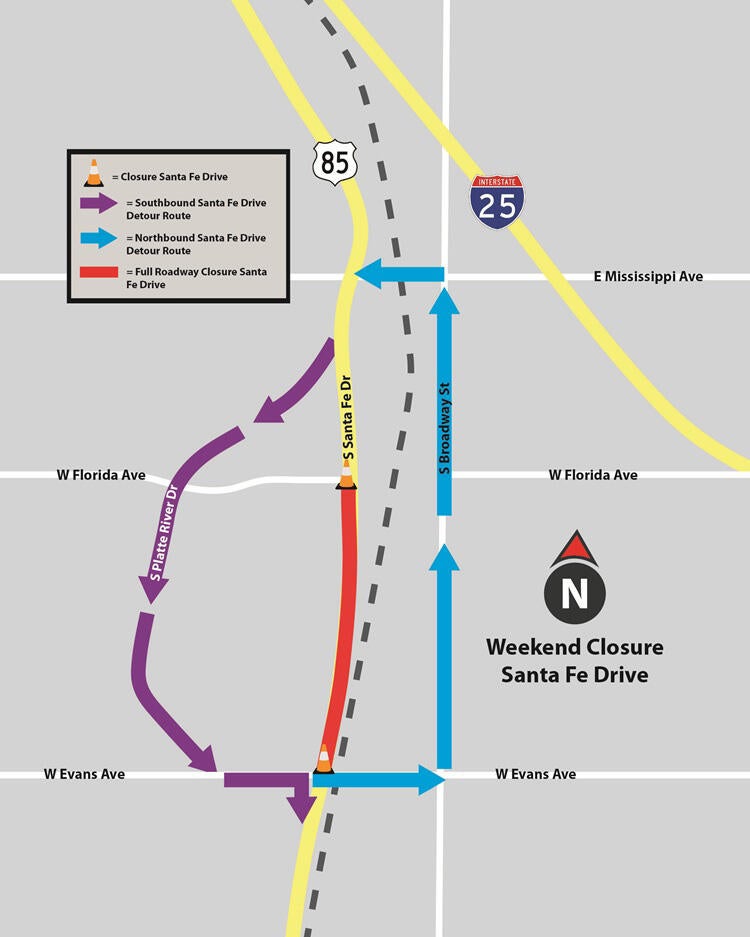
The Santa Fe Drive closure will begin at midnight on Saturday, July 11, and end on Monday, July 13, at 5 a.m. There will be detours in place. This includes:
- Southbound Santa Fe Drive Detour: Traffic will be routed to Platte River Drive to reenter southbound Santa Fe Drive at the West Evans Avenue on-ramp.
- Northbound Santa Fe Drive Detour: Access to northbound Santa Fe Drive will be at Mississippi Avenue via South Broadway Street.
- On-Ramp Closure: The West Evans Avenue on-ramp to northbound Santa Fe Drive will close at noon on Friday, July 10, to prepare for the full weekend closure and will remain closed until 5 a.m. on Monday, July 13. Traffic will be detoured to South Broadway Street to re-enter northbound Santa Fe Drive via Mississippi Avenue.
- Off-Ramp Closure: The southbound Santa Fe Drive off-ramp to West Evans Avenue will close for the full weekend period and remain closed until Friday, Sept. 11, while crews build new sidewalks and perform other concrete work at the southwest corner of the project. Detours will be posted to West Florida Avenue, West Dartmouth Avenue or West Hampden Avenue to bypass the ramp closure
During this closure, DOTI will reopen the underpass on Iowa Avenue. This is a new ADA accessible pathway that will be available between Santa Fe Drive and Acoma Street.
-

 Los Angeles, Ca14 minutes ago
O.C. police prep for beach, theme park ‘takeovers’ promoted on social media
-

 Detroit, MI36 minutes ago
Detroit city leaders to DHS: Stop ICE pursuits which endanger the community
-

 San Francisco, CA43 minutes ago
SF Supervisor Jackie Fielder hosts listening session after medical leave
-

 Dallas, TX51 minutes ago
The Stewpot artists find healing, purpose and income through art in Dallas
-

 Miami, FL54 minutes ago
Can Jason Marshall push for a starting spot – The Splash Zone 7/10/26
-

 Boston, MA59 minutes ago
Police investigating shooting in Downtown Crossing – Boston News, Weather, Sports | WHDH 7News
-
Denver, CO1 hour ago
Denver mayor announces new $100 million plan to bring in 10,000 jobs
-

 San Diego, CA1 hour ago
WEBTOON Brings Top Creators for San Diego Comic-Con Panels

