Colorado
Waivers don’t shield ski resorts that violate state law from liability, Colorado Supreme Court rules


The pages of fine print that skiers and snowboarders must agree to when hitting the slopes in Colorado — waivers of liability — do not protect ski resorts when resorts violate state laws or regulations, the Colorado Supreme Court ruled Monday.
The ruling, handed down in the case of a 16-year-old girl who fell from a ski lift at Crested Butte Mountain Resort and was paralyzed two years ago, likely ends a years-long push by the ski industry to use waivers to shield resorts against almost all lawsuits, even in cases where ski areas violated state law, experts said.
“It’s a sea change, in terms of ski areas’ responsibilities and consumers’ ability to be protected from ski areas’ negligence,” said Evan Banker, a personal injury attorney at Denver firm Chalat Hatten & Banker. “…From a consumer protection standpoint, it’s huge. Because liability breeds responsibility.”
In their 5-2 decision, the Colorado Supreme Court justices considered a lawsuit brought by Annie Miller and her father, Michael Miller, over Annie’s 30-foot fall from a lift at Crested Butte, which is owned by Vail Resorts. The father and daughter from Oklahoma boarded the Paradise Express chairlift, a four-seat, high-speed lift at the resort, on March 16, 2022.
Annie couldn’t get properly seated, and grabbed the chairlift to keep from falling. Her father and others began to yell for the lift to be stopped as she was dragged forward, but the lift continued with Annie hanging from the chair and her father trying to pull her back to safety.
Eventually, Annie fell and landed on her back. Even then, the lift did not stop, and Michael Miller was forced to ride to the top and ski down to his daughter, who suffered severe injuries and was paralyzed after the fall.
Michael Miller brought a negligence lawsuit against Crested Butte, arguing that the resort employees should have stopped the lift well before Annie fell and that failing to do so violated Colorado’s Ski Safety Act and the Passenger Tramway Safety Act. A lower court ruled much of Miller’s claim was invalid, and he appealed to the Colorado Supreme Court.
Monday’s ruling partially reversed the lower-court decision and allows Miller to continue to pursue the negligence lawsuit against the resort.
Sara Huey, a spokeswoman for Vail Resorts, declined to comment on the ruling because the Millers’ lawsuit is ongoing. In court filings, attorneys for Vail Resorts argued that the lawsuit misstated the precedent in Colorado around private liability waivers, which skiers and snowboarders must agree to when buying lift tickets and passes.
“Colorado courts have upheld private recreational waiver agreements, even where the plaintiff could have (or did) point to a statute regulating the activity,” attorney Michael Hofmann wrote. “The existence of recreational safety regulation has never been enough to prohibit private parties from agreeing that a waiver defense will be available.”
“Big victory for ski safety”
More broadly, the state high court’s decision likely ends efforts by the ski industry to expand the protections that waivers of liability give ski areas.
“This was a big victory for ski safety in Colorado,” said Bruce Braley, who represented the Millers. “It says unequivocally that ski areas cannot force skiers and snowboarders to sign away their rights to protection under the statutes and regulations that govern the ski industry in Colorado.”
The ruling turns back the clock on liability in some Colorado ski accident cases, Banker said.
“For many, many years… everyone sort of agreed that when you sign that waiver you are waiving claims of negligence, but you can always still make claims if the ski area fails to do the things it is required to by law, like maintaining the lift properly,” Banker said.
But since about 2017, the ski industry has been successfully challenging that understanding through targeted litigation, winning key court cases that strengthened the protection afforded by waivers and pushing to essentially provide complete immunity for anything that could happen at a ski resort unless there was gross negligence, Banker and Braley said.
“So what this has done is change that,” Banker said. “It brings us back to the landscape everyone understood it to be many years ago. Which is, you can waive claims of negligence, but the ski area doesn’t get to avoid its legal responsibility, its responsibility in statute and regulations, by having you sign a waiver.”
Adrienne Saia Isaac, a spokeswoman for the National Ski Areas Association, a Lakewood nonprofit that represents more than 300 sk- area members, said it is “too early to tell how the ruling will affect the Colorado ski industry.”
The association argued in court filings both that the lift operator at Crested Butte was not required to stop the lift in response to Annie Miller’s mishap, and that liability waivers do not allow ski areas to get around statutory regulations.
“While chairlift accidents within the reasonable control of ski area operators will never be eliminated, they are rare,” wrote Brian Birenbach, an attorney in Breckenridge representing the National Ski Areas Association. “This will not change by the continued enforcement of liability waivers in the courts.”
Two dissenting voices
Two justices dissented from the majority’s Monday ruling, arguing that the state Supreme Court should have upheld the lower court’s ruling in Miller’s lawsuit.
Justice Monica Márquez wrote in the dissent that the type of negligence Miller claimed, “negligence per se,” or negligence in violation of a specific statute or regulation, is practically no different from ordinary negligence — that is, negligence that violates a general reasonable duty of care — and so shouldn’t be treated differently from a claim of ordinary negligence.
“The dissent essentially says, ‘It’s still negligence, and you can waive claims of ordinary negligence, so there is nothing special about a per se duty of care,’ whereas what the majority opinion said is, ‘When the legislature speaks and sets out duties of care, it means something,’” Banker said.
Braley said the ruling should encourage Colorado ski areas to pay closer attention to safety laws and regulations.
“I think the industry as a whole is going to have to accept responsibility,” he said, “and take more seriously these statutory and regulatory requirements they have to comply with to provide safe passage on chair lifts in Colorado.”
Get more Colorado news by signing up for our daily Your Morning Dozen email newsletter.



As a result of a snow drought and a heat wave that have both set records, some Colorado residents face the earliest restrictions on their water use ever imposed.
Denver Water announced Wednesday that it is seeking a 20% cut in water use, asking people to turn off automatic watering systems until mid-May and restricting the watering of trees and shrubs to twice a week.
“The situation is quite serious,” said Todd Hartman, a spokesperson for the utility. “We’re in such a dire situation that we could be coming back to the public in two or three months and saying you’re limited to one day a week.”
It is the earliest in the year that Denver Water has ever issued a restriction, Hartman said.
Colorado’s snowpack peaked at extremely low levels on March 12 — nearly a month earlier than usual — then cratered during the recent heat wave that cooked nearly every state in the West.
“We already had the lowest snowpack we’ve seen since at least 1981, and now, with the heat wave conditions, we’ve already lost about 40% of the statewide snowpack” since the March 12 peak, said Peter Goble, Colorado’s assistant state climatologist. “Conditions are looking more like late April or early May.”
The water restrictions are a harbinger of what’s to come in many Western states as officials try to manage widespread drought concerns. Nearly every snow basin in the Mountain West had one of its warmest winters on record and is well behind normal when it comes to water supply, according to the U.S. drought monitor. The dwindling snowpack is likely to raise the risk of severe wildfires, hamper electricity generation at hydropower dams and force water restrictions for farmers.
Hartman said nearly every community east of the Rockies, along Colorado’s front range, is in much the same boat as Denver.
City Council members in Aurora are considering similar water restrictions; reservoirs there stand at about 58%, according to the city’s website. In the town of Erie, officials declared a water shortage emergency on March 20 after they observed a massive spike in consumption.
Gabi Rae, a spokesperson for the town, said Erie was perilously close to having taps run dry because so many residents had started watering their lawns early amid the unseasonable heat.
“We were a day away from running out of water. That’s why it was such an emergency,” she said.
Erie officials demanded that residents stop using irrigation systems altogether.
Goble said this month’s heat wave has set records in every corner of Colorado, sometimes by double digits.
“I can’t remember seeing a single heat wave that broke this many records, and seeing it across such a large portion of the country is certainly eye-popping,” he said, adding: “I’m located in Fort Collins, and we got up to 91 last Saturday. The previous record for March was 81, so we smashed that record. And it wasn’t just one day, either.”
Denver Water, which serves about 1.5 million residents in the city and its surrounding suburbs, gets about half of its water from the Upper Colorado River Basin and the South Platte River Basin. The latter’s snowpack was at about 42% of normal Tuesday, the utility reported. The Upper Colorado River Watershed was at 55%.
Systemwide, Denver Water’s reservoirs are about 80% full, which is only about 5 percentage points lower than in a typical year.
“That sounds pretty good,” Hartman said. “Except that what we’re not going to be able to rely on is that rush of water that will bring those reservoirs back up, because the snowpack is so low.”
In other words, the snowpack — a natural water reservoir — is mostly tapped already and won’t replenish reservoirs later this spring and into summer, when runoff usually peaks.
In Erie, city workers plan to aggressively police water use until sometime next week using smart meters that monitor residential usage. Rae said the city is also sending utility workers to patrol neighborhoods and look for sprinklers that are turned on.
“People have been kind of annoyed with how aggressive we were, and I don’t necessarily think they understand the ramifications if we weren’t,” Rae said. “It is an actual serious emergency situation. We were so close to reaching empty, there would literally be no water coming out of the taps — hospitals, schools, fire hydrants, your home would have no water.”
Although the limits on outdoor watering will be lifted soon, Rae expects more restrictions later this spring and summer.
Colorado
Suddenly hazy skies in Denver prompt some residents concerned about wildfire smoke to call 911

Some people who live in the Denver metro area on Thursday afternoon were making calls to 911 after skies became noticeably hazy and winds kicked up. It was due to smoke from wildfires in Nebraska moving into Colorado. A cold front also was moving through the Front Range, and there is dust in the air.
The poor air conditions led to reduced visibility downtown after 3 p.m. Several of CBS Colorado’s City Cams showed dust or smoke in the air.
Temperatures were expected to drop by as much as 20 to 30 degrees with the cold front.
The suddenly dusty skies prompted at least one fire agency to put out a plea to residents to please only call 911 “if you see flames.” That warning was put out by South Metro Fire Rescue, which shared a photo on X of an office building with haze visible outside.
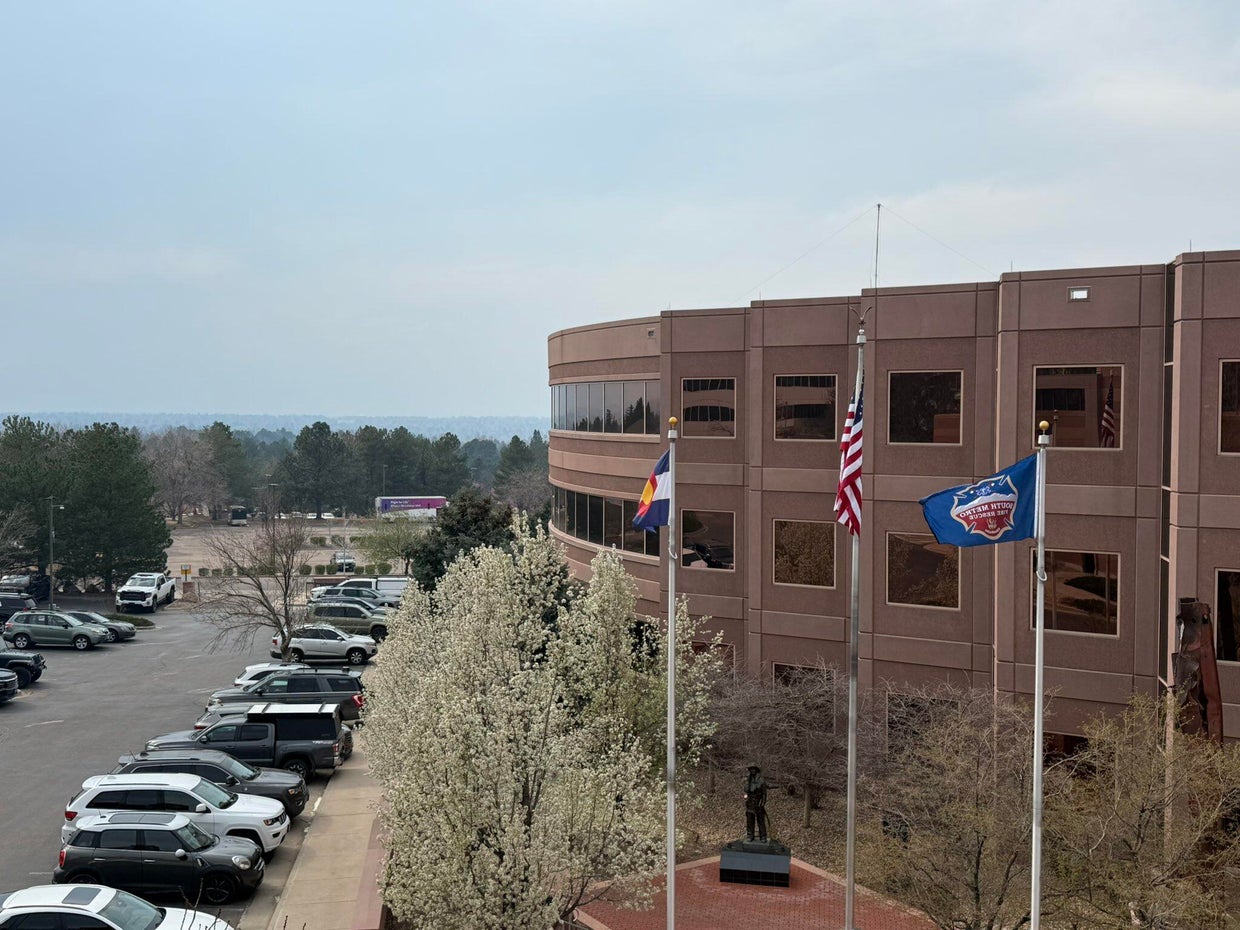
South Metro Fire Rescue said in their post that the smoke is from Colorado’s neighbor to the east. They called it a “significant haze” in the air.
Earlier this month, the Morrill Fire and the Cottonwood Fire burned a significant amount of Nebraska grassland and ranchland. They have mostly been contained by firefighters. Nebraska Gov. Jim Pillen said those two fires combined with several others have burned approximately 800,000 acres of land. On Thursday, Pillen announced that he is signing several executive actions intended to ease the burden caused by the fires.
There were no wildfires burning in the Denver metro area on Thursday afternoon.

ARAPAHOE COUNTY, Colo. (KKTV) – A homicide suspect based out of Colorado, wanted in a fentanyl-related death, is back in the state after being captured in Colombia.
The Arapahoe County Sheriff’s Office (ACSO) said 33-year-old Max Arsenault had been on the run since January 17.
Deputies said this stemmed from an incident in May 2023, where deputies responded to a call for a man named Nicholas Dorotik, who was found unresponsive.
ACSO said the cause of death was a mixed drug overdose involving meth and fentanyl, having about three times the lethal amount of fentanyl in his system.
One year later, Arsenault was arrested. He was scheduled for trial in January 2026 when deputies said he fled the country while on bond three days before the trial was set to start.
He was caught in Medellin, Colombia, on March 4, following a two-month international investigation. He has since been extradited back to Denver, where he is facing charges and awaiting trial.
Copyright 2026 KKTV. All rights reserved.

Idaho Senate introduces new bill to give local municipalities authority to control rat populations

Illinois vs Iowa prediction, analysis, Elite Eight expert picks for men’s March Madness

Police arrest suspect in Westfield homicide

Tennessee basketball vs Iowa State Sweet 16 tipoff time changed for later start

Kansas State Baseball 2026 at Utah

Florida High School Football Rankings: Top 25 teams – Oct. 21

How old is Bo Nix? What to know about Oregon quarterback ahead of 2024 NFL Draft

Cleary's 21 help Le Moyne down Central Connecticut State 69-64 in OT

99th annual Pony Swim held in Virginia

Indiana Members Credit Union announced as new anchor tenant at Bottleworks District

WATCH: Senate hearing goes silent after Angel Father confronts top Dem over daughter’s death

US diplomat Marco Rubio denounces settler violence, tolls in Hormuz strait

Iran-linked hackers have breached FBI Director Kash Patel’s personal emails | CNN Politics

Live: CPAC 2026 Day 2

Video: Will ICE Change Under Its New Leader?
-

 Detroit, MI1 week ago
Drummer Brian Pastoria, longtime Detroit music advocate, dies at 68
-

 Movie Reviews1 week ago
‘Youth’ Twitter review: Ken Karunaas impresses audiences; Suraj Venjaramoodu adds charm; music wins praise | – The Times of India
-

 Sports6 days ago
IOC addresses execution of 19-year-old Iranian wrestler Saleh Mohammadi
-

 New Mexico5 days ago
Clovis shooting leaves one dead, four injured
-
 Business1 week ago
Disney’s new CEO says his focus is on storytelling and creativity
-

 Technology5 days ago
YouTube job scam text: How to spot it fast
-

 Tennessee4 days ago
Tennessee Police Investigating Alleged Assault Involving ‘Reacher’ Star Alan Ritchson
-

 Texas1 week ago
How to buy Houston vs. Texas A&M 2026 March Madness tickets