Colorado
How Colorado funeral homes are rebuilding trust eroded by years of industry scandal


Mike Dudley can usually pick up on someone’s anxiety about dealing with Colorado’s funeral home industry the first time they sit down to talk.
It starts with pointed questions as he meets with families in the conference room at Rundus Funeral Home & Crematory in Broomfield, where Dudley is the general manager and funeral director. How is their loved one’s body going to be handled? Who will be caring for them? When, where and how will they be cremated or put in a casket?
Sometimes it comes out of the blue, like when a man called Dudley three years after Rundus cremated his loved one because he couldn’t stop thinking about whether or not he actually had the correct cremains.
“His mind just got wondering and he needed reassurance,” Dudley said. “Like, ‘How do I know this is in fact my person in the urn?’”
Whether it’s pointed questions from prospective clients or phone calls years after the fact, recent scandals in the state’s funeral industry have shaken Coloradans’ trust in the professionals who care for their deceased loved ones, funeral directors and industry experts told The Denver Post.
While Colorado lawmakers have made significant strides in adding state regulations to prevent future scandals, rehabilitating the funeral industry’s reputation is a more complicated task.
“The trust that’s been broken here, it’s going to take a long while for us to restore it,” said Matt Whaley, president of the Colorado Funeral Directors Association.
The effect of Colorado’s notoriously lax funeral home regulations burst into public view in 2018, when an FBI raid on Sunset Mesa Funeral Directors in Montrose found that mother-daughter team Megan Hess and Shirley Koch stole and sold hundreds of bodies around the world to turn a profit.
Hess is now serving a 20-year prison sentence and Koch is serving a 15-year sentence.
Coloradans are still seeing the fallout of more recent scandals, like the active investigation into Davis Mortuary owner (and former Pueblo County coroner) Brian Cotter, who operated the mortuary where state inspectors found 24 decomposing bodies in a hidden room in August.
Dudley is often at a loss for words when he thinks about the scandals, like what happened at the Return to Nature funeral home in Penrose, where owners Jon and Carie Hallford allowed 191 bodies, stacked on top of each other, to decompose for over four years while giving families fake cremains.
The Hallfords both face decades-long prison sentences after pleading guilty in their state criminal cases.
“Even when we’re transferring (the deceased) from a cot to a dressing table, we’re making sure their head doesn’t bang. We’re treating them as if they’re still alive, with care and respect. That you could let those people languish for years… how could you do that?” Dudley said. “How could you sit in front of a family and hand them an urn knowing full well it’s Quikrete?”
So when the man called him out of the blue asking about his loved one’s cremains, Dudley explained that every person who is cremated gets a metal disk with a unique set of numbers that stays with them through the whole process and is zip-tied to the bag of cremains that are returned to families.
“I said, ‘Tell me that number. Don’t tell me the name of your person. I’ll go back to our cremation log and tell you the name associated with the number,’” Dudley said. “I came back, said I have that number associated with this person, and he just said, ‘Oh, thank God.’”
Scandals had statewide, local ripple effects
Cases of industry workers mishandling bodies in Montrose, Penrose, Denver and Pueblo have had a far-reaching effect on Colorado’s funeral home industry, said Kim Bridges, who owns the parent company that oversees three metro Denver funeral homes, including Rundus.
“When these things started happening, it was awful for the industry,” she said. “It makes everyone look at the industry with skepticism and that’s a shame because you need to be able to trust the people you entrust your loved one to.”
Bridges Funeral Services, which Bridges owns with her husband, also oversees funeral and mortuary facilities in New Mexico, Tennessee and Florida.
The uptick in funeral directors and staff encountering families who are anxious about cremating or burying their loved ones is not limited to Rundus, said Whaley, who has worked in the funeral home industry for 38 years and is now market director at Dignity Memorial.
More people are also asking to witness cremations to make sure they know exactly what is happening to their loved one, he said.
When Dudley encounters people with questions or doubts about the funeral and cremation process, he tries to be as transparent as possible, answering their questions with as much detail as they want and offering tours of the facility.
For most, the offer is enough to calm their fears, Dudley said. But about a third of those want to see everything, from the plain-but-clean room lined with cabinets and counters where the deceased are prepared for services, to the massive, gray crematory that looks similar to a metal shipping container.
Whaley, Dudley and Bridges all shared the same sentiment: Families asking more questions about the funeral process is a good thing and should be welcomed.
“If someone doesn’t want to give a consumer all the information they’re asking for, shame on them,” Bridges said. “The consumer should go somewhere else and ask for a tour of the place.”
That kind of simple and up-front communication is the right way to rebuild trust with the community after a crisis, said Andy Boian, founder and CEO of the Colorado- and California-based public relations firm Dovetail Solutions.
Boian and other public relations experts who spoke to The Denver Post commented on the scandals hypothetically, as neither have worked directly with funeral homes on this issue.
Good communication includes walking people through the process, making sure they understand what’s happening and circling back regularly, he said.
“At the end of the day, that would ratify and settle a lot of people’s concerns,” Boian said.
That transparency now extends into Colorado’s industry regulations after state legislators, motivated by recent scandals, passed new laws to prevent the same kind of situation from happening at funeral homes or mortuaries ever again.
Passed in 2024, the three new laws require funeral directors and other industry professionals to obtain licenses; for state regulators to perform routine inspections at facilities; and for businesses to obtain consent and share more information about body donation.
Colorado officials say the new regulations are already making a difference — for example, bodies discovered in a hidden room at Davis Mortuary in Pueblo were found by state inspectors during their first-ever visit to the facility — though that impact isn’t necessarily felt by the people doing the work every day.

Bridges jokes that her staff are more nervous about a drop-by visit from her than from state inspectors.
“We welcome all oversight because we conduct ourselves in such a way that it’s not an issue,” she said. “If you have to run around and get things right before someone comes in, you’re doing something wrong.”
That ethos, Boian said, also represents another avenue for funeral homes to redeem themselves in the eyes of the community.
“There’s also an opportunity here as well, and that is to be the best and most proficient at your craft,” he said.
Overcoming scandal, moving forward
Crisis management experts told The Denver Post that while the public is usually willing to forgive and forget scandals if those involved do a good job communicating, the fraught nature of dealing with death makes this more complicated.
“It’s really tricky when it’s something sensitive like this,” said Kara Schmiemann, senior director of crisis communications at Red Banyan, a national crisis PR firm with offices in Denver. “When it has to do with our loved ones, these are the most difficult industries when they face a crisis because there’s a lot of emotion packed in there.”

And while the scandals at a handful of Colorado funeral homes may have sown skepticism among the general public, they had the opposite effect on Arapahoe Community College student Luke Olson.
Olson, who studies in the mortuary science program, was pursuing a mechanical engineering degree before he switched career paths. He said he was drawn to the hospitality of the field and the family connection — his grandfather was a mortician for a tiny town of 90 people.
“Going into the practice is emboldening to me and a new generation of death care practitioners who want to uphold the law and repair the damage that’s been done to Colorado’s reputation in the past,” Olson said.
Contrary to the stereotype about funeral home owners trying to profit off of the bereaved, people who get into the profession are not doing it for the money, Olson said, describing the wages as “very middle class.” (Funeral directors earn $51,607 per year on average, according to the National Funeral Directors Association.)
“You are going into it with the anticipation of serving your community and serving families,” he said.
Olson’s perspective is common among people studying mortuary science, said Faith Haug, mortuary science program chair at Arapahoe Community College.
“One of the things I appreciate with where the younger generation of funeral directors want to go is that it’s more family-centered, where things are not just spirited away to a back room and nobody knows what goes on,” Haug said.
And if there is a sliver of good to be found in the horrors carried out at a handful of Colorado funeral homes, it’s the chance that people will also want to be more involved in the death process for their loved ones as a result, Haug said.
“We have taken families out of the process in many ways, and all these things coming to light show that they deserve more transparency and more involvement if that’s what they want,” she said.
Get more Colorado news by signing up for our daily Your Morning Dozen email newsletter.



Target team members traded shopping carts for paint brushes on Friday as they helped transform spaces inside a Denver elementary school through the company’s Bullseye Builds program.
The volunteer effort at the Trevista at Horace Mann Elementary School included upgrades to the teacher’s lounge, outdoor beautification projects, and the creation of a new sensory room for students with disabilities. Employees spent the day painting, decorating and building spaces designed to better support both students and staff.
“It’s really exciting for the team because we get to roll up our sleeves and volunteer, and also make an impact to the students and teachers here at the school,” said Alisa Dalton, Target’s vice president of community engagement and belonging.
The project is part of Target’s nationwide Bullseye Builds initiative, which combines volunteer efforts with the company’s design expertise to support community needs identified at the local level.
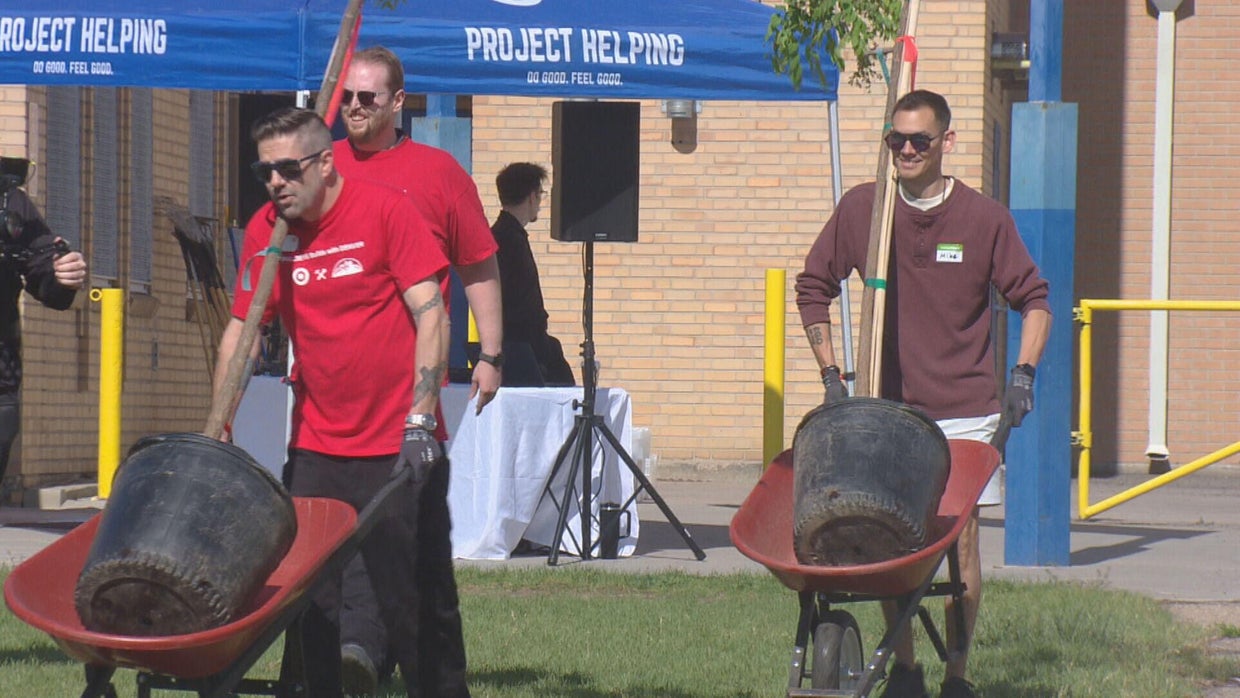
“We’re going to be doing 13 Bullseye Build programs across the country this year, and how we approach these projects is really listening to the community and where they need us most,” Dalton said.
Trevista Principal Jessica Mullins said the opportunity came after Target reached out while the school was applying for a grant through Apple.
Students quickly noticed the changes taking shape around campus.

“Kids are really excited [about] the vibe today, running around, they’re with Target,” Mullins said.
Mullins said the improvements will benefit more than just students.
“You have to take care of your staff,” she said. “When you have happy teachers, that impact takes care of your students.”

This story, originally titled “Bear Attack,” first appeared in the January 1980 issue of Outdoor Life. Until this attack in September 1979, grizzlies were thought to be extinct in Colorado. Two grizzly bears were killed in the state in 1951, before the bears were declared an endangered species. Both were about three years old. One of them was killed just a dozen miles or so from the place where Wiseman was attacked.
THE BEAR came at me with no warning. Ears flattened, neck hairs stiffly erect, it growled fiercely as it charged, full bore, right at me. I saw its flashing teeth as it came, and I knew in an instant it was a grizzly, although I’d never seen one in the wild before. There was no mistaking the hump on its back, the broad face and the guard hairs. I’ve seen a couple of hundred black bears in the woods, enough to know that this one was entirely different from the rest.
The grizzly’s attack started about 30 yards away, and I had no time to raise my bow and arrow. For a brief moment I thought the bear would go around me. Maybe its charge was a bluff. I’d had close confrontations with black bears before, and even had them approach me, but they all eventually backed off, giving me nothing more than a good scare.
This bear kept coming, growling and snapping its teeth with each terrifying bound. When I realized it meant business, I shouted at the top of my lungs, but it was no use. In two more leaps, the bear would be all over me.
I’m 46, a full-time outfitter, and I make my living taking people hunting and fishing. I was raised in Colorado and live in Crestone, near Alamosa. Fourteen years ago, I decided to go into outfitting and I’ve been at it ever since. The country I hunt is one of the most remote regions in the Rocky Mountains of Colorado.
I had little sensation of pain, but I vividly remember the sounds of flesh tearing as the bear ripped into me.
I had four elk hunters out that day, the last day of the 1979 bow season. The weather was balmy, with bright blue skies, and the warm temperature made for comfortable hunting, although it got chilly in the evening.
My hunters were W. C. Niederee and his son, Mike, from Great Bend, Kansas, and Rick Nelson and Jim Latin, both from McPherson, Kansas. On that last day, Ace Calloway guided Rick and Jim, Chuck Gibbs guided Dr. Niederee, and I took Mike. Al Brandenburg, my cook, remained in camp.
Dr. Niederee decided to hunt on a slope opposite camp that day. The rest of us rode out of camp together and split up about three miles down the trail. Ace, Rick and Jim rode south to hunt the East Fork of the Navajo River; Mike and I headed west for the Main Fork.
Mike was the only hunter in the party who hadn’t seen elk that week. Everyone had seen plenty of animals, and Rick said he’d looked at about 85. I figured the Main Fork would be a good place to show Mike some elk because I knew of some pockets that were always good. The area was just off the Continental Divide; it was rugged country that few people penetrated. It was about 11 miles by trail from camp to the place I wanted to hunt, about five miles overland.
About 2 p.m., we tied our horses in the timber and began to hunt on foot. We split up and planned to meet at the other end of the meadows, where I’d intercept Mike. Although I carried my bow, I wasn’t really hunting intently. I figured on looking for elk sign and later meeting Mike.
I worked my way along and kept my eyes on some open meadows in the timber. I thought I’d see Mike as he traveled through them. He never appeared, so I wandered up toward the horses to see if he’d returned to meet me there. Freckles, my Apaloosa mare, and Buckshot, Mike’s horse, stood quietly in the trees. Mike wasn’t around.
I headed back down to look for more sign. We were in a small finger off the main ridge, and I knew there was a good chance that Mike and I would meet. About 5 o’clock, while walking across a small flat, I heard an ominous growl a short distance away.
For a moment, while the grizzly charged straight at me, I thought it might be trying to get around me. But I quickly discounted that possibility as the bear narrowed the distance to just a few yards, still coming full steam. At close range, I could easily see the hump on its back and the yellow guard hairs. The bear growled continuously, and its open mouth exposed a set of huge teeth. My shouts, which might have startled or turned another bear, had no effect. This grizzly was enraged, and I was in bad trouble.
The charge lasted only a few seconds. I was carrying my compound bow at my side, but there was no time to nock an arrow. My knife was in my day pack, well out of reach for the precious split-second I had.
The bear was almost on top of me when I raised my bow, trying to fend off the attack. I shoved it in the grizzly’s face, but it bowled me over. The bow clattered to the ground, and arrows scattered everywhere.
As soon as I hit the ground I curled up into a ball. I brought my knees up under my belly to protect my vitals, stuck my face into my chest as far as I could, and clasped both hands behind my head to cover my neck. My day pack was still on my back, and would offer some protection there. I had read many articles that said playing dead was the thing to do during a bear attack. I knew that no man is a physical match with an enraged bear.
The grizzly immediately started mauling my right leg with its teeth. I had little sensation of pain, but I vividly remember the sounds of flesh tearing as the bear ripped into me. As I lay there helplessly, my only hope was that the grizzly would tire of me and leave.
It kept biting and chewing at my leg, and I forced myself to lie as quietly as I could. I still felt that if I didn’t present myself as a threat to the bear, it would quit and lumber off into the woods. Strange as it might seem, I never panicked, even as the grizzly continued to work over that right leg.
I felt the bear dragging me slightly, but most of the time it would bite into my leg, shake its head and bite into the leg again. It didn’t use its huge claws, just its teeth.
Then the bear dropped my leg and bit into my right shoulder. It clamped down hard, and penetrated my flesh deeply with its powerful jaws. I didn’t know it then, but the bear had bitten completely through my shoulder, from one side to the other. Later, at the hospital, doctors found puncture wounds all the way through. Clinical tests also showed it bit my shoulder twice, but there was no tearing, just deeply penetrating bites.
When the bear let go of my shoulder and started on my leg again, I remember telling myself, This could be the end.
At that point I realized that this was more than a passing attack. Playing dead was getting me nowhere, so I desperately started thinking about fighting back. If the mauling kept up, the grizzly would surely kill me.
In the blur of the ordeal, I saw an arrow lying close by. I reached for it, and because of good luck or providence, it was pointing toward the bear.
I’m convinced that my hunting background was a factor that weighed heavily in my survival. I always trained myself to instinctively shoot at one part of an animal rather than the whole thing. I focused all my attention on the grizzly’s frontal portion and brought the arrow up with as powerful a thrust as I could muster, all the while concentrating intently on a small spot that I judged to be vital. I’m right-handed, but the arrow was in my left. I plunged it deeply into the bear. Years ago, I was a meatcutter. I know something about animal anatomy, but lying on the ground with a bear tearing into me, I wasn’t sure I could drive it away before it killed me. Survival was all I could think of then, and I knew I must try.

The arrow I used, a new Bear razorhead fitted on a magnum aluminum shaft, is one of the strongest made. Somehow, the arrow snapped in half after I drove it into the bear. I remember reading about people who have by some incredible force lifted wrecked cars off their loved ones; the human brain in such cases goes momentarily haywire and the adrenalin flows. Maybe that’s what happened to me. All my senses were fine-tuned to driving off that grizzly. There was no other choice.
After the shaft broke, I reached for the arrow and yanked it back out of the grizzly. A stream of blood flowed from the wound, and I rammed the broken arrow back in again as hard as I could. I remember thinking that the blood looked like it was coming from the jugular. I was convinced I had struck a pretty good blow. At that point I thought, Maybe I’ve got a chance.
The grizzly gave no indication of being hurt and kept biting and tearing at my leg. It kept on growling, just as it had done throughout the entire attack. Right after I stabbed it, it started on my left leg for the first time.
Suddenly, the bear stopped working me over and walked over the top of me. A great gush of blood from the bear’s arrow wounds splashed over me as the animal stepped across. The grizzly loped off and stopped about 25 yards away. I saw it slowly lower itself to the ground. It lay still, and I knew it was dead.
I was off in a side finger of the drainage, and my only hope was to make it to the main trail where I might be found. I didn’t realize it at the time, but Mike was only a couple of hundred yards away from me throughout the entire ordeal.
I got up slowly, unsure whether my mangled right leg could hold my weight. I tested it carefully and was relieved to find that I could walk. The main trail wasn’t far, and I started for it standing up. The bleeding was starting to take its toll, though, and I felt myself going into shock.
I was about 90 yards from the scene of the attack when I heard Mike shout. I was surprised and relieved to hear him. I shouted back, and he appeared in the timber moments later.
Mike is 25 and a full-time farmer. He is tough and wiry, but when he walked out of the woods toward me, he looked like he’d seen a ghost. My physical appearance didn’t help. I was covered with blood from the top of my head to the soles of my feet. Every square inch of my camouflage clothing was blood-soaked, and my face and hands were crimson.
Afterward, I learned that Mike had heard the bear growl as it charged me. He also heard my shouts. By the time he got to the scene, the attack was over, and all he could see was a great spot of blood-soaked ground, my bow and scattered arrows. He was convinced the bear had killed me and dragged me off. He moved slowly with a nocked arrow, figuring he’d be facing the bear too. Then he spotted the bear lying dead and realized I might be alive after all.
We used the limited supplies from a small first aid kit to bandage my leg as well as we could, with strips of Mike’s shirt for wrappings. I made myself as comfortable as possible, and Mike went for help. The sun was setting, and I knew I was in for a long, hard night.
By the time Mike returned with the horses, I had grown much weaker. He brought them over to where I lay, and they got jittery when they caught a whiff of the bear and the blood. Mike tied Buckshot by the reins, and when he led Freckles toward me, Buckshot reared back and shucked the bridle. The spooked horse took off.
Mike tried to position Freckles in a way that would be easiest for me to get aboard. But when I stood up, I lost consciousness. Mike eased me to the ground, and it was a while before I came to.
I tried a second time to get on the horse, with Mike pushing and lifting me. Freckles is a big horse, 17 hands high. That worked against me now. I got my foot into the stirrup, swung my mangled right leg over and grabbed the saddle horn. I talked to Freckles, who was still jittery, and she settled right down.
We started off, and Freckles got shaky again because of the strange smells. Mike was leading Freckles using only a lead rope and halter, so I told him to put the bridle back on. When he did, we had better control, and she calmed down some.
By the time he got to the scene, the attack was over, and all he could see was a great spot of blood-soaked ground, my bow and scattered arrows. He was convinced the bear had killed me and dragged me off.
As we traveled, Mike led my horse, and he constantly looked back and said, “Ed, talk to me, talk to me.” I was slumped over in the saddle, bent over to the front. That way I wouldn’t pass out. If I tried to sit straight up, I’d feel myself getting dizzy and going under again. Mike tied my raincoat over the saddle horn to keep it from bouncing into my gut, but it was still painful to stay in the saddle. Riding wasn’t helping my leg which was still bleeding freely.
Mike wasn’t sure of the country, and every once in a while, when my head cleared enough that I could look around, I’d give him directions to get us on the trail. I was having trouble maintaining full consciousness.
Finally we got to a large meadow, and I decided I could go no further. I knew it would be foolhardy to continue because camp was still some 10 miles away and I’d never make it. The meadow would serve as a good place for a helicopter to land. It was about 7 in the evening, and I knew I had to rest and get my head down to where I could think straight. I was the only one who knew where we were, and I had to get Mike ready for what was in store for him. I had to describe in detail the overland route to base camp. If he took the trail, the way he had come, it would be an extra six miles or more, some of it with no visible trail. So he’d have to go across the mountains. It was the dark of the moon, and he had his work cut out for him.
Mike built a fire while I lay back and rested. He dragged wood to where I could reach it, but in his haste to get going for help, he didn’t gather as much as I’d need. He piled all the extra clothes on top of me. I told him to follow a nearby stream bed up to a pond and then cross the Continental Divide. The ride downhill would be pretty steep going. But he’d come out about half a mile above camp.
I knew it was asking a lot of him to find camp during the blackness of the night, but I was confident that with the landmarks I’d described to guide him, along with the trustworthy Freckles, he’d get there. All of my mountain horses are well oriented to the country, and they can find their way around as well as anyone.
After Mike left, I was as conservative as I could be with the firewood supply. As time wore on, though, I knew I was going to run out. The closest wood was some distance away, so I tried to burn a somewhat green log that Mike had inadvertently dragged over.

It started to get colder, and I knew I’d have to do something for warmth. I saw the outline of a log up the hill behind me, and it appeared there was some firewood around it. I rested again, did some isometric exercises to stimulate body heat a little, and covered my head with a jacket to retain as much heat as I could.
There was no way I’d be able to get up the hill and return to the original campfire with wood, so I started dragging myself along the ground, hoping to start another fire at the log. I used both arms and my left leg, and every move was a painful effort. I kept my head as low as possible to avoid passing out.
It was only 20 feet or so to the log. It seemed 10 times that far, but I kept myself from panicking. I concentrated on little things — like what I should do in the next hour, or two hours. I thought back about the sequence of events so far — I had survived a bear attack, my vital organs were intact, Mike was close by to assist me, I was at a point where I could be rescued, and now Mike was heading for help. I wouldn’t entertain the thought that it wouldn’t work. It would work. Help could be on its way by midnight, just an hour or so away. Dr. Niederee would be there with medical supplies, and I’d have my sleeping bag to warm up in.
But help didn’t come by midnight. The evening began to pass more slowly, and I wondered if the men might be having trouble finding me. I was in an area where we seldom hunted, and no one in camp was familiar with that part of the country.
A new problem came up. The evening breeze grew stronger, and I began shivering. I had to find protection from the wind, and looked about for some kind of shelter. I saw a small pine tree not far off. Its thick boughs grew to the ground. It was my only hope for a windbreak, so I inched over to it, covered myself with the clothing I had available and tried to get comfortable. I didn’t want to sleep, because if I slowed my body processes, I would only hasten hypothermia. The combination of shock and loss of blood made it dangerous to risk sleep. I had no choice but to stay alert.
While I lay there, I assessed my plight. I’m a practicing emergency medical technician, and I know something about vital life signs. If I could withstand the loss of blood and shock, hypothermia would be the only thing that could write the final chapter. Curiously enough, I was confident that I’d survive.
Suddenly, I saw two flashlights above me, coming off the ridge. I yelled and heard Mike shout back. He was alone, carrying a flashlight in each hand. It was about 3 in the morning. I’d been alone eight hours.
When he reached me, Mike immediately started a fire, but it was difficult because the wood was wet. Finally he got a good blaze going. I was eager for its warmth. He told me that his dad, Dr. Niederee, and Ace were on top of a high ridge. We spotted their flashlights, and they located us when they saw the fire. Mike hollered that he’d found me.
Help didn’t come by midnight. The evening began to pass more slowly, and I wondered if the men might be having trouble finding me.
The position of their flashlights told me that they were too far down the canyon. They needed to go back to a patch of thick timber and then work their way down through it. Mike tried to warn them about a steep hillside near them, but they apparently didn’t understand what he was saying.
About 5 a.m., Ace and Dr. Niederee appeared on foot, without medical supplies or sleeping bag. I learned that they had tried to work their way across some brush along the steep shale hillside when trouble began.
Ace’s horse hit the shale, slipped and spun around. The doctor’s horse, Puffer, slipped on the shale and slid about 10 feet down the mountain. Puffer somehow came to a stop, and Dr. Niederee eased out of the stirrups so as not to unbalance the horse. He got off, grabbed for a bush and fought his way up out of the loose shale. Puffer tried to get out but slid down another 100 feet. It was impossible for Ace and the doctor to get to the horse in the dark.
Later that morning some of my men tried to get Puffer out. They got the saddle, sleeping bag and medical supplies and planned to come back the next day with more help. But it was too late. In his attempt to get out, Puffer went over the edge of the cliff and fell 200 feet to his death.
Dr. Niederee looked my leg over and saw there was no immediate danger. He was concerned about hypothermia. The men built a fire to warm the length of my body.
After I was comfortable and somewhat warm, we spent the rest of the night waiting for the helicopter that was to come in at daybreak. Mike built a fire where he wanted the helicopter to land.
It began to get light, and we strained to hear the helicopter, but it didn’t come. Time began to drag because of the anticipation, and for the first time, I was beginning to look forward to going to the hospital.

About a half-hour after daybreak the helicopter broke the Continental Divide, and we all heard it at the same time. It was a beautiful sound, and it didn’t come any too soon. I was starting to shiver uncontrollably.
The Medivac team performed flawlessly and got me to Alamosa Community Hospital without a hitch. The pilot flabbergasted passers-by when he put the ship down smack in front of the emergency room door.
After the doctors looked me over, they quickly got me under an electric blanket. My temperature was down to 95 degrees, and my blood pressure was low. Dr. Niederee thought I’d lost as much as three pints of blood. My right leg from knee to ankle looked like hamburger. One of the small bones was broken, and there was infection as well as possible nerve damage. I also suffered bites on my left leg, both arms, and my right shoulder. I expect to go back in for surgery to help mend the broken bone in my leg, and some skin graft and nerve repair.
Now that the ordeal is over, I can’t help but think back on incidents in my hunting territory. Once I guided a hunter who watched over a horse carcass as a bait. During the night, a bear dragged the horse, which weighed about 400 pounds, to an area about 100 yards away to feed on it. I assumed it was a big black, but now I wonder if it could have been a grizzly.
Read Next: The Best Bear Hunting Cartridges
About seven years ago, while I was away from my base camp, a bear moved in and destroyed it. I found 7-inch wide prints in the dirt. Again, I thought it was a big black bear.
Three of my clients have insisted that they’ve seen grizzlies. I know there are plenty of blacks in my territory; my hunters saw five during the 1979 elk bow season alone. The blacks are blond, brown, fire-engine red, black, and shades in between. I always figured those “grizzlies” were big blacks, but now I’m not so sure.
With the grizzly encounter now a matter of history, one of my most sincere hopes is that experiences like mine will not make people fear the outdoors. As always, any bear is to be respected for its potential danger, not feared. I don’t know why the grizzly attacked me, but I have no qualms about going right back into that country as soon as I can. You can be sure of one thing, though. The next time I come across huge bear tracks, I’m going to wonder just what made them.
About Ed Wiseman, the Bear Attack Survivor
Ed Wiseman didn’t survive the grizzly attack because of luck. He is a powerful man, and he was able to use his strength against the bear. He did not wish to kill the bear and tried to avoid taking an aggressive stand until he realized it was a matter of life or death. Since the incident, Wiseman has repeatedly stated that he does not want people to fear bears, only respect them.
Since the attack, biologists have learned that the grizzly that attacked Wiseman was an old sow, more than 20 years old and weighing about 400 pounds.
Until this attack, grizzlies were thought to be extinct in Colorado. Two were killed in 1951, before the bears were declared an endangered species. Both were about 3 years old. One of them was killed just a dozen miles or so from the place where Wiseman was attacked.
Wiseman owns Toneda Outfitters in Crestone, Colorado, and hunts year-round. He uses hounds for cougars and bears. Wiseman runs a clean camp, and wants only serious hunters. He doesn’t allow alcoholic beverages, because he wants his hunters to be in their best physical shape each day in the mountains. Although he accommodates gun hunters, he is a bowhunter himself and specializes in archery hunts. He is an official measurer for the Pope and Young Club.
Mike Niederee, who was with Wiseman during the attack, says, “Ed is one of the finest outdoorsmen I’ve ever known. There’s a local saying that nobody keeps up with Ed Wiseman in the woods. He’s simply the toughest guy around.”
One of his nephews sums up Wiseman’s abilities this way: “Of course Uncle Ed won the bear fight. He wins every time.” —Jim Zumbo, Jan. 1980

-

 Movie Reviews1 minute ago
‘Red Rocks’ Review: Weirdo, Cliff-Jumping Kiddies Are the Focus of Bruno Dumont’s Latest Experiment
-

 World13 minutes ago
Cubans Cook With Charcoal and Wood Fires to Survive During Energy Crisis
-

 News20 minutes ago
Amid Iran War, Remembering the Losses From Another Middle East Conflict
-

 Politics26 minutes ago
5 Big Moments in the Texas Republican Senate Race
-

 Business32 minutes ago
New Waterside Getaways for the Summer
-
 Lifestyle1 hour ago
A kick takes on a life of its own in the kids’ book, ‘When Tad Kicked Vlad’
-

 Technology1 hour ago
On Trails is a wandering tale that blends hiking, science, and history
-

 World1 hour ago
At least 82 killed after massive gas explosion rips through coal mine in China

