Colorado
Colorado’s literary identity is building, page by page


The customer at the counter of West Side Books in North Denver was trading thoughts with Terry, the ponytailed, bespectacled, thoughtful employee at the register.
Which Jack Kerouac book should he start with?
“On the Road,” Terry answered, then added, “It’s probably easiest.” Somehow that sounded like the kind of understatedly perfect advice one so often receives at an independent bookstore.
Published in 1957, the roman à clef carved Kerouac (as Sal Paradise) and his pal Neil Cassady (Dean Moriarty) into the cornerstone of American letters but also into the history of this town. Kerouac famously bopped around Writers’ Square, My Brother’s Bar and Five Points.
One could argue that the next soul to shape Denver’s sense of its literary self as deeply wasn’t a writer but a purveyor of literature, and ardent defender of the First Amendment: Tattered Cover Book Store founder Joyce Meskis (who died in 2023). And then there was Clara Villarosa, the force behind one of the most robust Black-owned bookstores in the nation: the Hue-Man Bookstore, first in Denver and later, Harlem.
This wee bit of namechecking might be achingly nostalgic were it not for a palpable surge in literary oomph about town. Bookstores continue to have their share of existential challenges, but in the face of the too constant dirge that people (young people, they’re throwing you under the bus!) aren’t reading much, people are still visiting and opening bookstores, enrolling in craft workshops, launching reading series.
Next week features back-to-back events that speak to a surge in literary engagement: Lighthouse Writers Workshop’s gala, Illumination (Sept. 19) and the Margins Book Festival, a program of the Word: A Storytelling Sanctuary (Sept. 21-22).
The best arts ecosystems are both rooted and itinerant: locals stick around but also head out into the world even as folks come and decide to stay awhile. Kathryn Eastman, founding editor of the newly launched site the Rocky Mountain Reader, recalled recognizing something familiar in “Hum,” the well-reviewed, latest novel by Helen Phillips, who grew up in Colorado but currently lives in Brooklyn. “The main character’s desire — her desire for her children [is] to experience nature and the wild,” said Eastman during a recent video call. “It’s such a good book. And as soon as I found out that she was born and raised in Colorado, that aspect of the book made so much sense to me.”
On the other hand, Canada-born Vauhini Vara — her “Immortal King Rao” was a Pulitzer Prize finalist — makes her home in Colorado; she teaches at Colorado State University. Peter Heller, author of the bestselling novel “Dog Stars,” lives in town. His most recent novel, “Burn,” was published last month.
It’s not just an uptick in local luminaries or the parade of authors in and out of the city that suggest a sea change. It’s the cumulative effect of people rethinking how literature works in their lives.
“Booksellers all over the state are more and more becoming community centers,” said Eastburn. “Where there’s writing instruction, places where there are book clubs and places where mothers can gather and let their kids go over to the children’s section and all kinds of things that they do.”
“Denver’s a deliciously unpretentious place in which to engage in art making,” said Lighthouse’s program director Andrea Dupree, who co-founded the organization in 1997 with Michael Henry. “There’s something that feels both lower stakes and higher touch about the mountain West to many of us, especially if we’ve experienced other ecosystems.”
Here are five signs the local ecosystem is flourishing.
Illumination: A (Wild) Literary Soiree

Last year, the Lighthouse Writers Workshop gala’s honoree was the fearsome Roxane Gay. Arguably gentler but no less dynamic, Cheryl Strayed — author of “Wild” — headlines the Sept. 19 celebration. Lighthouse (where I sometimes teach) has much to celebrate. Summer’s Lit Fest was among the best attended in the organization’s near 20-year history and the second to take place in their sleek home in the York Street Yards complex.
“To many who participate in Denver’s literary scene, I think the result is a feeling of freedom — to take risks in their writing, to embrace their feelings of struggle (Michael Cunningham called it, memorably, that “writerly feeling of ineptitude”), to get it right, Dupree stated. “I’ve seen so many writers find their support teams here, and so many of those teams cross generations, race, gender and walk of life.”
Among the workshops, gatherings and retreats (the Writing in Color Retreat and the Queer Creatives Retreat), the organization offers its lauded Hard Times program, which provides space to writers experiencing — or who have experienced — homelessness, addiction, poverty or other challenges.
Tickets for the gala are selling briskly; tickets for a streaming version of an event featuring Strayed the next night are also available. Lighthouse Writers Workshop. 3844 York Street. lighthousewriters.org.
Margins Book Festival

Two years ago, the Margins Book Festival featured one of the most inspiring keynotes I’ve seen. It wasn’t so much a speech but more of a conversation between Nicole Counts, senior editor at the Random House imprint “One World,” and two of her writers, Nate Marshall and K-Ming Chang. In addition to sweetly confessional stories from the authors, the event offered a master class in what an insightful, supportive rapport between editor and writer looks — and sounds — like. So, the bar has been raised for next week’s edition of the biannual event.
The Margins Book Festival is the handiwork of the Denver-based literary arts organization Word: A Storytelling Sanctuary, founded in 2016 by Viniyanka Prasad, a criminal defense attorney. The Word places BIPOC writers with publishing professionals so that authors can find a path to sharing the stories that speak to and of them and deepen our broader cultural conversations.
Headlining the upcoming festival are authors R.O. Kwon, Karla Cornejo Villavicencio and Aaliyah Bilal. This year’s installment of the two-day festival will unfurl on the Santa Fe Arts District corridor.
Margins Book Festival, Sept. 21-22 at Su Teatro, Center for Visual Arts and other locations along the Santa Fe Arts District corridor. Admission is free, although passes are encouraged.
Two bookish hubs for the soul
On a recent and hot Sunday afternoon, Petals & Pages was cool, quiet, oasis-like. How apt. After all, this feminist, queer-owned haven in the Santa Fe Arts District sells a selection of smartly curated books, as well as flowers and plants. It also offers respite for the weary writer with its Writers Corner, and workshops galore. In a clever touch, the shop has memberships, which helps keep it chugging but also seeds its community-nurturing atmosphere. Petals & Pages, 956 Santa Fe Drive, Denver. petalsandpagesofdenver.com.
Flowers and book leaves? Who doesn’t appreciate a hybrid? In the Ballpark neighborhood sits the print-and-social-justice go-to, The Shop at MATTER. The creation of printmaker Rick Griffith and his partner Debra Johnson, MATTER is writing the good fight with its savvy collection of books and other printed treasures. Just bought the handsome (and prescient) “W.E.B. Du Bois’s Data Portraits: Visualizing Black America.” Barely resisted “Out There Screaming: An Anthology of New Black Horror,” edited by “Get Out” auteur Jordan Peele, (because a budget is a budget is a budget).
The bookstore is adjacent to MATTER’s design studio, where graphics and printmaking whiz Griffith plies his craft and teaches others to do the same. The Shop has room for gatherings, screenings, readings and more. This Saturday, it will host the monthly installment of the Silent Book Club. Think of it as a foxy reading room with very cool people who zip in and read in what the founders of the global gathering call “companionable silence.” The Shop at MATTER, 2114 Market St. shopatmatter.com
Reading Den
One of the coolest watering holes in town — pour me another one of those Kinda Tropicals, why don’tcha? — the woman-owned Fort Greene bar on 45th Avenue in Globeville plays host to a reading series that has its own burgeoning identity as wonderfully hip. The brainchild of Adam Vitcavage and Sarah Ann Noe, Reading Den’s next installment (Sept. 25) mixes a potent cocktail of local and visiting writers: Stefanie Kirby, Danny Goodman, O.O. Sangoyomi, Johnny Redway and Isabella Welch. The Reading Den at Fort Greene, 321 E. 45th Ave. fortgreenbar.com
Rocky Mountain Reader

Kathryn Eastburn modeled the new literary hub on Chapter 16, an online lit journal created in 2009 by the essayist Margaret Renkl (Reese Witherspoon’s beloved high-school teacher) and supported by Tennessee Humanities. Chapter 16’s tagline — “A Community for Writers, Readers & Passersby” — captures the expansive spirit of building camaraderie between those who write and those who read, and those who are sometimes one in the same.
“I just think what they’re doing makes sense,” said Eastburn, who lives in Colorado Springs. “They provide a hub for the whole state. And, you know, as media has become so fragmented and literary arts coverage is siloed, each organization has its own thing. It seemed like it was a good idea to bring together readers and writers, book lovers, in general, and publishers all together in one place.”
For her own, statewide site, which launched Sept. 1, Eastburn wants “people to know who’s out there and what they’re doing.” And this isn’t just an invitation for city dwellers.
“I want rural readers to know what’s going on, whatever population center is nearest them. There’s fascinating stuff going on all over the state, but people in Greeley don’t know what people in Durango are doing.” rockymountainreader.org
Subscribe to our weekly newsletter, In The Know, to get entertainment news sent straight to your inbox.



Colorado
Suddenly hazy skies in Denver prompt some residents concerned about wildfire smoke to call 911

Some people who live in the Denver metro area on Thursday afternoon were making calls to 911 after skies became noticeably hazy and winds kicked up. It was due to smoke from wildfires in Nebraska moving into Colorado. A cold front also was moving through the Front Range, and there is dust in the air.
The poor air conditions led to reduced visibility downtown after 3 p.m. Several of CBS Colorado’s City Cams showed dust or smoke in the air.
Temperatures were expected to drop by as much as 20 to 30 degrees with the cold front.
The suddenly dusty skies prompted at least one fire agency to put out a plea to residents to please only call 911 “if you see flames.” That warning was put out by South Metro Fire Rescue, which shared a photo on X of an office building with haze visible outside.
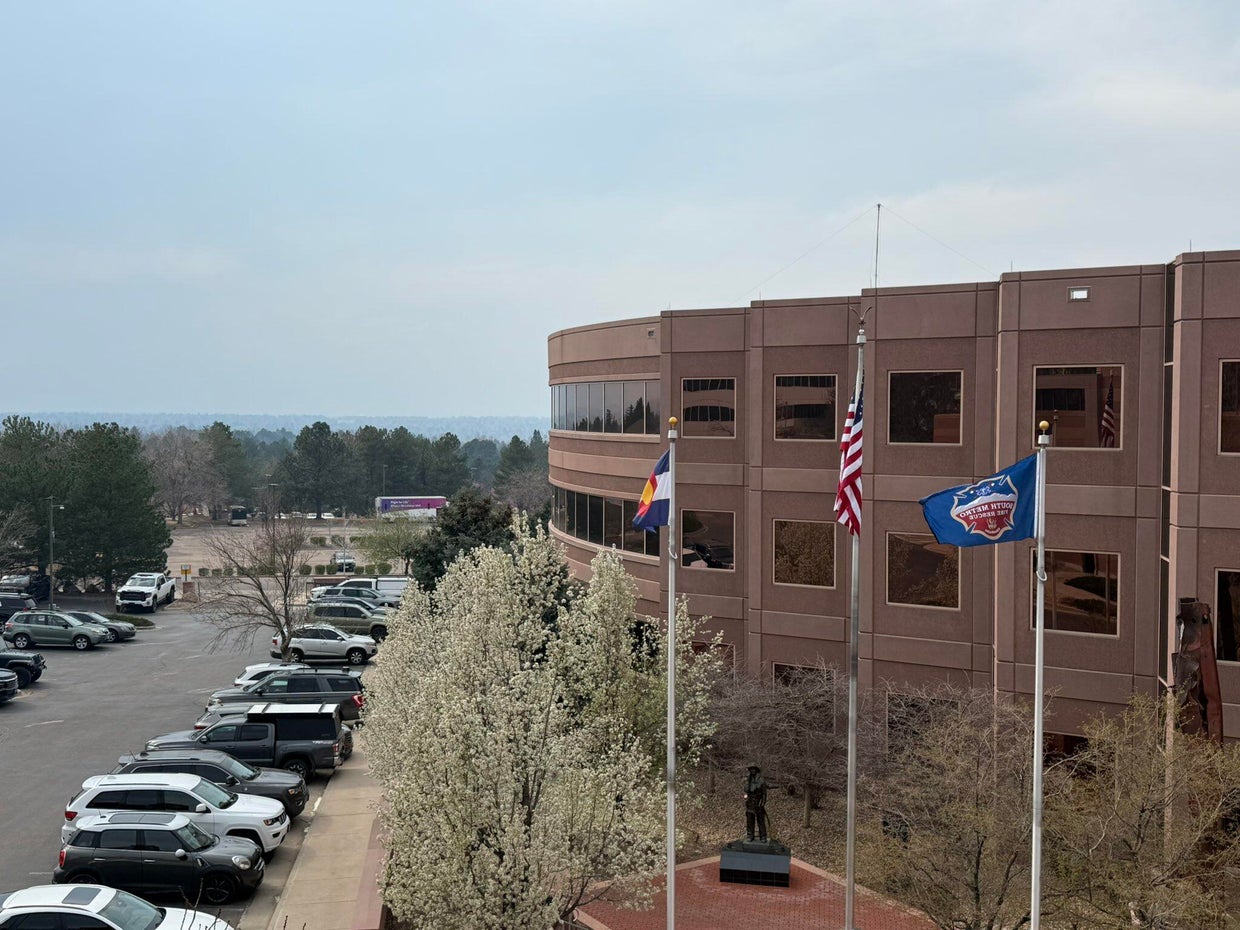
South Metro Fire Rescue said in their post that the smoke is from Colorado’s neighbor to the east. They called it a “significant haze” in the air.
Earlier this month, the Morrill Fire and the Cottonwood Fire burned a significant amount of Nebraska grassland and ranchland. They have mostly been contained by firefighters. Nebraska Gov. Jim Pillen said those two fires combined with several others have burned approximately 800,000 acres of land. On Thursday, Pillen announced that he is signing several executive actions intended to ease the burden caused by the fires.
There were no wildfires burning in the Denver metro area on Thursday afternoon.

ARAPAHOE COUNTY, Colo. (KKTV) – A homicide suspect based out of Colorado, wanted in a fentanyl-related death, is back in the state after being captured in Colombia.
The Arapahoe County Sheriff’s Office (ACSO) said 33-year-old Max Arsenault had been on the run since January 17.
Deputies said this stemmed from an incident in May 2023, where deputies responded to a call for a man named Nicholas Dorotik, who was found unresponsive.
ACSO said the cause of death was a mixed drug overdose involving meth and fentanyl, having about three times the lethal amount of fentanyl in his system.
One year later, Arsenault was arrested. He was scheduled for trial in January 2026 when deputies said he fled the country while on bond three days before the trial was set to start.
He was caught in Medellin, Colombia, on March 4, following a two-month international investigation. He has since been extradited back to Denver, where he is facing charges and awaiting trial.
Copyright 2026 KKTV. All rights reserved.


What channel is Mississippi State baseball vs Ole Miss on today? Time, TV schedule to watch college baseball game

Missouri bill that would split Jackson County and Kansas City gets little support from lawmakers

Montana’s measures to tackle housing crunch offer hope for Michigan

What Iowa coach Ben McCollum said after defeating Nebraska on Thursday

Scholarships available for Nevada Youth Range Camp

Florida High School Football Rankings: Top 25 teams – Oct. 21

How old is Bo Nix? What to know about Oregon quarterback ahead of 2024 NFL Draft

Cleary's 21 help Le Moyne down Central Connecticut State 69-64 in OT

99th annual Pony Swim held in Virginia

Indiana Members Credit Union announced as new anchor tenant at Bottleworks District

Video: Will ICE Change Under Its New Leader?

DHS shutdown breakthrough comes at cost for Republicans as funding fights nears end

Rubio joins crucial G7 talks as Iran war set to dominate second day

A surprise resignation could open the door for an independent to win a Montana Senate seat

Video: Savannah Guthrie Says She Believes Her Mother Was Taken for Ransom
-

 Detroit, MI1 week ago
Drummer Brian Pastoria, longtime Detroit music advocate, dies at 68
-

 Science1 week ago
How a Melting Glacier in Antarctica Could Affect Tens of Millions Around the Globe
-

 Movie Reviews1 week ago
‘Youth’ Twitter review: Ken Karunaas impresses audiences; Suraj Venjaramoodu adds charm; music wins praise | – The Times of India
-
 Science1 week ago
I had to man up and get a mammogram
-

 Sports6 days ago
IOC addresses execution of 19-year-old Iranian wrestler Saleh Mohammadi
-

 New Mexico5 days ago
Clovis shooting leaves one dead, four injured
-
 Business1 week ago
Disney’s new CEO says his focus is on storytelling and creativity
-

 Texas1 week ago
How to buy Houston vs. Texas A&M 2026 March Madness tickets