Colorado
Colorado crews planning mitigation of second underground coal mine fire near Marshall Fire’s origin


State mining safety crews are moving forward with plans to unearth a second active underground fire later this year in the area where the most destructive wildfire in Colorado history was ignited.
The Marshall Fire destroyed more than 1,000 homes on Dec. 30, 2021. It was pushed by 100 mph winds across open space and into the communities of Superior and Louisville. Two residents there were killed.
RELATED Marshall Fire investigation reveals most destructive fire in Colorado history was composed of 2 fires (2023)
Authorities, after an 18-month investigation, determined there were two ignition points – the first a smoldering wood pile on private property, the second below power lines. The latter is a point of contention, with Xcel Energy disagreeing with investigators’ conclusions. The company is fighting litigation blaming its lines for at least partially causing the blaze.
RELATED Investigators: Burning remnants of underground coal mines are possible cause of Marshall Fire (2022)
The investigation did not rule out the possibility that coal burning below ground for decades contributed to the fire. Winds as strong as those experienced during the Marshall Fire could conceivably draw heat from the underground coal fires to the surface.
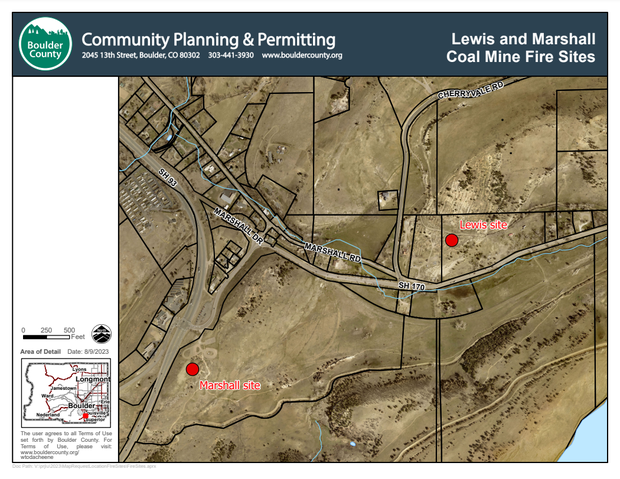
One such site contains the Lewis Mines that were abandoned and buried in 1946. A surface vent emitting heat measured at 120 degrees was discovered in 2018.

RELATED Disaster declaration issued for area in Boulder County to mitigate underground coal mine fire (2023)
Crews from Colorado’s Division of Reclamation, Mining and Safety started an overhaul of the Lewis Mine site in January. Excavators carefully extracted land adjacent to the Davidson Ditch, alternately digging and filling 10-foot “fingers” of steaming ground to keep the concrete irrigation channel from collapsing.

Crews dug 30 feet deep and encountered temperatures as high as 600 degrees. Where readings were greater than 90 degrees, crews mixed the heated soil with cool soil and rock until temperatures fell below that mark.

The project wrapped up in early April ahead of schedule.
Crews are now planning to turn ground 2,000 feet away above the Marshall Mines, a DRMS spokesman confirmed. The department is currently in the permitting process with Boulder County since the project, slated to start later this summer or fall, will affect access to county open space at the Marshall Mesa trailhead.
It will be the second time mitigation efforts have occurred at the Marshall Mines. A vent from the mines there was blamed for starting a small brush fire in 2005. Three years later, 275 tons of rock was dumped on the site, raising its surface 18 inches.
The recent Lewis Mines mitigation cost $316,002, according to the department’s spokesman, Chris Arend. The Marshall mitigation will be done now that additional federal money has been received by the department to address coal mine fires throughout the state.
In a 2018 DRMS study, there are 1,736 know abandoned coal mines in Colorado. A contractor hired by the state to examine them found 38 were actively burning or were dormant and extinguished after previously burning.



There are lots of cities and towns in the Denver area that are hosting professional fireworks shows on the Fourth of July this year.
Here are the shows taking place on July 4 in the Denver metro area:
Arvada
The City of Arvada’s annual fireworks display is scheduled to take place at Stenger Soccer Complex.
Date: Saturday, July 4
Time: 9:15 p.m.
Location: Stenger Soccer Complex
Admission: Free
Link: More Info
Aurora
The “4th of July Spectacular” takes place at the Aurora Municipal Center, located at 15151 E. Alameda Parkway.
Date: Saturday, July 4
Time: 9:30 p.m.
Location: Aurora Municipal Center
Admission: Free
Link: More Info
Brighton
Brighton’s Fourth of July festival takes place in Carmichael Park at 650 East Southern Street. Fireworks will be set off after the band Thumpin’ performs.
Date: Saturday, July 4
Time: After concert
Location: Carmichael Park
Admission: Free
Link: More Info
Broomfield
Broomfield’s Great American Picnic takes place at Broomfield County Commons Park, which is located at 13200 Sheridan Boulevard.
Date: Saturday, July 4
Time: 9:15
Location: Broomfield County Commons Park
Admission: Free
Link: More Info
Castle Rock
The Town of Castle Rock is planning to launch their Independence Day fireworks display from Miller’s Landing. The town is hosting a Independence Day Celebration at Festival Park, and the fireworks can be viewed from there, or several other locations in town.
Date: Saturday, July 4
Time: 9:30 p.m.
Location: Former Acme Brick facility
Admission: Free
Link: More Info
Commerce City
Fireworks will be set off outside Dick’s Sporting Goods Park as part of Commerce City’s 4thFEST celebration. They will be launched after the third of three rugby matches in the stadium.
Date: Saturday, July 4
Time: At the conclusion of the World Rugby Nations Cup
Location: Outside DICK’s Sporting Goods Park
Admission: 4thFEST is free, paid tickets required to see the rugby games
Link: More Info
Denver – Colorado Rockies games
Fans attending the July 4 Colorado Rockies home game at Coors Field will be treated to fireworks at the conclusion of the baseball game. There will also be fireworks for the game the night before — July 3.
Date: July 3 & 4 (against the San Francisco Giants)
Time: The fireworks are usually launched 20 to 30 minutes after the final out.
Location: Coors Field
Admission: Tickets required
Link: More Info
Englewood
In addition to all of its residents, the city of Englewood invites residents of Littleton, Sheridan, Arapahoe County and the South Suburban Parks & Recreation to their Independence Day Celebration.
Date: Saturday, July 4
Time: 9:15 p.m.
Location: Cornerstone Park and Belleview Park
Admission: Free
Link: More Info
Lone Tree
Lone Tree’s city fireworks display will be launched from Prairie Sky Park, and they’ll be viewable from many different locations in the city.
Date: Saturday, July 4
Time: 9:30 p.m.
Location: Prairie Sky Park
Admission: Free
Link: More Info
Longmont
You can watch a fireworks show in Longmont at 9:30 p.m. There will also be a drone show right before then.
Date: Saturday, July 4
Time: 9:30 p.m.
Location: Fireworks can be viewed “from many vantage points across the city.”
Admission: Free
Link: More Info
Louisville
The city of Louisville launches their annual fireworks show from Coal Creek Golf Course.
Date: Saturday, July 4
Time: 9:30 p.m.
Location: Coal Creek Golf Course
Admission: Free
Link: More Info
Northglenn
Fireworks are part of the July 4th Festival in Northglenn at E.B. Rains Jr. Memorial Park.
Date: Saturday, July 4
Time: 9:15 p.m.
Location: E.B. Rains Jr. Memorial Park
Admission: Free
Link: More Info
Parker
Fireworks on July Fourth will be visible from many parts of the town of Parker.
Date: Saturday, July 4
Time: 9:30 p.m.
Location: Fireworks launch northeast of Salisbury Park, although town officials encourage watching the fireworks from other areas, too
Admission: Free
Link: More Info
Thornton
Thornton’s fireworks display is called “Red, White & BOOM!” Fantabulous Fireworks.
Date: Saturday, July 4
Time: 9:30 p.m.
Location: Carpenter Park Fields
Admission: Free
Link:
More Info
Westminster
Date: Saturday, July 4
Location: Westminster City Park
Admission: Free
Link: More Info
There are other fireworks displays taking place in the Denver area on days other than July 4, including Lafayette (June 27), Glendale (June 2), Erie (July 3) and Littleton (July 3).

DENVER – The Colorado Avalanche Hockey Club announced today the team has signed defenseman Brett Kulak to a five-year contract extension through the 2030-31 season.
Kulak, 32, was originally acquired by the Avalanche in a trade with Pittsburgh on Feb. 24, 2026 and tallied three points (0g/3a) in 27 regular-season showings for Colorado over 19:08 of average time on ice per game. His 2025-26 regular season consisted of playing for the Edmonton Oilers and Penguins in addition to the Avalanche where he totaled 12 points (1g/11a) in 83 contests. Kulak was the only NHLer to skate in 83 games last season. Additionally, he dressed in his 600th career NHL contest on Nov. 15 at Carolina and notched his 100th career assist on Dec. 30 vs. Carolina.
The 6-foot-1, 192-pound defenseman was in the lineup for all 13 Stanley Cup Playoff games for the Avalanche in 2026 and chipped in five points (1g/4a) and logged 20:38 of time on ice per game. The goal was his first with the Burgundy and Blue, regular season or postseason, and it came as the overtime-winner in Game 5 of the Second Round (May 13) to send the Avalanche to the Western Conference Final. It was the third time a defenseman scored a series clinching overtime goal in Avalanche/Nordiques history and the first since Sandis Ozolinsh (Game 6 of the 1996 Conference Semifinal) did it 30 years to the date prior to Kulak’s. Additionally, Kulak’s marker was the 10th time an Avalanche/Nordiques skater sent the team to the next round with an overtime tally and the first instance since Artturi Lehkonen in Game 4 of the 2022 Western Conference Final (June 6, 2022).
A native of Edmonton, Alberta, Kulak has registered 137 points (29g/108a) in 663 career regular-season games with Colorado, Pittsburgh, Edmonton, the Montreal Canadiens and Calgary Flames from 2014-26. The last 370 of those games have come consecutively and he enters 2026-27 with the ninth-longest active “Iron Man” streak in the NHL. The left-shot defenseman has also added 29 points (4g/25a) over 111 career Stanley Cup Playoff contests and has been a member of three teams that have made it to the Stanley Cup Final (2023-24 and 2024-25 Oilers, 2020-21 Canadiens). Kulak’s 111 playoff games lead all NHL defensemen since making his postseason debut in 2020 and are second among all skaters in that span behind only Corey Perry (126).
Originally drafted by the Flames in the fourth round (105th overall) in the 2012 NHL Draft, Kulak appeared in 136 AHL games over parts of the 2012-19 campaigns (13g/41a). He was also a member of the then-ECHL Colorado Eagles for part of 2014-15. Prior to turning pro, Kulak played for the Western Hockey League’s Vancouver Giants from 2010-14 and amassed 128 points (35g/93a) in 216 regular-season contests.

COLORADO SPRINGS, Colo. (KKTV) – The Colorado Springs Police Department (CSPD) is searching for a missing child.
CSPD said 11-year-old Emilio Gerardo was last seen Thursday around 8:06 p.m. near North Carefree Circle and Peterson Road.
Gerardo is described as a 4-foot-8 and 65-pound Hispanic male with brown hair and brown eyes.
Police said he was last seen in a black shirt, black pants and black Converse shoes. They said he may have a VR headset with him.
Police said he could be in the area of Sand Creek High School or Remington Park.
If you see Gerardo or know where he may be, contact the Colorado Springs Police Department at 719-444-7000.
Copyright 2026 KKTV. All rights reserved.
-

 Oregon4 minutes ago
Public asked to help find missing 2-year-old Armani Andrews in Portland
-

 Pennsylvania7 minutes ago
Trump admin rule puts reproductive health care for 160K Pa. patients at risk, lawsuit says
-

 Rhode Island12 minutes ago
When will RI see promised Time-Varying Rates on electric bills? | Opinion
-

 South-Carolina19 minutes ago
Myrtle Beach is a hotspot for sharks and the potential to be bit
-

 South Dakota21 minutes ago
Work, housing and staffing: How South Dakota’s corrections chief aims to keep inmates from returning
-
Tennessee27 minutes ago
Tennessee GOP leaders denounce antisemitic Young Republicans mailers | The Jerusalem Post
-

 Texas33 minutes ago
A truck crash released 20 million bees. Local beekeepers rushed to save them.
-

 Utah37 minutes ago
‘2.5 minutes of terror’: Passengers sue Delta, alleging crew flew into dangerous weather despite warnings, injuring dozens

