West
Colorado residents to vote on hunting ban of mountain lions, other wild cats

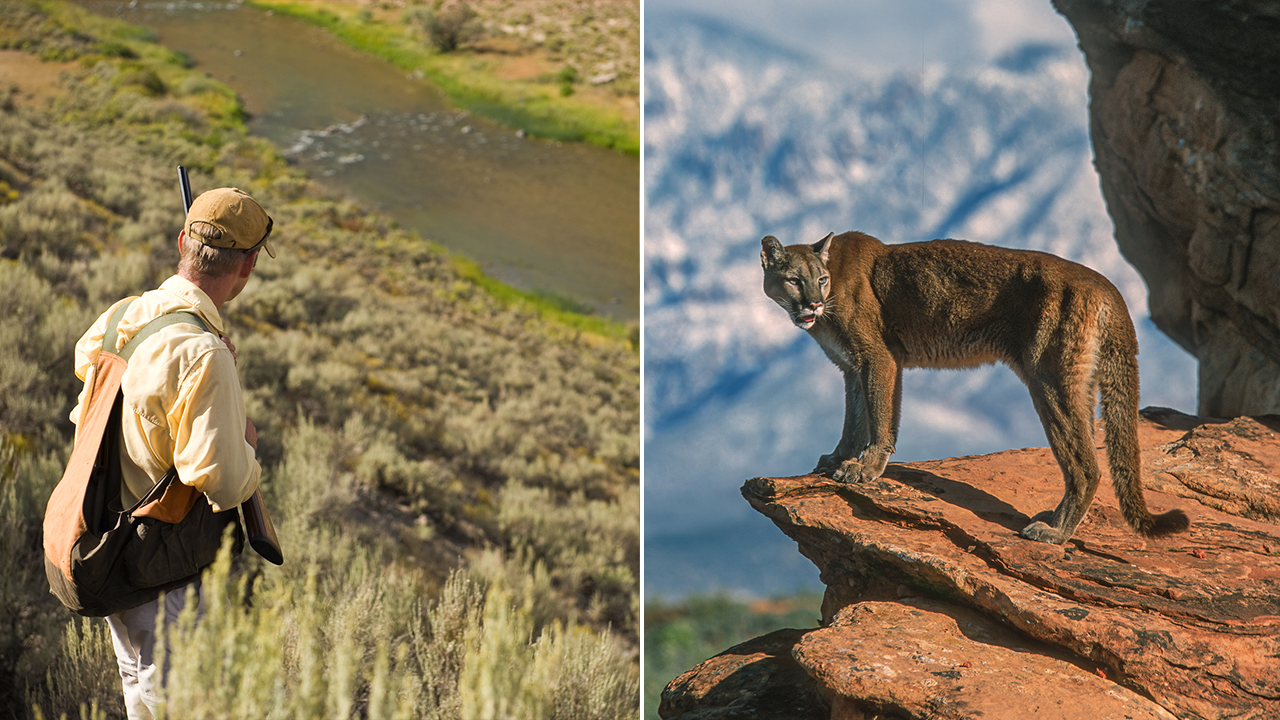
A proposal that would ban the hunting and commercial trapping of mountain lions along with other wild cats will soon be on the Colorado ballot.
The Colorado Secretary of State’s Office confirmed to Fox News Digital that Proposed Initiative #91, “Prohibit Trophy Hunting,” has more than enough signatures to qualify for the general election on Nov. 5.
If the measure passes, bobcats and lynx will also be protected.
PENNSYLVANIA’S ‘PROHIBITION ON SUNDAY HUNTING’ COULD END DUE TO LAWMAKERS
The initiative was heavily backed by wildlife advocates, including the Cats Aren’t Trophies (CATs) organization, which is based in Grand Lake, Colorado.
The Colorado Secretary of State’s Office added a ballot measure that would prohibit the hunting of mountain lions and other wild cats if approved by voters in November. (iStock)
“Colorado voters will have an opportunity to halt the inhumane and needless killing of mountain lions and bobcats for their heads and beautiful fur coats,” Samantha Miller, CATs’ campaign manager, said in a press release.
The proposed ballot measure accumulated nearly 200,000 signatures.
For more Lifestyle articles, visit www.foxnews.com/lifestyle
Mountain lions, also known as pumas, are solitary cats that are most active at dusk and dawn, according to The Mountain Lion Foundation. (iStock)
“While the measure stops the recreational trophy hunting and commercial fur trapping of wild cats, it allows lethal removal of any problem animal for the safety of people, pets or farm and ranch animals,” Miller added.
Last hunting season, Colorado hunters killed 502 cats in the Centennial State, according to Colorado Parks & Wildlife.
Fox News Digital reached out to Colorado Wildlife & Parks for comment.
Last hunting season, Colorado hunters killed 502 cats in the state, according to Colorado Parks & Wildlife. (iStock)
Though some states have specific regulations on hunting species of wild cats, California has prevented mountain lion hunting since 1972 and, since 1990, the state protects the animals as a “nongame species,” according to the California Department of Fish and Wildlife.
In 2015, California banned trapping of bobcats, while in 2020, bobcat hunting was also banned.
Mountain lions, also known as pumas, are solitary cats that are most active at dusk and dawn, according to the Mountain Lion Foundation in Sacramento.
Read the full article from Here


JUNEAU — The Alaska Senate has passed a bill that would allow physician assistants with sufficient training to practice under an independent license, removing the state’s current requirement that they work under a formal collaborative agreement with physicians.
Supporters say the change would reduce administrative burdens that can delay and increase the cost of care. But physicians who opposed the bill argue it lowers the bar for training and could affect patient care.
Senate Bill 89, sponsored by Anchorage Democratic Sen. Löki Tobin, passed by a unanimous vote in the Senate on Wednesday, with 18 votes in favor and two members absent. The bill would allow physician assistants to apply for an independent license after completing 4,000 hours of postgraduate supervised clinical practice.
Under current law, physician assistants in Alaska must operate under a collaborative plan with physicians. These plans outline the medical services a physician assistant can provide and require oversight from doctors.
The Alaska State Medical Board regulates physician assistants and authorizes them to provide care only within the scope of their training. Most physician assistants in Alaska work in family practice, though some are specially trained in particular fields. All care must be provided under a physician’s license through a collaborative agreement that also requires a second, alternate physician to sign off.
For some clinics, particularly in more remote areas, finding those physicians can be difficult.
Mary Swain, CEO of Cama’i Community Health Center in Bristol Bay, testified in support of the bill before the Senate Labor and Commerce Committee in March 2025. Her practice employs two physicians to maintain collaborative plans for its physician assistants. She said neither of them lived in the community, and the primary physician lived out of state.
Roughly 15% of physicians who hold collaborative agreements with Alaska-based physician assistants do not live in the state, according to Tobin. At the same time, Alaskans face some of the highest health care costs in the nation.
Jared Wallace, a physician assistant in Kenai and owner of Odyssey Family Practice, testified in support of the bill at a committee meeting in April.
Wallace said maintaining collaborative agreements is one of the most difficult parts of running his clinic. He said he pays a collaborative physician about $2,000 per physician assistant per month, roughly $96,000 a year, simply to maintain the required agreement.
“In my experience, a collaborative plan does not improve nor ensure good patient care,” Wallace said. “Instead, it is a barrier in providing good health care in a rural community where access is limited, is a threat that delicately suspends my practice in place, and if severed, the 6,000 patients that I care for would lose access to (their) primary provider and become displaced.”
Opposition to the bill largely came from physicians, who testified that physician assistants do not receive the same depth of training as doctors.
Dr. Nicholas Cosentino, an internal medicine physician, testified in opposition to the bill last April. He said that medical school training provides crucial experience in diagnosing complex cases.
“It’s not infrequent that you get a patient that you’re not exactly sure you know what’s going on, and you have to fall back on your scientific background, the four years of medical school training, the countless hours of residency to come up with that differential, to think critically and come up with a plan for that patient,” Cosentino said. “I think the bill as stated, 4,000 hours, does not equate to that level of training.”
The Alaska Primary Care Association said it supports the intent of the bill but argued that physician assistants should complete 10,000 hours in a collaborative practice model with a physician before practicing independently.
Other states that have moved to allow independent licensure for physician assistants have adopted a range of thresholds. North Dakota requires 4,000 hours, while Montana requires 8,000 hours. Utah requires 10,000 hours of postgraduate supervised work, while Wyoming does not set a specific statewide minimum hour requirement.
Tobin said the hour requirement chosen in the bill came from conversations with experts during the bill’s drafting.
“When we were working with stakeholders on this piece of legislation, we came to a compromise of 4,000 hours, recognizing and understanding that there was concerns, but also … understanding that it is a bit of an arbitrary choice,” she said.
The bill now heads to House committees before a potential vote on the House floor.

A man being held at a US immigration detention facility in Arizona died this week after reporting severe tooth pain and not receiving “timely medical attention”, according to a local official.
Emmanuel Damas, a Haitian asylum seeker, was being held at the Florence correctional center in Arizona when he began to feel a toothache in mid-February, a pain that weeks later led him to the hospital before he died on Monday.
“His reported struggle to receive timely medical attention before being transferred to a hospital raises serious and painful concerns about the quality of care provided to individuals in custody,” Christine Ellis, a Chandler city council member, said in an Instagram post.
According to Ellis, Damas was taken into custody by Immigration and Customs Enforcement (ICE) agents in Boston in September 2025 and was later transferred to the facility in Florence, Arizona.
The Arizona Daily Star reported that Ellis had called for an investigation into Damas’s death.
“He was complaining for almost two weeks straight, until he collapsed and got septic from the infection,” Ellis told the local news outlet. Ellis said Damas was transferred to a Scottsdale hospital sometime last week.
Ellis’s office, ICE and the Department of Homeland Security (DHS) did not immediately respond to a request for comment from the Guardian.
Damas’s death has not yet been reported by ICE, according to the agency’s notifications of detainee deaths. At least nine people have died under custody in 2026, according to ICE: Luis Gustavo Nunez Caceres, 42; Geraldo Lunas Campos, 55; Luis Beltrán Yáñez–Cruz, 68; Parady La, 46; Heber Sanchaz Domínguez, 34; Víctor Manuel Díaz, 36; Lorth Sim, 59; Jairo Garcia-Hernandez, 27; and Alberto Gutiérrez-Reyes, 48.
At least 32 people died in ICE custody last year, marking the deadliest year for detainees of the federal immigration agency in more than two decades.
The stark number of deaths has been just one component of a tumultuous tenure for Kristi Noem as homeland security secretary. On Thursday, Donald Trump announced he would be ousting Noem and replacing her with Markwayne Mullin, a Republican Oklahoma senator, starting on 31 March.
Under her helm, the DHS has faced bipartisan backlash after the shooting deaths of Renee Good and Alex Pretti in Minneapolis at the hands of federal immigration agents earlier this year. Noem accused both US citizens of being involved in “domestic terrorism”.
California
Signs of spring blooming at Antelope Valley California Poppy Reserve after wet, warm winter

It’s beginning to look a lot like spring!
The warm and wet weather this winter has led to the start of a dazzling super bloom at the Antelope Valley California Poppy Reserve.
“We had an unseasonably warm winter as well, so there’s actually a lot of growth,” said Callista Turney with California State Parks. “We’re having early wildflowers that are already at the park. So if you look at the poppy live cam, it shows a lot of orange already.”
The rain has helped the early blooms, but it’s actually the heat that accelerated the growth of the flowers.
“It will actually speed up the growth of the plants, so some of them were already blooming and that’s going to cause those blossoms to accelerate faster towards seed production. And the blossoms that are in the process of being formed, those are going to open up soon as well.”
We also sometimes see great super blooms in Death Valley National Park, Anza-Borrego Desert State Park, Joshua Tree and the Mojave National Preserve.
“It’s definitely a rare occurrence because we don’t always have the right conditions. It’s gotta be the weather, the wind, the rain, all coming together,” said Katie Tilford, Director of Development and Communications with the Theodore Payne Foundation.
If it continues to stay unseasonably warm, we’ll see a shorter bloom. The key to a longer season is milder weather.
Copyright © 2026 KABC Television, LLC. All rights reserved.

Thieves steal dozens of bikes meant for underprivileged kids from Atlanta nonprofit

Minneapolis City Council votes to extend eviction notice period

Chase Sexton out for at least another round, Indianapolis Supercross, with practice injuries

Pirates Winning Streak Ends With Loss to Cardinals

17-year-old hit by two vehicles after I-520 crash, officials say

Florida High School Football Rankings: Top 25 teams – Oct. 21

Cleary's 21 help Le Moyne down Central Connecticut State 69-64 in OT

How old is Bo Nix? What to know about Oregon quarterback ahead of 2024 NFL Draft

99th annual Pony Swim held in Virginia

Indiana Members Credit Union announced as new anchor tenant at Bottleworks District

Map: 4.9-Magnitude Earthquake Shakes Louisiana

Paxton vows he’s ‘staying in this race’ even if Trump backs Cornyn in Texas GOP clash

Which Kurdish groups is the US rallying to fight Iran?

Man accused of plot to assassinate Trump testifies Iran pressured him, says Biden and Haley were other possible targets

DHS defends McLaughlin against allegations husband’s company profited millions from ad contracts: ‘Baseless’
-

 World1 week ago
Exclusive: DeepSeek withholds latest AI model from US chipmakers including Nvidia, sources say
-

 Massachusetts1 week ago
Mother and daughter injured in Taunton house explosion
-

 Wisconsin4 days ago
Setting sail on iceboats across a frozen lake in Wisconsin
-

 Maryland5 days ago
AM showers Sunday in Maryland
-

 Florida5 days ago
Florida man rescued after being stuck in shoulder-deep mud for days
-

 Massachusetts3 days ago
Massachusetts man awaits word from family in Iran after attacks
-

 Denver, CO1 week ago
10 acres charred, 5 injured in Thornton grass fire, evacuation orders lifted
-

 Oregon6 days ago
2026 OSAA Oregon Wrestling State Championship Results And Brackets – FloWrestling