West
Coach of trans SJSU volleyball player blames teams that forfeited for 'appalling, hateful messages' to players

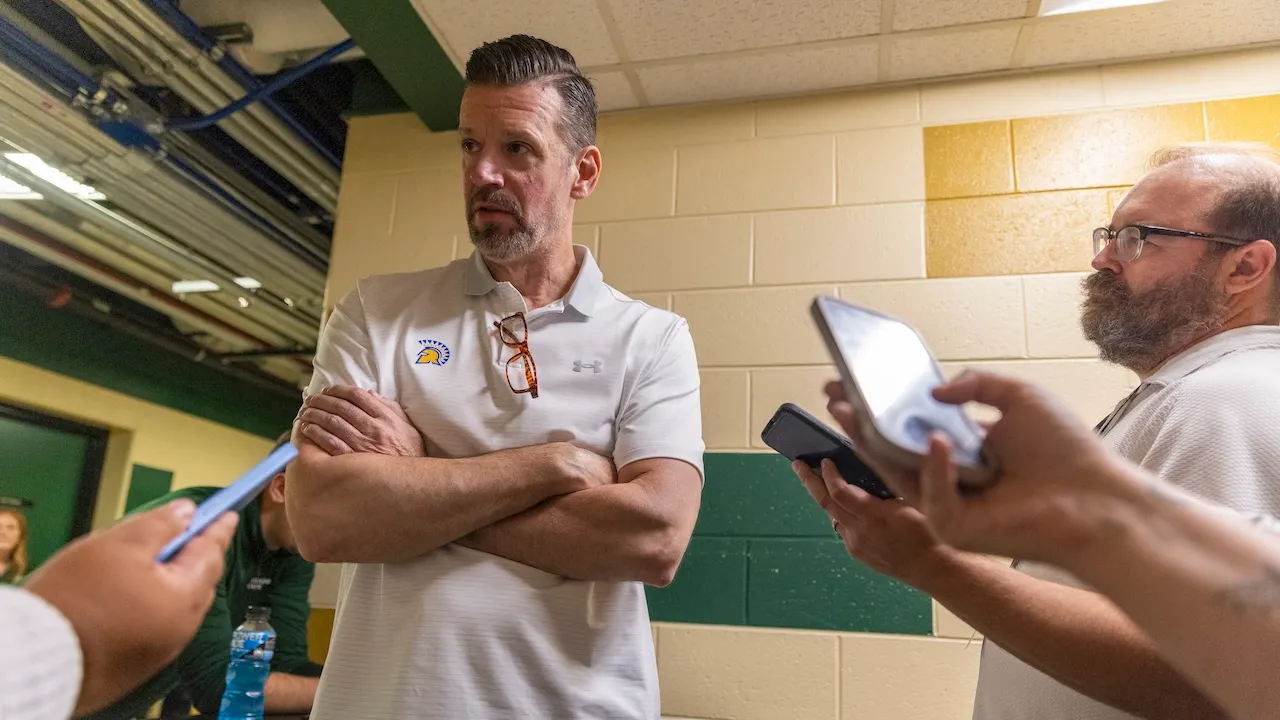
San Jose State volleyball head coach Todd Kress provided a statement to Fox News Digital Saturday after his team’s loss in the Mountain West Conference tournament final to Colorado State.
Kress addressed the national controversy surrounding a transgender player on his team and seven forfeited conference matches, including a tournament semifinal with Boise State.
“I will not sugarcoat our reality for the last two months. Our team prepared and was ready to play each match according to established Mountain West and NCAA rules of play. We did not take away anyone’s participation opportunities,” Kress wrote.
Boise State, Wyoming, Utah State and Nevada forfeited a total of seven matches against SJSU this season.
Kress said each of those forfeits resulted in the team’s players, coaches and staffers receiving “appalling, hateful messages.”
“Sadly, others who for years have played this same team without incident chose not to play us this season. To be clear, we did not celebrate a single win by forfeiture. Instead, we braced for the fallout. Each forfeiture announcement unleashed appalling, hateful messages individuals chose to send directly to our student-athletes, our coaching staff and many associated with our program,” Kress wrote.
The coach, in just his second season with the team, admitted it was one of the toughest seasons of his life.
“This has been one of the most difficult seasons I’ve ever experienced, and I know this is true as well for many of our players and the staff who have been supporting us all along. Maintaining our focus on the court and ensuring the overall safety and well-being of my players amid the external noise have been my priorities,” Kress said.
SJSU TRANSGENDER VOLLEYBALL SCANDAL: TIMELINE OF ALLEGATIONS, POLITICAL IMPACT AND A RAGING CULTURE MOVEMENT
Kress was named in a lawsuit filed by team co-captain Brooke Slusser and several other Mountain West players against the conference and San Jose State. The lawsuit alleges Kress has communicated with a private lawyer as part of his effort to get Slusser removed from the team and has told others he has filed Title IX complaints against Slusser based not on comments Slusser has made in practice, but on communications Slusser has made to the media and in public forums concerning her beliefs.
Slusser has also alleged the university has threatened to take away her scholarship for speaking on the issues of sharing a team, locker room and bedroom with transgender teammate Blaire Fleming.
Still, Kress thanked Slusser in his statement Saturday, along with Fleming and the other seniors on the team.
“Our team played their hearts out today, the way they have done all season. I want to recognize and thank our seniors — Alessia [Buffagni], Chandler [Manusky], Brooke [Bryant], Brooke and Blaire — for their tremendous efforts on the court all season long. They have all helped us to get where we are,” Kress wrote.
Kress also thanked San Jose State University Police Chief Michael Carroll for his work protecting the team from potential threats this season.
A San Jose State spokesperson previously confirmed to Fox News Digital that the program did not formally notify any of the opponents on its schedule of the situation involving Fleming and Slusser ahead of matches this season after Slusser joined her first lawsuit against the NCAA in September over her trans teammate’s presence.
However, that spokesperson also confirmed the university did coordinate police protection for the players with the schools that hosted the team’s away matches after security measures had to be elevated due to the attention the team was getting.
When Southern Utah became the first program to announce it would be forfeiting a match against the Spartans in early September, that was the first indicator of heightened security. That’s when the college brought in armed security.
INSIDE SAN JOSE STATE’S POLICE BATTLE TO PROTECT WOMEN’S ATHLETES THREATENED BY A TRANSGENDER CULTURE WAR
A San Jose State University spokesperson confirmed to Fox News Digital the volleyball team was told it would be getting added security of some kind after the first forfeit by an opposing program as news of Slusser’s lawsuit spread.
Shortly after the first forfeit, the university’s in-house police department was alerted to the situation and got involved. Police protection was assigned for every game thereafter, and police departments at other campuses were assigned to protect the team when it traveled.
Police presence was noticeably strong for the Spartans’ first meeting against eventual conference champion Colorado State Oct. 3. Multiple officers were photographed on the court that night, looking alert in the stands, entrances and at the players.
Colorado State University Police behind the San Jose State University Spartans’ bench monitor Moby Arena during a volleyball match between the Spartans and the Colorado State Rams in Fort Collins, Colo., Oct. 3, 2024. (Santiago Mejia/San Francisco Chronicle via Getty Images)
Slusser previously told Fox News Digital she had received a warning from a teammate Oct. 2, the night before a match, to “stay away” during the match because something “bad” was going to happen to her.
San Jose State University responded to questions about whether federal investigators had been involved.
“The university has asked students and staff to share all concerning communications with UPD to be evaluated and addressed appropriately, including in conjunction with proper authorities where appropriate,” San Jose State said in a previous statement.
And Kress was tasked with coaching his team through all of it. Kress is not the coach who recruited Fleming to SJSU. That was former head coach Trent Kersten, who left the program after Fleming’s first season in San Jose State in 2022.
A lawsuit that includes former Spartans assistant coach Melissa Batie-Smoose alleges Kersten recruited Fleming knowing the player was transgender but didn’t tell other players.
Kress took over the program in 2023 and expressed frustration with Kersten’s decision in an interview with OutKick.
San Jose State University Spartans head coach Todd Kress speaks with reporters after a loss against the Colorado State University Rams in Fort Collins, Colo., Oct. 3, 2024. (Santiago Mejia/San Francisco Chronicle via Getty Images)
“My frustration with Trent is an unfortunate situation,” Kress said. “[Kersten] obviously knows Blaire is in the crosshairs of this debate, and yet he has not reached out to [Fleming] one time to check in on [Fleming’s] mental health. I find it sad, to be honest.”
Before that, Kress suggested tension in the locker room because of Fleming’s presence on the team and Slusser’s lawsuits “might not be a bad thing.”
“Sometimes tension is not necessarily a bad thing, and I’m not saying that there is. But, you know, when you do have tension or you do have confrontations, I mean, I’m a person that believes that, from confrontation, good things usually happen. We settle our differences, and we work through it,” Kress told reporters Oct. 3 after the first Colorado State match.
“The last thing that I would want is there’s the white elephant in the room, and there is no tension, we don’t address it, and we never move past it, right? So I think there may be tension, but it dies. If we’re in a meeting room and there’s tension, it dies there. If there’s tension on the court, it dies there. We really don’t let the boundaries cross over, and that’s how I think we’ve been so successful thus far.”
Now the Spartans’ tournament run is over. The players made it through unharmed. But the lawsuits continue.
Follow Fox News Digital’s sports coverage on X, and subscribe to the Fox News Sports Huddle newsletter.
Read the full article from Here


Animal rights activists could soon get their way if officials in San Francisco decide to ban pet stores from selling live animals.
Dozens and dozens of animal rights activists this week called on the SF Animal Commission to vote on a Retail Animal Sales Ban that would prohibit stores in the city from selling any live pets.
During the commission meeting on Thursday, city leaders heard from proponents who said the ban would stop the “breeding mills” and “wild catching” of animals, like reptiles.
The proponents also claim that the ban would stop the neglect of animals, “invasive species,” and would solve the problem of overcrowded shelters and rescues.
Animal and human rights activist Kitty Jones told the commission that there’s a ton of support for the ban locally, noting more than 60 organizations have signed on to a letter calling for it.
Activists pointed out that there are 29 pet stores in the city that only offer services such as grooming, boarding, supplies and adoptions.
Only nine of the city’s pet stores still sell animals, according to officials.
Those included several Petco’s, the Animal Connection, Pet Central SF, the Animal company and Ocean Aquarium.
Pet shop owners in the city are not happy about the ban, and are willing to fight.
“This is our livelihood,” one worker at Pet Central SF told the San Francisco Chronicle. “This is a business, this is what we rely on.”
The longtime owner of the Animal Company, Rick French, said it would just be another terrible policy from the city that makes it harder for business owners to operate.
“Yet another footstep in San Francisco making it too difficult to run a business.”
“They’re just overreaching. It’s overboard,” he added. “I think there is going to be a lot of pushback on it. We are certainly going to organize and fight this as hard as we can.”
Julia Baran, the owner of the Animal Connection, said that banning the sale of live animals isn’t going to stop people from wanting to get them.
“It won’t stop people from getting the animal that they want,” Baran said. “They might just go to Craigslist or go online and get it shipped from across the country.”
The Post reached out to several pet stores in San Francisco for further comment.
The commission ended up agreeing to send a recommendation to SF Mayor Daniel Lurie and the Board of Supervisor to approve the ban.
Existing state laws already prohibit the retail sale of cats, dogs, rabbits, ferrets, gerbils, hedgehogs, and sugarglides (a little nocturnal furry animal), officials noted.
The only animals sold in California stores these days are amphibians, fish, birds, guinea pigs, hamsters, and reptiles.
In another post on on Facebook, Jones noted that the city of Albany, in the East Bay area of Alameda county, had recently “unanimously voted in support of a retail animal sales ban.”
“The city will draft an ordinance and vote on that in a few weeks.”
Last year, West Hollywood became the first city in LA county to ban pet stores, per the Los Angeles Times. The ban became official May 1, 2026. The report noted that animals at shelters and rescues can still be sold.
Denver, CO
Forget Denver, Retire To An Underrated Utah City Near Gorgeous Canyons Instead (And It’s Affordable) – Islands

If you’ve ever made the scenic drive from Las Vegas to the popular Zion National Park, home to one of the five most beautiful canyons in the American West, you’ve likely passed through the city of St. George, Utah, even if you didn’t realize it at the time. For many travelers, St. George is little more than a smattering of gas stations and fast-food joints visible from Interstate 15. Look closer, though, and you’ll find that tucked into the area’s striking red cliffs is an underrated and historic destination, southern Utah’s largest city, and one of America’s top retirement destinations.
Retirees drawn to Denver’s outdoorsy vibe may want to instead consider the canyon views of St. George. Located near several state and national parks, it offers a smaller and generally more affordable alternative to the Mile High City. Plus, while both St. George and Denver get a lot of sunshine — averaging more than 250 sunny days annually — winters in southern Utah are typically milder than in central Colorado.
What makes St. George such a desirable place for retirees? And how is it more affordable than Denver? Let’s look at that and more in this guide to one of Utah’s most gorgeous yet underrated cities.
Retirees can explore mountains and canyons in St. George

St. George is famous for the red sandstone-ridged cliffs that hug the city’s edges and glow bright fire red at sunset. Outdoor lovers can explore the city’s stunning landscape through the numerous hiking and cycling trails, with nearby Snow Canyon State Park (pictured above) being a popular local spot for adventure. Sometimes called Zion’s “little sibling,” Snow Canyon State Park has soaring sandstone cliffs and 18 hiking trails that wind through black basalt, lava tubes, and a slot canyon. It also has four picnic areas, a campground, and a 4.3-mile scenic drive for those wishing to see the sights without having to hike. Whiptail Trail is paved and fairly level, making it a good choice for those unsteady on their feet or in a wheelchair. Snow Canyon State Park is only a 15-minute drive from St. George, and entrance to the park is affordably priced, costing just $10 per vehicle for Utah residents 65 and older.
St. George offers a number of paved and well-maintained walking and biking trails accessible to those with mobility issues. The 5.2-mile loop trail, Mayor’s Loop, tops AllTrails’ list of wheelchair-friendly trails in St. George. And “Nice paved trail, mostly flat. Great for birding,” one reviewer on AllTrails wrote about the 5.3-mile Virgin River Loop, which links to Mayor’s Loop.
In all, St. George boasts over 72 miles of paved trails, allowing retirees to easily partake in a range of outdoor recreational activities — from walking and jogging to cycling and birdwatching. With 14 golf courses located in and around it, this sunny southern Utah city is also becoming well known among golfers as an affordable year-round golf vacation destination.
A variety of affordable activities and a charming, walkable downtown
While St. George may be a city of more than 100,000 residents, its walkable downtown feels charmingly small-town. From the park fountain and old-timey carousel to the Mormon temple and quaint antique shops, St. George has the vintage shine of a bygone era. However, its location less than two hours from Las Vegas and just 30 minutes from Zion National Park means that, small-town vibe or not, St. George is far from isolated.
The community also offers plenty of free and low-cost activities. The Red Hills Desert Garden has trails that wind through more than 5,000 plants and trees, Town Square Park offers free movie nights and an annual art festival, and the St. George Active Life Center provides seniors with more than 100 activities each month, many of which require only a small donation. Moreover, St. George and the surrounding area have several budget-friendly museums, including the free McQuarrie Memorial Pioneer Museum and the Rosenbruch Wildlife Museum, which charges seniors $6.
Whether you’re looking to live in southern Utah year-round or just visit for a vacation, life in St. George is generally more affordable than in cities like Denver. Expenses are about 15% lower in St. George than in Denver, including things like food costs and public transportation. For example, a 10-ride bus card costs $5 for seniors in St. George and $13.50 in Denver.

The Seattle Sounders will play their last home game until after the World Cup break when they host the LA Galaxy today. The Galaxy have started the season in uneven form, going 4–5–4. That includes a 3–1 loss to Sporting KC on Wednesday.
The Sounders, meanwhile, come into this game riding a nine-game unbeaten run that is their longest since starting the 2021 season on a 13-game unbeaten run.
This will be the Galaxy’s third consecutive away game and they’ve been on the road for a full week, having gone from LA to Atlanta to Kansas City to Seattle. The Sounders are playing their third game this week, all of which have been at home.
- The Sounders have never lost at home to the LA Galaxy during Brian Schmetzer’s tenure as head coach, holding a 6–0–5 record at Lumen Field.
- The Sounders are second in MLS with five goals from substitutes, including goals from Osaze De Rosario and Danny Musovski in the last two games.
- The Sounders tied a franchise record by extending their home unbeaten streak in league play to 14 games. They also have a 22-game unbeaten streak across all competitions.
- Andrew Thomas has stopped 87% of the shots he’s faced this year, the best mark in MLS.
Absences: Injury, international duty and suspension
Sounders
OUT: Pedro de la Vega — Knee; Nikola Petković — Knee; Yeimar Gómez Andrade — Hamstring; Alex Roldan — Hamstring
Galaxy
OUT: Julian Aude — Ankle; João Klauss — Foot
QUESTIONABLE: Emiro Garces — Foot
Sounders: WWDDW
Galaxy: LWDWL
Kit matchup

Officials
REF: Joe Dickerson; AR1: Cameron Blanchard; AR2: Logan Brown; 4TH: Alyssa Pennington; VAR: Younes Marrakchi; AVAR: Kevin Huet
How to Watch
Match date/kickoff time: Saturday, May 16, 6:25 PM PT
Venue: Lumen Field, Seattle
Global Streaming English: AppleTV (Keith Costigan & Maurice Edu)
Global Streaming Spanish: AppleTV (Sergio Ruiz & Walter Roque)
English TV: FS1 (Mike Watts & Lloyd Sam)
Spanish TV: Fox Deportes (Alejandro Luna & Álvaro Izquierdo)
Local Radio: 93.3 KJR-FM Seattle, iHeartMedia (Danny Jackson, Brad Evans & Steve Zakuani)
Local Spanish Radio: El Rey 1360 AM (Rodriguez, Maqueda, Tapia)
Is this game available to stream for free? Yes
Will Sounders radio be available as an alternate feed? Yes
Lineups

Highlights will be posted as the match progresses.
This is Seattle Sounders vs. LA Galaxy; watch with us
Sounder at Heart receives a portion of all sales made from links on this page.
-
 Lifestyle20 minutes ago
Bulgarian banger ‘Bangaranga’ bags country its 1st Eurovision win
-

 Technology32 minutes ago
Sony tries to explain that its AI Camera Assistant doesn’t suck
-

 World38 minutes ago
WHO declares Ebola outbreak in Central Africa a public health emergency after 80 suspected deaths
-

 Politics44 minutes ago
Trump celebrates after UN climate committee moves away from its most extreme global warming scenario
-

 Health50 minutes ago
Ancient Chinese movement shows promise for reducing blood pressure at home, study says
-

 Sports56 minutes ago
Napoleon Solo wins 151st Preakness Stakes
-

 Technology1 hour ago
License plate cameras at Home Depot and Lowe’s spark privacy fears
-
Business1 hour ago
Commentary: Trump’s ‘weird war’ on wind power will jeopardize our energy future and cost Americans billions


