West
Charlie Kirk posthumously awarded Medal of Freedom on what would have been his 32nd birthday


NEWYou can now listen to Fox News articles!
President Donald Trump posthumously awarded Turning Point USA (TPUSA) co-founder Charlie Kirk the Presidential Medal of Freedom Tuesday — the highest award issued to civilians in the U.S.
“Today, we’re here to honor and remember a fearless warrior for liberty, a beloved leader who galvanized the next generation like nobody I’ve ever seen before. And an American patriot of the deepest conviction, the finest quality and the highest caliber. The late, great Charlie Kirk,” Trump said from the Rose Garden on Tuesday.
“Five weeks ago, our nation was robbed of this extraordinary champion,” he continued. “He was assassinated in the prime of his life for boldly speaking the truth, for living his faith and relentlessly fighting for a better and stronger America. He loved this country. And that’s why this afternoon it’s my privilege to posthumously award Charles James Kirk, our nation’s highest civilian honor, the Presidential Medal of Freedom.”
Kirk, 31, was shot and killed during his “American Comeback Tour” at Utah Valley University in September. His death came a year after two assassination attempts against Trump.
CHARLIE KIRK’S COLLEAGUES AND PASTORS PRAISE HIS PATRIOTISM AS TRUMP READIES HIGHEST CIVILIAN HONOR
President Donald Trump walks onto the stage after being introduced by Turning Point USA founder Charlie Kirk at the Turning Point Action conference in West Palm Beach, Florida, July 15, 2023. (Joe Raedle/Getty Images)
The award ceremony was held in the Rose Garden, notching the first high-profile event in the garden since Trump ordered the area to go under a revamp earlier this year.
“We were hoping we were able to get outside and the weather allowed us to. It was supposed to be a terrible rainy day. I was telling Erika God was watching, and he didn’t want that for Charlie,” Trump said.
Individuals who receive the Presidential Medal of Freedom are those who presidents determine have provided an “especially meritorious contribution” to the national security of the U.S., world peace or other cultural endeavors. Trump is awarding Kirk the award at the White House on what would have been his 32nd birthday.
Charlie Kirk’s widow, Erika Kirk, accepts the Presidential Medal of Freedom on behalf of her husband at the White House on Oct. 14. (Fox News )
“We’re entering his name forever into the eternal roster of true American heroes. He’s a true American hero, an amazing person. Way, way beyond his years. And I’m honored to be joined by a woman who has endured unspeakable hardship with unbelievable strength. And that’s Charlie’s widow, Erika. And I just want to thank you, Erika,” Trump said on Tuesday.
Argentina President Javier Milei, members of the Cabinet such as Attorney General Pam Bondi , as well as Speaker of the House Mike Johnson, House Majority Leader Steve Scalise, and other lawmakers were among high-profile names who joined the event.
‘SLEEPING GIANT’ LIKELY WOKE UP FOR TURNING POINT USA AFTER CHARLIE KIRK’S ASSASSINATION
An image of slain conservative commentator Charlie Kirk is placed at a memorial in his honor, at Utah Valley University in Orem, Utah, Sept. 29, 2025. (Jim Urquhart/Reuters)
Kirk’s widow, Erika, has been tapped to serve as TPUSA’s new chief executive officer in the wake of her husband’s death to lead the organization and guide the next generation of conservative leaders.
“Charlie grew Turning Point into the largest conservative youth organization in the entire country,” Trump said on Tuesday of Kirk’s leadership of TPUSA and its growth since his killing. “He forged a personal bond with countless young conservatives. He fought for free speech, religious liberty, strong borders, and a very strong and proud America. In everything he did, he put America first. He really put America first. And ultimately, Charlie became more than a leader of an important organization. He became the leader of historic movements all over the country.”
Erika Kirk delivered a short speech during the ceremony, reflecting on her husband’s dedication to preserving America’s legacy of freedom, his love of his family and how he lived without fear due to his Christian faith.
President Donald Trump posthumously awards the Presidential Medal of Freedom to late conservative activist Charlie Kirk as he presents the Medal to his wife Erika Kirk, left, during a ceremony in the Rose Garden of the White House on Oct. 14, 2025, in Washington, D.C. (Kevin Dietsch/Getty Images)
“Ironically, for a man who impacted millions, Charlie never desired to be the center of attention. He just wasn’t. My husband was not a man of extravagance. He loved simple but deeply meaningful things. … He loved his late night walks. He loved buying more books than he could ever read because he felt there was no such thing as a book budget. And he loved being able to read to our kids the same bedtime story on repeat because he knew it was their favorite,” Kirk’s young widow said.
“President Trump, I have spent seven and a half years trying to find the perfect birthday gift for Charlie, and it’s so difficult. And those of you that have spouses or loved ones, you know how difficult it is sometimes to buy a gift for someone that you love because he wasn’t a materialistic man, so that also did not help. But now I can say with confidence, Mr. President, that you have given him the best birthday gift he could ever have,” she said.
TRUMP TO AWARD CHARLIE KIRK MEDAL OF FREEDOM AFTER CAMPUS ASSASSINATION
President Donald Trump joined Charlie Kirk’s widow, Erika, on stage at the Turning Point USA founder’s memorial service in Arizona on Sept. 21, 2025. (Eric Thayer/Getty Images)
The suspect behind Kirk’s assassination, Tyler Robinson, was charged in September with aggravated murder, along with other charges.
“Like those martyrs before him, Charlie’s voice, his message and his legacy are stronger and greater than ever before. They are greater than ever before. Look, this is a horrible event, but it brought out the greatness of Charlie. Nothing could have ever supplanted this. It’s incredible the way people are talking about him,’ Trump said of the assassination.
Trump remarked during the ceremony that political violence at the hands of left-leaning individuals has been on the rise.
Guests gathered to attend the ceremony in the Rose Garden of the White House on Oct. 14, 2025, in Washington, D.C. (Kevin Dietsch/Getty Images)
“They seem to become very violent on the left. They’ve rammed vehicles into federal law enforcement, fired sniper rifles at ICE agents and me, you know, but I was I made a turn at a good time,” Trump said, referring the first assassination attempt on his life in July of 2024.
Trump awarded Kirk with the medal following his visit to the Middle East to oversee a peace agreement between Israel and Hamas.
David Engelhardt, lead pastor of Kings’ Church in New York City and board member of TPUSA, told Fox News Digital ahead of the event that it’s a “privilege” to watch Kirk be honored with the award.
“Charlie is the right recipient to the Medal of Freedom because he believed that God’s moral order, found in faith, is not a limit to freedom but the soil it grows in,” Engelhardt told Fox News Digital. “People who destroy that soil in the name of safe spaces and to protect against ‘dangerous ideas’ will soon find their land barren. Charlie stood for freedom rightly ordered and founded in the gravity of God’s system.”
Read the full article from Here



Four people were arrested and three others were cited following a fight that took place following a San Francisco Giants game at Oracle Park Thursday night.
According to San Francisco police, the fight broke out at 9:46 p.m., after the matchup between the Giants and Colorado Rockies in which San Francisco won 8-2. Officers working at the ballpark responded and detained seven people who were involved.
A preliminary investigation by police determined that the altercation was result of a verbal dispute that turned physical.
Officers said they developed probable cause to place four people under arrest. Police identified those arrested as 29-year-old Major Norton of Suisun City, 21-year-old Jaylynn Del Toro of Fresno, 23-year-old Elijah Ortega- Garcia of Selma in Fresno County and 26-year-old Gisselle Lopez of Vallejo.
All four were booked into San Francisco County Jail on suspicion of disturbing the peace and public intoxication. Norton was also booked on suspicion of assault likely to produce great bodily injury.
Three people were cited for disturbing the peace and released. Police did not provide additional details about the fight.
In a statement to CBS News Bay Area, a Giants spokesperson said the incident “was a horrible and intolerable display of behavior.”
“SFPD made multiple arrests and those involved will be banned from the park,” the team added.
The Giants are in the middle of a four-game series with the Rockies, which concludes on Sunday. Both teams are at the bottom of the National League West standings heading into next week’s All-Star break.

Getty
Peyton Watson #8 of the Denver Nuggets is a potential Lakers free-agent target.
The Los Angeles Lakers are still exploring means to improve their roster ahead of the upcoming season. Moves have been made already, but there are opportunities to add more talent around Luka Doncic.
One potential target for L.A. is Denver Nuggets star, Peyton Watson. In a proposed multi-team deal involving the Miami Heat and New Orleans Pelicans, the Lakers could land the high upside talent.
In the deal:
Both Watson and Jones have been linked with a move to L.A. this offseason, but no deal has been able to push forward. This proposal offers a chance to get both with one swing.
Lakers’ Outline for Acquiring Peyton Watson Through Trade
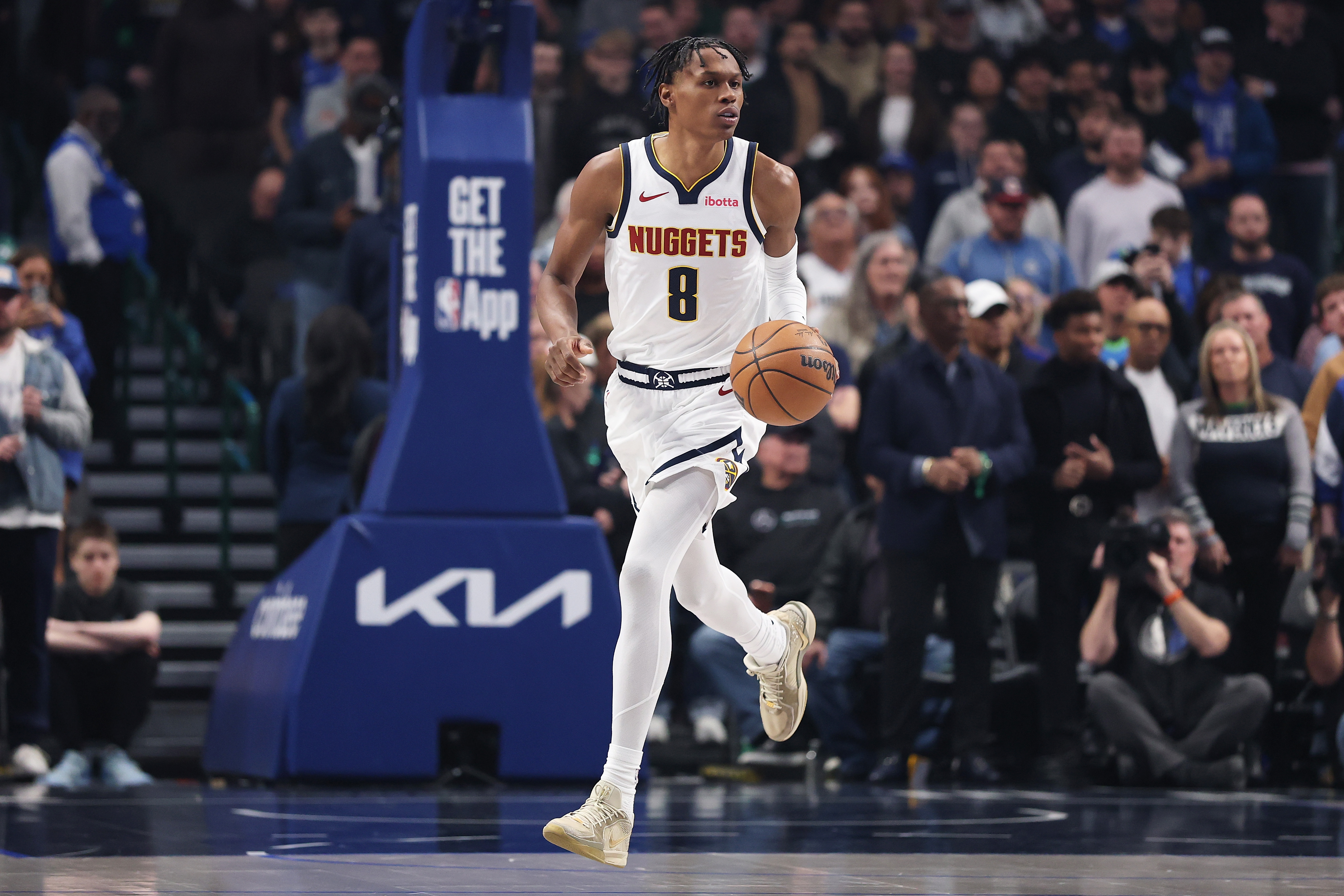
GettyDALLAS, TEXAS – JANUARY 14: Peyton Watson #8 of the Denver Nuggets handles the ball during a game against the Dallas Mavericks at American Airlines Center on January 14, 2026 in Dallas, Texas.
Watson, 23, is a restricted free agent, which makes any approach difficult. The Nuggets could match any offer to retain him and are reportedly planning to do so.
The 6-foot-8 star is coming off a breakout season in Mile High City, averaging 14.6 points, 4.9 rebounds, 2.1 assists and 1.1 blocks per game. He shot 49.1% from the field and 41.1% from three while starting 40 of his 54 appearances.
Watson’s camp is reportedly seeking north of $25 million per year which is unfavorable for the Nuggets at this point. Denver already has huge commitments to Nikola Jokic, Jamal Murray, Anthony Gordon and Christian Braun.
The Lakers can capitalize on the Nuggets’ need to move for pieces for flexibility and pitch a move for Watson. There would be adequate space to fit in the incoming star with the outgoings in this framework.
The Lakers can offer Watson a multi-year deal that doesn’t affect their flexibility. Vanderbilt’s outgoing deal is the most notable, which is why the Lakers have put him at the top of their moving list for now.
Watson’s Upside and Adding Herb Jones to the Roster

GettyLuka Doncic #77 of the Los Angeles Lakers passes the ball as he is pressured by Herbert Jones #2 and Jeremiah Fears #0 of the the New Orleans Pelicans during the second quarter of an 2025 Emirates NBA Cup game at Smoothie King Center on November 14, 2025 in New Orleans, Louisiana.
The Lakers would also get Jones out of this trade from the Pelicans. He is on a three-year, $68 million extension going through 2028-29 with a player option. His cap hit for 2026-27 sits at around $14.9 million.
With Watson and Jones, the Lakers would be bringing in roughly $38 million worth of salary, adding both Saddiq Rey for depth while sending out only about $26 million. This scenario would push L.A. well over its luxury limit but not into restrictive zones.
A potential lineup having Watson and Jones alongside Doncic, Austin Reaves and the newly acquired Walker Kessler, is positioned to be a strong core.
The real hurdle is getting Denver to move on from Watson. The franchise is committed to keeping him, even if it means giving up one of their more seasoned stars. They did activate a qualifying offer, making him restricted and they intend to match offers. Although a sign-and-trade is not impossible and the Lakers can work with that.
Adel Ahmad Adel is a writer with over five years of experience covering the NBA. His work has appeared on various media platforms, both national and local. More about Adel Ahmad

A massive wave of cyclists ranging from kids as young as 9 to grandparents in their 80’s just launched a 207-mile journey from Seattle to Portland. They are keeping completely off the highway, sticking to backroads and local bike trails. Meanwhile, local commuters are feeling the squeeze as northbound Interstate 5 gridlock forces heavy weekend traffic onto those exact same surface streets.
-

 News6 minutes ago
US congressman says he was detained by armed Israeli settlers in occupied West Bank
-

 Los Angeles, Ca1 hour ago
New details emerge in fatal stabbing of boy in El Monte
-

 Detroit, MI2 hours ago
1 dead, 1 injured after two-vehicle crash at Collingwood and Belleterre in Detroit
-

 San Francisco, CA2 hours ago
4 arrested, 3 cited after brawl following Giants vs. Rockies game at Oracle Park
-

 Dallas, TX2 hours ago
Mark Cuban takes legal action against Dallas Mavericks ownership over potential new arena deal
-

 Miami, FL2 hours ago
South Florida Dirt: A timeline of the Vacchi vs. Stern legal battle
-

 Boston, MA2 hours ago
Tall Ships begin historic Boston parade of sails
-

 Denver, CO2 hours ago
Lakers Proposed to Land Peyton Watson in Massive 9-Player Blockbuster Trade

