California
'Doomsday fish' washed ashore in California, but what does that mean?

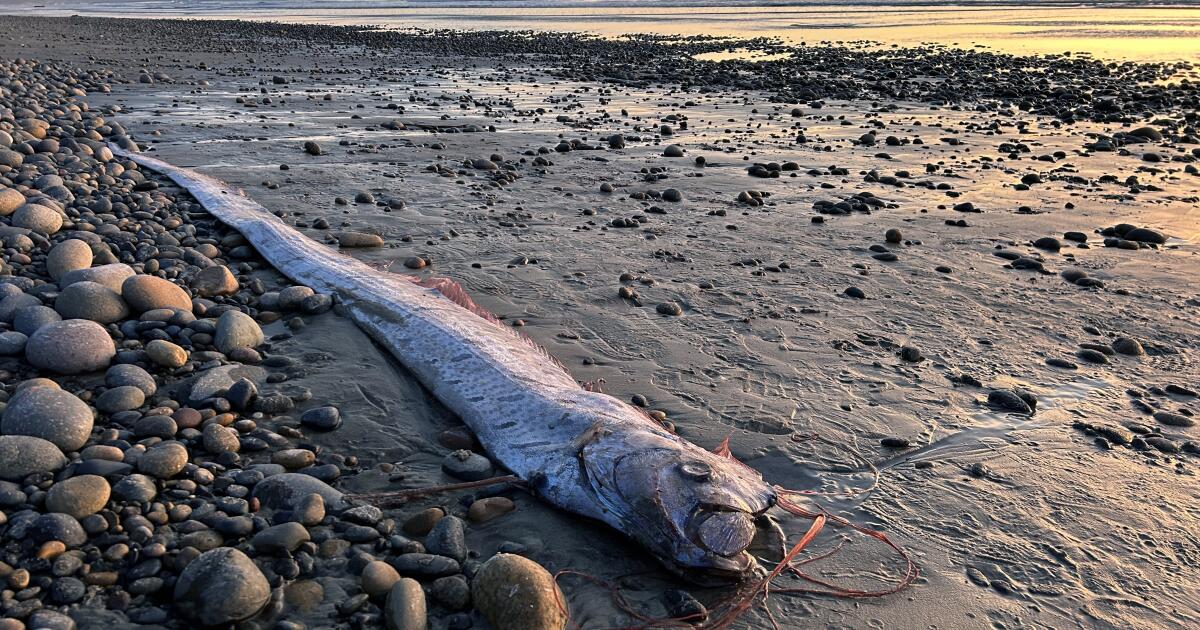
If one oarfish landing on a beach is a sign of a disaster to come, how bad will it be if three wash up in quick succession?
A silvery 10-foot-long creature, the oarfish has fueled fisherman’s tales of sea serpents — and in some cultures has been a portent of natural disasters.
It’s rare to see an oarfish up close in California; only 22 have washed ashore since 1901, according to UC San Diego’s Scripps Institution of Oceanography. But in the last three months, three of them have surfaced on Southern California beaches.
The latest was on Nov. 6, when an oarfish was discovered at Grandview Beach by Alison Laferriere, a doctoral candidate at Scripps Institution of Oceanography. The other two beached in La Jolla and Huntington Beach.
The last time a series of oarfish came ashore in California and other parts of the world was over several months in 2013 and 2014. Misty Paig-Tran, associate professor of biological science at Cal State Fullerton, studied four of them.
Every time an oarfish makes an appearance on the sand, it’s a spectacle for scientists as well as the general public for several reasons.
To start with, nobody is expecting a behemoth that’s up to 25 feet long to come so close to the California coast, said Paig-Tran.
“What’s special about them is that when they’re freshly dead or just about to die and you look at their skin, it actually [looks] like a mirror,” she said.
Its length combines with its silver skin and bright red scarlet fins to give it a mythical look.
Since the 1500s, sailors have told of sea monsters as long as their ships, and have even drafted maps that warned of areas in the ocean where such creatures resided. Their depictions appear to describe oarfish.
Oarfish generally live in the upper layers of the ocean depths, from about 300 feet to almost 3,000 feet underwater. Scientists call this section of the ocean the “twilight zone” because the fish that inhabit it are basically living in darkness with only a small glimpse of light, Paig-Tran said.
The twilight zone is too deep for divers to reach and explore, adding to the allure of this species.
If an oarfish happens to swim up to the ocean’s surface, a sailor would see a long slithering creature with spiky protrusions on its head and could believe it was a sea monster, Paig-Tran said.
It’s a jarring sight, but oarfish are anything but dangerous. Oarfish are bottom feeders, meaning they primarily feed on krill (a small shrimp-like creature) using powerful mouths shaped liked vacuum nozzles, according to Scripps.
An oarfish’s body is extremely delicate, so much so that if you pick one up it could break in half because of its jelly-like bones, Paig-Tran said.
Another factor that adds to the mystique of this creature is the lack of knowledge about its history and daily life, including how it mates, when it lays eggs, what its movement patterns are and how often it feeds.
Scientists are able to study the creatures only when they wash up on a beach.
“When a body comes up, we can do our best to look to the biology and the physiology and try to make our best guesses, but we don’t get to see it living in its natural environment,” Paig-Tran said. “It’s a completely open-ended question of what’s going on with these fishes.”
Why are dead oarfish washing ashore?
Scientists don’t know why these oarfish have died and washed ashore.
The latest oarfish spotted in Encinitas was recovered by a team of NOAA Fisheries Service and transported to Southwest Fisheries Science Center, where it will undergo an autopsy so researchers can learn more about the biology, anatomy, genomics and life history of oarfish, according to Scripps.
The deaths of the three fish that have surfaced “may have to do with changes in ocean conditions and increased numbers of oarfish off our coast,” said Ben Frable, manager of Scripps Oceanogaphy Marine Vertebrate Collection.
“Sometimes it may be linked to broader shifts, such as the El Niño and La Niña cycle, but this is not always the case,” he said.
There was a weak El Niño earlier this year, and this wash-up coincided with the recent red tide and Santa Ana winds last week. But many other factors could have played a role in these strandings, Frable added.
Another possible explanation is that the oarfish got stuck in a current and couldn’t go back down into deeper waters.
Oarfish aren’t strong swimmers. They primarily rely on their dorsal fin, whereas strong swimmers use their caudal fin or back tail, Paig-Tran said.
An oarfish that gets caught in a current and is taken up to the surface doesn’t have a good way to get back down.
“If you are a fish that lives in the deep and you got stuck on the surface, you’re kind of hosed,” she said.
Where did the “doomsday” name come from?
Oarfish have been dubbed “doomsday” fish because some cultures consider it a bad sign when they appear. The moniker is derived from a manipulation of Japanese folklore that became popular following the Fukushima disaster, Frable said.
“In the two years prior to the disaster, about a dozen oarfish washed up in Japan, most hundreds of miles away from this area.” he said.
In the aftermath of the natural disaster, people latched onto these strandings as an omen of the disaster.
This prompted researchers in Japan in 2019 to test whether oarfish and other deep-sea animal strandings were correlated with earthquakes, tsunamis and other factors.
“They found no correlation whatsoever,” Frable said. “But the name is too evocative to disappear.”
On the other hand, Paig-Tran said there could be some truth to the myth because when an earthquake happens, it releases pressure that can change a current underwater.
“When the pressure gets released, it changes the currents that [the fish are] living in, and it brings them up to the surface with this kind of big bolus of air and gasses and whatever the turbulence [is] from this earthquake,” she said.
So, are the oarfish that surfaced in Southern California a harbinger of a massive earthquake? According to Paig-Tran: probably not.

California
Mother, daughter found ‘alive and well’ after going missing on Southern California hiking trail

A mother and daughter who went missing after going for a hike on a difficult trail in San Bernardino County’s San Gorgonio Wilderness have been found “alive and well,” the sheriff’s department announced Friday.
The San Bernardino County Sheriff’s Department told KTLA they were uninjured and “walked out on their own.”
Krystal Meyers, 41, and her daughter Alexis Meyers Martinez, 21, were hiking on the Vivian Creek Trail Thursday but didn’t return, according to the San Bernardino County Sheriff’s Department.
They were last known to be at the 10,300-foot elevation mark above the High Creek switchbacks at 11 a.m., according to the San Gorgonio Search and Rescue team.
The Vivian Creek Trail is widely considered one of the more strenuous and hazardous routes in the San Gorgonio Wilderness.
The U.S. Forest Service says it’s the shortest and steepest route to the summit of Mount San Gorgonio and requires experienced mountaineering skills.
Officials did not provide any further details about the circumstances surrounding their disappearance.

BAKERSFIELD, Calif. (KBAK/KBFX) — The California Highway Patrol is urging drivers to stay focused on the road as they head out for Fourth of July celebrations.
The holiday weekend can be a dangerous time on our roads as millions of drivers are expected to travel.
CHP Officer Jorge Toro joined Eyewitness News Mornings to share how drivers can stay safe behind the wheel.
Officer Toro also highlighted the importance of sober driving over the holiday.
BE THE FIRST TO COMMENT
He says anyone hosting a party should make sure all of their guests get home safely, ensuring anyone who may be impaired doesn’t drive.

California is returning a stretch of rugged Mendocino County coast to the Indigenous nations whose ancestors once stewarded its shores.
State transportation officials recently approved the transfer of Blues Beach and the surrounding bluffs to Kai Poma, a nonprofit founded by representatives of the Sherwood Valley Band of Pomo Indians, Round Valley Indian Tribes and Coyote Valley Band of Pomo Indians.
The transfer of 136 acres just south of the community of Westport will mark the first time land managed by the California Department of Transportation has been returned to Indigenous tribes.
“This is beyond huge,” said J. Carlos Rivera, tribal chairman of the Sherwood Valley Band of Pomo Indians. “It’s enormous from our tribal perspective that we are basically obtaining the land that our people once lived on before colonization.”
California purchased the swath of rocky cliffs and windswept shoreline in the 1960s to expand the construction of Highway 1 and create a scenic viewpoint for highway travelers, according to a California Coastal Commission report.
More recently, public access has been largely unregulated, and summer weekends and holidays have drawn large groups who camp and party on the beach, at times driving through sensitive areas, damaging cultural sites and leaving behind trash, the report states.
Kai Poma plans to conduct cultural and archaeological resource studies and environmental surveys and then prepare a resource management plan for the property, according to planning documents. The nonprofit and the Coastal Commission have drafted a public access management plan that states the land will be open from sunrise to sunset.
Rivera described the entire property as a sacred site. The coastal waters are used by tribal people for seaweed and abalone gathering, and the shores host youth cultural camps, he said. “Protecting the land, it has a deeper meaning for us because we’re connected to the land,” he said.
The effort to acquire the land took years — and required a change in state law. Caltrans lacked the ability to transfer land to tribal governments until 2021, when Gov. Gavin Newsom signed a bill sponsored by state Sen. Mike McGuire (D-Healdsburg) that enabled the transfer, according to a news release issued at the time. The law also bars commercial activity on the property and requires public access be maintained.
“With 136 acres now officially transferred into tribal stewardship, one of the most spectacular stretches of the Mendocino Coast will be forever protected,” McGuire said in a statement.
“This agreement, the first of its kind in California, gives these three dynamic Native American tribes the rightful opportunity to reclaim sacred lands and cultural traditions on this special piece of earth. And it’s about damn time.”
The land transfer cleared its last regulatory hurdle June 26 with the approval by the California Transportation Commission, said Neil Thapar, an attorney who works as an advisor and legal consultant to Kai Poma. Caltrans staff will next record the deed transferring the title from the state of California to Kai Poma, which is expected to happen any day, he said.
-

 Massachusetts51 seconds ago
American flags
-

 Minnesota8 minutes ago
New LeBron James Rumors Reveal Wolves Free-Agent Pitch to NBA Icon Amid ‘Ramped Up’ Contract Pursuit
-

 Mississippi11 minutes ago
Mississippi Lottery Mississippi Match 5, Cash 3 results for July 3, 2026
-
Missouri16 minutes ago
Missouri Lottery Mega Millions, Pick 3 winning numbers for July 3, 2026
-
Montana23 minutes ago
Montana Lottery Mega Millions, Big Sky Bonus results for July 3, 2026
-

 Nebraska26 minutes ago
NEBRASKA REACTS Survey Results: Husker Football Plus a Concert? Here’s What You Said
-

 Nevada31 minutes ago
Exclusive | California’s illegal fireworks trade fueled by nefarious interstate pipeline
-

 New Hampshire38 minutes ago
Fireworks Near Me: July 4th Events Around Concord For 2026

