California
California mushroom poisonings are on the rise. Here’s what’s being done to curb exposure

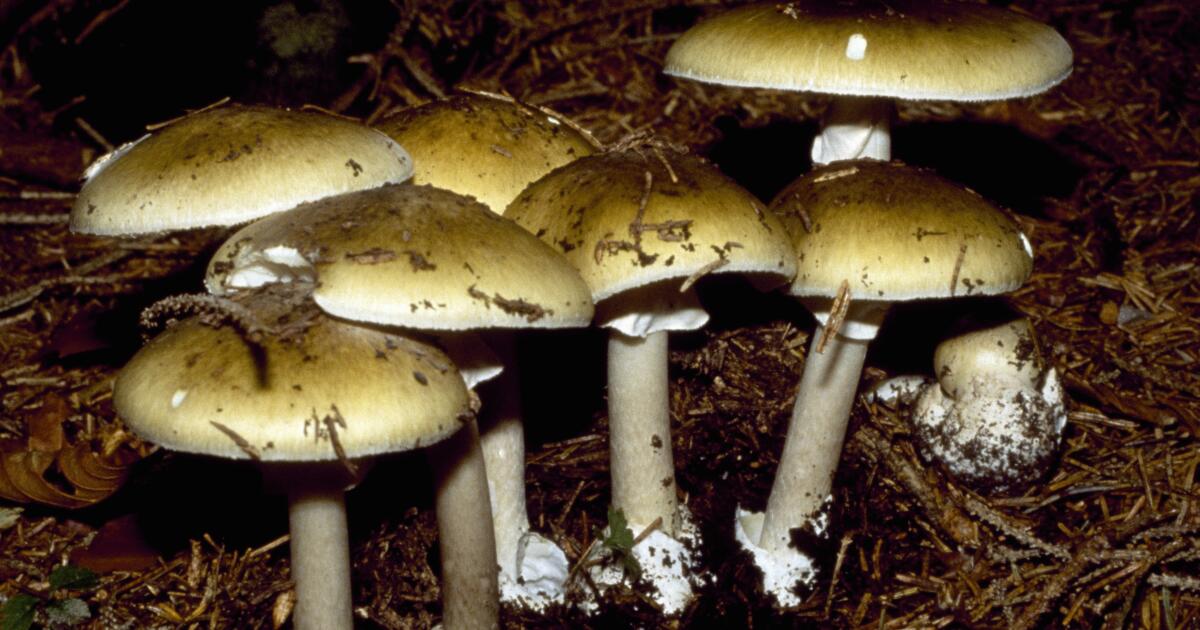
David Yturralde arrived at the mushroom talk in Newport Beach recently armed with a pen and paper and a host of questions. The goal, he said, was to demystify those fascinating fungi that popped up on his grass after heavy winter rain.
He’s long been interested in the mushrooms that sprout on the front lawn of his San Clemente home, but he’s always been too timid to pick any. And there’s no way he’s collecting any to taste, he said.
“Mushrooms are mysterious little things because right away your parents tell you, as a child, don’t eat that,” he said.
But after hearing about recent illnesses and fatalities related to the death cap mushroom, Amanita phalloides, in California, Yturralde and several others who gathered in the Environmental Nature Center’s conference room sought answers about which mushrooms in the area are deadly.
In the past three months, California has seen a sudden uptick in the number of people becoming sickened and dying after accidentally eating poisonous mushrooms found in the wild. While the fatalities have occurred along the Central Coast and in Northern California, the phenomenon has prompted concerns and discussions among mycological societies and amateur foragers across the Golden State.
The most recent death was reported on Jan. 27 by public health officials in Contra Costa County who confirmed a 60-year-old man died after eating wild mushrooms, bringing the total number of fungi-related fatalities to four.
Public health officials could not identify which wild mushroom caused the man’s death, said Nicola Gillette, spokesperson for Contra Costa Health. But officials said the man, who was described as being of “Hispanic descent,” died after eating wild mushrooms foraged at a regional park in the county.
“Preliminary information indicates the man may have mistaken the mushroom for a variety that is edible in his home country,” Gillette said.
The California Department of Public Health reported 39 death cap-related illnesses, including four fatalities and three liver transplants, between Nov. 18 and Jan. 18.
In a typical year, the California Poison Control Center may receive up to five cases of poisonous mushroom-related illness, according to authorities.
The last major outbreak occurred in 2016 with 14 reported cases, and while there were no deaths, three people required liver transplants and one child suffered a “permanent neurologic impairment.”
In this slew of cases, the California Department of Public Health has reported that 60% of affected individuals spoke Spanish as their primary language — other affected people speak Mixteco, Mandarin Chinese, Ukrainian, Russian and English.
The incidents that have occurred within the Latino community this year could be an anomaly, said Mike McCurdy, president of the San Francisco Mycological Society.
The society has been working closely with the state public health department to create a warning sign and fliers with a QR code leading to more information in multiple languages that can be distributed in recreational areas such as parks, nature preserves and hiking trails.
Generally, people are accidentally poisoned after they mistakenly eat a wild mushroom they thought was safe, McCurdy said.
Some situations are more nefarious. In 2025 Erin Patterson, a 51-year-old Australian woman, was sentenced to life in prison for murdering three relatives and trying to kill another by intentionally feeding them a beef Wellington that included poisonous fungi in the ingredients.
Two of the most toxic mushrooms that can be found in the state are the death cap and the western destroying angel mushroom, Amanita Ocreata. Death cap mushrooms have a dome-shaped cap that may have olive or yellowish tones, while the western destroying angel has a cream or ochre-colored cap.
At the start of Joanne Schwartz’s presentation in Newport Beach recently, the expert amateur mycologist acknowledged the number of recent deaths caused by toxic fungi.
“Guess what, these mushrooms are right here in Orange County,” Schwartz said. “You might even have one on your lawn.”
She warned the roughly 20 attendees that some edible mushrooms look like toxic ones, many grow side by side and if a person collects a mushroom species in one part of the world, there might be a deadly look-alike somewhere else.
While mushroom poisonings have been concentrated further north, word of the deaths and illnesses has trickled down to Southern California, sparking fear among those who are wary of the spongy wonders, said Rudy Diaz, president of the Los Angeles Mycological Society.
When mushroom poisonings make the headlines, people who aren’t a part of the fungi community tend to see those who are as being irresponsible or ruining habitats, he said.
On a recent hike with a friend, Diaz said he was looking at some mushrooms he found on the trail and a stranger “chided me for doing something so risky.”
“For people who have been able to redevelop that kind of spiritual connection with the land through their years of observation and study, eating things that you forage is kind of like an active communion with these environments that you love and you’ve come to know,” Diaz said.
But experts, including Diaz, say eating mushrooms isn’t a necessary part of observing, learning and appreciating them.
For those who are well versed in mushrooms in Southern California, there isn’t a sense of alarm of possible poisonings because the toxic mushrooms are a lot less conspicuous in the southern part of the state.
In Northern California, death caps are abundant in local parks, “whereas here in Southern California you have to dig through some oak litter before you tend to spot things,” Diaz said.
Still, the message from the mycology society and mycologists throughout the state is one of caution: Unless you’re familiar with your local environment, have an expert you can consult or are part of a mushroom or foraging club, you should not be eating wild mushrooms.
Mycologists use dichotomous keys to identify the species of mushroom based on its physical characteristics including the cap, stem, ring and gills.
The mistake people outside the fungi community or beginners make when identifying mushrooms is solely relying on social media, a field guide or an app like iNaturalist, said Bob Cummings, a leading mycology expert in Santa Barbara. Just comparing the mushroom to a photo isn’t enough to make an accurate species identification, he said.
Schwartz encouraged the public to be active participants in community science. Her hope, she said, is that people get engaged with mushrooms because there’s so much to learn about the more than 1,500 species in Orange County and over 3,000 types of fungi in the state.
Mushrooms, toxic or not, are OK for all to pick and observe, she said.
Yturralde came away from the weekend discussion with his mind made up.
“I’m open to learning more about mushrooms, but I’m not interested in eating anything that I find,” Yturralde said. “In other words, I learned that it’s best to only eat what’s in the [grocery store].”



California
California’s leading GOP candidate for governor reacts to Swalwell’s exit from race | CNN Politics

California’s leading GOP candidate for governor reacts to Swalwell’s exit from race
Republican Gov. candidate Steve Hilton joins CNN’s Dana Bash after one of his opponents, Rep. Eric Swalwell, exited the California governor’s race amid sexual misconduct allegations. “We desperately need change. And no Democrat can provide that,” Hilton says.

FRESNO, Calif. (FOX26) — A new effort to crack down on dangerous drivers in California is gaining attention as lawmakers push forward legislation aimed at repeat speeders.
Assembly member Esmeralda Soria has introduced a bill that would require certain drivers with multiple speeding offenses to install a device in their vehicles that automatically limits how fast they can go. The measure, known as the “Stop Super Speeders Act” (AB 2276), is designed to improve road safety and prevent deadly crashes.
The program could first roll out as a pilot in several counties, including Fresno, Kern, Los Angeles, San Bernardino, San Diego, Santa Clara, and Shasta. While the proposal was initially intended to be implemented statewide, consultants recommended starting with a smaller pilot program.
The legislation is driven in part by tragic cases like that of Paul Martinez, who was killed at just 21 years old after being struck by a speeding driver in Fresno. His father, Joe Martinez, says the loss is something he lives with every day.
“Being 21 years old and suddenly your entire life, dreams, goals—everything—is just wiped out by the distraction of one person who was speeding,” he said. According to reports, the driver who hit Paul was traveling 54 miles per hour in a 40 mph zone.
Traffic safety remains a serious concern in Fresno. Data from Smart Growth America ranks the city as the seventh worst in the nation for pedestrian deaths.
“I do not want to see another father who grieves every single day because he lost his child to someone driving recklessly,” Soria said.
Under AB 2276, judges would have the authority to require repeat offenders to install Intelligent Speed Assistance (ISA) devices in their vehicles. The technology functions similarly to cruise control but automatically adjusts a car’s speed based on posted limits using GPS data.
“Once the technology is installed, it knows the speed limit of the neighborhood or freeway and makes adjustments accordingly,” Soria explained. “This is for those folks who haven’t learned their lesson from simply getting a ticket.”
However, the proposal has drawn criticism from some groups. Opponents argue that the bill’s language is too broad and could create unintended safety risks. Critics say there are situations where drivers may need to accelerate quickly to avoid danger, and limiting speed could make those situations more hazardous.
Supporters counter that the bill is about accountability and protecting lives on the road.
“You would think this is a no-brainer bill,” said Martinez, “It holds repeat offenders accountable.”
The bill is still in the early stages of the legislative process. Its next step is review by the Assembly Appropriations Committee.

The California Republican Party will make endorsements of the candidates running for office — including for the state’s next governor — on Sunday during the final day of the California Republican Convention in San Diego.
Candidates made their plea for endorsement to the party’s delegates at the convention, held at the Sheraton San Diego Resort on Harbor Island, on Saturday — with promises to root out alleged misuse of spending, push forward voter identification initiatives and boost affordability in the state.
The party faces what could be an uphill battle to win in the majority Democratic state, and is also coming off the loss of Proposition 50 last year, in which voters overwhelmingly voted to redistrict the state to benefit Democrats.
Despite the challenges, Republican candidates and convention attendees showed up hopeful for their odds — with especially strong enthusiasm behind the two candidates for governor, Riverside County Sheriff Chad Bianco and former Fox News commentator Steven Hilton.
“This election has always been ours for the taking,” said Bianco. “It is up to us — conservative, common-sense Republicans — to show proven leadership, compassion and integrity matters.”
Hilton has been endorsed by President Donald Trump — a development some expect could hurt his chances of winning in the largely blue state.
But many of the candidates expressed support and alignment with the Trump administration and its policies, including efforts to ban transgender athletes in women’s and girls’ sports and abolish sanctuary cities, which limit cooperation with federal immigration enforcement.

“It’s going to be a whole new story in California,” Hilton said. “We are going to play our part in (Trump’s) golden age for America.”
That support for Trump was on full display at the convention, with loud cheers from the audience when the candidates mentioned the president’s policies and signs saying “Make California Golden Again,” co-opting his signature slogan.
Associate delegate from Ventura County Jennifer McCarthy says she wants a candidate with Trump’s ideals, which is why she’s supporting Hilton.
“I think he has the political and the business experience, plus the media experience, that he will be able to make the difference in California,” she added.
The party’s delegates will announce its endorsements during the final day of the convention on Sunday.

Along with the candidate forum, the convention on Saturday offered a series of events, including a book signing with former Trump administration press secretary Sean Spicer and a panel on voter identification and the future of elections.
Booths with volunteers promoting candidates and vendors selling merchandise lined the main hall of the convention, and bedazzled clothing for sale — along with rows of “Make America Great Again” hats and other Trump-related merchandise — further decorated the space.

San Diego resident Blake Marnell says he’s been often seen at Trump rallies wearing a signature suit with a brick pattern on it — to symbolize his support for the Trump administration’s border fence — but he left the outfit at home on Saturday, since the convention was more focused on California issues.
Marnell is supportive of Hilton for governor and says he thinks he will be able to reach independent voters as well as Republicans.
“I don’t see Steve Hilton as being a party politician,” he said. “He’s got a lot of crossover.”
But Louisa Millington, from Riverside, says Trump’s endorsement of Hilton is detrimental in a state like California.
“I would vote for (Trump) again today, but in California, we need a governor for California, not for Washington, D.C.,” she said. “We can’t have our president picking and crowning who’s going to be our governor in California.”

Georgia man charged with trafficking 17-year-old girl for sex in McDuffie County, AG says

Man, 26, dies after jumping off cliff at ‘End of the World’ | Honolulu Star-Advertiser

IDFG brings early-season fishing to Southwest Idaho community ponds

Illinois departments probing West Suburban hospital’s finances after abrupt closure, state rep. says

Monday storm blows across northeast Indiana, northwest Ohio

Florida High School Football Rankings: Top 25 teams – Oct. 21

How old is Bo Nix? What to know about Oregon quarterback ahead of 2024 NFL Draft

Cleary's 21 help Le Moyne down Central Connecticut State 69-64 in OT

99th annual Pony Swim held in Virginia

Indiana Members Credit Union announced as new anchor tenant at Bottleworks District

Embattled Rep Tony Gonzales announces plans to resign amid sexual misconduct allegations

UN experts slam attacks on Gaza shelters, forced displacement in West Bank

DOJ fires at least 4 prosecutors involved in FACE Act cases during Biden administration

Melania Trump’s Epstein remarks turn up the heat on DOJ, Acting AG Todd Blanche to do more
Newsletter: Cautious optimism in Brussels as Orbán ousted in landslide Hungarian opposition win
-

 Atlanta, GA1 week ago
1 teenage girl killed, another injured in shooting at Piedmont Park, police say
-

 Georgia7 days ago
Georgia House Special Runoff Election 2026 Live Results
-

 Arkansas4 days ago
Arkansas TV meteorologist Melinda Mayo retires after nearly four decades on air
-

 Pennsylvania1 week ago
Parents charged after toddler injured by wolf at Pennsylvania zoo
-
 Milwaukee, WI1 week ago
Potawatomi Casino Hotel evacuated after fire breaks out in rooftop HVAC system
-

 Technology1 week ago
Anthropic essentially bans OpenClaw from Claude by making subscribers pay extra
-

 Austin, TX6 days ago
ABC Kite Fest Returns to Austin for Annual Celebration – Austin Today
-

 World1 week ago
Zelenskyy warns US-Iran war could divert critical aid from Ukraine