California
California mushroom poisonings are on the rise. Here’s what’s being done to curb exposure

David Yturralde arrived at the mushroom talk in Newport Beach recently armed with a pen and paper and a host of questions. The goal, he said, was to demystify those fascinating fungi that popped up on his grass after heavy winter rain.
He’s long been interested in the mushrooms that sprout on the front lawn of his San Clemente home, but he’s always been too timid to pick any. And there’s no way he’s collecting any to taste, he said.
“Mushrooms are mysterious little things because right away your parents tell you, as a child, don’t eat that,” he said.
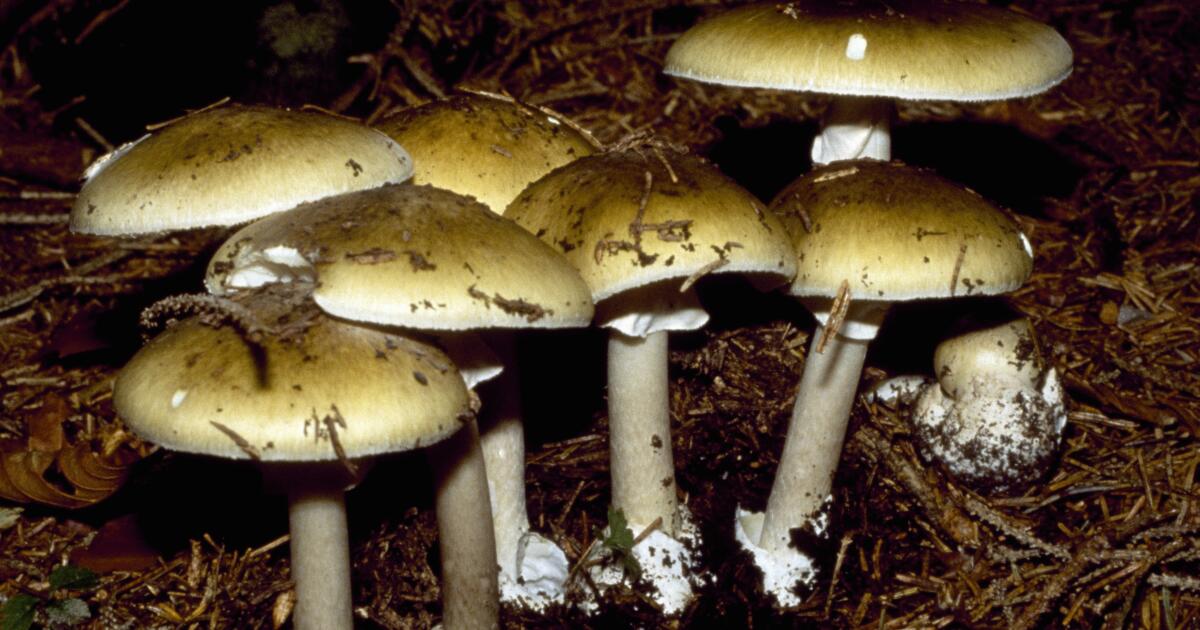
But after hearing about recent illnesses and fatalities related to the death cap mushroom, Amanita phalloides, in California, Yturralde and several others who gathered in the Environmental Nature Center’s conference room sought answers about which mushrooms in the area are deadly.
In the past three months, California has seen a sudden uptick in the number of people becoming sickened and dying after accidentally eating poisonous mushrooms found in the wild. While the fatalities have occurred along the Central Coast and in Northern California, the phenomenon has prompted concerns and discussions among mycological societies and amateur foragers across the Golden State.
The most recent death was reported on Jan. 27 by public health officials in Contra Costa County who confirmed a 60-year-old man died after eating wild mushrooms, bringing the total number of fungi-related fatalities to four.
Public health officials could not identify which wild mushroom caused the man’s death, said Nicola Gillette, spokesperson for Contra Costa Health. But officials said the man, who was described as being of “Hispanic descent,” died after eating wild mushrooms foraged at a regional park in the county.
“Preliminary information indicates the man may have mistaken the mushroom for a variety that is edible in his home country,” Gillette said.
The California Department of Public Health reported 39 death cap-related illnesses, including four fatalities and three liver transplants, between Nov. 18 and Jan. 18.
In a typical year, the California Poison Control Center may receive up to five cases of poisonous mushroom-related illness, according to authorities.
The last major outbreak occurred in 2016 with 14 reported cases, and while there were no deaths, three people required liver transplants and one child suffered a “permanent neurologic impairment.”
In this slew of cases, the California Department of Public Health has reported that 60% of affected individuals spoke Spanish as their primary language — other affected people speak Mixteco, Mandarin Chinese, Ukrainian, Russian and English.
The incidents that have occurred within the Latino community this year could be an anomaly, said Mike McCurdy, president of the San Francisco Mycological Society.
The society has been working closely with the state public health department to create a warning sign and fliers with a QR code leading to more information in multiple languages that can be distributed in recreational areas such as parks, nature preserves and hiking trails.
Generally, people are accidentally poisoned after they mistakenly eat a wild mushroom they thought was safe, McCurdy said.
Some situations are more nefarious. In 2025 Erin Patterson, a 51-year-old Australian woman, was sentenced to life in prison for murdering three relatives and trying to kill another by intentionally feeding them a beef Wellington that included poisonous fungi in the ingredients.
Two of the most toxic mushrooms that can be found in the state are the death cap and the western destroying angel mushroom, Amanita Ocreata. Death cap mushrooms have a dome-shaped cap that may have olive or yellowish tones, while the western destroying angel has a cream or ochre-colored cap.
At the start of Joanne Schwartz’s presentation in Newport Beach recently, the expert amateur mycologist acknowledged the number of recent deaths caused by toxic fungi.
“Guess what, these mushrooms are right here in Orange County,” Schwartz said. “You might even have one on your lawn.”
She warned the roughly 20 attendees that some edible mushrooms look like toxic ones, many grow side by side and if a person collects a mushroom species in one part of the world, there might be a deadly look-alike somewhere else.
While mushroom poisonings have been concentrated further north, word of the deaths and illnesses has trickled down to Southern California, sparking fear among those who are wary of the spongy wonders, said Rudy Diaz, president of the Los Angeles Mycological Society.
When mushroom poisonings make the headlines, people who aren’t a part of the fungi community tend to see those who are as being irresponsible or ruining habitats, he said.
On a recent hike with a friend, Diaz said he was looking at some mushrooms he found on the trail and a stranger “chided me for doing something so risky.”
“For people who have been able to redevelop that kind of spiritual connection with the land through their years of observation and study, eating things that you forage is kind of like an active communion with these environments that you love and you’ve come to know,” Diaz said.
But experts, including Diaz, say eating mushrooms isn’t a necessary part of observing, learning and appreciating them.
For those who are well versed in mushrooms in Southern California, there isn’t a sense of alarm of possible poisonings because the toxic mushrooms are a lot less conspicuous in the southern part of the state.
In Northern California, death caps are abundant in local parks, “whereas here in Southern California you have to dig through some oak litter before you tend to spot things,” Diaz said.
Still, the message from the mycology society and mycologists throughout the state is one of caution: Unless you’re familiar with your local environment, have an expert you can consult or are part of a mushroom or foraging club, you should not be eating wild mushrooms.
Mycologists use dichotomous keys to identify the species of mushroom based on its physical characteristics including the cap, stem, ring and gills.
The mistake people outside the fungi community or beginners make when identifying mushrooms is solely relying on social media, a field guide or an app like iNaturalist, said Bob Cummings, a leading mycology expert in Santa Barbara. Just comparing the mushroom to a photo isn’t enough to make an accurate species identification, he said.
Schwartz encouraged the public to be active participants in community science. Her hope, she said, is that people get engaged with mushrooms because there’s so much to learn about the more than 1,500 species in Orange County and over 3,000 types of fungi in the state.
Mushrooms, toxic or not, are OK for all to pick and observe, she said.
Yturralde came away from the weekend discussion with his mind made up.
“I’m open to learning more about mushrooms, but I’m not interested in eating anything that I find,” Yturralde said. “In other words, I learned that it’s best to only eat what’s in the [grocery store].”



See the best High Desert fireworks through the years
Fireworks have long lit up the California High Desert, from community shows in Victorville and Apple Valley to backyard celebrations that filled the night sky. Revisit Fourth of July moments through the years.
Each year, fireworks light up the sky across the United States for the nation’s Independence Day. With 2026 marking the nation’s 250th birthday, fireworks shows may be a bigger draw.
With California being so fire-prone, the state has strict fireworks laws, but does that mean that people won’t enjoy fireworks without risking jail time on July 4?
Are fireworks illegal in California?
The California Department of Forestry and Fire Protection, or CalFire, is the agency in charge of managing fireworks and classifying which ones are safe to light.
The California Fireworks Law was passed in 1938 and designated the Office of the State Fire Marshal as the only fireworks classification authority in the state, according to CalFire.
The fire marshal’s office classifies fireworks through lab analysis and field testing. It also requires that all parties dealing in fireworks, such as pyrotechnic operators, manufacturers, and retailers, have licensing.
Along with the aforementioned law, the State’s Explosive Law authorizes the fire marshal to “adopt regulations for the safe use, handling, storage and transportation of explosives,” CalFire says.
“Safe and Sane” fireworks are less likely to cause injury and generally mean that the fireworks do not explode or fly, according to the City of Fontana.
There are almost 300 communities in the state that allow “Safe and Sane” fireworks.
It is illegal in the state to sell, transport, or use fireworks that don’t carry the “Safe and Sane” seal or use any in a nonpermitted community. If convicted, you can face a fine up to $50,000, a year in jail or both, according to CalFire.
All other fireworks are considered illegal in the state and are prohibited from being operated by unauthorized parties in most jurisdictions.
Some illegal fireworks include:
- Wire Core Sparklers
- Sky rockets
- Bottle rockets
- Roman candles
- Aerial shells
- Firecrackers
- Other fireworks that explode, go into the air, or move on the ground in an “uncontrollable manner.”
How to safely use fireworks
CalFire has put out a list of safety tips to avoid injury when handling fireworks.
CalFire recommends:
- Use only State Fire Marshal-approved fireworks
- Verify local ordinances before purchasing or using fireworks.
- Always read the directions on labels.
- Children should always have an adult present.
- Only use fireworks outdoors.
- Avoid using fireworks near dry grass or other flammable materials.
- Only light one firework at a time.
- Have a bucket of water and a hose nearby in case of fire.
- During a drought, it is recommended that you use a bucket of reused water to submerge your firework after use to ensure it’s completely extinguished.
- Never place any part of your body directly over a fireworks device when lighting the fuse.
- Back up several feet immediately after lighting a firework.
- Never point or throw fireworks at another person.
- Never attempt to relight or fix fireworks.
- Never experiment with fireworks.
- Do not wear loose-fitting clothing while lighting fireworks.
- Never carry fireworks in your pockets.
Ernesto Centeno Araujo covers breaking news for the Ventura County Star. He can be reached at ecentenoaraujo@vcstar.com, 805-437-0224 or @ecentenoaraujo on Instagram and X.
California
California bill to block registered sex offenders from local office rejected by Senate committee

FRESNO, Calif. (KFSN) — California bill aimed at preventing registered sex offenders from holding local elected office was halted Tuesday after a Senate committee declined to advance the measure without changes opposed by its author.
Assembly Bill 2753, introduced by Assemblywoman Esmeralda Soria in February, would have prohibited anyone who is or has been required to register as a sex offender from running for local elective office.
“This issue is critical. We have heard loud and clear from the community that we must do something,” Soria said.
The proposal came to a stop in the Senate Elections Committee, where lawmakers argued the bill’s restrictions were too broad.
California’s sex offender registration system is divided into three tiers. Tier 1 offenders are generally required to register for 10 years, Tier 2 offenders for 20 years and Tier 3 offenders for life.
According to Soria, committee members proposed limiting the bill to Tier 3 offenders. She rejected those amendments, arguing that the legislation should apply more broadly.
“For this not to be the law today, where we’re banning people that have committed some of the most horrific crimes against children, against other people, you know, and we have survivors out there, I think it’s a disservice,” Soria said.
The bill had attracted significant support before reaching the Senate. It was backed by the Fresno City Council and passed the Assembly floor in April.
Fresno City Council President Nelson Esparza traveled to Sacramento to testify in favor of the measure and said he was disappointed by the outcome.
“I call it really a gut punch for our community, and what we had experienced here, and sort of the upheaval… I don’t think we want that to happen again here at Fresno,” Esparza said.
Esparza referenced controversy earlier this year involving registered sex offender Rene Campos, who sought a seat on the Fresno City Council but ultimately did not qualify for the ballot.
Opponents of the bill argued that candidacies should be decided by voters rather than restricted by law.
“It should be a decision made by the voters, so a person should not be barred from running for office and let the voters make the decision that makes the most sense for them,” said civil rights attorney Janice Bellucci.
With the committee declining to move the bill forward under its current language, efforts to enact the proposed restrictions have stalled for now.
Copyright © 2026 KFSN-TV. All Rights Reserved.

BAKERSFIELD, Calif. (KBAK/KBFX) California voters will face a high-profile “billionaire tax” measure on the November ballot, a proposal supporters say would raise new revenue, but critics warn could push some of the state’s wealthiest residents to leave.
If passed, the measure would impose a one-time 5% tax on California billionaires living in the state as of Jan. 1, 2026.
Tal Eslick, owner of Vista Consulting, said, “I think there is this effort, especially on the part of progressive state leaders, to somehow, you know, go after billionaires or maybe even the trillionaires that may exist in the future.”
Billionaire tax measure heads to California’s November ballot, with Kern County watching (AP Photo/Jeff Chiu, File)
Political analysts say a proposal like this could encourage some of California’s wealthiest residents to relocate, potentially taking investment and business activity with them.
Eslick said, “And for that matter, they can come back occasionally to visit and do a little bit of business, but live in a state that is a little more accommodating for them from a tax standpoint.”
Questions have also been raised about what the impact could be for Kern County if billionaires leave the state.
Sherod Waite, CEO of Moneywise Guys, said, “It’s questionable how much revenue would actually be generated from the tax and how much revenue would be lost from those people exiting the state. It’s questionable. It’s a gamble.”
Waite said billionaires leaving could reduce state revenue that could be used in Kern County.
Billionaire tax measure heads to California’s November ballot, with Kern County watching (AP Photo/Jeff Chiu, File)
“Think of all the support services that the state offers to the entire state, including us here in Kern County, that are paid for by tax dollars,” he said.
Gov. Gavin Newsom has been outspokenly against a state wealth tax and is instead proposing a national tax policy that would tax anyone with a net worth of $100 million.
Newsom said, “It’s time for a national billionaire’s tax and a new social contract. Just think of this, just ten percent of people own 2/3’s of the nation’s wealth.”
Eslick said Newsom’s position can be difficult to square.
“It’s a naturally confusing sort of position to be opposed to the tax in California but be supportive of it at a national level. But I think that’s him walking a treacherous political road,” he said.
Billionaire tax measure heads to California’s November ballot, with Kern County watching (AP Photo/Jae C. Hong, File)
In a statement regarding the measure, Assemblyman Stan Ellis said in part, “This would hurt Kern’s energy, Agriculture, manufacturing, and working families through lost investment, fewer jobs and unstable state funding.”
-

 Miami, FL5 minutes ago
Ex-con lists $138M in luxury penthouses, including Miami trophy condo
-

 Boston, MA8 minutes ago
Celtics reportedly trading Jaylen Brown to 76ers for Paul George, picks
-

 Denver, CO13 minutes ago
LeBron James to the Nuggets? Latest reports and betting odds
-

 Seattle, WA20 minutes ago
Residents and activists clash over plan to curb SEPA appeals at Seattle hearing
-

 San Diego, CA23 minutes ago
San Diego family celebrates UCSD graduation amid ICE fears
-

 Milwaukee, WI28 minutes ago
ICE enforcement in Milwaukee, city accuses feds of violating ordinance
-

 Atlanta, GA35 minutes ago
Severe Thunderstorm Warnings issued for North Georgia, metro Atlanta
-

 Minneapolis, MN38 minutes ago
Minneapolis closes three beaches ahead of 4th of July weekend due to high e. coli levels

