California
California Bible college students claim they were confined, surveilled and made to do unpaid labor


In 2018, emergency dispatchers received a strange call from a remote valley in Riverside County. The caller was a 22-year-old student who said that she had been unable to leave her rural college campus for months while she was forced to work without compensation. She said she lived there with 300 others, dispatch records show, and that barbed wire surrounded the school.
The location she called from matched the address of Olivet University — a Christian Bible school set against the San Jacinto Mountains near the high desert town of Anza. Its entrance is marked by a grove of olive trees, but the more than 900-acre gated campus isn’t visible from the street; visitors must make an appointment to enter.
For years, the university and the teachings of its founder have drawn students from around the world, mostly from east Asia, seeking an academic experience rooted in Christianity. The promise of a U.S. student visa and a scholarship combined to make an unbeatable opportunity. But instead of feeling the sense of freedom they hoped to encounter in America, students described an environment where they were under near-constant surveillance and stripped of their independence.
In interviews with The Times, and in a lawsuit filed this year against the university, its founder, former president and others, several former students and employees from Olivet University and its business described a big brother-like atmosphere on multiple campuses where administrators prevented adults from leaving, they said, and forced them to work, sometimes for free.
Tingbo Cao, left, and wife Qilian Zhou, from China, thought they would receive a tuition-free education at Olivet University, but were forced to work instead. They recently escaped what former students and workers have described as a religious cult.
(Genaro Molina / Los Angeles Times)
The university has faced multiple law enforcement inquiries, and the U.S. Department of Homeland Security Investigations confirmed that an investigation into the university continues. No one has been charged in the probe. Former students and an attorney representing the lawsuit’s Plaintiffs say they have been contacted by federal agents in recent weeks.
Olivet has denied all allegations.
“These allegations continue to be completely false,” Olivet President Jonathan Park said in a statement. “Every government entity that has looked into these claims of human trafficking hasn’t found anything substantiating their veracity.”
The university did not say which government entities it was referring to. When asked to clarify, Park said “the university has received no indication from any state or federal investigators that the school is even being investigated for human trafficking, let alone finding anything that has substantiated the veracity of these false human trafficking claims.”
He did not respond to specific claims that students were forced to work for little or no pay or that they could not leave campus without permission.
The suit filed in California by four students, including the one who made the emergency call, said they were forced to work at least 40 hours a week doing tasks that included manual labor and gardening, and that their only outing was a weekly shopping trip to a grocery store — chaperoned by school employees. Any other plans to leave the campus required written permission, the suit said.
“At all times while Plaintiffs lived at Olivet’s Anza campus, they were not permitted to come and go from campus unless they first received permission from an Olivet employee,” the suit alleges. “Plaintiffs were required to have a form signed by an Olivet employee authorizing them to leave the campus. Plaintiffs were required to explain where they intend to go, why they were leaving, with whom, and for how long.”
The isolation added to their sense of being trapped. The university sits in a small valley of desert scrub four miles from the two lane highway that runs to the nearest city, Temecula, which is another 25 miles away.
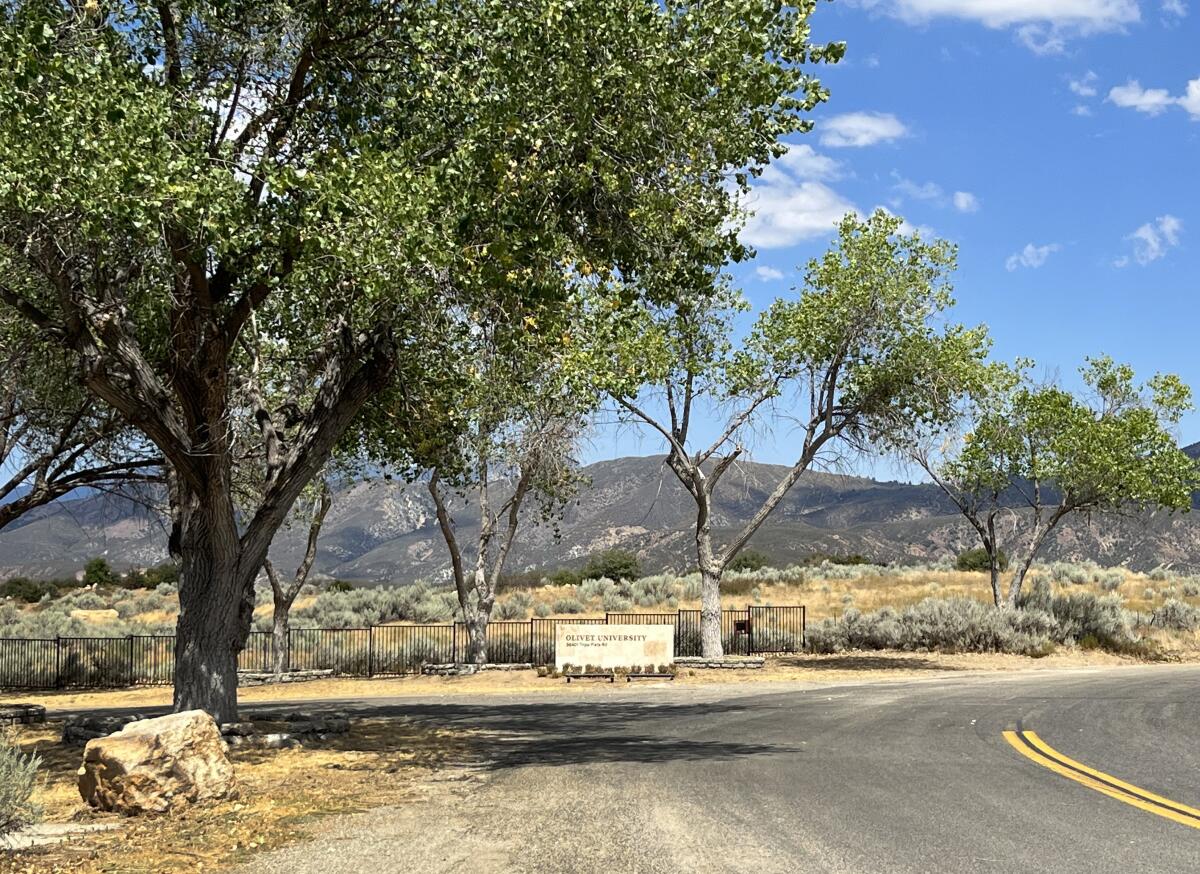
Olivet University’s network includes extension campuses in Mill Valley, Calif., and other U.S. cities. It is not related to Olivet Nazarine University in Illinois or the University of Olivet in Michigan.
(Colleen Shalby / Los Angeles Times)
Some in the Anza community who spoke to The Times said they were unfamiliar with the university, beyond allegations they’ve read about; others who grew up in the area said they were wary of the mysterious campus less than 10 miles from the town’s main drag.
Darren Harris, an attorney representing some former students, said the lawsuit is on hold for a federal investigation. Harris said that he has heard from investigators with the Department of Homeland Security and the U.S. attorney’s office in Los Angeles. The Department of Justice said it would not respond to questions related to an investigation.
Harris said that his clients fear Olivet’s power and that one client pulled out from the lawsuit over fear and intimidation. Their hope is that their case is fully investigated.
“They were promised to attend school, basically for free, under the guise of a fully paid scholarship, fully paid tuition, books, etc. And when they arrived there, they were told that they needed to be put to work to pay for school,” Harris said. “They never got paid for those jobs. They were working under duress and if they did not agree to do so, they would have been dismissed by the university. Meanwhile the university set up their visas, set up their arrangements to come there and obviously set up their schooling and living conditions.”
The California attorney general’s office filed a complaint last year with the state’s Department of Consumer Affairs for the Bureau for Private Postsecondary Education — the office responsible for giving Olivet authority to grant degrees — against the headquarters in Anza, one of its extension campuses in Mill Valley and a connected church in Los Angeles over record-keeping and regulations.
The accusation sought “to revoke or suspend the institution’s approval to operate,” DCA communications deputy director Monica Vargas said. “The matter will be heard before an administrative law judge at the Office of Administrative Hearings.”
A hearing is set for November, according to the OAH calendar.
Olivet was founded in 2000 by Korean American pastor David Jang. Aside from its main campus in Anza, the university system includes extension campuses in Mill Valley north of San Francisco; Washington, D.C.; Nashville; St. Ann, Mo., outside St. Louis; and Sanford, Fla., near Orlando. A campus in New York lost permission to operate in 2022 after the university failed to meet state requirements for curriculum, administrative policies and working conditions.
In 2018, the Manhattan district attorney’s office charged the university and several of its executives for fraud and money laundering. Olivet University pleaded guilty to conspiracy to commit money laundering and to falsification of business records, court documents show. The university said it has never pleaded guilty or been convicted of fraud or money laundering.
The university system, a 501(c)(3) nonprofit, reported $17.5 million in revenue and $80.5 million in total assets on its 2022 tax return. It interconnects with the World Olivet Assembly Inc. — a nonprofit connected to ministry work that reported more than $20 million in revenue and $85.25 million in total assets on its 2022 tax return. Those familiar with the Olivet network said it encompasses ecommerce businesses that include Amazon storefronts and has had connections to media.
Owners who founded the company that acquired Newsweek in 2013 were once connected to the university, for example. The relationship between Newsweek Media Group and Olivet was also probed by the Manhattan district attorney’s office and detailed by Newsweek, which has continued to report on allegations against Olivet under threat of legal action.
Olivet’s business entities have also been scrutinized in recent years. A complaint filed last year in Texas accused World Olivet Assembly and the university of opening multiple ecommerce accounts under various names and funneling funds back into the Olivet community. The complaint named Park as a defendant before he became the university’s president in June.
The university system’s accreditor, the Association for Biblical Higher Education, put Olivet on probation for less than two years in 2020 and then placed the university under warning in 2022 until earlier this year. Neither the investigations nor the accreditation status appear to have affected university operations as records show that some campus branches were approved during that time, including the school in Florida — a move that troubled residents.
“Olivet is a Christian university, accredited and is in good standing with ABHE [Assn. for Biblical Higher Education], with a focus on training students for careers in missions and ministry,” Park said.
The university system is not related to Olivet Nazarene University in Illinois or the University of Olivet in Michigan.
The lawsuit’s claims that students were unable to come and go and were forced to work without pay matched stories from others once connected to the university.
Former students Tingbo Cao, 41, and Qilian Zhou, 35, arrived in the U.S. from China in 2011 to join the Olivet University community. For years the couple lived on the San Francisco campus — the school’s former headquarters — before moving to the Mill Valley location when it opened. Although they were promised scholarship money, they said that most of their time was eaten by work that university leaders required them to perform to pay for their education.
With monetary help from their families, they said they loaned hundreds of thousands of dollars to the university in 2019. Years later, they awaited reimbursement, but said they received pushback from the university and didn’t get repaid until this year.
Cao said the university still owes thousands of dollars in interest accruing on the loan. The husband and wife said they have spoken to law enforcement about their experience.
Park said that the university has not received loans from students.
“This is simply not true,” he said.
The couple left the university this year with their young daughters. Zhou said that she and her husband decided to come forward because they believe they “will be safe” from possible intimidation or retaliation from the Olivet community if their story is public. Others who spoke with The Times anonymously voiced a similar fear.
Zhou said that as a graphic design student at Olivet, she often spent more than 50 hours a week creating graphics and selling products such as crystals and T-shirts via online storefronts on Amazon and Etsy. She said she typically purchased the materials from China, but never saw money from the sales and was never fully compensated for her hours of work, which she had to do in addition to classes and a mandatory 5 a.m. daily prayer service. She said that her parents sent money, clothes and other resources the family couldn’t afford.
Money she did receive from Olivet typically went back to the university amid near-constant pressure to donate, she said.
Cao did similar work while studying for his degree. During the pandemic, for example, he said he spent 70 hours a week selling masks on Etsy on top of school work. He had only a few hours to sleep.
He said his stress was compounded by a growing concern that money he lent to the school in 2019, pulled from funds he received from his parents, wouldn’t be paid back. In 2022, he said that he had a stroke due in part to stress.
“I was overwhelmed,” he said.
Another former student said she spent most of her time selling products like toenail fungus cream on Amazon storefronts, but wasn’t paid in full for the hours she worked. When her family raised concerns about the time spent on work, she researched the legality of what she had been tasked with and started to ask questions. After bringing her frustrations to a university leader, she said community students and faculty isolated her and that university leaders called her family and told them she had been “brainwashed” by outsiders.
“Suddenly, they were really aggressive,” she said. “I [thought]: ‘I’m not safe.’”
She left this year after nearly a year at the Northern California campus. She said she continues to fear retaliation.
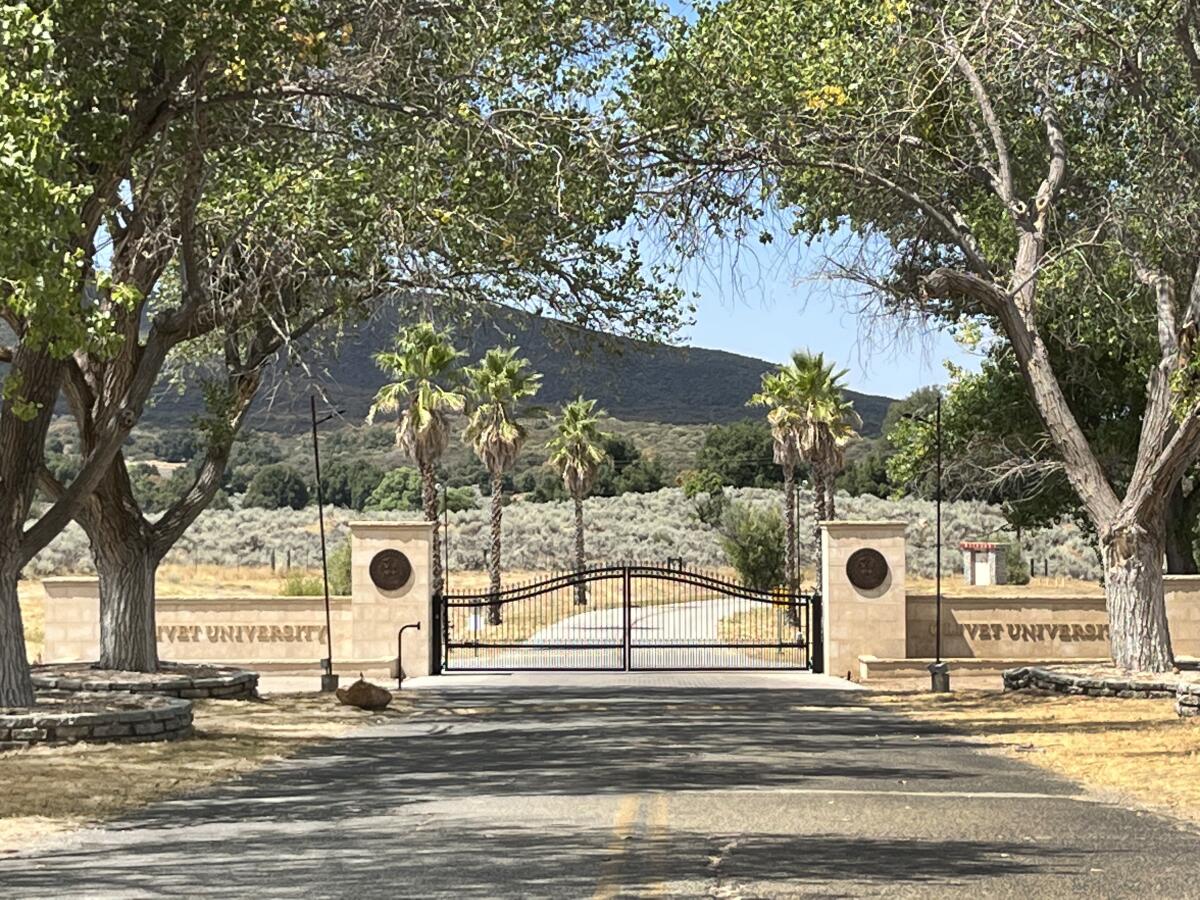
Olivet University, a gated campus of more than 900 acres, is not visible from the street; visitors must make an appointment to enter.
(Colleen Shalby / Los Angeles Times)
In an interview with The Times, one woman said that while she was never physically trapped in the way that former students have described, other practices made it difficult to leave the community.
She said that she and her husband were wedded in an arranged marriage. She said the practice was a common way to reinforce a member’s bond to Jang’s “Community” and make it difficult for members to leave, knowing that if they did, they would likely be separated from their loved ones.
The woman, who asked to remain anonymous for safety concerns, said that she and her now ex-husband left the community years ago. She said that some of her family members were also connected with Olivet and that she didn’t reunite with them until they left.
Rep. Ken Calvert (R-Corona), whose district includes Anza, recently called for an investigation into the university system.
“All colleges and institutions of higher learning must be safe environments for students, including those coming to America from abroad,” Calvert said in a statement to The Times. “In any situation where there are accusations of wrongdoing and mistreatment of students our local, state and federal law enforcement agencies must fully investigate.”
The Department of Justice has not provided Calvert’s office with substantive information about the investigation into Olivet.

California
Mother, daughter found ‘alive and well’ after going missing on Southern California hiking trail

A mother and daughter who went missing after going for a hike on a difficult trail in San Bernardino County’s San Gorgonio Wilderness have been found “alive and well,” the sheriff’s department announced Friday.
The San Bernardino County Sheriff’s Department told KTLA they were uninjured and “walked out on their own.”
Krystal Meyers, 41, and her daughter Alexis Meyers Martinez, 21, were hiking on the Vivian Creek Trail Thursday but didn’t return, according to the San Bernardino County Sheriff’s Department.
They were last known to be at the 10,300-foot elevation mark above the High Creek switchbacks at 11 a.m., according to the San Gorgonio Search and Rescue team.
The Vivian Creek Trail is widely considered one of the more strenuous and hazardous routes in the San Gorgonio Wilderness.
The U.S. Forest Service says it’s the shortest and steepest route to the summit of Mount San Gorgonio and requires experienced mountaineering skills.
Officials did not provide any further details about the circumstances surrounding their disappearance.

BAKERSFIELD, Calif. (KBAK/KBFX) — The California Highway Patrol is urging drivers to stay focused on the road as they head out for Fourth of July celebrations.
The holiday weekend can be a dangerous time on our roads as millions of drivers are expected to travel.
CHP Officer Jorge Toro joined Eyewitness News Mornings to share how drivers can stay safe behind the wheel.
Officer Toro also highlighted the importance of sober driving over the holiday.
BE THE FIRST TO COMMENT
He says anyone hosting a party should make sure all of their guests get home safely, ensuring anyone who may be impaired doesn’t drive.

California is returning a stretch of rugged Mendocino County coast to the Indigenous nations whose ancestors once stewarded its shores.
State transportation officials recently approved the transfer of Blues Beach and the surrounding bluffs to Kai Poma, a nonprofit founded by representatives of the Sherwood Valley Band of Pomo Indians, Round Valley Indian Tribes and Coyote Valley Band of Pomo Indians.
The transfer of 136 acres just south of the community of Westport will mark the first time land managed by the California Department of Transportation has been returned to Indigenous tribes.
“This is beyond huge,” said J. Carlos Rivera, tribal chairman of the Sherwood Valley Band of Pomo Indians. “It’s enormous from our tribal perspective that we are basically obtaining the land that our people once lived on before colonization.”
California purchased the swath of rocky cliffs and windswept shoreline in the 1960s to expand the construction of Highway 1 and create a scenic viewpoint for highway travelers, according to a California Coastal Commission report.
More recently, public access has been largely unregulated, and summer weekends and holidays have drawn large groups who camp and party on the beach, at times driving through sensitive areas, damaging cultural sites and leaving behind trash, the report states.
Kai Poma plans to conduct cultural and archaeological resource studies and environmental surveys and then prepare a resource management plan for the property, according to planning documents. The nonprofit and the Coastal Commission have drafted a public access management plan that states the land will be open from sunrise to sunset.
Rivera described the entire property as a sacred site. The coastal waters are used by tribal people for seaweed and abalone gathering, and the shores host youth cultural camps, he said. “Protecting the land, it has a deeper meaning for us because we’re connected to the land,” he said.
The effort to acquire the land took years — and required a change in state law. Caltrans lacked the ability to transfer land to tribal governments until 2021, when Gov. Gavin Newsom signed a bill sponsored by state Sen. Mike McGuire (D-Healdsburg) that enabled the transfer, according to a news release issued at the time. The law also bars commercial activity on the property and requires public access be maintained.
“With 136 acres now officially transferred into tribal stewardship, one of the most spectacular stretches of the Mendocino Coast will be forever protected,” McGuire said in a statement.
“This agreement, the first of its kind in California, gives these three dynamic Native American tribes the rightful opportunity to reclaim sacred lands and cultural traditions on this special piece of earth. And it’s about damn time.”
The land transfer cleared its last regulatory hurdle June 26 with the approval by the California Transportation Commission, said Neil Thapar, an attorney who works as an advisor and legal consultant to Kai Poma. Caltrans staff will next record the deed transferring the title from the state of California to Kai Poma, which is expected to happen any day, he said.
-

 Colorado8 seconds ago
Where to watch San Francisco Giants vs Colorado Rockies: TV channel, start time, streaming for July 4
-

 Connecticut5 minutes ago
Several state parks, beaches close Friday due to capacity
-

 Delaware12 minutes ago
Beloved farm owner, 65, fatally crushed by one of his own camels in Delaware
-

 Florida15 minutes ago
Publix? Walmart? What Florida stores are open and closed on July 4
-

 Georgia20 minutes ago
Georgia baseball has nation’s No. 1 transfer class
-

 Hawaii27 minutes ago
Man accused of trying to run over police officers in Kalihi arrested
-

 Idaho30 minutes ago
Fire burning near Ammon foothills – East Idaho News
-
 Illinois35 minutes ago
Illinois Launches Holiday DUI Crackdown

